EUDR Solutions – Keep Your Supply Chain Deforestation-Free and EU-Compliant
Published
, 8 minute read
Share this article
Quick summary: EUDR Solutions: Learn how technology enables end-to-end traceability, automates deforestation risk assessment, and ensures compliant, audit-ready supply chains for uninterrupted EU market access.
EUDR solutions are the traceability, satellite-monitoring and due-diligence tools that prove the commodities you place on the EU market are deforestation-free and let you keep selling without shipment rejections. This guide breaks down what an EUDR solution must do, how the main approaches compare, and how to choose the right one for your role before the 30 December 2026 deadline.
In plain terms: an EUDR solution is software that maps every product back to the plot of land it came from, checks that land against satellite forest data, scores deforestation risk, and files a Due Diligence Statement (DDS) to the EU TRACES system on your behalf.
See where your supply chain stands.
Most teams discover compliance gaps 90 days before the deadline too late to fix manually.
Mandatory retention for all due-diligence records and DDS reference numbers
Of downstream supply-chain actors currently have systems to trace deforestation (30% upstream)
Sources: European Commission, Regulation (EU) 2023/1115 & amending Regulation (EU) 2025/2650; industry traceability-readiness analysis. Update the 12%/30% figures against your latest cited source before publishing.
Don’t leave EU market access to chance.
Miss one geolocation point and your DDS gets rejected at the border.
If you source, import, or trade cocoa, coffee, soy, palm oil, rubber, timber, or cattle into the EU, EUDR is now your operating reality not a pledge, but law. EUDR solutions exist because the manual alternative breaks down fast. The pains buyers bring to us are consistent:
Fragmented supplier data — thousands of smallholder plots with no GPS coordinates or polygon boundaries.
Manual deforestation checks that can’t scale — cross-referencing plots against satellite data by hand is impossible at volume.
DDS preparation that eats weeks — compiling geocoordinates, EORI numbers, HS codes and legality docs per batch.
Audit panic — documentation scattered across emails, spreadsheets and PDFs with no single source of truth.
Risk that lags reality — static risk scores that miss new deforestation alerts or country reclassifications.
The cost of getting it wrong: rejected shipments, market-access bans across all 27 member states, penalties tied to turnover, and reputational damage that reaches investors and buyers. EUDR solutions turn that liability into a repeatable, audit-ready system.
Who this is for: Procurement & sourcing heads at operators — need plot-level supplier data and risk flags before purchase. Compliance & legal teams — need audit-ready DDS records with full chain of custody, retained five years. Sustainability & ESG directors — need verifiable deforestation-free claims for CSRD and customer questionnaires. Exporters & traders in origin countries — need to onboard farmers and hand clean data to EU importers.
What to Look for in EUDR Solutions: The 5 Non-Negotiables
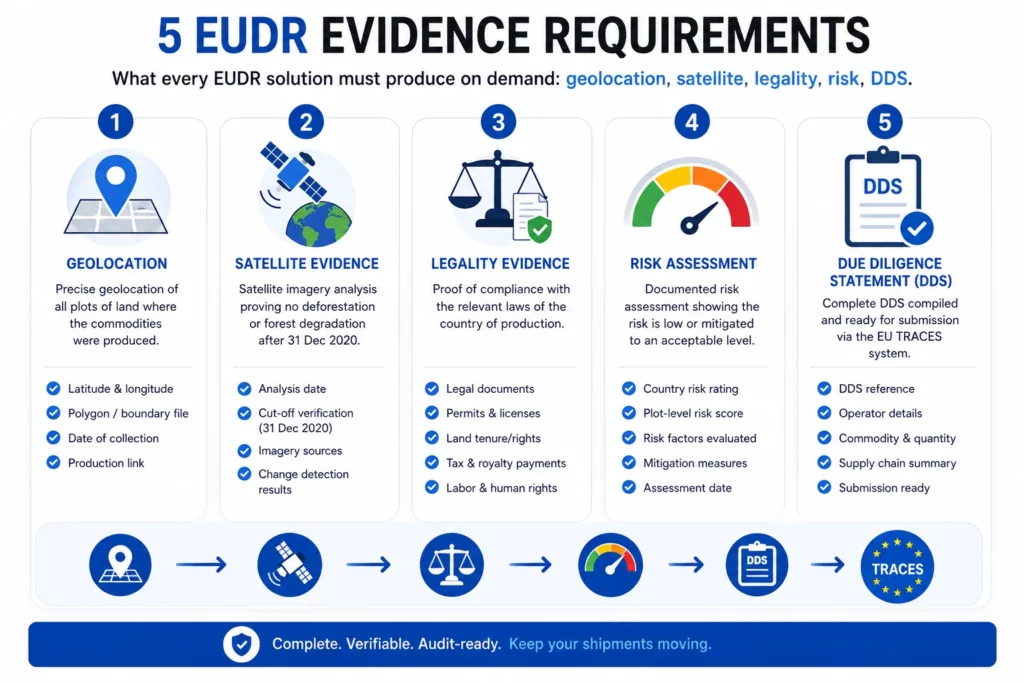
Use these five evidence categories as your buying checklist. Any EUDR solution worth shortlisting has to produce all five on demand because EU customs and auditors will check all five
Plot-level geolocation. Every batch traced to the exact farm via GeoJSON points or polygons. A country or region is not enough.
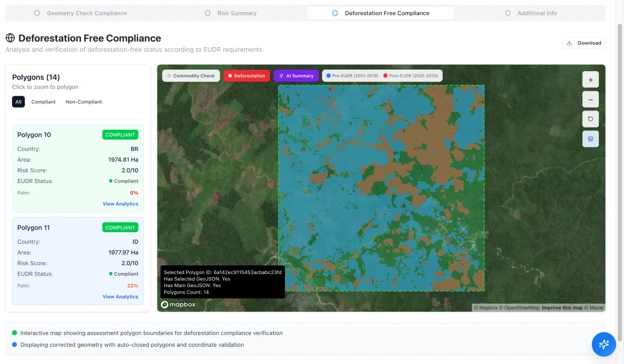
Satellite-verified forest cover. Plot coordinates cross-referenced with Sentinel-2 (Copernicus), Landsat and Hansen/JRC datasets to confirm no clearing after 31 December 2020.
Legal land use & labor rights. Legality documentation at the supplier level, land tenure, environmental permits, labor and indigenous rights.
Risk assessment & mitigation. Documented risk scoring per region and supplier, with mitigation steps where risk is ‘not negligible.’
Digital DDS via EU TRACES. Auto-populated Due Diligence Statements with geocoordinates, HS codes, EORI numbers and supplier traceability, retained for five years.
Regulation reference: operators (those first placing product on the EU market) carry the full compliance burden; downstream operators and traders retain and share DDS reference numbers and register in the system. Source: European Commission, Regulation (EU) 2023/1115, Articles 3–10, as amended by 2025/2650.
EUDR Solutions Compared: A Capability-by-Capability Breakdown
Meeting EUDR demands an interconnected system, not a single tool. Here is what each capability inside a modern EUDR solution does and the buyer outcome it delivers.
Satellite monitoring & remote sensing
EUDR solutions screen production plots against real-time and historical satellite imagery (Sentinel-2, Landsat, Planet Labs) before goods leave the country of origin. This moves you from reactive post-shipment checks to predictive pre-purchase screening, flagging problem plots 6–12 months before shipment.
Blockchain-based traceability
A tamper-proof ledger records every transaction from smallholder farm to EU customs. Unlike PDFs or spreadsheets, the data has cryptographic permanence acting as a parallel verification layer in regions with unreliable land registries, trusted by importers, regulators and lenders.
Mobile geo-mapping & supplier onboarding
Field agents and farmers capture GPS coordinates, upload land documents and submit legality evidence from a mobile app even offline. This makes EUDR solutions workable for the tens of thousands of smallholders who supply most of the world’s cocoa, coffee and rubber.
Agentic AI for risk scoring & DDS automation
The most time-consuming part of compliance preparing and submitting Due Diligence Statements is largely automated. AI analyzes plot data, flags risk indicators, auto-populates DDS fields (geocoordinates, EORI, HS codes, legal references) and routes submissions to EU TRACES. Work that took weeks per batch now takes hours.
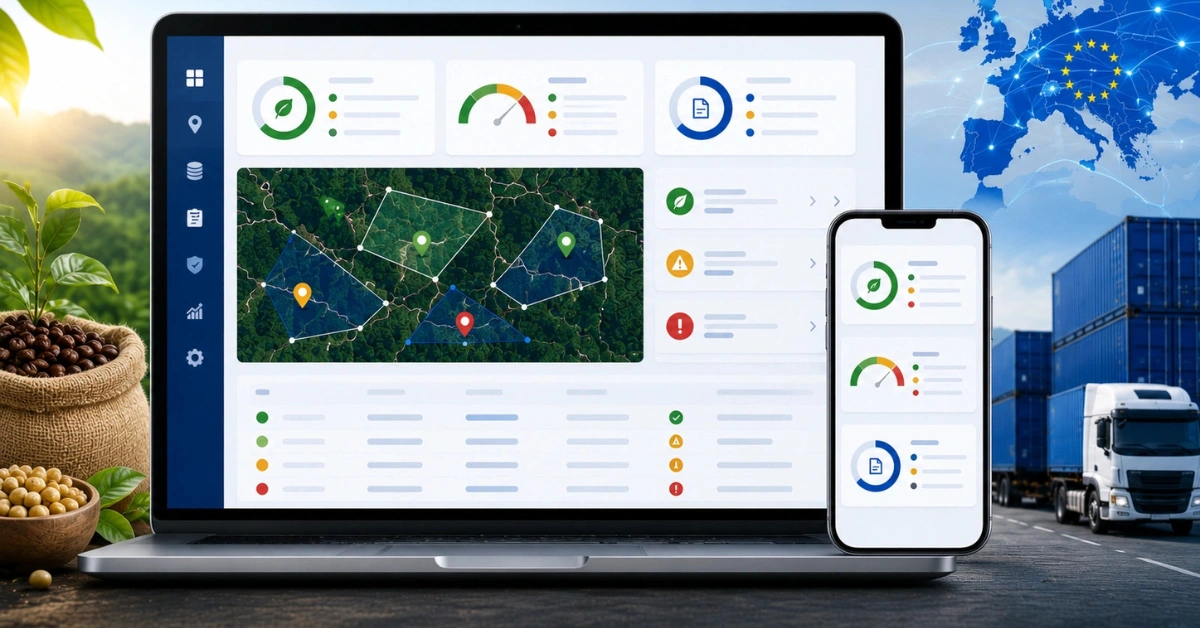
Best-in-class EUDR solutions consolidate satellite layers, supplier profiles, blockchain audit trails and DDS data into one role-based dashboard, with native EU TRACES and FSC compatibility and API links to SAP and Oracle. Disconnected point tools create the data gaps that cause shipment delays and failed audits; a unified platform removes them by design.
Stop managing EUDR compliance in spreadsheets.
TraceX customers cut DDS preparation time by 80%+ and clear customs without delays.
EUDR Solutions vs the Alternatives: How the Approaches Compare
At the decision stage, the real question is which approach to compliance you adopt. This is how the three common paths stack up against the five non-negotiables.
Capability
Spreadsheets & manual
Point tools (single-function)
Unified EUDR solution (e.g. TraceX)
Plot-level geolocation
Manual entry, error-prone
Maps plots, no risk link
Mobile GPS + polygon capture, GeoJSON export
Satellite verification
Not feasible at scale
Separate tool, manual sync
A multi-layered analytical system that intelligently cross-validates evidence from an ensemble of over a dozen specialized remote sensing models and geospatial layers.
Risk scoring
Static, lags reality
Limited, siloed
Real-time alerts + dynamic scoring
DDS to TRACES
Hand-keyed per batch (weeks)
Partial templates
AI auto-populates & submits (hours)
Audit trail
Scattered files
Tool-by-tool exports
Single tamper-proof record, 5-yr retention
Outcome
High rejection risk
Data gaps at handoffs
End-to-end, audit-ready compliance
Be honest in your own version: name where a point tool genuinely competes, and where it doesn’t. Buyers at this stage know the nuances of their problem hedged or vague comparisons read as untrustworthy.
EUDR Solutions in Action: From Compliance Pain to Business Outcome
Mapping the most common compliance pains to a specific capability and the measurable outcome it delivers:
Compliance pain
EUDR solution capability
Business outcome
Manual geo-mapping of thousands of plots
Mobile app, offline GPS + GeoJSON export
Plot data collected in days, not months zero coordinate-error rejections
No view of historical deforestation
JRC 2020 baseline + Hansen loss timeline
Screen plots before purchase, not after shipment
DDS prep takes weeks per batch
Agentic AI auto-populates and files to TRACES
DDS preparation cut from weeks to hours at scale
Supplier docs scattered everywhere
Centralized blockchain-secured supplier portal
One audit-ready record per supplier no gaps at customs
Static risk scores
Real-time alerts + dynamic scoring
Proactive risk management replaces firefighting
Disconnected systems before audits
Unified platform with SAP/Oracle/FSC integration
End-to-end traceability, zero data breaks
Choosing EUDR Solutions by Role
EUDR compliance looks different depending on where you sit. Match the solution to the buyer:
Procurement & sourcing heads
Need plot-level supplier data and satellite risk flags before purchase decisions, plus documentation that clears EU customs without rework. Look for a real-time supplier risk dashboard that makes deforestation-free sourcing a default, not an audit scramble.
Compliance & legal teams
Need audit-ready DDS records with complete chain of custody, retained five years and accessible on demand. Look for tamper-proof audit trails and direct TRACES submission that cuts manual workload by 80%+.
Sustainability & ESG directors
Need verifiable deforestation-free claims that satisfy investor reporting, CSRD disclosure and customer due-diligence questionnaires. Look for solutions that pair EUDR with Scope 3 / digital-MRV tracking so one platform covers multiple mandates.
Exporters & traders in origin countries
Need to onboard farmers, capture compliant data at source, and hand a clean, referenceable record to EU importers. Look for offline mobile capture and standardized export formats.
Build Your Deforestation-Free Supply Chain with TraceX EUDR Solutions
TraceX EUDR solutions deliver end-to-end traceability, automated risk assessment and compliant due-diligence workflows so you eliminate deforestation risk and keep uninterrupted access to EU markets. With the right digital infrastructure, even complex, smallholder-heavy supply chains can reach reliable, audit-ready EUDR compliance well ahead of the 2026 deadline.
Frequently Asked Questions (FAQ’s)
What are EUDR solutions?
EUDR solutions are digital platforms that help companies prove commodities placed on the EU market are deforestation-free and legally produced — combining plot-level geolocation, satellite verification, risk scoring and automated Due Diligence Statement (DDS) filing to EU TRACES.
When is the EUDR deadline?
Following Regulation (EU) 2025/2650, large and medium operators must comply by 30 December 2026; micro and small operators by 30 June 2027. Core obligations are unchanged only the application date moved.
Which commodities does EUDR cover?
Seven: cocoa, coffee, soy, palm oil, rubber, wood and cattle, plus derived products such as chocolate or leather.
Do EUDR solutions submit the DDS for me?
Leading EUDR solutions auto-populate the DDS with geocoordinates, HS codes and EORI numbers and submit it directly to EU TRACES, cutting preparation from weeks to hours.
Can EUDR solutions handle smallholder supply chains?
Yes — mobile, offline-capable geo-mapping lets field agents and farmers capture GPS coordinates and legality evidence, making compliance achievable for fragmented smallholder networks.
How long must records be kept?
All due-diligence documentation and DDS reference numbers must be retained for at least five years.
Start using TraceX
Transparency, Trust, & Success for your Climate Journey.
We use cookies on our website to give you the most relevant experience by remembering your preferences and repeat visits. By clicking “Accept All”, you consent to the use of ALL the cookies. However, you may visit "Cookie Settings" to provide a controlled consent.
This website uses cookies to improve your experience while you navigate through the website. Out of these, the cookies that are categorized as necessary are stored on your browser as they are essential for the working of basic functionalities of the website. We also use third-party cookies that help us analyze and understand how you use this website. These cookies will be stored in your browser only with your consent. You also have the option to opt-out of these cookies. But opting out of some of these cookies may affect your browsing experience.
Necessary cookies are absolutely essential for the website to function properly. These cookies ensure basic functionalities and security features of the website, anonymously.
Cookie
Duration
Description
cookielawinfo-checkbox-analytics
11 months
This cookie is set by GDPR Cookie Consent plugin. The cookie is used to store the user consent for the cookies in the category "Analytics".
cookielawinfo-checkbox-functional
11 months
The cookie is set by GDPR cookie consent to record the user consent for the cookies in the category "Functional".
cookielawinfo-checkbox-necessary
11 months
This cookie is set by GDPR Cookie Consent plugin. The cookies is used to store the user consent for the cookies in the category "Necessary".
cookielawinfo-checkbox-others
11 months
This cookie is set by GDPR Cookie Consent plugin. The cookie is used to store the user consent for the cookies in the category "Other.
cookielawinfo-checkbox-performance
11 months
This cookie is set by GDPR Cookie Consent plugin. The cookie is used to store the user consent for the cookies in the category "Performance".
viewed_cookie_policy
11 months
The cookie is set by the GDPR Cookie Consent plugin and is used to store whether or not user has consented to the use of cookies. It does not store any personal data.
Functional cookies help to perform certain functionalities like sharing the content of the website on social media platforms, collect feedbacks, and other third-party features.
Performance cookies are used to understand and analyze the key performance indexes of the website which helps in delivering a better user experience for the visitors.
Analytical cookies are used to understand how visitors interact with the website. These cookies help provide information on metrics the number of visitors, bounce rate, traffic source, etc.
Advertisement cookies are used to provide visitors with relevant ads and marketing campaigns. These cookies track visitors across websites and collect information to provide customized ads.
Download the 2026 Traceability Scorecard and Benchmark Your Supply Chain Across 10 Critical Capabilities.
Download our eBook
Don’t Wait for an Audit to Find Your EUDR Gaps
The 2026 Simplification Package changes how HS codes, DDS pass-through and geolocation rules apply to you. Get the free guide and 20-point readiness checklist before enforcement catches you unprepared.