EUDR Simplified Declaration: Eligibility, Requirements and Practical Examples
Published
, 8 minute read
Share this article
Quick summary: Understand EUDR Simplified Declaration eligibility, required information, declaration identifiers and practical examples for coffee, cocoa, rubber and timber producers.
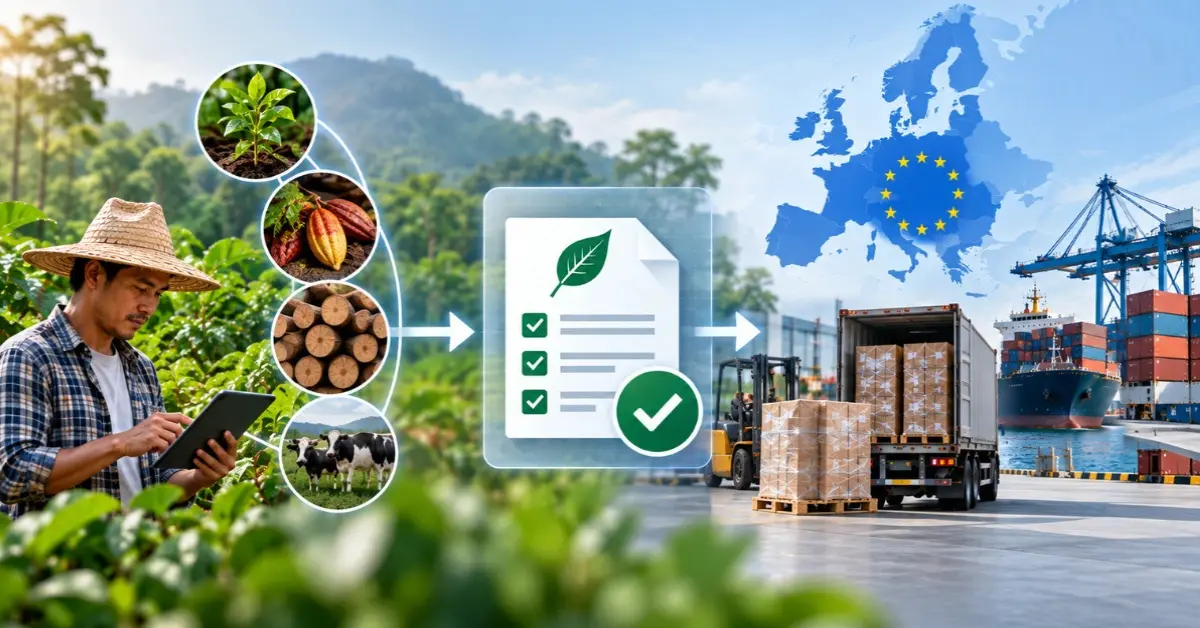
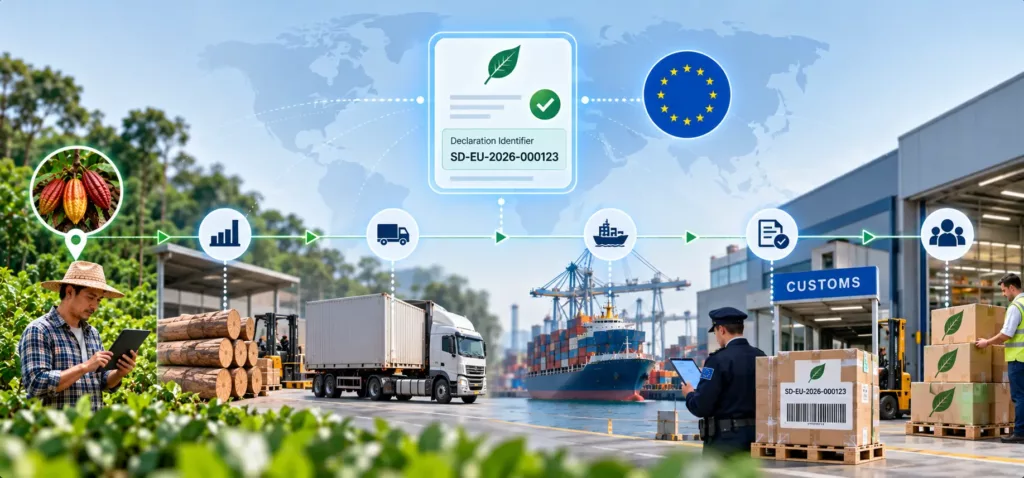
The EUDR Simplified Declaration (SD) is a one-time submission route in the EU Deforestation Regulation (EUDR) Information System for eligible micro or small primary operators. Rather than submitting a separate Due Diligence Statement (DDS) for every relevant shipment, an eligible operator can submit a declaration covering the relevant products it produced itself, subject to the applicable conditions. The Information System assigns a declaration identifier that follows the relevant products through the supply chain.
The simplified route is designed to reduce repetitive reporting for a specific group of producers not to remove the underlying EUDR requirements. Eligibility, accurate production information and the ability to connect the declaration identifier to relevant products remain essential.
Key Takeaways
The EUDR Simplified Declaration is available only to eligible micro or small primary operators meeting the applicable conditions.
Small company size alone does not make a trader or intermediary eligible.
The declaration contains operator, activity, commodity/product and production-location information specified by the applicable rules.
For an SD, production location can be provided using GeoJSON geometry, postal address(es) or cadastral identifier(s), according to current Information System guidance.
The Information System assigns a declaration identifier that must be linked to relevant products and passed through the supply chain as required.
Major changes to the information can require an update; the SD should not be treated as a static, submit-and-forget record.
Are your supplier records, plot geolocation, and due diligence evidence ready for scrutiny?
Identify potential gaps before they become compliance challenges.
Download our eBook to assess your EUDR readiness, uncover data gaps, and take proactive steps towards stronger compliance.
Eligibility depends on the operator’s status, location and production activity. Current EUDR Information System documentation describes the route for a natural person or micro/small undertaking established in a low-risk country that places relevant products on the market or exports products it produced itself in that country. An authorised representative may submit on behalf of an eligible operator when the relevant conditions, including a written mandate, are met.
This distinction matters in practice. A small coffee farmer producing coffee on their own farm may qualify if all conditions are satisfied. A small trader buying coffee from dozens of independent farms and reselling it does not qualify simply because the business is small. Confirm the operator role and the current country-risk classification before relying on the simplified route.
What Information Does the Declaration Contain?
The SD must contain the information specified in Annex III and the applicable Information System rules. Depending on the activity and product, this can include operator and activity details, relevant commodity and product information, country of production, product or HS classification, quantities, and production-location details. The exact fields depend on the applicable requirements and the circumstances of the operator.
A notable difference is the production-location format. Current Information System documentation allows an SD to use GeoJSON geometry, postal address(es) or cadastral identifier(s). This flexibility can help eligible producers who do not already maintain geospatial files. It does not remove the need to identify the relevant production location accurately.
Read our guide to EUDR due diligenceto understand the key requirements, avoid common compliance gaps, and discover how TraceX helps streamline supplier data management, risk assessment, traceability, and DDS preparation.
How the EUDR Simplified Declaration Works
Confirm eligibility: check operator size and role, country-risk classification, and whether the operator produced the relevant products itself.
Prepare the data: assemble operator, activity, commodity, product and production-location information required by the applicable rules.
Submit the declaration: submit through the EUDR Information System, directly or through an authorised representative where permitted.
Capture the declaration identifier: retain the identifier returned by the Information System and associate it with the relevant products.
Connect it to trade flows: ensure purchasing, product and shipment records can retrieve the applicable identifier and supporting information.
Monitor changes: review whether major changes require an update and maintain the record accordingly.
Missed Our Webinar on EUDR Beyond DDS? Catch the Recording!
Watch the webinar recording to understand what lies beyond DDS filing and how to strengthen your EUDR compliance workflow.
Example 1: A small coffee producer with repeated shipments
A micro or small coffee producer established in a low-risk country grows and exports its own coffee. If the producer meets the eligibility conditions, it may submit one SD covering its relevant products rather than preparing a separate DDS for every shipment. The declaration identifier can then be linked to the producer’s relevant coffee products and trade records. This reduces repetitive submissions, but accurate producer and product data are still needed.
Example 2: A small cocoa producer supplying an EU buyer
An eligible cocoa producer supplies an EU chocolate manufacturer several times a year. The buyer should capture the SD identifier and connect it to the relevant cocoa purchases and product records. If important information in the declaration changes, the producer should assess whether an update is required. The buyer should not assume that a declaration identifier alone replaces every other applicable traceability or due diligence responsibility.
Example 3: A small rubber producer versus a rubber trader
A small rubber producer harvesting rubber from its own production areas may qualify if the conditions are met. A similarly sized trader buying rubber from other producers is not automatically eligible. The difference is the operator’s production relationship and role—not company size alone. This is why eligibility checks should happen before a business designs its reporting process around an SD.
Example 4: A small sawmill selling its own wood
A small forestry business or sawmill may be able to use the simplified route if it meets the legal eligibility conditions. However, the declaration does not waive the substantive EUDR conditions for wood, including the relevant deforestation-free and legality requirements. A simplified reporting process is not an exemption from the underlying regulation.
Example 5: A producer using an authorised representative
An eligible producer with limited capacity to use the Information System may work with an authorised representative where permitted and under a written mandate. A practical workflow is: producer data collection → eligibility check → SD submission → declaration identifier → buyer and shipment records. Responsibilities and access to the supporting information should be agreed clearly.
Declaration Identifier vs DDS Reference Number
The declaration identifier generated for an SD and a DDS reference number relate to different declaration routes. Downstream businesses should not assume every relevant product will arrive with a DDS reference. Their systems and procedures should be able to capture the appropriate identifier, link it to the relevant product and transaction, and make it available to the parties who need it.
Learn how to manage DDS reference numbers, link declarations to relevant shipments and transactions, and maintain accurate compliance records across your supply chain.
Confusing a declaration identifier with a DDS reference number.
Failing to connect the identifier to the relevant product, purchase or shipment.
Treating the SD as permanently fixed even when major changes occur.
Assuming the simplified route removes the underlying EUDR requirements.
How Digital Traceability Can Support the Process
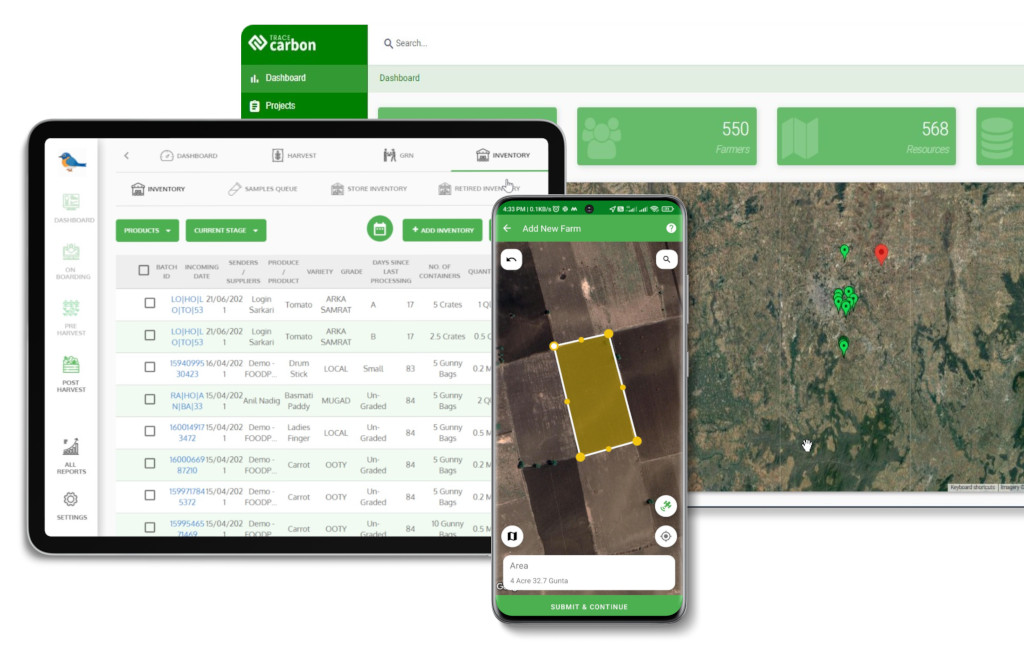
A digital traceability workflow can help organise producer and product data, validate required fields, maintain production-location records and connect declaration identifiers to purchases and shipments. For organisations working with many suppliers, this can reduce repeated manual entry and make it easier to retrieve the relevant information. The value depends on the platform’s actual functionality and how well it fits the organisation’s existing processes.
TraceX supports digital traceability and EUDR data workflows that help businesses organise supplier, product, production-location and shipment information. To evaluate fit, ask for a demonstration using a representative producer-to-shipment scenario, including how eligibility, data gaps, identifier capture and updates are handled. Software can support the process; it does not guarantee compliance or replace the operator’s responsibilities.
Conclusion: Make Simplified Declaration Data Work Across the Supply Chain
The EUDR Simplified Declaration can reduce repetitive reporting for eligible micro or small primary operators, especially producers with recurring sales. The process still depends on confirming eligibility, preparing accurate information, keeping the declaration current when required, and connecting the declaration identifier to relevant products and trade flows. Businesses should validate their position against the current EUDR rules and Information System guidance before using the simplified route.
Need to connect supplier data, production locations and declaration identifiers across your supply chain?
Explore TraceX’s EUDR capabilities to assess the workflow against your requirements.
Does every small business qualify for an EUDR Simplified Declaration?
Not every small business qualifies for a simplified declaration,eligibility depends on the applicable operator status, establishment in a low-risk country, and producing the relevant products itself, among other relevant conditions. A small trader is not automatically eligible.
Does an SD replace a DDS?
For eligible operators using the simplified route, the SD replaces the per-shipment DDS approach described in the current Information System guidance. It is not a universal alternative available to every operator.
Can a producer use a postal address instead of GeoJSON?
Current Information System guidance allows an SD production location to be represented by GeoJSON geometry, postal address(es) or cadastral identifier(s), subject to the applicable requirements.
What happens if information changes after submission?
If information changes after submission it may require an update. Operators should monitor relevant information and consult current Information System rules to determine when an update is necessary.
Does the declaration identifier prove that a product is compliant?
No,the identifier links products to the declaration record; it is not, by itself, proof that every applicable EUDR obligation has been met. The relevant requirements and responsibilities still apply.
Start using TraceX
Transparency, Trust, & Success for your Climate Journey.
We use cookies on our website to give you the most relevant experience by remembering your preferences and repeat visits. By clicking “Accept All”, you consent to the use of ALL the cookies. However, you may visit "Cookie Settings" to provide a controlled consent.
This website uses cookies to improve your experience while you navigate through the website. Out of these, the cookies that are categorized as necessary are stored on your browser as they are essential for the working of basic functionalities of the website. We also use third-party cookies that help us analyze and understand how you use this website. These cookies will be stored in your browser only with your consent. You also have the option to opt-out of these cookies. But opting out of some of these cookies may affect your browsing experience.
Necessary cookies are absolutely essential for the website to function properly. These cookies ensure basic functionalities and security features of the website, anonymously.
Cookie
Duration
Description
cookielawinfo-checkbox-analytics
11 months
This cookie is set by GDPR Cookie Consent plugin. The cookie is used to store the user consent for the cookies in the category "Analytics".
cookielawinfo-checkbox-functional
11 months
The cookie is set by GDPR cookie consent to record the user consent for the cookies in the category "Functional".
cookielawinfo-checkbox-necessary
11 months
This cookie is set by GDPR Cookie Consent plugin. The cookies is used to store the user consent for the cookies in the category "Necessary".
cookielawinfo-checkbox-others
11 months
This cookie is set by GDPR Cookie Consent plugin. The cookie is used to store the user consent for the cookies in the category "Other.
cookielawinfo-checkbox-performance
11 months
This cookie is set by GDPR Cookie Consent plugin. The cookie is used to store the user consent for the cookies in the category "Performance".
viewed_cookie_policy
11 months
The cookie is set by the GDPR Cookie Consent plugin and is used to store whether or not user has consented to the use of cookies. It does not store any personal data.
Functional cookies help to perform certain functionalities like sharing the content of the website on social media platforms, collect feedbacks, and other third-party features.
Performance cookies are used to understand and analyze the key performance indexes of the website which helps in delivering a better user experience for the visitors.
Analytical cookies are used to understand how visitors interact with the website. These cookies help provide information on metrics the number of visitors, bounce rate, traffic source, etc.
Advertisement cookies are used to provide visitors with relevant ads and marketing campaigns. These cookies track visitors across websites and collect information to provide customized ads.
Download the 2026 Traceability Scorecard and Benchmark Your Supply Chain Across 10 Critical Capabilities.
Download our eBook
Don’t Wait for an Audit to Find Your EUDR Gaps
The 2026 Simplification Package changes how HS codes, DDS pass-through and geolocation rules apply to you. Get the free guide and 20-point readiness checklist before enforcement catches you unprepared.