EUDR Rubber Compliance: The Complete Buyer’s Action Guide for 2026
Published
, 8 minute read
Share this article
Quick summary: A complete guide to EUDR rubber regulations for operators, traders, and EU importers. Learn compliance requirements, traceability rules, geolocation data needs, and due diligence steps to place rubber products on the EU market.
EUDR rubber compliance requires EU importers and operators to prove that natural rubber and rubber-derived products (HS codes 4001–4017) are:
Deforestation-free after the 31 December 2020 cut-off date
Legally sourced with verifiable land-tenure documentation
Traceable to GPS-verified plantation plots
Accompanied by a filed Due Diligence Statement (DDS) in EU TRACES before customs clearance
Compliance deadline: 30 December 2026 (large operators) | June 2027 (SMEs). Non-compliance penalties include shipment seizure, fines up to 4% of annual EU turnover, and market access bans.
Key Takeaways — What You Need to Know
EUDR rubber rules apply to ALL natural rubber products (HS 4001–4017) placed on or exported from the EU market.
Deadline: 30 December 2026 for large operators; June 2027 for SMEs.
Every shipment needs a filed DDS with GPS coordinates, deforestation check, and legal sourcing proof.
Smallholder-heavy supply chains (70% of natural rubber) are the hardest compliance challenge.
Platforms like TraceX automate geolocation collection, supplier risk scoring, and DDS generation.
Is your business truly ready for EUDR?
Our EUDR Compliance Checklist helps you evaluate whether you have the essential building blocks in place.
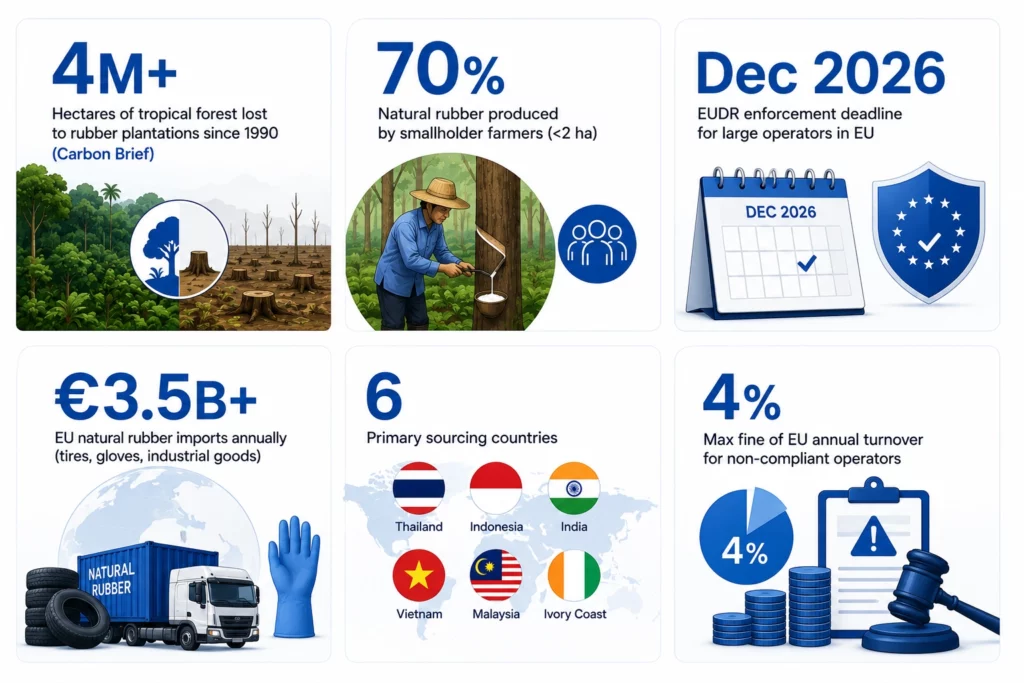
EUDR rubber regulations are reshaping a €3.5B+ EU import market. Here are the numbers that define the compliance challenge:
EUDR Rubber Regulations: What They Mean for Your Supply Chain
EUDR rubber regulations formally EU Regulation 2023/1115 require that natural rubber and rubber-derived products entering or leaving the EU market are deforestation-free, legally produced, and GPS-traceable to the exact plantation plot where the rubber was harvested.
Plain-language definition: If you import rubber tires, gloves, hoses, or any product containing natural rubber into the EU, you must prove the rubber didn’t come from deforested land after 31 December 2020 and you must file a Due Diligence Statement (DDS) before shipments clear customs.
EUDR Rubber Compliance: Who Must Act (and By When)
EUDR rubber compliance obligations fall on every actor who touches the EU rubber supply chain:
EU Operators — companies placing rubber products on the EU market for the first time. Must file a full DDS before marketing. Deadline: 30 Dec 2026.
EU Traders — businesses reselling rubber already in the EU. Must retain traceability records and can rely on an existing operator DDS. Deadline: 30 Dec 2026.
Non-EU Exporters (India, Indonesia, Thailand, Vietnam, Malaysia) — must provide verifiable GPS-level traceability data to enable EU buyer DDS filing. No DDS from them = no shipment.
SMEs — all requirements apply; slightly extended deadline to June 2027. Simplified procedures available only where risk is proven negligible.
Deadline Alert: 30 December 2026 for large operators. If you cannot prove a deforestation-free origin by then, your rubber cannot enter the EU market. Shipments will be blocked at customs.
EUDR Rubber Products in Scope: HS Code Reference Table
EUDR rubber regulations cover a wide range of HS codes. Use this reference to determine if your specific product category requires a DDS:
You must submit exact GPS coordinates of each rubber plot not a village name, not a country. The EU cross-checks coordinates against satellite imagery to verify land status as of 1 January 2021.
Single-point GPS for smallholder farms (plots under 4 hectares)
GeoJSON polygon boundaries for larger commercial plantations
Offline GPS collection tools required for low-connectivity remote zones
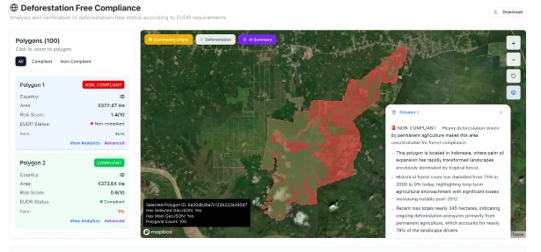
After GPS collection, each plot must be verified against deforestation databases (Global Forest Watch, Hansen data). Plots with deforestation risk after December 31, 2020 are a compliance red flag requiring documented mitigation before DDS submission.
3. EUDR Rubber Legal Sourcing: Land Tenure & Country Risk
Legal sourcing proof requires evidence of land tenure (title deeds or legal declarations), compliance with labor and environmental laws in the origin country, and documentation showing no involvement in illegal activities or corruption.
4. EUDR Rubber Risk Assessment: Document Before You File
Each operator must assess supply chain risk and document it not just conduct it. Risk factors include country-level deforestation ratings, proximity to protected forests, supplier documentation quality, and historical land-use trends. Risk mitigation steps (audits, satellite checks) must be documented before DDS submission.
5. EUDR Rubber DDS Filing: What Goes Into Your TRACES Submission
Every batch of rubber requires a submitted DDS in EU TRACES before it reaches EU buyers. The DDS must include geolocation data, risk assessment results, legal sourcing proof, batch references, and a 5-year audit trail commitment.
How do you map thousands of rubber plantations and prepare them for EUDR compliance?
Discover how a leading global tire manufacturer transformed its natural rubber supply chain with large-scale polygon mapping, enabling accurate plot-level traceability and stronger regulatory readiness under the EU Deforestation Regulation.
EUDR Rubber Traceability: Why Rubber Supply Chains Are the Hardest to Certify
EUDR rubber traceability is more complex than cocoa or coffee. Here’s why:
The Smallholder Problem
70% of global natural rubber is produced by smallholder farmers on plots smaller than 2 hectares across remote regions of Southeast Asia and West Africa. These farmers typically:
Have no formal land titles or legal documentation
Operate in areas with no mobile connectivity or internet access
Have never collected GPS coordinates or filed compliance documents
Work through 3–5 layers of intermediary traders, making chain-of-custody verification extremely difficult
EUDR Rubber Compliance vs. Non-Compliance: What’s at Stake
Here’s what separates operators who will clear customs in 2026 from those who won’t:
Compliance Area
✅ EUDR-Compliant Operator
❌ Non-Compliant Risk
Geolocation
GPS polygon per farm plot, verified in TRACES
No coordinate data; village-level only
Deforestation Check
Satellite-verified vs. Dec 2020 baseline
Manual checks, no audit trail
DDS Filing
Submitted before customs clearance
Filed after shipment or missing entirely
Supplier Records
5-year digital audit trail with immutable records
Paper-based, incomplete, or unverifiable
Outcome
Market access secured, audit-ready
Shipment blocked, fines up to 4% turnover
EUDR Rubber Compliance Software: How TraceX Closes the Gap
TraceX’s EUDR Solutions is purpose-built for fragmented agricultural supply chains. Here is what it delivers, mapped to each EUDR rubber requirement:
Farm-Level GPS Mapping — Mobile-first offline field tools for GPS and polygon collection across remote smallholder zones. Works without internet.
Satellite Deforestation Verification — Automated cross-check of farm coordinates against Global Forest Watch and protected area boundaries. Flags risk before it enters your supply chain.
Supplier Onboarding at Scale — Digital onboarding for thousands of smallholder farmers. Field-agent mediated entry for farmers without smartphones.
Chain-of-Custody Traceability — Links every batch and SKU to its plantation source with timestamped, immutable records across multi-port, multi-SKU shipments.
Automated DDS Generation — Pulls verified data from the traceability system to auto-generate TRACES-ready Due Diligence Statements. Reduces manual documentation errors.
5-Year Audit Records — All compliance documentation stored with full version control. Audit-ready for EU customs and enforcement bodies at any time.
ESG & CSRD Alignment — One system for EUDR compliance, CSRD reporting, and voluntary sustainability standards.
Ready to Get EUDR-Ready for Rubber?
Assess your EUDR rubber supply chain in minutes — identify geolocation gaps, deforestation risks, and documentation issues before they block EU market access.
No. EUDR rubber regulations apply only to natural rubber and rubber-derived products containing natural rubber. Synthetic rubber (HS 4002) is exempt unless blended with natural rubber, in which case the natural rubber portion must be EUDR-compliant.
What is the EUDR rubber compliance deadline?
30 December 2026 for large operators placing rubber products on the EU market. SMEs have an extended deadline of June 2027. Non-EU exporters must supply compliant data to EU buyers before these dates.
What GPS data is required for EUDR rubber compliance?
Single-point GPS coordinates for smallholder farms under 4 hectares. GeoJSON polygon boundaries for larger commercial plantations. All coordinates must be verifiable against satellite deforestation data as of 31 December 2020.
What happens if my EUDR rubber DDS is rejected?
Shipments without a filed and accepted DDS will be blocked at EU customs. Penalties for non-compliance include product seizure, fines of up to 4% of annual EU turnover, and potential bans from the EU market.
How do I collect GPS data from smallholder rubber farmers?
The most practical approach is mobile-first field tools that work offline apps that let field agents collect GPS coordinates on behalf of farmers in low-connectivity areas. TraceX supports field-agent mediated data entry for farmers without smartphones, with data synced to the compliance platform when connectivity is available.
Are retreaded tires subject to EUDR rubber regulations?
Partially. Tire treads are in scope and require EUDR rubber compliance. Casings and carcasses are exempt. Operators handling retreaded tires must separate scope tracking by component type.
Does EUDR apply to rubber imported from all countries?
Yes, regardless of origin country. Whether rubber comes from Thailand, Indonesia, India, Vietnam, Malaysia, Ivory Coast, or any other sourcing region, EU importers must comply with EUDR rubber requirements. Country-level deforestation risk ratings affect how thorough your due diligence must be.
Start using TraceX
Transparency, Trust, & Success for your Climate Journey.
We use cookies on our website to give you the most relevant experience by remembering your preferences and repeat visits. By clicking “Accept All”, you consent to the use of ALL the cookies. However, you may visit "Cookie Settings" to provide a controlled consent.
This website uses cookies to improve your experience while you navigate through the website. Out of these, the cookies that are categorized as necessary are stored on your browser as they are essential for the working of basic functionalities of the website. We also use third-party cookies that help us analyze and understand how you use this website. These cookies will be stored in your browser only with your consent. You also have the option to opt-out of these cookies. But opting out of some of these cookies may affect your browsing experience.
Necessary cookies are absolutely essential for the website to function properly. These cookies ensure basic functionalities and security features of the website, anonymously.
Cookie
Duration
Description
cookielawinfo-checkbox-analytics
11 months
This cookie is set by GDPR Cookie Consent plugin. The cookie is used to store the user consent for the cookies in the category "Analytics".
cookielawinfo-checkbox-functional
11 months
The cookie is set by GDPR cookie consent to record the user consent for the cookies in the category "Functional".
cookielawinfo-checkbox-necessary
11 months
This cookie is set by GDPR Cookie Consent plugin. The cookies is used to store the user consent for the cookies in the category "Necessary".
cookielawinfo-checkbox-others
11 months
This cookie is set by GDPR Cookie Consent plugin. The cookie is used to store the user consent for the cookies in the category "Other.
cookielawinfo-checkbox-performance
11 months
This cookie is set by GDPR Cookie Consent plugin. The cookie is used to store the user consent for the cookies in the category "Performance".
viewed_cookie_policy
11 months
The cookie is set by the GDPR Cookie Consent plugin and is used to store whether or not user has consented to the use of cookies. It does not store any personal data.
Functional cookies help to perform certain functionalities like sharing the content of the website on social media platforms, collect feedbacks, and other third-party features.
Performance cookies are used to understand and analyze the key performance indexes of the website which helps in delivering a better user experience for the visitors.
Analytical cookies are used to understand how visitors interact with the website. These cookies help provide information on metrics the number of visitors, bounce rate, traffic source, etc.
Advertisement cookies are used to provide visitors with relevant ads and marketing campaigns. These cookies track visitors across websites and collect information to provide customized ads.
Download the 2026 Traceability Scorecard and Benchmark Your Supply Chain Across 10 Critical Capabilities.
Download our eBook
Don’t Wait for an Audit to Find Your EUDR Gaps
The 2026 Simplification Package changes how HS codes, DDS pass-through and geolocation rules apply to you. Get the free guide and 20-point readiness checklist before enforcement catches you unprepared.