EUDR Plywood Compliance: How to Keep HS 4412 Panels Moving Into the EU
Published
, 12 minute read
Share this article
Quick summary: Explore the EUDR regulations for plywood, veneered panels, and laminated woods. Learn how businesses can comply with deforestation-free sourcing, legal harvesting, and traceability standards for EU market access.
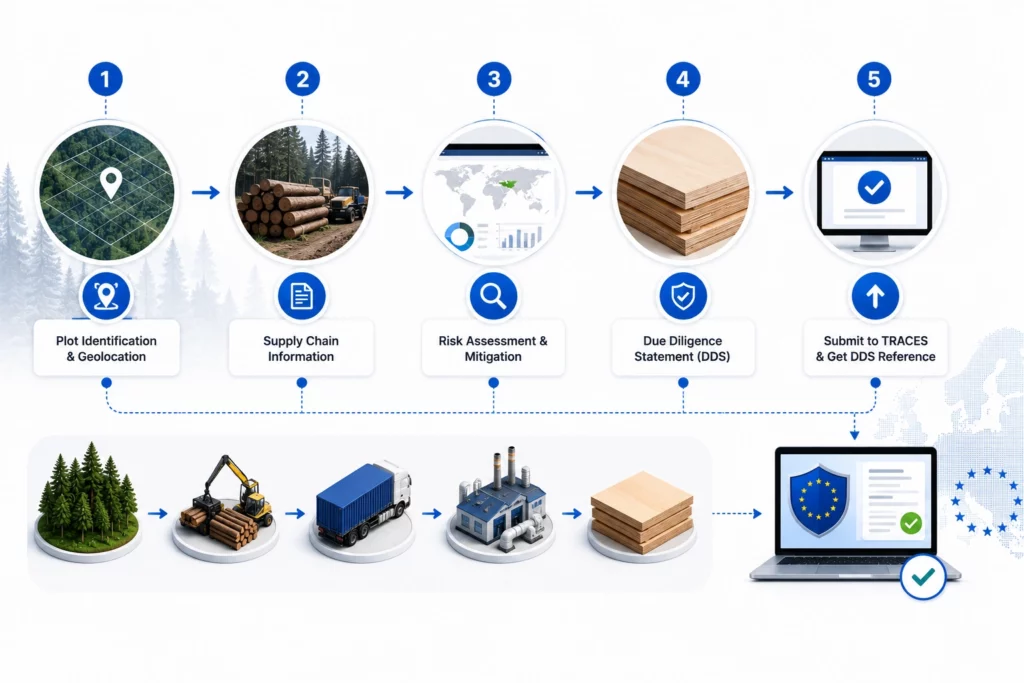
EUDR plywood compliance means proving that every plywood, veneered panel, and laminated wood product under HS Code 4412 placed on the EU market is deforestation-free and legally harvested. Operators must file a Due Diligence Statement (DDS) for each batch containing plot-level geolocation coordinates, proof of legality under the producer country’s laws, and traceability references linking the product back to its harvest plots. Wood sourced from land deforested or degraded after 31 December 2020 is prohibited. Large and medium operators must comply from 30 December 2026; micro and small enterprises from 30 June 2027. Non-compliance risks shipment blocks, market withdrawal, and fines that can reach at least 4% of EU-wide annual turnover.
EUDR plywood requirements are forcing a hard look at supply chains that were never built for plot-level visibility. A single container of panels can contain face veneers from Gabon, core plies from Vietnam, and adhesive-bonded timber from Brazil and under the EU Deforestation Regulation, every one of those wood inputs must be traced back to the plot where the tree was felled.
In plain terms: the EUDR is an EU law that bans products linked to deforestation or forest degradation after 31 December 2020 from being placed on, or exported from, the EU market. For wood-based panels under HS Code 4412, that means proving batch by batch, with coordinates that the timber was legally harvested from deforestation-free land.
For exporters in India, Vietnam, Indonesia, or Brazil, and for EU importers acting as operators, the stakes are commercial as much as regulatory. Shipments without a valid DDS reference number will not clear customs. This guide covers exactly what falls in scope, the five obligations, why panels are uniquely difficult, and how to build a compliance workflow that scales.
Key Takeaways
HS Code 4412 — plywood, veneered panels, and laminated/engineered wood sits squarely inside EUDR scope; panels with non-wood cores or 100% pre-consumer recycled inputs may fall outside it, but only after documented verification.
Five obligations drive compliance: deforestation-free proof, legal harvesting, a Due Diligence Statement per batch, end-to-end traceability, and five-year record-keeping.
Multi-layer panels are the hard case: a single sheet can combine face veneer, core plies, and adhesively bonded timber from different countries every wood input needs plot-level origin data.
Certifications like FSC or PEFC support risk assessment but do not replace the DDS, geolocation coordinates, or plot-level evidence obligations.
Automated traceability platforms compress DDS preparation from hours per shipment to minutes and keep records audit-ready.
EUDR Plywood Scope: Which HS 4412 Products Are Covered
HS Code 4412 captures the wood-based panels used across construction, furniture, flooring, automotive interiors, and marine applications. If your product ships under this code, EUDR obligations attach by default. The families below are in scope:
Plywood in all thicknesses and grades structural, interior, decorative, and marine plywood alike.
Veneered panels a core (wood, MDF, or particleboard) faced with a thin wood veneer.
Laminated and engineered wood panels layered or composite constructions where wood fibre, particle, or veneer inputs are bonded with adhesives.
Plywood: layered construction, layered risk
Plywood is manufactured from cross-oriented wood veneers glued under pressure. Each veneer layer is a distinct wood input, and layers frequently come from different suppliers, species, and countries. That construction is precisely what makes plywood compliance demanding: one panel, many origins, and each origin needs geolocation and legality evidence.
Veneered panels: the face layer still counts
A veneered MDF panel might contain only a fraction of a millimetre of decorative hardwood but that face veneer is a wood input, and it triggers the full due diligence obligation. The core material must be assessed too: wood-fibre cores (MDF, particleboard) are in scope, while genuinely non-wood cores are not.
Laminated and engineered wood: composite complexity
OSB, blockboard, laminated decorative panels, and similar engineered constructions combine strands, particles, or plies from aggregated timber flows. Aggregation is the enemy of traceability mills that pool logs from dozens of harvest sites must maintain segregation or mass-balance records that keep plot data attached to each output batch.
Exclusions — narrow, and only with proof
Non-wood cores: panels whose core is plastic, metal, or synthetic fibre fall outside EUDR wood-product scope for that component though any wood veneer on the surface remains in scope.
Recycled content: products made entirely from post-consumer recycled wood are generally exempt, but the recycled status must be documented; pre-consumer offcuts and mill residues typically do not qualify as recycled under EUDR definitions and should be treated as virgin inputs. [VERIFY current Commission guidance on recycled-material treatment]
The safe operating assumption: if any component of the panel is virgin wood, build the compliance file. Exemption claims without documentation are a customs delay waiting to happen.
Are your products covered by EUDR? Start with the right HS codes.
EUDR Plywood Requirements: The Five Obligations Explained
Compliance for HS 4412 products rests on five pillars. Miss any one and the DDS fails — and without a DDS reference number, the shipment does not enter the EU.
1. Deforestation-free proof
Every wood input must originate from land that was not deforested or degraded after 31 December 2020. Proof is geospatial: plot coordinates cross-checked against satellite imagery and forest-cover baselines. Buyers increasingly ask for this evidence during supplier qualification, well before customs ever sees it.
2. Legal harvesting and sourcing
Timber must be harvested in accordance with the laws of the country of origin — covering land-use rights, harvest permits, environmental regulations, third-party rights, and labour law. For panel producers buying through intermediaries, this means collecting legality documentation from actors two or three tiers upstream.
3. Due Diligence Statement (DDS) for every batch
The DDS, filed through the EU’s TRACES information system, is the operative compliance document. For plywood and panels it must contain:
Geolocation of all harvest plots — coordinates to at least six decimal places, with polygons required for plots larger than four hectares.
Proof of legality for each origin, mapped to the producer country’s legal framework.
Verification of deforestation-free status against the 2020 cut-off.
Traceability references connecting the batch to upstream operators and any prior DDS submissions.
4. Supply chain traceability, forest to panel
Traceability must survive every transformation: log to veneer, veneer to panel, panel to shipment. Mills that blend inputs must be able to state which plots fed which production batch. This is where spreadsheet-based systems collapse — batch-plot linkage across peeling, pressing, and finishing is a data-model problem, not a filing problem.
5. Record-keeping for five years
All due diligence evidence — coordinates, permits, risk assessments, DDS submissions — must be retained for at least five years and produced on demand to competent authorities. Enforcement is built on checks and audits; retrieval speed matters as much as retention.
EUDR Plywood Compliance Challenges: Why Panels Are the Hard Case
Panel products concentrate nearly every difficulty the regulation creates. If you run compliance, procurement, or export operations for HS 4412 products, these will look familiar:
Multi-origin construction. A single panel routinely combines veneers and cores from multiple countries with different risk classifications, multiplying the evidence burden per SKU.
Upstream opacity. Veneer often passes through traders and peeling mills before reaching the panel plant; harvest-plot data rarely travels with it unless contracts demand it.
Smallholder data gaps. In sourcing regions across South and Southeast Asia, plantation timber comes from thousands of small plots with no digital records coordinates must be captured in the field.
GeoJSON quality failures. Malformed polygons, insufficient decimal precision, and plot-area mismatches are among the most common causes of DDS rejection.
Volume. An exporter shipping weekly containers needs a repeatable DDS pipeline, not a heroic one-off documentation effort per shipment.
The pattern behind all five: compliance data lives upstream, but liability lives with whoever places the product on the EU market. Closing that gap manually does not scale.
Simplify EUDR Compliance for Your Wood Supply Chain
EUDR Plywood Compliance with TraceX: From Plot Data to DDS, Automated
TraceX’s EUDR Solutions is built for exactly this multi-tier, multi-origin problem. Instead of chasing coordinates over email and assembling statements in spreadsheets, panel businesses run a single pipeline from forest plot to DDS reference number:
Plot mapping and validation. Field teams and suppliers capture geolocation (points and polygons) through a mobile interface; the platform validates precision, geometry, and plot-size rules before data enters the system.
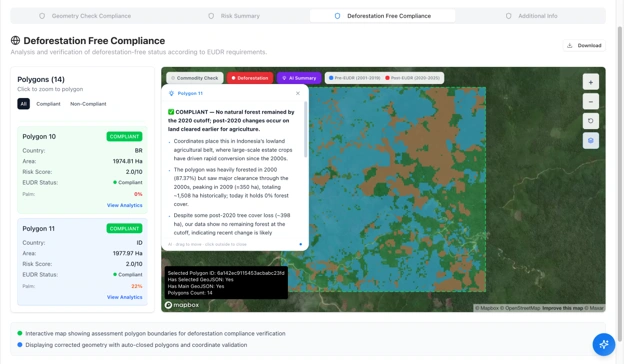
Satellite deforestation screening. Every plot is automatically checked against forest-cover change since 31 December 2020, with screening evidence stored per plot.
Supplier and legality documentation. Harvest permits, land-title records, and certification documents are collected against each supplier and linked to the batches they feed.
Batch-level traceability through transformation. The platform models the log-to-veneer-to-panel flow, so every production batch carries its full upstream plot lineage including blended and mass-balance scenarios.
Automated DDS generation. Compliant statements are compiled from verified data and submitted, returning the reference numbers your EU customers and customs require.
See How a Leading Tire Manufacturer Built an EUDR-Ready Supply Chain
Discover how a global tire company established end-to-end chain of custody, improved supplier traceability, and strengthened compliance with EUDR through a digital-first approach. Explore the challenges they faced, the solution they implemented, and the results they achieved.
EUDR plywood compliance in practice: three scenarios
A plywood exporter in Kochi, India, shipping panels to the EU can use TraceX to map harvest plots across Kerala’s plantation belt, screen them against the cut-off date, and generate a DDS per container clearing customs without holds and turning compliance into a sales asset with EU buyers.
A veneered-panel manufacturer in Bengaluru can apply the same workflow to its face-veneer supply from Tamil Nadu and Karnataka, isolating the wood-derived component of an MDF-core product and documenting it independently of the core material.
A laminated engineered-wood producer in Brazil can map veneer sourcing in Amazonas and Pará high-scrutiny origins and use plot-level screening evidence to satisfy both EUDR obligations and buyer-side sustainability audits in a single data set.
Where certification fits — and where it stops
FSC, PEFC, and similar schemes remain valuable risk-mitigation signals in your due diligence, and certified supply bases are usually faster to document. But certification alone does not satisfy the regulation: authorities require the DDS, the coordinates, and the plot-level evidence regardless of certificate status. Treat certification as an input to risk assessment, never as the compliance deliverable itself.
Certification is only one piece of the EUDR compliance puzzle.
EUDR Plywood Compliance: Manual Process vs. Automated Platform
Compliance task
Manual / spreadsheet approach
Automated EUDR platform
Geolocation capture
Coordinates collected over email and Excel; frequent precision and format errors in GeoJSON files
Mobile plot mapping with built-in validation for six-decimal precision and polygon rules
Deforestation screening
Ad-hoc satellite checks, if any; no audit trail against the 31 Dec 2020 cut-off
Automated satellite screening of every plot against the cut-off date, with stored evidence
DDS preparation
Manually compiled per shipment; hours per batch and high error/rejection risk in TRACES
DDS auto-generated from verified plot, legality, and batch data; submitted with reference numbers
Supplier documents
Permits and legality proofs scattered across inboxes and shared drives
Central supplier repository linked to each batch and each DDS
Record-keeping (5 yrs)
Version-control risk; records hard to retrieve under audit
Immutable, audit-ready records retrievable by shipment, plot, or supplier
EUDR Plywood Readiness Checklist for Exporters and Importers
Use this as a pre-shipment audit. If any item is unresolved, the shipment carries compliance risk:
Confirmed HS classification for every SKU, with wood/non-wood component analysis documented for exemption claims.
Full supplier map to harvest level, including traders and peeling mills between forest and panel plant.
Geolocation data for all active plots six-decimal precision, polygons for plots over four hectares, validated GeoJSON.
Satellite screening evidence against the 31 December 2020 cut-off for every plot.
Legality documentation per origin country, mapped to local law (permits, land rights, labour compliance).
Batch-to-plot linkage maintained through veneer peeling, pressing, and finishing.
DDS workflow tested end-to-end in TRACES, with reference numbers flowing to EU customers.
Five-year record retention with rapid retrieval by shipment, plot, or supplier.
Frequently Asked Questions (FAQ’s)
What does EUDR compliance require for plywood and veneered panels?
Products under HS 4412 must be deforestation-free (post-2020) and legally harvested, with a Due Diligence Statement filed per batch containing plot geolocation, legality proof, and traceability references. Without a valid DDS reference, the product cannot be placed on the EU market.
Does FSC or PEFC certification make my panels EUDR-compliant?
No. Certification supports risk assessment and can simplify evidence collection, but the DDS, geolocation coordinates, and plot-level documentation remain mandatory for certified and uncertified wood alike.
Are recycled or non-wood-core panels exempt?
Panels made entirely from post-consumer recycled wood are generally out of scope, and genuinely non-wood cores are not wood inputs but any virgin wood veneer stays in scope, and exemption claims require documentation. When components mix, treat the product as in scope.
When do EUDR plywood obligations apply?
Large and medium operators must comply from 30 December 2026; micro and small enterprises from 30 June 2027. Given prior date shifts, verify against the latest official EU position before planning around them.
What happens if a shipment is non-compliant?
Consequences range from customs holds and mandatory corrective action to product withdrawal, confiscation, and fines benchmarked at a maximum of at least 4% of EU-wide turnover plus the commercial damage of failing EU buyers’ compliance requirements.
Start using TraceX
Transparency, Trust, & Success for your Climate Journey.
We use cookies on our website to give you the most relevant experience by remembering your preferences and repeat visits. By clicking “Accept All”, you consent to the use of ALL the cookies. However, you may visit "Cookie Settings" to provide a controlled consent.
This website uses cookies to improve your experience while you navigate through the website. Out of these, the cookies that are categorized as necessary are stored on your browser as they are essential for the working of basic functionalities of the website. We also use third-party cookies that help us analyze and understand how you use this website. These cookies will be stored in your browser only with your consent. You also have the option to opt-out of these cookies. But opting out of some of these cookies may affect your browsing experience.
Necessary cookies are absolutely essential for the website to function properly. These cookies ensure basic functionalities and security features of the website, anonymously.
Cookie
Duration
Description
cookielawinfo-checkbox-analytics
11 months
This cookie is set by GDPR Cookie Consent plugin. The cookie is used to store the user consent for the cookies in the category "Analytics".
cookielawinfo-checkbox-functional
11 months
The cookie is set by GDPR cookie consent to record the user consent for the cookies in the category "Functional".
cookielawinfo-checkbox-necessary
11 months
This cookie is set by GDPR Cookie Consent plugin. The cookies is used to store the user consent for the cookies in the category "Necessary".
cookielawinfo-checkbox-others
11 months
This cookie is set by GDPR Cookie Consent plugin. The cookie is used to store the user consent for the cookies in the category "Other.
cookielawinfo-checkbox-performance
11 months
This cookie is set by GDPR Cookie Consent plugin. The cookie is used to store the user consent for the cookies in the category "Performance".
viewed_cookie_policy
11 months
The cookie is set by the GDPR Cookie Consent plugin and is used to store whether or not user has consented to the use of cookies. It does not store any personal data.
Functional cookies help to perform certain functionalities like sharing the content of the website on social media platforms, collect feedbacks, and other third-party features.
Performance cookies are used to understand and analyze the key performance indexes of the website which helps in delivering a better user experience for the visitors.
Analytical cookies are used to understand how visitors interact with the website. These cookies help provide information on metrics the number of visitors, bounce rate, traffic source, etc.
Advertisement cookies are used to provide visitors with relevant ads and marketing campaigns. These cookies track visitors across websites and collect information to provide customized ads.
Download the 2026 Traceability Scorecard and Benchmark Your Supply Chain Across 10 Critical Capabilities.
Download our eBook
Don’t Wait for an Audit to Find Your EUDR Gaps
The 2026 Simplification Package changes how HS codes, DDS pass-through and geolocation rules apply to you. Get the free guide and 20-point readiness checklist before enforcement catches you unprepared.