EUDR Commodities: Which Products Are Covered and What Your Business Must Do
Published
, 12 minute read
Share this article
Quick summary: Wondering if the EU Deforestation Regulation (EUDR) applies to your business? Learn about the commodities covered, affected industries, and compliance requirements to ensure your supply chain remains deforestation-free and EU market-ready.
EUDR commodities soy, palm oil, coffee, cocoa, cattle, rubber, and wood must be proven deforestation-free to enter the EU market. Businesses that import or export these commodities must collect farm-level GPS data, run risk assessments, and file a Due Diligence Statement (DDS) via TRACES NT before placing products on the EU market. Large operators deadline: December 30, 2026. SMEs: June 30, 2027. Non-compliance risks include blocked shipments, fines up to 4% of annual turnover, and permanent market access loss.
EUDR commodities including soy, palm oil, coffee, cocoa, cattle, rubber, and wood are at the centre of one of the most significant supply chain regulations the EU has ever introduced. If your business sources, processes, imports, or exports any of these commodities into the EU market, this regulation applies to you directly. And if you’re not already building a compliance programme, you’re running out of time.
The EU Deforestation Regulation (Regulation EU 2023/1115) came into force in June 2023 with a clear mandate: eliminate deforestation-linked products from European supply chains. It requires every operator placing covered commodities on the EU market to prove their products are deforestation-free, legally produced, and traceable all the way back to the exact plot of land where they were grown or harvested.
This blog breaks down every EUDR-covered commodity, what compliance looks like in practice, the penalties for non-compliance, and how TraceX is helping businesses across the supply chain meet their obligations without disrupting operations.
90%
of global forest loss is driven by agricultural expansion the primary target of EUDR regulation (World Resources Institute)
EUDR Commodities: The 7 High-Risk Categories You Need to Know
EUDR commodities are defined in Annex I of Regulation EU 2023/1115 as products whose production has been historically linked to deforestation and forest degradation. The regulation covers both raw commodities and their derived products meaning the compliance obligation extends far beyond farmers and exporters to include processors, traders, manufacturers, and importers.
The 7 EUDR commodity categories are:
Soy
Palm oil
Coffee
Cocoa
Cattle (beef and leather)
Wood and timber
Rubber
Importantly, derived products containing these commodities are also covered. A chocolate bar, a piece of furniture, or a palm oil-based cosmetic if it contains any Annex I commodity, it falls within the EUDR scope.
EUDR Commodities Scope: Full Breakdown by Category
EUDR Commodities Explained: What Each Sector Needs to Know
EUDR commodities carry different compliance challenges depending on the supply chain structure, sourcing geography, and product complexity. Here is what compliance means for each category.
EUDR Commodities: Soy Compliance Requirements
Soy is one of the highest-risk EUDR commodities due to its central role in animal feed and its direct link to large-scale deforestation in South America. The regulation captures not just raw soya beans but the entire downstream product chain including tofu, soy milk, soy protein, and soybean oil.
For soy importers, the core obligation is demonstrating that every batch of product traces to farmland that was not deforested after December 31, 2020. Given that soy supply chains often pass through trading companies and aggregation points, achieving farm-level traceability requires digital tools that can collect GPS data at source and maintain chain-of-custody through processing.
Palm oil has been one of the largest single drivers of deforestation globally, and it appears across an extraordinary range of industries food, cosmetics, biodiesel, and personal care products. Whether your business is placing palm oil in a food product or using it as a feedstock for biofuel, EUDR compliance for Palm Oil is mandatory.
For palm oil traders and processors, the challenge is plantation-level traceability across fragmented sourcing geographies in Indonesia, Malaysia, and West Africa. Buyers must ensure that every palm fruit cluster traces back to a mapped, verified, deforestation-free plantation and that this data is captured in a form that supports DDS filing via TRACES NT.
EUDR Commodities: Coffee Compliance Requirements
Coffee brings a compliance challenge that most importers underestimate: the vast majority of global coffee is grown by smallholder farmers across fragmented landscapes in Ethiopia, Colombia, Vietnam, Brazil, and beyond. Collecting accurate GPS data from millions of small plots is operationally demanding without a digital platform.
Coffee companies sourcing through cooperatives, exporters, or traders must ensure their due diligence reaches back to the individual farm level. Certifications like Rainforest Alliance or Fairtrade are not sufficient the EUDR requires geo-verified, satellite-confirmed deforestation-free sourcing backed by a formal DDS.
of tropical forests in SE Asia lost to rubber plantations in the past 30 years driving EUDR’s rubber compliance mandate (Carbon Brief)
EUDR Commodities: Cocoa Compliance Requirements
Cocoa is one of the most scrutinised EUDR commodities due to the significant overlap between cocoa-growing regions and high deforestation risk zones particularly in Côte d’Ivoire and Ghana, which together supply over 60% of the world’s cocoa. Companies across the chocolate, confectionery, and food ingredient supply chain are directly affected.
For cocoa operators, polygon-level farm mapping is becoming standard practice for compliance a single GPS point per farm is often insufficient to satisfy the geolocation verification requirements that competent EU authorities expect to see. The scale of smallholder sourcing makes this technically challenging without purpose-built traceability infrastructure.
Exporting cocoa to the EU? EUDR compliance starts at the farm.
EUDR Commodities: Cattle (Beef and Leather) Compliance Requirements
Cattle is the only EUDR commodity with direct animal origin, which creates unique compliance dynamics. Operators placing beef, leather goods, or processed cattle products on the EU market must trace sourcing back to the farm where the animal was raised and verify that the pastureland was not deforested after December 31, 2020.
The challenge for importers of beef from Brazil and other high-risk origins is the complexity of cattle movements between farms before slaughter. A cattle hide sold into the leather supply chain may have passed through multiple properties each of which requires verification. Digital traceability platforms that support farm-of-origin documentation are critical for managing this at scale.
EUDR Commodities: Wood and Timber Compliance Requirements
Wood and timber have the most diverse product footprint of any EUDR commodity category. The regulation covers not just raw lumber but furniture, paper, flooring, plywood, wooden packaging, and any other product containing wood. If your company imports wooden products of any kind, EUDR Wood compliance applies.
For timber operators, the compliance foundation is legal harvest verification proving that wood was harvested in accordance with the laws of the source country including land rights, environmental regulations, and tenure. This requires documentary evidence alongside geolocation data for every harvest plot.
EUDR Commodities: Rubber Compliance Requirements
Natural rubber and rubber-derived products including tyres, gloves, latex-based goods, and adhesives must meet the same deforestation-free and traceability standards as all other EUDR commodities. The challenge for the rubber supply chain is the concentration of smallholder producers in Southeast Asia and the aggregation model used by most latex processing facilities.
Rubber operators must trace sourcing back to plantation-level GPS coordinates and verify that no forest clearance occurred after the December 2020 cut-off date. Blockchain-backed traceability tools are increasingly being used to create immutable records from plantation to port.
Exporting natural rubber or rubber products to the EU?
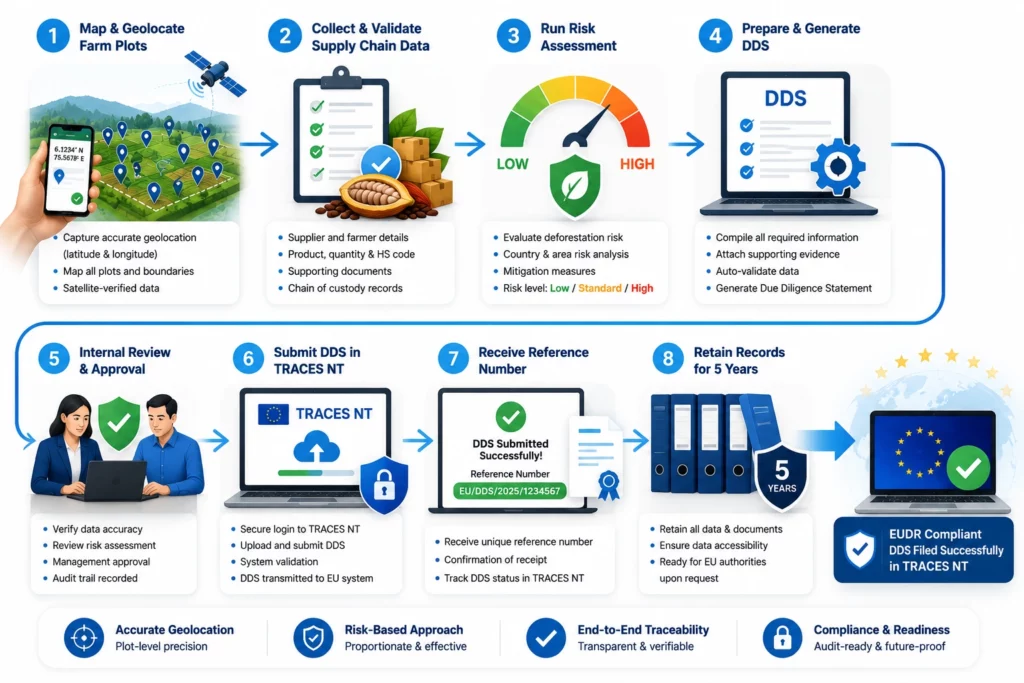
EUDR Commodities Compliance: What You Are Required to Do
Regardless of which EUDR commodities your business handles, the core compliance obligations are consistent. Here is what the regulation requires and what auditors will look for.
Step
Action Required
Tool/Method
Deadline Risk
1
Map all sourcing plots to GPS coordinates (polygon preferred)
TraceX geolocation module
High missing data = DDS rejection
2
Verify no deforestation after Dec 31, 2020 cut-off
Satellite monitoring, ESA data
High single failure blocks market access
3
Conduct structured risk assessment per commodity
Risk scoring dashboard
Medium needed before DDS filing
4
File Due Diligence Statement (DDS) via EU TRACES NT
TraceX DDS generation
Critical large operators: Dec 30, 2026
5
Maintain records for minimum 5 years
Secure audit-ready data vault
Ongoing failure triggers audits
EUDR Commodities: Due Diligence Statement Requirements
The Due Diligence Statement (DDS) is the formal compliance document that every operator must file before placing EUDR-covered commodities on the EU market. It must be submitted through the EU TRACES NT system and must reference GPS-verified geolocation data, product descriptions, volumes, country of origin, and the outcome of your risk assessment.
Filing a DDS with missing or inaccurate information is one of the most common causes of shipment rejection. Operators must ensure that DDS submissions are complete, accurate, and backed by auditable source data maintained for a minimum of five years.
Filing your EUDR Due Diligence Statement (DDS) doesn’t have to be complicated.
EUDR Commodities Non-Compliance: What Happens If You Fail
EUDR commodities that cannot be proven deforestation-free will be denied entry to the EU market. But the penalties for non-compliance go significantly further than blocked shipments:
Fines up to 4% of annual EU turnover for operators
Confiscation of non-compliant products and revenue derived from them
Temporary exclusion from public procurement processes
Mandatory publication of enforcement decisions creating reputational exposure
Potential criminal liability for intentional non-compliance
For businesses with significant EU market exposure, the financial and reputational risk of non-compliance far exceeds the cost of building a robust traceability and due diligence system. The question is no longer whether to invest in EUDR compliance it is how to do so efficiently before enforcement deadlines arrive.
Dec 30, 2026
Enforcement deadline for large operators and traders. SMEs: June 30, 2027. Missing the deadline means blocked market access.
EUDR Commodities Compliance with TraceX: How It Works
TraceX EUDR Solutions provide an end-to-end compliance platform built specifically for EUDR-regulated supply chains. Whether you are sourcing one EUDR commodity or managing compliance across multiple categories, TraceX gives you the tools to meet every obligation without disrupting your operations.
EUDR Commodities Geolocation Mapping
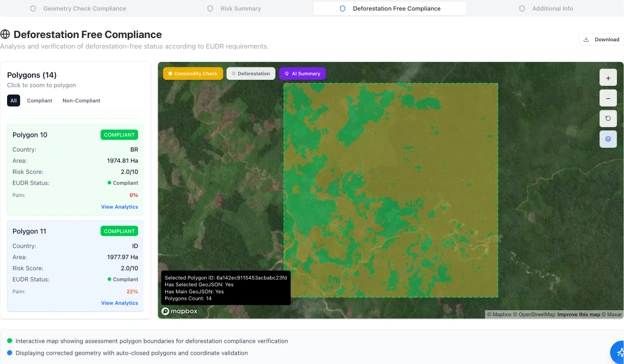
TraceX enables farm-level polygon mapping at scale capturing GPS coordinates for every sourcing plot, whether from smallholder farmers, large plantations, or complex aggregation networks. Satellite-based deforestation verification is built into the platform, automatically flagging any sourcing area linked to post-2020 forest loss.
EUDR Commodities Risk Assessment Automation
Manual risk assessments across diverse sourcing geographies are resource-intensive and error-prone. TraceX automates risk scoring using country risk benchmarks, satellite data, and supplier profiles giving compliance teams a clear, auditable output that supports DDS preparation without requiring analysts to review each record manually.
EUDR Commodities DDS Generation and TRACES Filing
TraceX generates TRACES NT-ready Due Diligence Statements directly from the platform pulling verified geolocation data, product information, risk assessment outputs, and supplier documentation into a single compliant document. DDS submissions are traceable, timestamped, and stored for the mandatory five-year retention period.
EUDR Commodities Supplier Onboarding
One of the most operationally complex challenges for EUDR compliance is bringing suppliers into the data collection process particularly when working with smallholder networks in low-connectivity environments. TraceX supports digital and offline supplier onboarding, enabling farm-level data collection even in the field without consistent internet access.
Ready to achieve EUDR commodity compliance?
TraceX helps importers, exporters, and supply chain operators across all 7 EUDR commodity categories build audit-ready compliance programmes from farm-level mapping to DDS submission. Don’t wait until your shipment is blocked.
What does it take to make a global tire supply chain EUDR-ready?
Discover how a leading tire manufacturer transformed its natural rubber supply chain to meet the EU Deforestation Regulation (EUDR). By implementing end-to-end traceability, plot-level geolocation mapping, supplier engagement, and robust due diligence processes, the company strengthened compliance while protecting uninterrupted access to the European market.
The 7 EUDR commodities are soy, palm oil, coffee, cocoa, cattle (beef and leather), wood and timber, and rubber. Derived products containing these commodities — such as chocolate, furniture, tyres, and palm oil-based cosmetics — are also covered.
Do sustainability certifications satisfy EUDR commodity requirements?
No. Fairtrade, Rainforest Alliance, Organic, and similar certifications do not satisfy EUDR compliance requirements. The regulation requires independent geo-verified proof that your product is deforestation-free, backed by farm-level GPS data and a formally filed Due Diligence Statement.
What is the EUDR commodity compliance deadline?
Large operators and traders must comply by December 30, 2026. Small and medium enterprises have until June 30, 2027. Businesses that cannot demonstrate compliance by these dates will be denied EU market access.
What happens if I cannot trace my EUDR commodities to farm level?
If your supply chain lacks farm-level geolocation data, your Due Diligence Statement cannot be filed — which means your products cannot enter the EU market. The time to address traceability gaps is now, before the compliance deadline, not after a shipment is blocked at customs.
How does TraceX help with EUDR commodity compliance?
TraceX provides an integrated EUDR compliance platform covering farm-level polygon mapping, satellite deforestation verification, automated risk assessment, supplier onboarding, and TRACES NT-ready DDS generation — allowing businesses to manage compliance across multiple EUDR commodity categories from a single platform.
Does EUDR apply to products derived from covered commodities?
Yes. Derived products listed in Annex I are fully in scope. This includes items like chocolate (cocoa), plywood (wood), biodiesel (palm oil), and natural rubber gloves the regulation is not limited to raw commodity exports.
Start using TraceX
Transparency, Trust, & Success for your Climate Journey.
We use cookies on our website to give you the most relevant experience by remembering your preferences and repeat visits. By clicking “Accept All”, you consent to the use of ALL the cookies. However, you may visit "Cookie Settings" to provide a controlled consent.
This website uses cookies to improve your experience while you navigate through the website. Out of these, the cookies that are categorized as necessary are stored on your browser as they are essential for the working of basic functionalities of the website. We also use third-party cookies that help us analyze and understand how you use this website. These cookies will be stored in your browser only with your consent. You also have the option to opt-out of these cookies. But opting out of some of these cookies may affect your browsing experience.
Necessary cookies are absolutely essential for the website to function properly. These cookies ensure basic functionalities and security features of the website, anonymously.
Cookie
Duration
Description
cookielawinfo-checkbox-analytics
11 months
This cookie is set by GDPR Cookie Consent plugin. The cookie is used to store the user consent for the cookies in the category "Analytics".
cookielawinfo-checkbox-functional
11 months
The cookie is set by GDPR cookie consent to record the user consent for the cookies in the category "Functional".
cookielawinfo-checkbox-necessary
11 months
This cookie is set by GDPR Cookie Consent plugin. The cookies is used to store the user consent for the cookies in the category "Necessary".
cookielawinfo-checkbox-others
11 months
This cookie is set by GDPR Cookie Consent plugin. The cookie is used to store the user consent for the cookies in the category "Other.
cookielawinfo-checkbox-performance
11 months
This cookie is set by GDPR Cookie Consent plugin. The cookie is used to store the user consent for the cookies in the category "Performance".
viewed_cookie_policy
11 months
The cookie is set by the GDPR Cookie Consent plugin and is used to store whether or not user has consented to the use of cookies. It does not store any personal data.
Functional cookies help to perform certain functionalities like sharing the content of the website on social media platforms, collect feedbacks, and other third-party features.
Performance cookies are used to understand and analyze the key performance indexes of the website which helps in delivering a better user experience for the visitors.
Analytical cookies are used to understand how visitors interact with the website. These cookies help provide information on metrics the number of visitors, bounce rate, traffic source, etc.
Advertisement cookies are used to provide visitors with relevant ads and marketing campaigns. These cookies track visitors across websites and collect information to provide customized ads.
Download the 2026 Traceability Scorecard and Benchmark Your Supply Chain Across 10 Critical Capabilities.
Download our eBook
Don’t Wait for an Audit to Find Your EUDR Gaps
The 2026 Simplification Package changes how HS codes, DDS pass-through and geolocation rules apply to you. Get the free guide and 20-point readiness checklist before enforcement catches you unprepared.