EUDR Due Diligence for Wood Importers: A Step-by-Step Guide to Filing Before 30 December 2026
Published
, 9 minute read
Share this article
Quick summary: EUDR due diligence for wood importers starts 30 December 2026. See the data you need, the 3-step process and how to file your DDS on time.
EUDR due diligence for wood importers is the mandatory process of collecting supplier and plot-level geolocation data, assessing deforestation and legality risk, mitigating any risk that is not negligible, and filing a Due Diligence Statement (DDS) in the EU Information System before wood products are placed on the EU market. It applies from 30 December 2026 to large and medium importers, and to micro and small importers already covered by the EU Timber Regulation (EUTR).
Key takeaways
Importers that first place timber on the EU market are operators and carry the full due diligence and DDS obligation.
The wood deadline is 30 December 2026, including for micro and small firms already under the EUTR.
Every DDS needs plot-level geolocation, species names, harvest dates and evidence that the wood is legal and deforestation-free after 31 December 2020.
FSC or PEFC certification supports your risk assessment but never replaces geolocation or the DDS.
Downstream buyers no longer file their own DDS, so your statement is the record the whole chain relies on.
For more than a decade, timber importers worked under the EUTR, which asked one question: was this wood legally harvested? The EU Deforestation Regulation (Regulation (EU) 2023/1115) adds a second question, whether the land was deforested after 31 December 2020, and demands proof down to the forest plot. That shift turns EUDR due diligence for wood importers into a data exercise rather than a paperwork exercise.
This guide covers who must comply, what data you need, the three-step process, and how to evaluate tools that can get you filing-ready before the deadline.
Download our eBook
Assess your EUDR readiness, uncover data gaps, and take proactive steps towards stronger compliance.
EUDR Due Diligence for Wood Importers: Who Must Comply and When
If your company is the first to place wood products on the EU market, the full obligation sits with you.
Operators, including importers, carry out due diligence and file the DDS.
Downstream operators and traders now collect DDS reference numbers instead of filing.
Dates differ by company size, with a timber exception for smaller firms.
An importer that releases wood products into free circulation in the EU is an operator under the regulation. That makes EUDR due diligence for wood importers a direct legal duty, not something you can hand to a foreign supplier. Regulation (EU) 2025/2650, adopted in December 2025, lightened the load further down the chain: downstream operators and traders no longer submit their own DDS, and only the first downstream buyer must collect and keep your reference number. Your statement becomes the single record every customer depends on.
The obligations apply from 30 December 2026 for large and medium operators, and from 30 June 2027 for most micro and small operators. Timber is the exception: micro and small importers of products already covered by the EUTR must also comply from 30 December 2026. Timber harvested before 29 June 2023 stays under EUTR transitional rules until the end of 2029.
Scope covers Annex I wood products such as logs, sawn timber, plywood, veneer, particleboard, pulp, paper and wooden furniture, while most printed products were removed by the 2025 amendment. Because the Commission updated the Annex I product list in September 2026, confirm your HS codes before you build your process.
EUDR Wood Due Diligence Requirements: The Data You Must Collect
Article 9 of the regulation sets out the information every DDS is built on.
Product description, HS code, trade name and quantity
Common name and full scientific name of each wood species
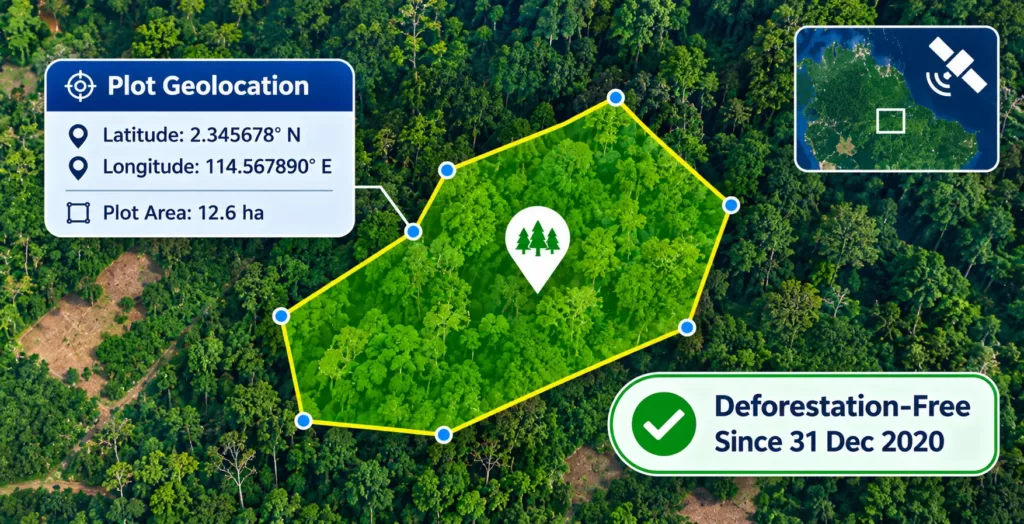
Country of production and geolocation of every plot (polygons for plots above 4 hectares)
Date or time range of harvest
Names and addresses of suppliers and customers
Verifiable evidence of deforestation-free and legal production
Species data is where EUDR due diligence for wood importers differs most from other commodities. You need the full scientific name, not “hardwood” or “tropical mix”, because species drives both legality risk and the plausibility of the stated origin. Legality evidence must cover the laws of the country of harvest, including land-use rights, forest management, environmental protection, third-party and labour rights, and tax and customs rules.
A certificate is evidence, not a Due Diligence Statement.
FSC and PEFC certification can strengthen your risk assessment, but neither replaces plot-level geolocation, the deforestation-free check against the 2020 cut-off, or the DDS itself.
Is your certification enough to meet EUDR requirements? Understand the differences between sustainability certification and EUDR duediligence, andlearn what your business needs to prepare.
EUDR Due Diligence Process for Wood Importers in Three Steps
The regulation defines a three-step cycle you repeat for every product you place on the market.
Collect information
Assess risk
Mitigate risk, then file the DDS
EUDR Information Collection for Timber Supply Chains
Map each shipment back through traders, sawmills and concession holders to the harvest plots. Effective EUDR due diligence for wood importers depends on validating supplier coordinates early, because a self-intersecting polygon or a plot that lands in the sea will be rejected long before anyone assesses risk.
EUDR Risk Assessment for Wood Products
Article 10 lists the criteria: the country’s risk classification (low, standard or high), forest presence in the area, supply chain complexity, the risk of mixing with wood of unknown origin, species-specific concerns, corruption and document falsification, and any sanctions. For wood sourced only from low-risk countries, simplified due diligence applies: you still collect information and file a DDS, but you can skip the full assessment unless there are signs of circumvention.
Discover how to strengthen your risk assessment process and build a more transparent, EUDR-ready supply chain.
If risk is not negligible, mitigate it before filing: request more documents, commission independent audits or satellite checks, or support suppliers to close data gaps. Only when risk is negligible do you submit the DDS in the EU Information System and receive a reference number. Keep records for five years and review your due diligence system at least once a year. Getting EUDR due diligence for wood importers right at this step is what protects you during a competent authority check.
Not sure which products are in scope?
Run your HS codes through TraceX’s free EUDR Scope Check before you start chasing supplier data.
Check your products with the free EUDR ScopeCheck >
EUDR Due Diligence Challenges for Timber Importers
Wood supply chains create problems that coffee or cocoa chains rarely face.
Multi-tier sourcing: logs pass through concession holders, sawmills and traders, and each tier can blur the origin.
Mixed-origin products: plywood, particleboard and pulp combine fibre from many plots, and every contributing plot must be traced.
Species verification: mislabelled or bundled species undermine both the legality and the deforestation assessment.
Supplier reluctance: forest owners may hesitate to share polygons, especially across borders.
Volume: a single importer can need hundreds of DDS submissions a year.
These are the reasons EUDR due diligence for wood importers rarely survives on spreadsheets once shipment volumes grow.
EUDR Due Diligence for Wood Importers: Manual vs Platform
Comparing the two approaches shows where manual processes break.
Data capture and validation
Risk assessment and filing
Audit readiness
Area
Manual (spreadsheets and email)
Compliance platform
Supplier data collection
Emailed templates in inconsistent formats
Structured supplier portal and offline mobile capture
Geolocation validation
Visual checks; errors surface at filing
Automated GeoJSON and polygon validation
Deforestation check
Ad hoc map reviews
Satellite analysis against the 31 Dec 2020 cut-off
TraceX’s EUDR compliance solution, brings supplier data, geolocation and risk evidence into one workflow. Suppliers capture plot data on an offline mobile app available in 15 languages, a GeoJSON validator catches polygon errors before filing, and [agentic AI parses supplier documents and drafts the DDS]. For EUDR due diligence for wood importers, that means one defensible record per shipment.
The EUDR legal methodology has been validated by Maruszkin Law Firm, the platform is GDPR, ISO 27001, SOC 1 and SOC 2 compliant, and paper manufacturer is among TraceX’s EUDR clients.
EUDR Due Diligence Checklist for Wood Importers
Use these questions to evaluate any compliance software.
Does it validate polygons and points before submission, not after?
Can it capture full scientific species names and harvest dates per batch?
Does it trace mixed-origin products like plywood and pulp back to every plot?
Does it apply Article 10 criteria and Commission country benchmarking with evidence attached?
Can it file the DDS in the EU Information System and store reference numbers?
Does it keep a five-year audit trail ready for competent authority checks?
Can your team onboard before 30 December 2026?
A tool that answers yes to all seven makes EUDR due diligence for wood importers repeatable instead of a scramble before each shipment.
EUDR Due Diligence for Wood Importers: Next Steps
Start with supplier data now, then test filings before the deadline.
Confirm scope
Collect and validate plot data
Run a test DDS
The 30 December 2026 deadline leaves little room for trial and error. Strong EUDR due diligence for wood importers starts with clean supplier data, and with typical onboarding of about four weeks, starting now gives your team time to collect plot data and test filings before the first shipment that counts.
Get filing-ready with TraceX
See how TraceX Solutions turns supplier data into a defensible DDS for every wood shipment. Start a 15-day free trial with full platform access, no credit card required, or book a guided demo.
When does EUDR due diligence for wood importers start?
EUDR due diligence for wood importers applies from 30 December 2026 for large and medium companies, and for micro and small companies placing timber products already covered by the EUTR.
Do I need a DDS if my supplier is FSC-certified?
Yes. Certification supports your risk assessment, but you still need plot-level geolocation, deforestation-free evidence and your own DDS.
What are the penalties for non-compliance?
Member States set penalties, which must include fines of up to at least 4% of the operator’s total annual EU turnover, confiscation of products and revenues, and temporary exclusion from public procurement.
Does the EUTR still apply to timber?
Timber harvested before 29 June 2023 follows EUTR transitional rules until the end of 2029. Other wood placed on the market from 30 December 2026 follows the EUDR.
What changed for downstream buyers in 2025?
Regulation (EU) 2025/2650 removed the duty for downstream operators and traders to file their own DDS. Only the first downstream buyer collects and keeps the reference number, which makes accurate EUDR due diligence for wood importers the anchor for the whole chain.
Start using TraceX
Transparency, Trust, & Success for your Climate Journey.
We use cookies on our website to give you the most relevant experience by remembering your preferences and repeat visits. By clicking “Accept All”, you consent to the use of ALL the cookies. However, you may visit "Cookie Settings" to provide a controlled consent.
This website uses cookies to improve your experience while you navigate through the website. Out of these, the cookies that are categorized as necessary are stored on your browser as they are essential for the working of basic functionalities of the website. We also use third-party cookies that help us analyze and understand how you use this website. These cookies will be stored in your browser only with your consent. You also have the option to opt-out of these cookies. But opting out of some of these cookies may affect your browsing experience.
Necessary cookies are absolutely essential for the website to function properly. These cookies ensure basic functionalities and security features of the website, anonymously.
Cookie
Duration
Description
cookielawinfo-checkbox-analytics
11 months
This cookie is set by GDPR Cookie Consent plugin. The cookie is used to store the user consent for the cookies in the category "Analytics".
cookielawinfo-checkbox-functional
11 months
The cookie is set by GDPR cookie consent to record the user consent for the cookies in the category "Functional".
cookielawinfo-checkbox-necessary
11 months
This cookie is set by GDPR Cookie Consent plugin. The cookies is used to store the user consent for the cookies in the category "Necessary".
cookielawinfo-checkbox-others
11 months
This cookie is set by GDPR Cookie Consent plugin. The cookie is used to store the user consent for the cookies in the category "Other.
cookielawinfo-checkbox-performance
11 months
This cookie is set by GDPR Cookie Consent plugin. The cookie is used to store the user consent for the cookies in the category "Performance".
viewed_cookie_policy
11 months
The cookie is set by the GDPR Cookie Consent plugin and is used to store whether or not user has consented to the use of cookies. It does not store any personal data.
Functional cookies help to perform certain functionalities like sharing the content of the website on social media platforms, collect feedbacks, and other third-party features.
Performance cookies are used to understand and analyze the key performance indexes of the website which helps in delivering a better user experience for the visitors.
Analytical cookies are used to understand how visitors interact with the website. These cookies help provide information on metrics the number of visitors, bounce rate, traffic source, etc.
Advertisement cookies are used to provide visitors with relevant ads and marketing campaigns. These cookies track visitors across websites and collect information to provide customized ads.