EUDR Due Diligence for Rubber Importers: A 7-Step Plan to Clear Every Consignment by 30 December 2026
Published
, 11 minute read
Share this article
Quick summary: EUDR due diligence for rubber importers: what's in scope after the 2026 Annex I update, deadlines, country risk, and a 7-step plan to file every DDS on time.
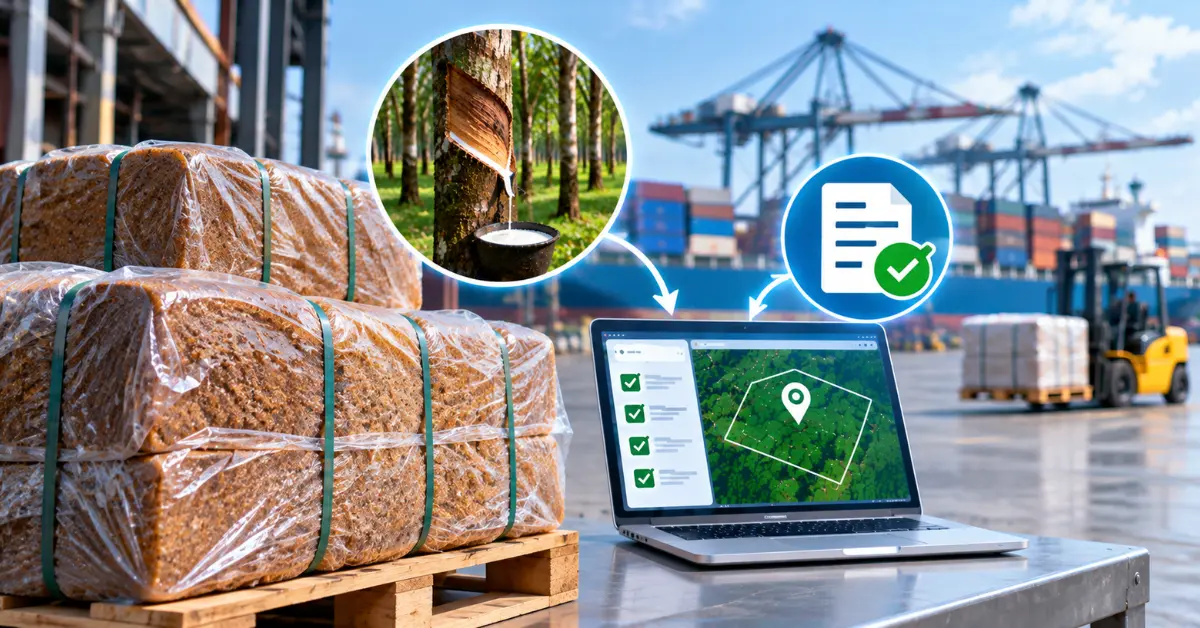
EUDR due diligence for rubber importers is the process an EU importer of natural rubber or in-scope rubber products must complete before customs release: collect plot-level geolocation and legality evidence for the Hevea natural rubber in each consignment, assess and mitigate deforestation risk, and submit a due diligence statement (DDS) in the EU Information System. It applies from 30 December 2026 for large and medium companies and from 30 June 2027 for micro and small operators.
Key takeaways
The importer is the operator. Whoever first places rubber on the EU market files the DDS and owns the evidence, even when the data comes from an exporter.
Scope narrowed on 18 September 2026. Conveyor and transmission belts (4010), other vulcanised rubber articles (4016) and retreaded or used tyres are out. Natural rubber, compounds, sheets, new tyres, inner tubes, gloves and hard rubber stay in.
Only Hevea natural rubber counts, with no minimum share. A tyre with a small natural rubber content still needs due diligence for that share.
Country risk sets the depth, not the data. Thai, Vietnamese and Indian origins get simplified due diligence; Indonesian, Malaysian and Ivorian origins need full risk assessment. Geolocation is required for all of them.
Smallholder plot data is the bottleneck, so supplier data requests should go out now.
Download our eBook
Assess your EUDR readiness, uncover data gaps, and take proactive steps towards stronger compliance.
What the obligation is, who carries it, and what it produces.
The legal test every consignment must pass
Why the importer is the operator
The three steps under Articles 9 to 11
EUDR due diligence for rubber importers means proving, consignment by consignment, that the natural rubber in your goods was produced on land that has not been deforested since 31 December 2020, and in line with the laws of the country of production. Under Regulation (EU) 2023/1115, the EUDR, the importer is the “operator”: the company that first places the product on the EU market.
That role carries three linked duties: collect information on the product and its plots of origin (Article 9), assess the risk of non-compliance (Article 10), and mitigate that risk until it is negligible (Article 11). The output is a DDS submitted in the EU Information System. Its reference number goes into the customs declaration, so without it the goods are not released.
If your company clears the goods for free circulation, the statement and the evidence behind it are yours, even if every data point came from an exporter.
Understand EUDR requirements for natural rubber, covered rubber products, farm-level traceability, deforestation checks and due diligence obligations.
EUDR Due Diligence Scope for Rubber Importers After the 2026 Annex I Update
Which rubber products still need a DDS, which left scope, and which were never covered.
CN headings in and out of Annex I
The Hevea-only rule
How blended products like tyres are treated
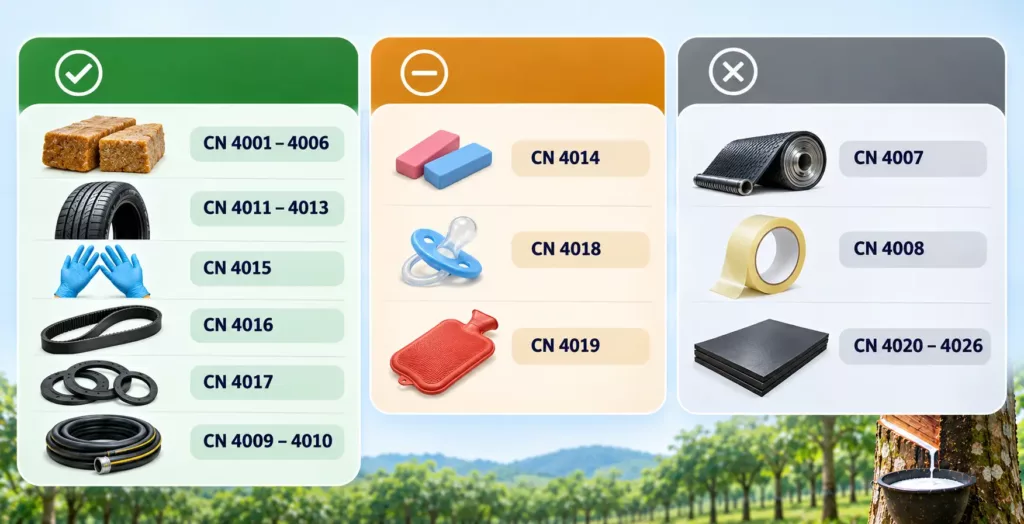
Delegated Regulation (EU) 2026/2102 entered into force on 18 September 2026 and rewrote the rubber entries in Annex I. Rubber saw more change than any other commodity, so any internal scope list built in 2025 needs re-checking before EUDR due diligence for rubber importers can begin in earnest.
Status
CN heading
Products
In scope
ex 4001, 4005, 4006
Natural rubber in primary forms (TSR, RSS, latex), compounded and other unvulcanised rubber
In scope
ex 4007, 4008, 4017
Rubber thread and cord; plates, sheets, strip and profiles; hard rubber
In scope
ex 4011, 4012 90 30, 4013
New pneumatic tyres, treads for retreading, inner tubes
In scope
ex 4015
Apparel and accessories of vulcanised rubber, including gloves
Removed 18 Sept 2026
4010, ex 4016, used and retreaded tyres
Conveyor and transmission belts, seals, gaskets, mats and other vulcanised articles
Never covered
4002, 4003, 4004, 4009, 4014
Synthetic, reclaimed and waste rubber; tubes and hoses; hygienic and pharmaceutical articles
Two rules sit on top of the table. First, only rubber from the Hevea brasiliensis tree is covered, so guayule, balata and synthetic rubber fall outside even inside the same headings. Second, for blended products such as tyres, due diligence applies to the natural rubber share only, and the Commission has confirmed there is no de minimis threshold. A tyre with a small share of natural rubber is caught.
Practical tip: keep a written record of every negative scope decision, backed by a supplier declaration of natural rubber content. “Contains no natural rubber” only holds at inspection if the evidence is on file.
EUDR Due Diligence Deadlines for Rubber Importers by Size and Role
When the obligation starts for you and what your role requires.
Application dates for large, medium, micro and small companies
Obligations for compounders, tyre plants and distributors
Penalties for non-compliance
Your role
Applies from
What you must do
Large or medium importer (operator)
30 December 2026
Full due diligence and a DDS before each consignment is released
Micro or small importer established by 31 December 2024
30 June 2027
Same duties as other operators, six months later
Downstream operator or trader (EU compounder, tyre plant, distributor)
30 December 2026, all sizes
No own DDS; keep supplier and customer records and DDS reference numbers for five years
For EUDR due diligence for rubber importers, the date that matters is set by the operator’s own size, while downstream companies and traders are bound from 30 December 2026 whatever their size.
Rubber already released for free circulation before your application date is not covered, even if it is sold later, so record stock dates now. Watch customs warehouses: whoever releases uncleared stock after the deadline becomes the importer. Penalties set by member states include fines of at least 4% of annual EU turnover for the most serious breaches, confiscation of goods and exclusion from public procurement.
Discover how to collect supplier information, verify deforestation-free sourcing, assess risks and establish a robust due diligence process for EUDR compliance.
EUDR Due Diligence Steps for Rubber Importers: A 7-Step Workflow
The sequence that takes a rubber importer from scope check to filed DDS.
Classification, role mapping and country risk
Geolocation, legality and risk mitigation
Filing and record keeping
Most importers today run this process in spreadsheets, with plot data arriving as PDFs and email attachments from exporters. That works for a pilot shipment, not for a year of consignments. The seven steps below are the minimum workflow for EUDR due diligence for rubber importers.
Rubber Importer Step 1: Classify Every Article Against the New Annex I
Match each SKU’s CN code to the amended Annex I, remove 4010, 4016 and retreaded tyres, and record natural rubber content per article. This step alone can shrink your in-scope list.
Rubber Importer Step 2: Map Each Sourcing Route to Your Role
Direct imports make you the operator. Rubber bought from another EU importer makes you downstream or a trader. Many tyre makers hold both roles across different input streams, so map routes, not the company as a whole.
Rubber Importer Step 3: Sort Origins by Country Risk
Under Implementing Regulation (EU) 2025/1093, Thailand, Vietnam, India and Sri Lanka are low risk; Indonesia, Malaysia, Côte d’Ivoire and Cambodia are standard risk; Myanmar is high risk. Inspection rates are roughly 1%, 3% and 9% respectively. Simplified due diligence removes the risk assessment and mitigation steps, not geolocation or the DDS, and it falls away if material from another origin could have been mixed in. That matters for rubber traded through hubs such as Singapore.
Not sure which of your rubber SKUs are still in scope?
Run the free TraceX EUDR Scope Check to classify your products against the 2026 Annex I in minutes
Rubber Importer Step 4: Collect Plot Geolocation From Smallholder Chains
Most natural rubber comes from smallholders, passing through collectors, dealers and processors before it becomes TSR or sheet. Plot data is where EUDR due diligence for rubber importers most often stalls, so start supplier requests early. You need coordinates for every plot: a single point for plots up to four hectares, a polygon above that, plus the date or period of production. Validate GeoJSON files before upload, because format errors are the most common cause of rejected statements.
Rubber Importer Step 5: Verify Deforestation-Free Status and Legality
Check each plot against satellite data for forest loss after 31 December 2020. Rubber plantations count as agricultural land, so the question is whether the land was forest at the cut-off date. Legality covers land-use rights, labour, tax and environmental law; land title is usually the hardest evidence in smallholder chains. FSC certification or GPSNR membership supports risk mitigation but never replaces the DDS, plot geolocation or verifiable evidence.
Discover how TraceX helped a tire manufacturer digitize supplier geolocation, validate rubber origins using satellite data, automate risk assessments and streamline DDS generation through SAP integration.
Rubber Importer Step 6: Assess and Mitigate Risk for Standard and High-Risk Origins
Document a risk assessment per supplier and region, then mitigate with extra data, audits or independent checks. Write segregation into contracts: material of known origin cannot be mixed with material of unknown origin, and one unseparated non-compliant lot blocks the whole batch.
Rubber Importer Step 7: Submit the DDS and Keep Records for Five Years
Register in the EU Information System, submit the DDS before release, and put the reference number in the customs declaration. Keep the full evidence pack for five years and review your due diligence system at least once a year. That closes the loop of EUDR due diligence for rubber importers for each consignment.
EUDR Due Diligence for Rubber Importers: Manual Process vs TraceX
How a purpose-built platform changes each step, and where the manual approach breaks.
Where spreadsheets fail at volume
What TraceX automates
Side-by-side comparison
The pain in EUDR due diligence for rubber importers is rarely the regulation itself. It is the volume: thousands of small plots per origin, multi-tier traders, and a new DDS for every consignment. Manual workflows turn each shipment into a document chase.
How TraceX EUDR Solutions supports rubber importers
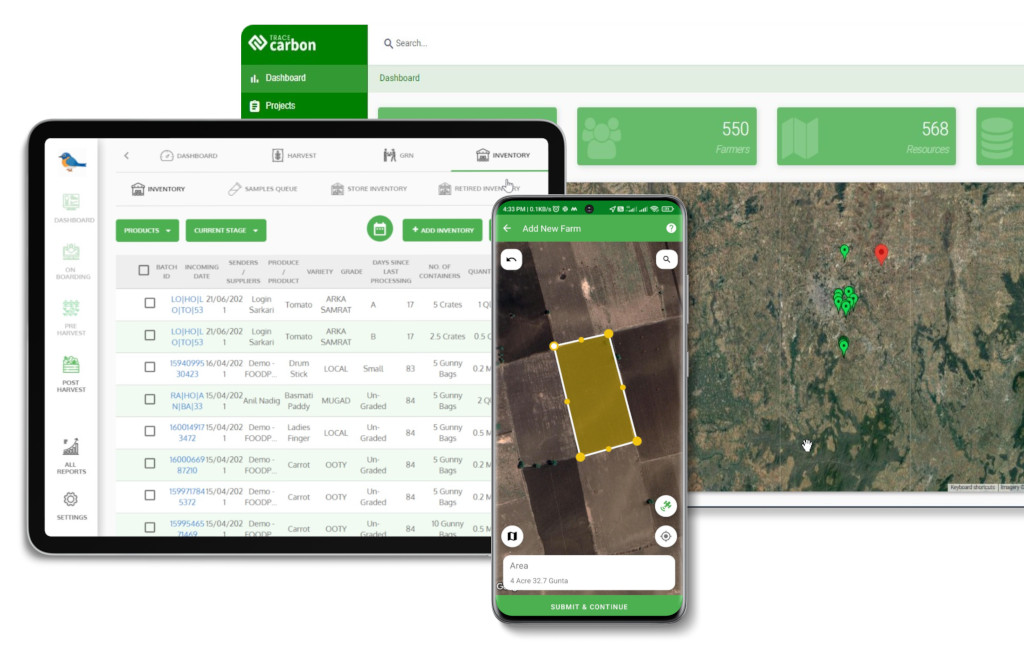
Supplier and cooperative portal with offline mobile capture of smallholder plot points and polygons
Geolocation validation against JRC and Hansen datasets, plus Sentinel-2 deforestation alerts
Agentic AI that extracts KYC, land tenure and certification data from supplier documents and emails
Defensible risk assessment engine that applies country tiers and supplier-level risk automatically
DDS generation and API submission to the EU Information System, with reference numbers returned
Built on GDPR, ISO 27001 and SOC 1 and SOC 2 compliant infrastructure, with regulatory input from our European legal partner.
EUDR Due Diligence Software Checklist for Rubber Importers
Questions to ask any vendor before you commit.
Scope and risk logic
Data capture and validation
Filing, security and audit readiness
Use this list to compare tools on what EUDR due diligence for rubber importers actually requires in rubber supply chains:
Does it apply the 2026 Annex I rubber scope and flag natural rubber content per SKU?
Does it update country risk tiers when the Commission revises the list?
Can smallholders and collectors submit plot points and polygons offline?
Does it validate GeoJSON and screen plots against the 31 December 2020 cut-off?
Can it enforce batch segregation and block mixing with unknown-origin material?
Does it submit DDS via API and pass reference numbers to customs and customers?
Is data held on GDPR, ISO 27001 and SOC 2 compliant infrastructure, with five-year retention?
Frequently Asked Questions
Do I need a DDS for tyres with only a small share of natural rubber?
Yes. There is no minimum threshold. Due diligence covers the natural rubber share only, not synthetic rubber, steel or carbon black.
Are rubber seals, gaskets and conveyor belts still covered?
No. Headings 4010 and 4016 were removed from Annex I on 18 September 2026. Plates, sheets and compounds you import to make them are still covered.
Does low-risk Thai origin remove the need for geolocation?
No. Simplified due diligence skips risk assessment and mitigation, but you still need plot geolocation, legality evidence and a DDS, and the simplification is lost if mixing with other origins is possible.
Who files the DDS when an EU compounder buys natural rubber from an EU importer?
The importer files it. The compounder is a downstream operator: it keeps supplier and customer records and the reference numbers, but submits no statement of its own.
When does EUDR due diligence for rubber importers start?
EUDR due diligence for rubber importers applies from 30 December 2026 for large and medium companies and from 30 June 2027 for micro and small operators established by 31 December 2024.
Is synthetic rubber covered by the EUDR?
No. Only natural rubber from Hevea brasiliensis is in scope.
Can FSC certification or GPSNR membership replace EUDR due diligence?
No. They support risk mitigation, but the DDS, plot-level geolocation and verifiable evidence are still required.
Start using TraceX
Transparency, Trust, & Success for your Climate Journey.
We use cookies on our website to give you the most relevant experience by remembering your preferences and repeat visits. By clicking “Accept All”, you consent to the use of ALL the cookies. However, you may visit "Cookie Settings" to provide a controlled consent.
This website uses cookies to improve your experience while you navigate through the website. Out of these, the cookies that are categorized as necessary are stored on your browser as they are essential for the working of basic functionalities of the website. We also use third-party cookies that help us analyze and understand how you use this website. These cookies will be stored in your browser only with your consent. You also have the option to opt-out of these cookies. But opting out of some of these cookies may affect your browsing experience.
Necessary cookies are absolutely essential for the website to function properly. These cookies ensure basic functionalities and security features of the website, anonymously.
Cookie
Duration
Description
cookielawinfo-checkbox-analytics
11 months
This cookie is set by GDPR Cookie Consent plugin. The cookie is used to store the user consent for the cookies in the category "Analytics".
cookielawinfo-checkbox-functional
11 months
The cookie is set by GDPR cookie consent to record the user consent for the cookies in the category "Functional".
cookielawinfo-checkbox-necessary
11 months
This cookie is set by GDPR Cookie Consent plugin. The cookies is used to store the user consent for the cookies in the category "Necessary".
cookielawinfo-checkbox-others
11 months
This cookie is set by GDPR Cookie Consent plugin. The cookie is used to store the user consent for the cookies in the category "Other.
cookielawinfo-checkbox-performance
11 months
This cookie is set by GDPR Cookie Consent plugin. The cookie is used to store the user consent for the cookies in the category "Performance".
viewed_cookie_policy
11 months
The cookie is set by the GDPR Cookie Consent plugin and is used to store whether or not user has consented to the use of cookies. It does not store any personal data.
Functional cookies help to perform certain functionalities like sharing the content of the website on social media platforms, collect feedbacks, and other third-party features.
Performance cookies are used to understand and analyze the key performance indexes of the website which helps in delivering a better user experience for the visitors.
Analytical cookies are used to understand how visitors interact with the website. These cookies help provide information on metrics the number of visitors, bounce rate, traffic source, etc.
Advertisement cookies are used to provide visitors with relevant ads and marketing campaigns. These cookies track visitors across websites and collect information to provide customized ads.