EUDR Compliance Checklist: 15 Things to Verify Before Your EU Shipment
Published
, 18 minute read
Share this article
Quick summary: Use this 15-point EUDR compliance checklist to verify product scope, supplier data, geolocation, legality, risk assessment and DDS readiness before EU shipments.
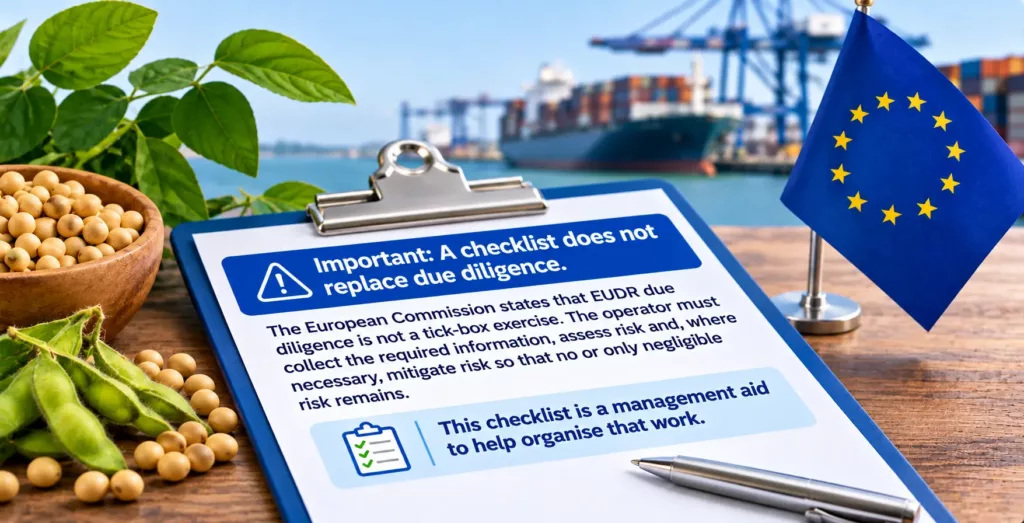
EUDR compliance checklist brings the key readiness questions together in one place. Use it to identify gaps, assign owners and organise the evidence your business may need. It is a practical planning tool not a substitute for the EUDR legal text, official guidance or advice from your competent authority or legal adviser.
With the EU Deforestation Regulation (EUDR) application date approaching, businesses trading in covered commodities and products need more than a general understanding of the regulation. They need to know which products are in scope, which entity carries the legal responsibility, what information must be collected from suppliers, how sourcing risks will be assessed and whether the required declaration is ready before the relevant market or export activity.
For importers, exporters, manufacturers, processors and traders, the challenge is often operational. Supplier information may be spread across spreadsheets, plot coordinates may arrive in inconsistent formats, legality documents may be incomplete, and procurement records may not be connected to the sourcing locations that produced the commodity.
Key Takeaways
.Know Your Product Scope: Verify whether your commodities and products fall under EUDR Annex I.
Clarify Your Responsibilities: Identify your role as an operator, trader or other supply-chain participant and understand your applicable obligations.
Strengthen Supplier Data: Collect accurate supplier details, production information, geolocation and legality evidence.
Validate Geolocation: Ensure plot coordinates and polygons meet EUDR requirements and can be linked to the relevant products.
Assess Deforestation Risks: Verify compliance with the 31 December 2020 cut-off date and evaluate forest degradation risks for wood.
Maintain Traceability: Connect sourcing locations, raw materials, processing activities and finished products.
Prepare for DDS Submission: Ensure the responsible operator has the required information and evidence before placing products on the EU market.
Download our eBook
Assess your EUDR readiness, uncover data gaps, and take proactive steps towards stronger compliance.
EUDR application dates: confirm which deadline applies to your business
As of November 2026, the European Commission lists the following application dates:
Business / product category
Application date
Large and medium-sized operators and traders
30 December 2026
Micro and small operators already covered by the EU Timber Regulation (EUTR)
30 December 2026
Other micro and small enterprises
30 June 2027
Certain products newly added to Annex I by the 2026 Delegated Act
30 December 2027
Do not determine your deadline from turnover or headcount alone without checking the applicable EU SME definition, the entity’s status and the transitional provisions. In particular, certain micro and small operators previously covered by the EUTR have the earlier 30 December 2026 date. The 2026 Delegated Act also gives newly added products a later application date.
The EUDR covers cattle, cocoa, coffee, oil palm, rubber, soy and wood, together with the relevant products listed in Annex I. A commodity being covered does not automatically mean every product made from it is covered: check the exact product description and CN/HS classification, including any ‘ex’ limitation in Annex I.
EUDR compliance checklist: 15 things to verify
Work through these checks for each relevant product, sourcing flow and responsible legal entity. Record the evidence, the person responsible and any unresolved gap.
1. Confirm that the product is within EUDR scope
Check the latest Annex I against the product’s exact description and CN/HS code. Review any ‘ex’ code wording and product-specific limitations. Do not rely on a broad commodity label or an HS chapter alone. Keep the classification rationale and supporting product specifications on file.
Evidence to organise: product description, CN/HS classification, bill of materials or product specification, and the applicable Annex I entry.
2. Identify the responsible operator and each actor’s role
Map the legal entities involved in placing the product on the EU market or exporting it from the EU. Identify the upstream operator responsible for due diligence and the DDS or simplified declaration where required. Do not assume that the shipper, consignee, importer of record, freight forwarder or customs broker is automatically the responsible operator. Check the current downstream operator and trader rules as amended in 2025.
Evidence to organise: legal-entity map, trade-flow diagram, contracts, Incoterms and a documented role assessment.
3. Confirm your company-size category and applicable obligations
Determine whether the relevant legal entity qualifies as micro, small, medium or large under the applicable EU rules, and whether it was previously covered by the EUTR. This affects the application date and may affect which obligations apply. Assess each legal entity separately rather than assuming a parent-company classification applies to every subsidiary.
Evidence to organise: entity-level size assessment, financial/headcount information where relevant, group structure and EUTR status.
4. Establish a complete supplier and producer list
Identify direct suppliers and the upstream producers or sourcing locations needed to establish the origin of relevant commodities. For complex chains, map aggregators, cooperatives, mills, processors and intermediaries. A supplier name alone may not establish where the commodity was produced.
Evidence to organise: supplier register, producer register, supplier IDs, country of production, contact details and supply-chain relationships.
5. Collect the required product and transaction information
For each relevant product, organise the product description, trade name and type, quantity, country of production, supplier information and other Article 9 information. Make sure units, product descriptions and quantities can be reconciled across purchase orders, invoices, inventory and shipment records.
Evidence to organise: purchase orders, invoices, product specifications, quantity records, country-of-production information and transaction references.
6. Obtain plot-level geolocation in the required format
Collect the geolocation of the plot of land where the relevant commodity was produced. EUDR geolocation requirements depend on the commodity and the relevant provisions. For land plots exceeding four hectares used for production of relevant commodities other than cattle, a polygon is required; points are not a substitute for the required polygon. Coordinates must meet the required precision. Micro and small primary operators may have specific simplified-declaration provisions, so check whether those apply to your case.
Evidence to organise: original GPS data, GeoJSON or other supported geometry files, plot identifiers, collection date, producer linkage and any corrections.
7. Validate geospatial files before using them
Check that coordinates are in the correct coordinate reference system, geometry is valid, polygons are closed, features are readable and the file matches the producer and sourcing record. Identify duplicate plots, overlaps, missing coordinates, invalid geometry and implausible locations. Keep the original supplier submission and the validated version so changes are traceable.
Evidence to organise: validation report, source file, corrected file, exception log and reviewer sign-off.
8. Capture production dates and quantities at the relevant level
Connect the commodity or product to the relevant production or harvest period and quantity information required by the regulation and applicable Information System fields. Make sure the quantity represented in sourcing and procurement records is consistent with the quantity covered by the declaration. Avoid treating a shipment date as a substitute for a production or harvest date.
Evidence to organise: harvest or production records, procurement receipts, batch records, inventory movements and quantity reconciliation.
9. Collect evidence of legal production
Identify the relevant legislation in the country of production and collect evidence that the commodity was produced in accordance with it. The documents required depend on the country, commodity, land tenure and applicable laws. Land title is not a universal or exclusive form of proof; other official or legally recognised rights and permits may be relevant depending on local law. Do not assume that one generic supplier declaration is sufficient in every case.
Evidence to organise: applicable permits, land-use or harvesting rights, concessions, licences, tax or customs records and other relevant official or legally recognised evidence.
10. Screen sourcing locations for deforestation or forest degradation
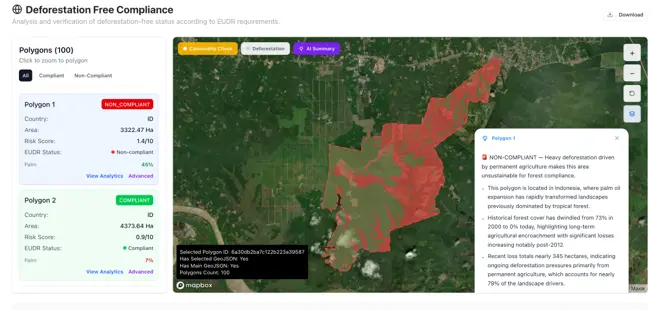
Assess whether the relevant commodity was produced on land that was subject to deforestation after 31 December 2020. For wood, assess whether harvesting induced forest degradation after that date. Use appropriate and credible geospatial information, including the EU Forest Observatory as a support resource, while recognising that map layers are not a substitute for the legal assessment. Investigate alerts, overlaps and inconsistencies rather than treating an automated signal as a final legal conclusion.
Evidence to organise: map sources and dates, plot-screening outputs, satellite observations, investigation notes and documented conclusions.
11. Assess supply-chain and circumvention risks
Consider country and regional context, supplier reliability, complexity of the supply chain, mixing risks, product characteristics and any substantiated concerns. A low-risk country classification may allow simplified due diligence under Article 13 when the legal conditions are met, but it does not remove the requirement to collect the relevant Article 9 information. If there are red flags or indications of circumvention or mixing, assess whether the simplified route remains available.
Evidence to organise: risk assessment, country benchmark reference, supplier checks, chain-of-custody records and red-flag investigation.
12. Apply mitigation where risk is not negligible
Where the assessment identifies more than negligible risk, take adequate and proportionate mitigation measures before the product is placed on the EU market or exported. This may involve obtaining additional information, independent surveys or audits, or other steps appropriate to the risk. Document why the measures address the identified concern and why the remaining risk is negligible. If the required information cannot be obtained or risk cannot be reduced to negligible, the product must not be placed on the EU market or exported.
Evidence to organise: mitigation plan, additional supplier evidence, audit or survey reports, corrective actions and final risk conclusion.
13. Determine whether a DDS or simplified declaration is required and submit it in time
The applicable declaration route depends on the actor’s role and the legal provisions that apply. Where a DDS is required, the responsible operator or authorised representative submits it through the EUDR Information System in TRACES. Certain micro and small primary operators may use a simplified declaration. Ensure the relevant declaration is submitted before the product is placed on the EU market or exported, as applicable. A service provider may support preparation or filing under an appropriate mandate, but this does not automatically transfer the operator’s legal responsibility.
Evidence to organise: submitted declaration, reference number or declaration identifier, mandate where relevant, and supporting due-diligence records.
14. Coordinate declaration references with customs and downstream partners
For imports, the DDS reference number or simplified declaration identifier must be available for the customs process in accordance with the applicable rules. Confirm who will lodge the customs declaration and how the reference will be communicated, checked and linked to the correct product and quantity. A DDS may cover multiple shipments or batches where the legal conditions are met; monitor the quantities covered and do not reuse a reference beyond its valid scope.
Evidence to organise: declaration reference, customs instructions, shipment-to-declaration mapping, quantity balance and partner communication record.
15. Maintain records and a process for changes
Keep the due-diligence system, supporting information and relevant records for the required retention period—generally five years. Review and update procedures at least annually and when relevant circumstances change. Establish a process to respond promptly to new information or substantiated concerns, including changes to suppliers, plots, production dates, quantities, product classification or sourcing routes.
Who is responsible for what? Understand the supply-chain roles
The correct allocation of responsibility depends on the role of each legal entity and the amended EUDR rules. The following is a high-level orientation, not a substitute for a role assessment against the current Regulation and official guidance.
Supply-chain actor
Practical role to clarify
Upstream operator
The entity placing a relevant product on the EU market for the first time or exporting it from the EU generally carries the upstream due-diligence responsibility and submits the required DDS, subject to applicable simplified provisions.
Micro or small primary operator
May be eligible for a simplified declaration route and specific information arrangements. Confirm eligibility and the applicable provisions.
Downstream operator
Obligations were simplified by the 2025 amendment. Determine whether the entity must register, retain information or verify upstream due diligence in response to substantiated concerns.
Trader
Obligations depend on SME status and position in the supply chain under the amended rules. Do not assume all traders submit a DDS.
Authorised representative
May submit a declaration on behalf of an operator where properly authorised. The operator’s legal responsibility is not automatically transferred.
Exporter / producer outside the EU
Often supplies the upstream data and evidence needed by the responsible EU operator. Contractual data duties should be clearly agreed, but providing data does not by itself make the exporter the DDS-submitting operator.
Customs broker / freight forwarder
May need the relevant DDS reference or declaration identifier for customs procedures. Handling customs clearance does not automatically make the broker the EUDR operator.
EUDR supplier data requirements: what should you request?
A practical supplier data request should be specific enough for the supplier to understand what is needed, why it is needed and how the information should be provided. The exact data set depends on the commodity, product, role and applicable declaration route.
Data category
What to request or verify
Supplier identity
Legal name, address, supplier ID and relevant upstream relationships.
Commodity and product
Commodity type, commercial description, product code and quantity.
Country of production
Country where the relevant commodity was produced—not merely the country of dispatch or processing.
Producer and plot
Producer linkage and geolocation for the relevant production plot, subject to applicable exceptions or simplified provisions.
Production period
Relevant production or harvest date or period and related quantity information.
Legality evidence
Documents and information relevant to applicable legislation in the country of production.
Traceability records
Procurement, aggregation, processing, inventory and batch links connecting the sourced commodity to the relevant product.
Updates and declarations
Change notifications, declaration references or identifiers where applicable, and supporting evidence.
Give suppliers a standard template and clear file instructions. For geospatial data, specify accepted formats, coordinate precision, polygon requirements and how to label each plot. Explain how errors will be returned for correction and how revised data will be version-controlled.
Confirm product scope, legal-entity roles, company-size category and applicable deadline.
Scope and responsibility register.
Days 6–12
Map suppliers, producers and sourcing locations; issue standard supplier data requests.
Supplier and plot data tracker.
Days 13–18
Validate geolocation; collect legality evidence; reconcile production and procurement information.
Validated sourcing dataset and evidence repository.
Days 19–24
Complete risk assessment and investigate alerts, inconsistencies and missing information.
Risk register and mitigation actions.
Days 25–30
Confirm declaration route, prepare required submissions, map references to shipments and test customs handoffs.
Reviewed declaration workflow and shipment-readiness sign-off.
How digital traceability can support EUDR readiness
EUDR readiness depends on connecting information that is often held by different teams and organisations: supplier onboarding, producer and plot records, geospatial files, legality documents, risk assessments, procurement transactions, inventory and shipment data. Managing these records in disconnected spreadsheets can make it difficult to identify missing information, track corrections and establish a consistent evidence trail.
A digital traceability and compliance platform can help structure these workflows. Depending on the implementation, it can support:
Centralised supplier and producer profiles with traceable updates.
Collection and validation of plot-level coordinates and geospatial files.
Organisation of satellite screening outputs, risk flags and investigation records.
Capture and storage of legality documents and supporting evidence.
Connections between sourcing locations, procurement, inventory, processing and batches.
Preparation and management of due-diligence information and declaration references.
Dashboards that help teams identify incomplete data and unresolved exceptions.
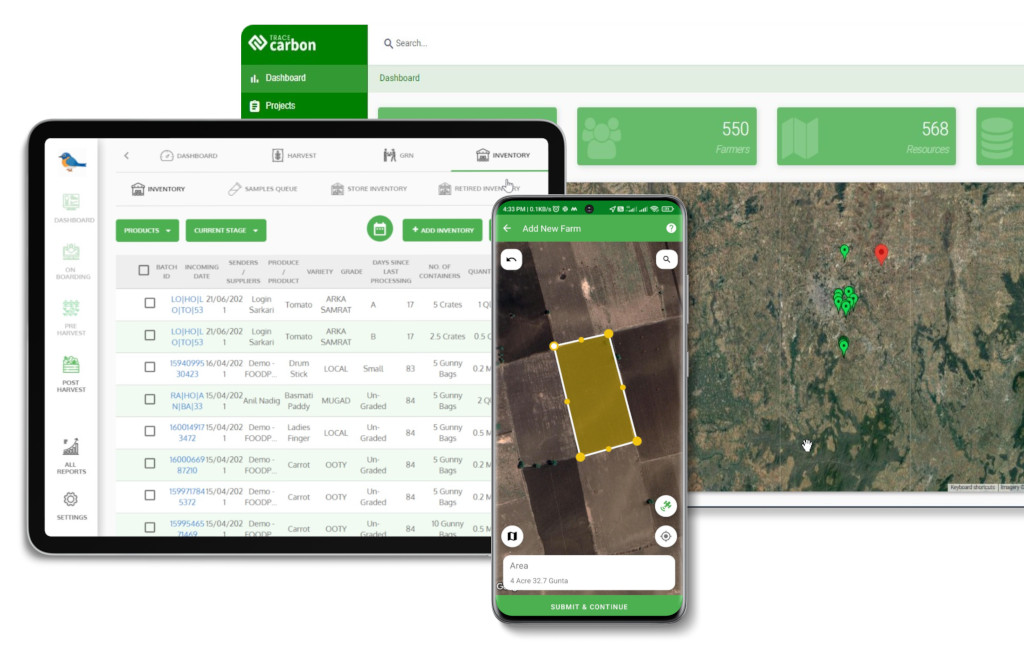
TraceX EUDR Solutions supports businesses with supplier onboarding, geolocation management, risk-screening workflows, traceability and compliance information .FoodSign product supports farm-level data capture and agricultural traceability; Cleara supports regulatory compliance workflows, including the organisation of sourcing information and due-diligence evidence. The exact scope, integrations and declaration workflows should be confirmed against the customer’s requirements and implementation.
NEED TO IDENTIFY YOUR EUDR DATA GAPS?
TraceX can help your team review supplier coverage, plot-level geolocation, risk-screening records and traceability workflows.
Final takeaway: turn EUDR requirements into an operational process
The most useful EUDR readiness exercise is not simply asking whether a DDS can be generated. It is checking whether the business can connect the right product to the right legal entity, supplier, producer, sourcing plot, legality evidence, risk assessment, quantity and declaration reference and keep that information current.
Start with the 15 checks in this guide. Assign an owner to every gap, agree a supplier-data collection process and test the handoff between compliance, procurement, operations and customs partners before the first applicable shipment.
If your organisation needs help structuring supplier onboarding, geolocation validation, risk-screening evidence and traceability workflows, speak with TraceX about an EUDR readiness assessment.
Frequently asked questions
What is an EUDR compliance checklist?
An EUDR compliance checklist is a practical management aid for checking whether a business has identified in-scope products, understood its legal role, collected required supplier and production information, assessed deforestation and legality risks, completed any required mitigation and prepared the applicable DDS or simplified declaration. The European Commission does not prescribe one universal checklist; the operator must cover the legal due-diligence steps.
When does the EUDR apply?
The EUDR applies from 30 December 2026 to large and medium-sized operators and traders and to micro and small operators already covered by the EU Timber Regulation. Most other micro and small enterprises have an application date of 30 June 2027. Certain products newly added to Annex I by the 2026 Delegated Act apply from 30 December 2027. Businesses should verify their entity status and transitional position.
What information must suppliers provide for EUDR?
Depending on the product and declaration route, supplier information may include supplier and producer identity, commodity and product description, quantity, country of production, plot geolocation, production or harvest information and evidence relevant to legal production. The responsible operator must determine whether the information collected satisfies Article 9 and the applicable rules.
Are GPS coordinates enough for EUDR?
Not in every case. EUDR requires geolocation for the relevant production plots. For plots above four hectares used to produce relevant commodities other than cattle, polygons are required. Applicable coordinate precision and specific simplified provisions must also be considered. A coordinate point should not be used where the law requires a polygon.
Does a low-risk country mean that no EUDR due diligence is required?
No. Where the legal conditions for simplified due diligence under Article 13 are met, the operator may not need to carry out the Article 10 risk assessment and Article 11 mitigation steps. However, the required Article 9 information still has to be collected, and simplified due diligence is not available where relevant conditions or red flags prevent its use.
Who submits the EUDR Due Diligence Statement?
The upstream operator responsible for placing a relevant product on the EU market for the first time or exporting it from the EU generally submits the DDS, subject to applicable simplified provisions. An authorised representative may submit on the operator’s behalf where properly authorised. The shipper, consignee, importer of record or customs broker is not automatically the responsible operator.
Does every shipment need a separate DDS?
Not necessarily. A DDS may cover multiple batches or shipments where the legal conditions are met and the declared quantity is sufficient. The operator must monitor the quantities covered and submit a new declaration when additional quantities require it. The appropriate declaration structure should be checked against the current legal text and Information System rules.
How long must EUDR records be retained?
The EUDR generally requires relevant due-diligence information, documents and records to be kept for five years. Businesses should maintain an organised record of the information collected, risk assessment, mitigation and relevant updates.
Can satellite monitoring alone prove EUDR compliance?
No. Satellite and forest-cover data can help screen plots and identify potential changes, but an alert or map overlay needs to be interpreted in context. Businesses should investigate relevant signals and maintain supporting evidence. A digital screening result does not by itself establish legal compliance.
Can an exporter outside the EU submit the DDS?
An exporter outside the EU may provide information and evidence to the responsible operator and may support the process under contractual arrangements. The legal obligation to conduct due diligence and submit the declaration rests with the relevant operator under the Regulation. An authorised representative can act for that operator where the legal requirements are met.
Start using TraceX
Transparency, Trust, & Success for your Climate Journey.
We use cookies on our website to give you the most relevant experience by remembering your preferences and repeat visits. By clicking “Accept All”, you consent to the use of ALL the cookies. However, you may visit "Cookie Settings" to provide a controlled consent.
This website uses cookies to improve your experience while you navigate through the website. Out of these, the cookies that are categorized as necessary are stored on your browser as they are essential for the working of basic functionalities of the website. We also use third-party cookies that help us analyze and understand how you use this website. These cookies will be stored in your browser only with your consent. You also have the option to opt-out of these cookies. But opting out of some of these cookies may affect your browsing experience.
Necessary cookies are absolutely essential for the website to function properly. These cookies ensure basic functionalities and security features of the website, anonymously.
Cookie
Duration
Description
cookielawinfo-checkbox-analytics
11 months
This cookie is set by GDPR Cookie Consent plugin. The cookie is used to store the user consent for the cookies in the category "Analytics".
cookielawinfo-checkbox-functional
11 months
The cookie is set by GDPR cookie consent to record the user consent for the cookies in the category "Functional".
cookielawinfo-checkbox-necessary
11 months
This cookie is set by GDPR Cookie Consent plugin. The cookies is used to store the user consent for the cookies in the category "Necessary".
cookielawinfo-checkbox-others
11 months
This cookie is set by GDPR Cookie Consent plugin. The cookie is used to store the user consent for the cookies in the category "Other.
cookielawinfo-checkbox-performance
11 months
This cookie is set by GDPR Cookie Consent plugin. The cookie is used to store the user consent for the cookies in the category "Performance".
viewed_cookie_policy
11 months
The cookie is set by the GDPR Cookie Consent plugin and is used to store whether or not user has consented to the use of cookies. It does not store any personal data.
Functional cookies help to perform certain functionalities like sharing the content of the website on social media platforms, collect feedbacks, and other third-party features.
Performance cookies are used to understand and analyze the key performance indexes of the website which helps in delivering a better user experience for the visitors.
Analytical cookies are used to understand how visitors interact with the website. These cookies help provide information on metrics the number of visitors, bounce rate, traffic source, etc.
Advertisement cookies are used to provide visitors with relevant ads and marketing campaigns. These cookies track visitors across websites and collect information to provide customized ads.