Quick summary: EUDR Compliance Alternatives help you compare Excel, ERP, consultants, internal tools and dedicated platforms to build scalable, audit-ready workflows.
EUDR Compliance Alternatives: What Are Your Options? As the EUDR application date approaches, companies are asking a practical question: what is the right way to operationalize compliance? Options include Excel, ERP systems, consultants, internal tools, supplier portals and dedicated compliance platforms. Each can support part of the process; the right approach depends on supply-chain complexity, supplier volume, geolocation requirements, traceability needs, internal technology capability and audit-readiness expectations.
The key distinction is between understanding EUDR and operationalizing it. EUDR due diligence involves gathering information, assessing risk and, where necessary, mitigating risk before relevant products are placed on the EU market or exported. The European Commission’s Information System is the regulatory submission environment, but the business still needs reliable source data and connected records.
Key Takeaways
Excel can support smaller programs and initial readiness exercises, but manual reconciliation becomes harder as complexity grows.
ERP systems provide important transactional data but may need additional capabilities for plot-level geolocation, evidence and compliance workflows.
Consultants can provide regulatory expertise, but organizations still need an operational process to execute due diligence continuously.
Internal tools provide control and customization but require ongoing engineering and regulatory maintenance.
Dedicated platforms can provide purpose-built workflows connecting source, traceability, risk, evidence and regulatory processes.
A hybrid architecture can connect ERP, supplier data, geospatial information and the EUDR Information System.
December 2026 is approaching. Is your supply chain actually ready?
Move from spreadsheets and fragmented supplier data to a traceable, audit-ready EUDR workflow with TraceX.
A useful way to evaluate EUDR Compliance Alternatives is to start with the workflow rather than the technology. A business needs to establish product and supply-chain scope, collect required information, establish production locations, assess deforestation and legality risks, maintain supporting evidence, connect source information to relevant products and quantities, and prepare the applicable regulatory submission.
The current EUDR Information System documentation includes product details, operator identification, country of production and producer geolocation. For relevant DDS submissions, producer geolocation is provided as GeoJSON, with specific requirements for coordinates and plot size. The system also applies technical validation rules, including checks for invalid geometry, coordinate ranges, producer limits and a 25 MB geolocation-data limit per DDS. These requirements show why EUDR is more than a document-filing exercise.
1. Excel and Spreadsheets
Excel is often the first EUDR compliance alternative because most organizations already use it. A structured workbook can track suppliers, countries, plots, documents, risk assessments, quantities, DDS references and shipment status.
Low initial cost and familiar to procurement and sustainability teams.
Easy to customize for different commodities and suppliers.
Useful for pilots, smaller supplier populations and readiness assessments.
Can become difficult when multiple people edit data, evidence is stored separately, and source-to-shipment relationships become complex.
Manual validation and reconciliation can create version-control, duplication and completeness challenges.
Excel can therefore be useful as a starting point, but companies should test whether it can maintain one consistent record across suppliers, plots, materials, batches and shipments as volumes increase.
2. ERP Systems
ERP systems already contain valuable information: supplier master data, purchase orders, materials, quantities, inventory, production orders, sales orders and shipments. This makes ERP an important part of an EUDR architecture.
However, an ERP is generally designed around enterprise transactions rather than plot-level environmental evidence. EUDR workflows can require geolocation, GeoJSON, source evidence, risk assessment and relationships between production plots and the material ultimately used in an EU-bound product.
The practical model for many enterprises is therefore not ERP versus EUDR compliance, but ERP plus the data and workflow capabilities needed for EUDR. The EUDR Information System provides APIs for organizations whose IT systems manage DDS electronically and want to automate submission.
Learn how EUDR ERP integration can connect your existing enterprise data with supplier information, geolocation, risk assessment, compliance evidence and DDS workflows—reducing manual data entry and creating a more connected compliance process. The EU EUDR Information System also provides APIs for machine-to-machine management of DDS and declarations.
Consultants can help organizations interpret regulatory requirements, define policies, identify applicable products, design due diligence procedures and support supplier engagement or audits. This can be valuable when an organization is building its compliance framework.
The operational question comes afterward: how will the organization collect, validate, update and connect the underlying data every time material is sourced and shipped? A consultant-led model still needs an execution layer for supplier information, geolocation, evidence, risk decisions, traceability and regulatory records.
A practical model can combine regulatory expertise with internal processes and technology rather than treating consulting and technology as mutually exclusive alternatives.
4. Internal EUDR Tools
Companies with strong internal IT and data teams may build their own EUDR capability. An internal solution can be tailored to existing procurement, ERP, GIS and data architecture.
Full control over workflows and data models.
Potentially deep integration with existing enterprise systems.
Ability to tailor interfaces to commodity-specific processes.
Ongoing responsibility for regulatory changes, integrations, security, maintenance and testing.
Need for capabilities covering GIS, regulatory data, workflow design and EU Information System integration.
The build approach can work where EUDR is part of a broader enterprise compliance architecture and sufficient engineering resources are available. Total cost should include ongoing maintenance, not just initial development.
Learn what to look for in EUDR technology solutions, how different technologies support the compliance workflow, and how to connect your existing ERP and supply-chain systems with EUDR requirements.
A dedicated EUDR platform is designed around the compliance workflow rather than being adapted from a general-purpose system. Depending on the solution, capabilities may include supplier onboarding, geolocation collection, GeoJSON validation, satellite-based checks, evidence management, risk assessment, traceability, shipment readiness and DDS workflows.
The value of a dedicated platform is less about replacing every existing system and more about connecting the gaps between them. ERP can remain the system of record for transactions while a compliance layer manages source-level information and regulatory workflows.
This becomes particularly relevant for organizations managing many suppliers, countries, plots, products, processing stages or EU shipments.
EUDR Compliance Alternatives: How Do They Compare?
Approach
Initial Effort
Geolocation
Traceability
Scalability
Typical Use
Excel
Low
Manual
Manual
Low–Medium
Pilot / smaller programs
ERP
Medium
Usually needs extension
Strong for transactions
Medium–High
Enterprise transaction backbone
Consultant
Variable
Process-dependent
Process-dependent
Depends on model
Regulatory design / advisory
Internal Tools
High
Can be tailored
Can be tailored
Potentially high
Organizations with strong IT
Dedicated Platform
Medium
Purpose-built workflows
Purpose-built workflows
High
Complex / multi-supplier programs
The Better Question: What Does Your Supply Chain Need?
There is no single technology model that fits every organization. A business sourcing from 20 suppliers with limited product complexity may have different needs from a multinational managing thousands of plots, multiple commodities and several processing stages.
Supplier volume and onboarding complexity
Number and quality of source geolocations
Commodity and product complexity
Number of processing and transformation stages
Need to connect material to batches and shipments
Existing ERP and data architecture
Internal GIS and engineering capability
Frequency of regulatory change
Audit and evidence requirements
Need for API-based regulatory submission
A Hybrid EUDR Compliance Model
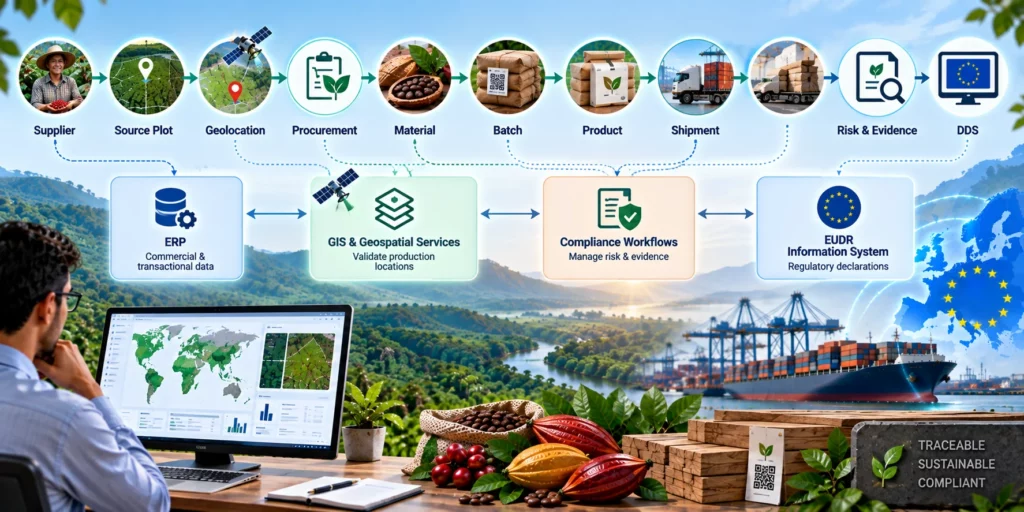
For many enterprises, the practical architecture is hybrid. ERP remains responsible for commercial and transactional data. Supplier-facing workflows collect source information. GIS and geospatial services validate production locations. Compliance workflows manage risk and evidence. The EUDR Information System is then used for the applicable regulatory declarations.
A useful model is: Supplier → Source Plot → Geolocation → Procurement → Material → Batch → Product → Shipment → Risk & Evidence → DDS.
The EUDR Information System documentation supports API integration, while GeoJSON validation and submission requirements create specific technical considerations for the integration layer.
How to Choose an EUDR Compliance Alternative
Before selecting an approach, run a practical readiness assessment. Pick several representative EU-bound shipments and trace each one backward from shipment to product, batch, material, supplier and production plot. Then test whether supporting evidence and risk decisions can be retrieved without manual reconstruction.
Can we identify every relevant supplier?
Can we establish the production location for the relevant material?
Can we validate the submitted geolocation?
Can we connect source quantities to material purchased and used?
Can we retrieve legality and deforestation-free evidence?
Can we document risk assessment and mitigation decisions?
Can we identify gaps before shipment?
Can we prepare regulatory data without rebuilding it manually?
If the process works only because a few experienced employees know where everything is stored, the organization may have an operational scalability risk.
How TraceX Fits Into EUDR Compliance
TraceX approaches EUDR as an operational traceability and compliance workflow rather than only a DDS submission task. The platform can connect supplier and source data with geolocation, procurement, batch and shipment records, risk assessment, evidence and regulatory workflows.
This model is designed for organizations that already have ERP, procurement or consulting processes but need a connected compliance layer across the supply chain. The objective is to create a structured path from source data to shipment readiness while maintaining an auditable record of the information and decisions behind compliance.
TraceX helps enterprises connect supplier, source, geolocation, procurement, traceability, risk, evidence and shipment workflows into a structured EUDR compliance process.
Yes. Excel can support supplier, document, risk and shipment tracking, particularly for smaller or early-stage programs. The key question is whether the process remains accurate and manageable as supplier, plot, product and shipment volumes increase.
Can an ERP system handle EUDR compliance?
An ERP can provide important procurement, inventory, production and shipment data. Additional capabilities may be required for plot-level geolocation, GeoJSON, evidence, risk workflows and regulatory integration.
Do companies need dedicated EUDR software?
Not every organization will need the same technology model. The appropriate approach depends on supply-chain complexity, internal systems, supplier volume, geolocation requirements, traceability needs and regulatory workflow requirements.
Is a consultant enough for EUDR compliance?
Consultants can support regulatory interpretation, program design and supplier engagement. Companies still need an operational mechanism to collect, validate, connect and maintain the underlying compliance data.
What should an EUDR compliance system connect?
A robust workflow should connect relevant supplier and source information with geolocation, procurement, quantities, processing, batches, products, shipments, risk assessment, evidence and applicable regulatory declarations.
Start using TraceX
Transparency, Trust, & Success for your Climate Journey.
We use cookies on our website to give you the most relevant experience by remembering your preferences and repeat visits. By clicking “Accept All”, you consent to the use of ALL the cookies. However, you may visit "Cookie Settings" to provide a controlled consent.
This website uses cookies to improve your experience while you navigate through the website. Out of these, the cookies that are categorized as necessary are stored on your browser as they are essential for the working of basic functionalities of the website. We also use third-party cookies that help us analyze and understand how you use this website. These cookies will be stored in your browser only with your consent. You also have the option to opt-out of these cookies. But opting out of some of these cookies may affect your browsing experience.
Necessary cookies are absolutely essential for the website to function properly. These cookies ensure basic functionalities and security features of the website, anonymously.
Cookie
Duration
Description
cookielawinfo-checkbox-analytics
11 months
This cookie is set by GDPR Cookie Consent plugin. The cookie is used to store the user consent for the cookies in the category "Analytics".
cookielawinfo-checkbox-functional
11 months
The cookie is set by GDPR cookie consent to record the user consent for the cookies in the category "Functional".
cookielawinfo-checkbox-necessary
11 months
This cookie is set by GDPR Cookie Consent plugin. The cookies is used to store the user consent for the cookies in the category "Necessary".
cookielawinfo-checkbox-others
11 months
This cookie is set by GDPR Cookie Consent plugin. The cookie is used to store the user consent for the cookies in the category "Other.
cookielawinfo-checkbox-performance
11 months
This cookie is set by GDPR Cookie Consent plugin. The cookie is used to store the user consent for the cookies in the category "Performance".
viewed_cookie_policy
11 months
The cookie is set by the GDPR Cookie Consent plugin and is used to store whether or not user has consented to the use of cookies. It does not store any personal data.
Functional cookies help to perform certain functionalities like sharing the content of the website on social media platforms, collect feedbacks, and other third-party features.
Performance cookies are used to understand and analyze the key performance indexes of the website which helps in delivering a better user experience for the visitors.
Analytical cookies are used to understand how visitors interact with the website. These cookies help provide information on metrics the number of visitors, bounce rate, traffic source, etc.
Advertisement cookies are used to provide visitors with relevant ads and marketing campaigns. These cookies track visitors across websites and collect information to provide customized ads.
Download the 2026 Traceability Scorecard and Benchmark Your Supply Chain Across 10 Critical Capabilities.
Download our eBook
Don’t Wait for an Audit to Find Your EUDR Gaps
The 2026 Simplification Package changes how HS codes, DDS pass-through and geolocation rules apply to you. Get the free guide and 20-point readiness checklist before enforcement catches you unprepared.