Quick summary: EUDR Coffee Compliance for Importers: A Readiness Guide covering traceability, risk assessment, due diligence requirements, penalties, and how to prepare before EU enforcement deadlines.
EUDR coffee importers must prove their coffee is deforestation-free and legally produced. That means collecting geolocation coordinates for every farm plot of origin, verifying production occurred on land not deforested after 31 December 2020, assessing and mitigating sourcing risk, and filing a due diligence statement (DDS) in the EU Information System before each shipment clears customs. Non-compliance penalties can reach at least 4% of EU-wide annual turnover.
EUDR coffee importers face one of the most demanding traceability mandates ever applied to a soft commodity. In plain terms: the EU Deforestation Regulation (EUDR) requires any company placing coffee on the EU market to prove with farm-level geolocation data and a filed due diligence statement that the coffee is deforestation-free and legally produced in its country of origin.
If you import green beans, roasted coffee, or coffee-based products into the EU, this guide walks through exactly what the regulation demands, where coffee supply chains make compliance hard, and how to decide between manual processes and compliance automation.
Key Takeaways
EUDR applies to coffee (HS 0901 and derived products) placed on or exported from the EU market.
Compliance applies from [30 December 2025] for medium/large operators and [30 June 2026] for micro and small enterprises — VERIFY before publishing.
Every consignment needs a due diligence statement (DDS) filed in the EU Information System, backed by plot-level geolocation data.
Coffee is high-exposure: millions of smallholder plots, multi-tier supply chains, and mixed-origin lots make manual compliance fragile.
Automated platforms from TraceX compress DDS preparation from days to minutes per consignment.
EUDR Coffee Importers: What the Regulation Actually Requires
The EUDR makes importers legally responsible for proving coffee is deforestation-free covering scope, deadlines, and penalties.
Which coffee products fall in scope
Who counts as an operator vs. a trader
Deadlines and penalty exposure
EUDR scope for coffee products
Regulation (EU) 2023/1115 covers coffee under HS heading 0901 — green, roasted, and decaffeinated coffee, plus husks and skins and listed derived products in Annex I. [Editor: confirm the current Annex I product list; extracts/instant coffee treatment has been a point of guidance updates.] The rule applies whether you import 20 containers a month or a single specialty micro-lot.
Operator vs. trader: where importers sit
If your company is the first to place coffee on the EU market, you are an operator the party carrying full due diligence obligations. Downstream traders reference upstream DDS numbers, but large traders share operator-level duties. Most importers reading this are operators, and the liability cannot be outsourced to suppliers.
The obligations apply from 30 December 2026 for medium and large companies and 30 June 2027 for micro and small enterprises .Penalties include fines of at least 4% of EU-wide annual turnover, confiscation of goods and revenues, and temporary exclusion from public procurement. Shipments without a valid DDS reference simply do not clear customs.
EUDR Compliance Requirements for Coffee Importers: The 5-Step Due Diligence Process
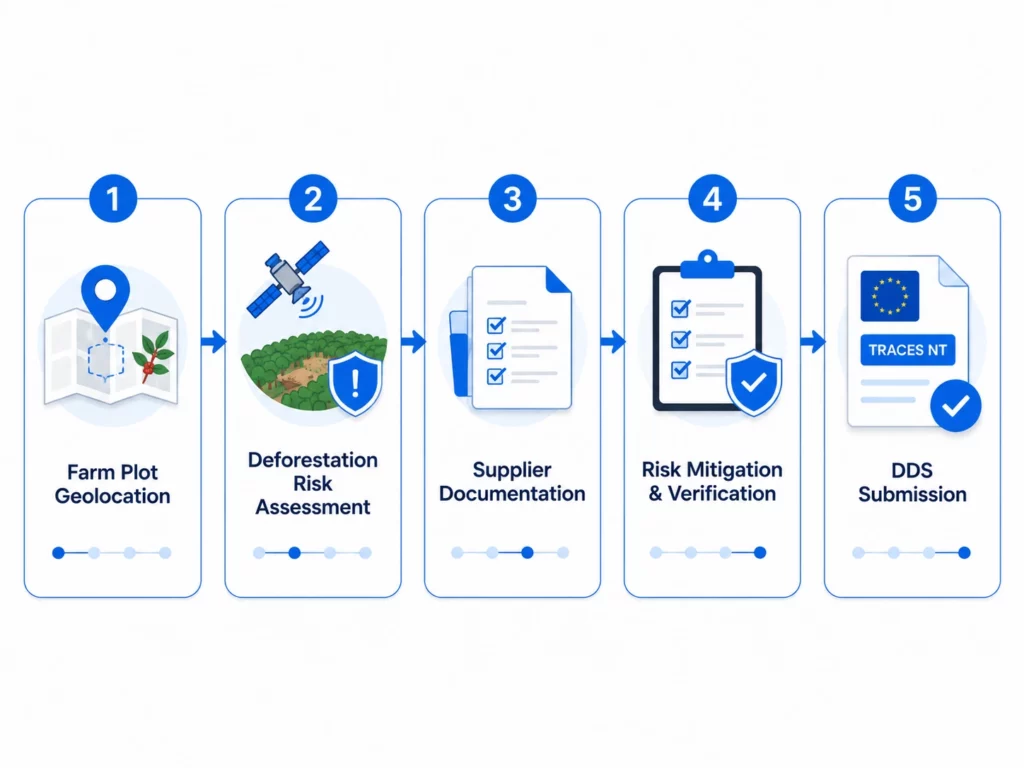
Due diligence under EUDR is a repeatable 5-step cycle — data collection, verification, risk assessment, mitigation, and DDS filing.
Geolocation and supplier data collection
Deforestation and legality verification
Risk assessment and mitigation
Filing the due diligence statement (DDS)
Step 1 — Collect geolocation data for every coffee plot
Every plot where your coffee was grown needs geolocation coordinates: a single point for plots under 4 hectares, polygon boundaries for anything larger. For a typical blended container drawing on hundreds of smallholder plots, this is the single heaviest data lift in the entire regulation.
Step 2 — Verify deforestation-free status against the 2020 cutoff
Coordinates must be checked against satellite imagery to confirm no deforestation occurred on that land after 31 December 2020. In practice this means remote-sensing analysis of every plot something no spreadsheet can do.
Step 3 — Verify legality in the country of production
Deforestation-free is not enough. The coffee must also have been produced in line with the origin country’s laws: land-use rights, environmental rules, labor and human-rights protections, and anti-corruption provisions. Documentary evidence must be collected and retained for five years.
Step 4 — Assess and mitigate sourcing risk
Using the EU’s country benchmarking (low / standard / high risk) plus supply-chain complexity signals, importers must conclude there is no more than negligible risk. Where risk is not negligible, mitigation — additional documentation, independent audits, or supplier changes — is mandatory before the coffee can be placed on the market. Sourcing from low-risk countries allows simplified due diligence, but geolocation and DDS duties still apply.
Step 5 — File the due diligence statement in the EU Information System
Before each consignment is placed on the market, the operator files a DDS in the EU Information System (integrated with TRACES), receives a reference number, and quotes it in the customs declaration. No DDS number, no clearance.
Smallholder fragmentation, mixed lots, and multi-tier intermediaries make coffee uniquely difficult under EUDR.
Smallholder data gaps at origin
Blending and mixed-origin lots
Documentation quality across intermediaries
Smallholder fragmentation and missing plot data
Most coffee is grown on farms smaller than2 hectares, often without formal land titles or mapped boundaries. Cooperatives may aggregate cherry from thousands of members. Getting accurate, verifiable coordinates for each contributing plot and keeping them current season over season is where most compliance programs stall.
Blended lots break simple traceability
A single export lot routinely mixes coffee from many washing stations and hundreds of farms. Under EUDR, the DDS must cover every plot that could have contributed to the consignment. That forces importers to reconstruct chain-of-custody at a granularity the trade has never routinely documented.
Multi-tier supply chains and document chaos
Between farm and port sit collectors, mills, cooperatives, and exporters each with their own paperwork formats, languages, and record-keeping standards. Reconciling certificates, purchase records, and geodata across PDFs, spreadsheets, and photos of paper receipts is where manual compliance teams drown.
“The regulation doesn’t ask whether traceability is convenient for coffee. It asks whether you can prove it plot by plot, shipment by shipment
EUDR Compliance for Coffee Importers: Manual vs. Automated
Compliance task
Manual approach
Automated
Geolocation collection
Emailing suppliers for coordinates; formats vary; frequent gaps
Supplier portal + mobile capture; validation on entry; polygon support
Deforestation check
Not feasible in-house; outsourced per-lot analysis
Automated satellite screening of every plot vs. 2020 baseline
Legality documentation
Chasing PDFs across intermediaries; version confusion
AI document extraction, centralized evidence vault, 5-year retention
Risk assessment
Ad-hoc judgment; hard to evidence to authorities
Rule-based risk scoring per EU benchmarking, with audit trail
DDS filing
Manual entry into EU Information System per consignment
Auto-generated DDS with direct [EU IS / TRACES] submission [verify integration]
Time per consignment
[Days] of analyst work
[Minutes]
Audit readiness
Reconstructed after the fact
Continuous, exportable audit trail
EUDR Software for Coffee Importers: What to Evaluate Before You Buy
Plot-level geodata handling — points and polygons, bulk import, validation against country boundaries and overlap errors.
Integrated deforestation screening — satellite verification built in, not a separate vendor.
Supplier onboarding at smallholder scale — works for cooperatives with low connectivity, multiple languages, and mobile-first capture.
DDS automation — generates and submits statements to the EU Information System and returns reference numbers for customs.
Document intelligence — extracts and reconciles legality evidence from unstructured supplier documents.
Audit trail and retention — five-year evidence storage with authority-ready exports.
How TraceX supports EUDR coffee importers
Pain: compliance teams spend X hours per consignment chasing plot data and assembling DDS evidence across fragmented supplier documents.
Feature: TraceX EUDR Solutions combines supplier data collection, automated satellite deforestation checks, AI-driven document extraction, risk scoring, and one-click DDS generation in a single workflow.
Benefit: consignments clear due diligence in minutes instead of days, with negligible-risk conclusions you can evidence to competent authorities.
See how a leading global tire manufacturer mapped thousands of rubber farm polygons to achieve EUDR compliance. Read the case study to discover how digital geolocation and supplier collaboration streamlined traceability at scale.
EUDR coffee importers that build compliance into their sourcing workflow now will clear customs while competitors scramble.
TraceX automates the entire cycle plot geolocation, satellite deforestation checks, legality documentation, risk scoring, and DDS filing in one platform built for agri supply chains.
Obligations apply from [30 December 2025] for medium and large operators and [30 June 2026] for micro and small enterprises. [Verify against current EU guidance — dates have shifted once already.]
Do EUDR coffee importers need geolocation for every farm?
Yes. Every plot of land where the coffee in a consignment was produced must be geolocated — a point for plots under 4 hectares, polygons above that. Blended lots must cover all contributing plots.
What is a due diligence statement (DDS) for coffee?
The DDS is the formal declaration filed in the EU Information System confirming the consignment is deforestation-free and legal. Its reference number is required in the customs declaration before the coffee can enter the EU market.
Does certified coffee (Rainforest Alliance, Fairtrade, organic) automatically comply?
No. Certifications can support your risk assessment as supplementary evidence, but they do not replace the importer’s own due diligence, geolocation data, or DDS filing obligations.
What happens if an EUDR coffee importer doesn’t comply?
Consignments without a valid DDS won’t clear customs, and penalties include fines of at least 4% of EU-wide turnover, confiscation of goods and revenue, and exclusion from public procurement.
Can small coffee importers use simplified due diligence?
Simplified due diligence applies to sourcing from countries benchmarked as low risk not to small companies per se. SMEs get a later application date [verify], but the core geolocation and DDS obligations still apply.
Start using TraceX
Transparency, Trust, & Success for your Climate Journey.
We use cookies on our website to give you the most relevant experience by remembering your preferences and repeat visits. By clicking “Accept All”, you consent to the use of ALL the cookies. However, you may visit "Cookie Settings" to provide a controlled consent.
This website uses cookies to improve your experience while you navigate through the website. Out of these, the cookies that are categorized as necessary are stored on your browser as they are essential for the working of basic functionalities of the website. We also use third-party cookies that help us analyze and understand how you use this website. These cookies will be stored in your browser only with your consent. You also have the option to opt-out of these cookies. But opting out of some of these cookies may affect your browsing experience.
Necessary cookies are absolutely essential for the website to function properly. These cookies ensure basic functionalities and security features of the website, anonymously.
Cookie
Duration
Description
cookielawinfo-checkbox-analytics
11 months
This cookie is set by GDPR Cookie Consent plugin. The cookie is used to store the user consent for the cookies in the category "Analytics".
cookielawinfo-checkbox-functional
11 months
The cookie is set by GDPR cookie consent to record the user consent for the cookies in the category "Functional".
cookielawinfo-checkbox-necessary
11 months
This cookie is set by GDPR Cookie Consent plugin. The cookies is used to store the user consent for the cookies in the category "Necessary".
cookielawinfo-checkbox-others
11 months
This cookie is set by GDPR Cookie Consent plugin. The cookie is used to store the user consent for the cookies in the category "Other.
cookielawinfo-checkbox-performance
11 months
This cookie is set by GDPR Cookie Consent plugin. The cookie is used to store the user consent for the cookies in the category "Performance".
viewed_cookie_policy
11 months
The cookie is set by the GDPR Cookie Consent plugin and is used to store whether or not user has consented to the use of cookies. It does not store any personal data.
Functional cookies help to perform certain functionalities like sharing the content of the website on social media platforms, collect feedbacks, and other third-party features.
Performance cookies are used to understand and analyze the key performance indexes of the website which helps in delivering a better user experience for the visitors.
Analytical cookies are used to understand how visitors interact with the website. These cookies help provide information on metrics the number of visitors, bounce rate, traffic source, etc.
Advertisement cookies are used to provide visitors with relevant ads and marketing campaigns. These cookies track visitors across websites and collect information to provide customized ads.
Download the 2026 Traceability Scorecard and Benchmark Your Supply Chain Across 10 Critical Capabilities.
Download our eBook
Don’t Wait for an Audit to Find Your EUDR Gaps
The 2026 Simplification Package changes how HS codes, DDS pass-through and geolocation rules apply to you. Get the free guide and 20-point readiness checklist before enforcement catches you unprepared.