Deforestation free Supply Chains for EUDR Compliance
Published
, 8 minute read
Share this article
Quick summary: Learn how to build deforestation-free supply chains for EUDR compliance using geolocation mapping, satellite validation, and digital Due Diligence Statements. Ensure traceability, reduce compliance risk, and maintain EU market access.
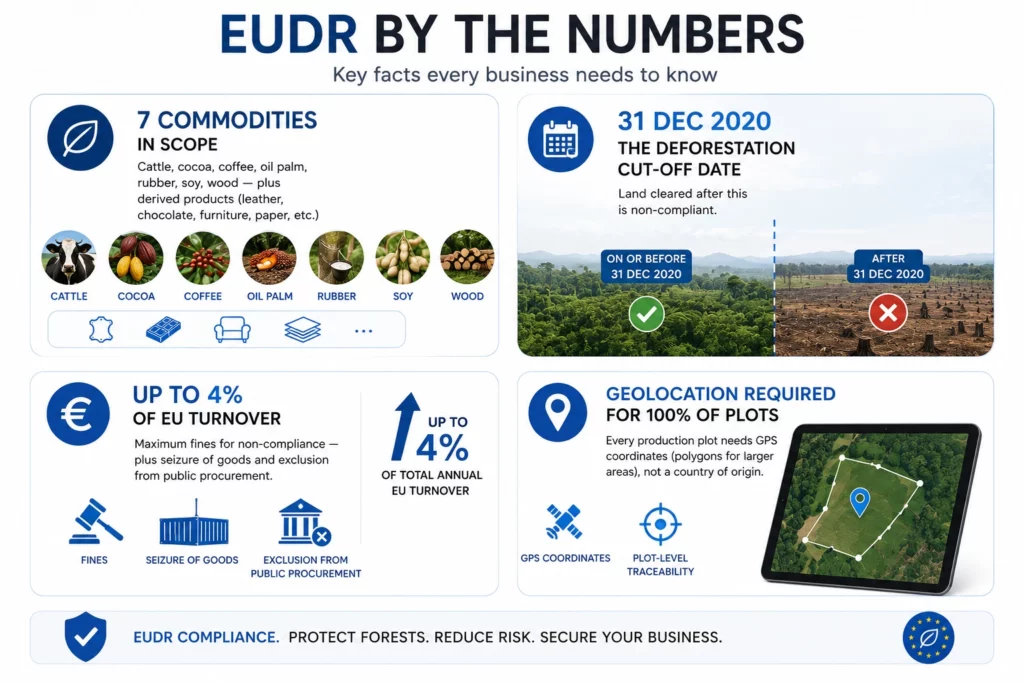
Adeforestation free supply chain is one where every in-scope commodity, cattle, cocoa, coffee, oil palm, rubber, soy, and wood can be traced to a plot of land that was not deforested after 31 December 2020, with geolocation coordinates and a due diligence statement to prove it. Under the EU Deforestation Regulation (EUDR), this is now the condition for selling those goods (and their derivatives) on the EU market.
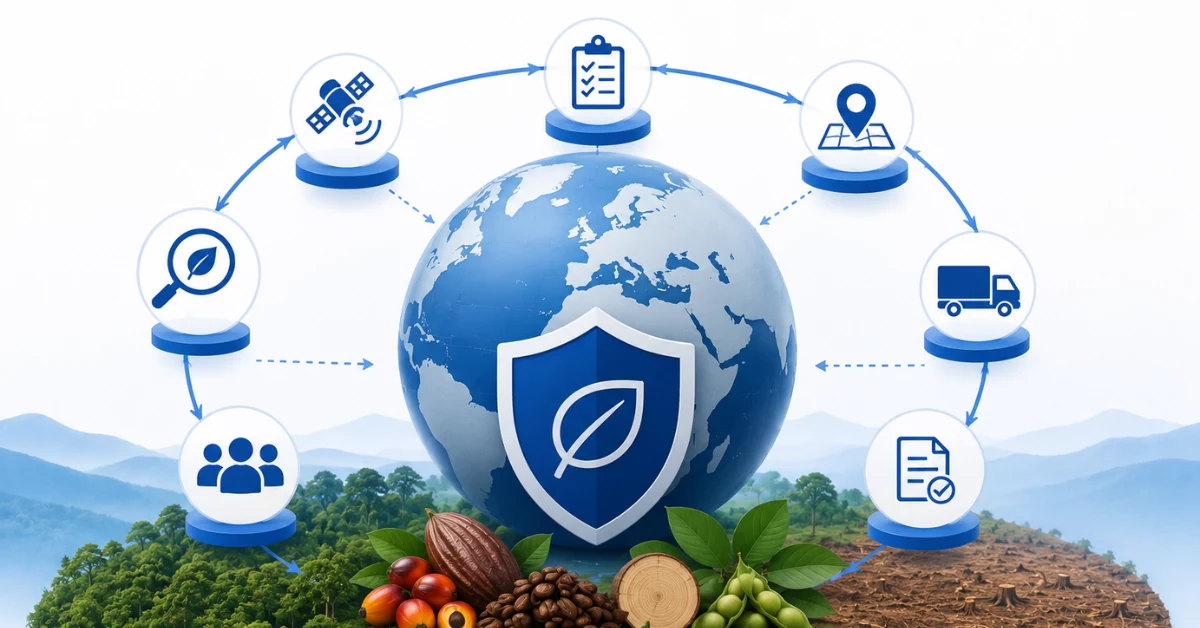
To get there, an operator needs four things in place:
Geolocation coordinates (polygons) for every production plot
Batch-level traceability from origin to the EU border
A documented deforestation risk assessment
Deforestation-free supply chains have gone from a sustainability talking point to a hard requirement for keeping product flowing into Europe. If you run sourcing, sustainability, or compliance for a company that places coffee, cocoa, soy, palm oil, rubber, cattle products, or timber on the EU market, the pressure is no longer abstract: you have to prove, plot by plot, that what you import wasn’t grown on recently deforested land and do it without grinding your shipments to a halt.
Most teams we talk to already feel the gap. The certificates, supplier spreadsheets, and PDF attestations that worked last year don’t produce the one thing EUDR actually asks for: verifiable, geo-located, traceable proof for every batch. This guide breaks down what “deforestation-free” legally means, the data you need, how the workflow looks when it’s working, and how to choose tooling that gets you audit-ready instead of audit-anxious.
Deforestation-free supply chain (n.): a sourcing chain in which every in-scope raw material is traceable to a specific plot of land, with proof that the land was not deforested or degraded after the EUDR cut-off date of 31 December 2020.
Deforestation-free supply chains by the numbers
Why the old way of proving “deforestation-free” breaks under EUDR
Most sourcing teams already collect some sustainability data. The problem isn’t effort it’s that the format doesn’t match what EUDR demands. Here’s where the current approach falls apart:
Certificates aren’t geolocation. A certification scheme tells a regulator a supplier is ‘certified,’ not which plot a specific batch came from. EUDR wants the plot.
Spreadsheets don’t trace batches. When coffee from 40 smallholders is bulked, a spreadsheet can’t show which beans in which container map to which coordinates.
Supplier email chains don’t survive an audit. The proof exists across inboxes and PDFs no one can reassemble on demand.
Risk is assessed once, not monitored. EUDR expects an ongoing risk assessment, not a one-time questionnaire.
The result is a familiar bind: you can’t confidently sign a due diligence statement, so shipments sit or you sign and carry the liability. Neither is acceptable when up to 4% of EU turnover is on the line.
What EUDR actually requires
Strip away the legal text and EUDR comes down to four obligations. Each one maps to a piece of data you have to be able to produce on demand.
EUDR obligation
The data it needs
The pain if you can’t produce it
Geolocation
GPS coordinates / polygons for every plot of production
Goods can’t legally enter the EU market
Traceability
An unbroken chain from plot → processor → exporter → EU
You can’t link a batch to its origin under audit
Risk assessment
Deforestation + legality risk scored per source
Due diligence statement is unsupportable
Due diligence statement (DDS)
A filed statement referencing all of the above
No DDS = no market access
Not sure which of your commodities are in scope?
Talk to our team and we’ll map your exposure in one call.
How a deforestation-free supply chain works when the data does the proving
Map every production plot to GPS coordinates
Capture geolocation at the source instead of chasing it later. Field teams and suppliers record point coordinates for smallholdings and polygons for larger plots, straight from a mobile device even offline.
Removes the pain of: a country-of-origin field where EUDR needs a plot.
Polygon mapping for plots above the regulation’s size threshold.
Coordinates attach to the supplier and the batch, not a loose spreadsheet.
Maintain an unbroken chain of custody so any batch can be walked back to the exact plots it came from even after bulking, processing, and export. This is what turns ‘certified’ into ‘provable.’
Removes the pain of: not being able to link a container back to its sources.
Batch splitting and merging tracked across every handoff.
Origin evidence travels with the product, ready for the DDS.
See how a leading global tire manufacturer built an end-to-end chain of custody to achieve EUDR compliance. Read the case study to learn how digital traceability, supplier collaboration, and verifiable sourcing strengthened compliance without disrupting operations.
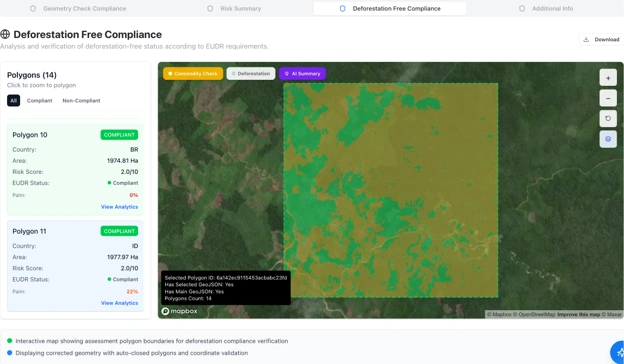
Score and monitor deforestation risk against satellite data
Check each plot’s coordinates against forest-cover and deforestation datasets to score risk and flag anything cleared after the 2020 cut-off continuously, not once.
Removes the pain of: a one-time questionnaire that doesn’t hold up as ‘ongoing’ risk assessment.
Satellite / polygon overlay to detect post-cut-off clearing.
Risk scores feed straight into the due diligence statement.
Generate an audit-ready due diligence statement
Assemble geolocation, traceability, and risk evidence into a due diligence statement you can file with confidence in minutes, with the supporting records one click away.
Removes the pain of: rebuilding proof from inboxes and PDFs at audit time.
DDS pre-populated from the data already in the system.
Every claim links back to its source record for inspection.
Buyers at this stage are comparing options, so here’s an honest side-by-side. Replace the competitor columns with the two or three you actually go head-to-head with, and be specific — vague comparison tables convert worse than honest ones.
Capability
TraceX
[Competitor A]
[Competitor B]
Spreadsheets
Plot geolocation (polygons)
Yes
[verify]
[verify]
No
Batch-level traceability
Yes
[verify]
[verify]
No
Satellite deforestation risk
Yes
[verify]
[verify]
No
Auto-generated DDS
Yes
[verify]
[verify]
No
Offline field data capture
Yes
[verify]
[verify]
No
Audit-ready record vault
Yes
[verify]
[verify]
Partial
Why teams choose a built-for-EUDR platform over bolting it onto existing tools
The forced tradeoff most teams hit: keep stitching together certificates, GIS files, and supplier emails (cheap, but unprovable under audit) or adopt a system that captures geolocation, traceability, and risk in one place (provable, and faster to a filed DDS). TraceX EUDR Solutions is built for the second path: [VERIFY — insert your 1–2 sentence differentiator: e.g., the commodities you specialise in, your smallholder/offline strength, integrations, or speed-to-DDS].
Ready to make your supply chain provably deforestation-free?
Who this is for: deforestation-free sourcing by commodity and role
Coffee & cocoa importers: thousands of smallholder plots to geolocate before goods can clear EU customs.
Palm oil & soy traders: bulked commodities where batch-level traceability is the hard part.
Timber & rubber manufacturers: derived products (furniture, tyres) that inherit the obligation.
Sustainability/compliance leads: need an audit-ready DDS without adding headcount.
Procurement leads: need supplier data captured without stalling existing buying relationships.
Frequently Asked Questions (FAQ’s)
What is a deforestation-free supply chain?
A deforestation-free supply chain is one where every in-scope commodity is traceable to a plot of land that wasn’t deforested or degraded after 31 December 2020, backed by geolocation data and a due diligence statement.
Does EUDR apply to my company?
If you place cattle, cocoa, coffee, oil palm, rubber, soy, or wood — or products derived from them — on the EU market, or export them from it, EUDR most likely applies. Scope depends on your role (operator vs trader) and size. [VERIFY current thresholds.]
What data do I need to be EUDR-compliant?
Four things: geolocation coordinates for every plot, batch-level traceability to origin, a documented deforestation risk assessment, and a filed due diligence statement that ties them together.
When is the EUDR deadline?
[VERIFY] Compliance for large and medium operators was targeted for 30 December 2025 after a 12-month delay, with later dates for micro and small enterprises. Confirm the current date before relying on it.
How long does it take to build a deforestation-free supply chain?
It depends on plot count and supplier readiness. The slow part is collecting geolocation from the field; once captured, traceability, risk scoring, and DDS generation are fast. [VERIFY with a real customer timeline.]
Is certification enough for EUDR?
No. Certification can support your risk assessment, but EUDR requires plot-level geolocation and traceability that most certification schemes don’t provide on their own.
Start using TraceX
Transparency, Trust, & Success for your Climate Journey.
We use cookies on our website to give you the most relevant experience by remembering your preferences and repeat visits. By clicking “Accept All”, you consent to the use of ALL the cookies. However, you may visit "Cookie Settings" to provide a controlled consent.
This website uses cookies to improve your experience while you navigate through the website. Out of these, the cookies that are categorized as necessary are stored on your browser as they are essential for the working of basic functionalities of the website. We also use third-party cookies that help us analyze and understand how you use this website. These cookies will be stored in your browser only with your consent. You also have the option to opt-out of these cookies. But opting out of some of these cookies may affect your browsing experience.
Necessary cookies are absolutely essential for the website to function properly. These cookies ensure basic functionalities and security features of the website, anonymously.
Cookie
Duration
Description
cookielawinfo-checkbox-analytics
11 months
This cookie is set by GDPR Cookie Consent plugin. The cookie is used to store the user consent for the cookies in the category "Analytics".
cookielawinfo-checkbox-functional
11 months
The cookie is set by GDPR cookie consent to record the user consent for the cookies in the category "Functional".
cookielawinfo-checkbox-necessary
11 months
This cookie is set by GDPR Cookie Consent plugin. The cookies is used to store the user consent for the cookies in the category "Necessary".
cookielawinfo-checkbox-others
11 months
This cookie is set by GDPR Cookie Consent plugin. The cookie is used to store the user consent for the cookies in the category "Other.
cookielawinfo-checkbox-performance
11 months
This cookie is set by GDPR Cookie Consent plugin. The cookie is used to store the user consent for the cookies in the category "Performance".
viewed_cookie_policy
11 months
The cookie is set by the GDPR Cookie Consent plugin and is used to store whether or not user has consented to the use of cookies. It does not store any personal data.
Functional cookies help to perform certain functionalities like sharing the content of the website on social media platforms, collect feedbacks, and other third-party features.
Performance cookies are used to understand and analyze the key performance indexes of the website which helps in delivering a better user experience for the visitors.
Analytical cookies are used to understand how visitors interact with the website. These cookies help provide information on metrics the number of visitors, bounce rate, traffic source, etc.
Advertisement cookies are used to provide visitors with relevant ads and marketing campaigns. These cookies track visitors across websites and collect information to provide customized ads.
Download the 2026 Traceability Scorecard and Benchmark Your Supply Chain Across 10 Critical Capabilities.
Download our eBook
Don’t Wait for an Audit to Find Your EUDR Gaps
The 2026 Simplification Package changes how HS codes, DDS pass-through and geolocation rules apply to you. Get the free guide and 20-point readiness checklist before enforcement catches you unprepared.