Common Packaging Materials Under PPWR: The Complete 2026 Compliance Guide
Published
, 6 minute read
Share this article
Quick summary: Common packaging materials under PPWR from paper to composites each carry different recyclability and documentation rules. See all 10 and the data to keep.
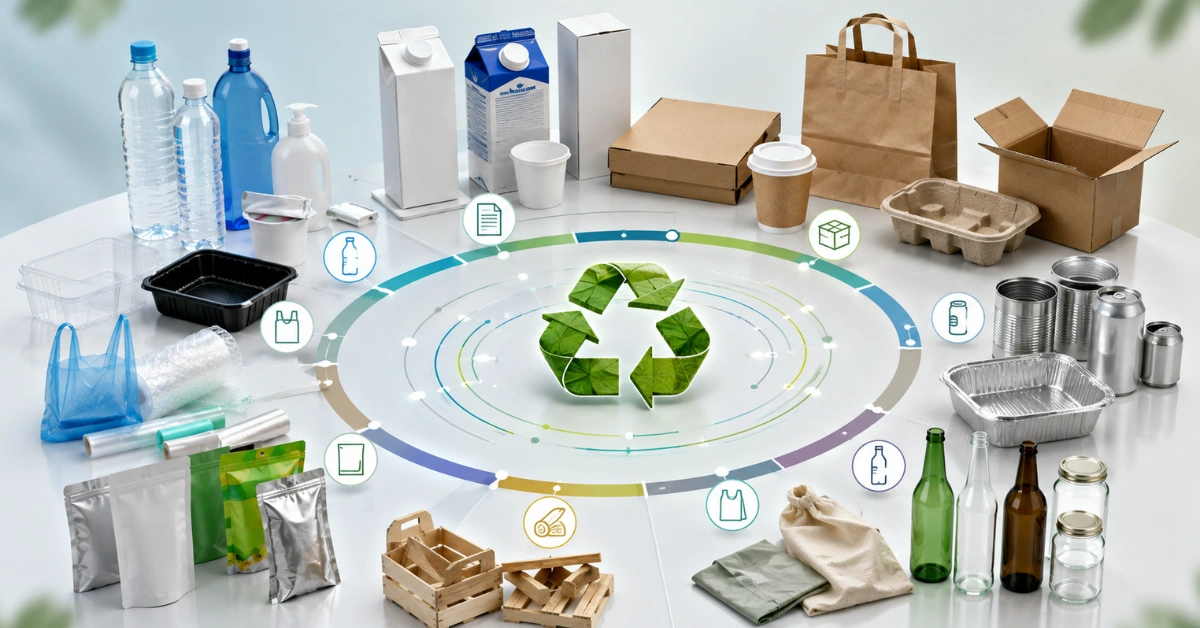
The common packaging materials under PPWR are paper and paperboard, corrugated cardboard, plastics (PET, HDPE, LDPE, PP), glass, aluminium, steel, wood, flexible packaging, composite/multi-material packaging, and textile packaging. PPWR (Regulation (EU) 2025/40) applies to all of them regardless of material from 12 August 2026, but recyclability grades (A–C from 2030; A/B only from 2038), recycled-content minimums, and technical documentation obligations differ by material and by packaging component.
Common packaging materials under PPWR range from paper and glass to multi-layer composites and while the Packaging and Packaging Waste Regulation (Regulation (EU) 2025/40) applies to every one of them, each material carries a different recyclability grade, recycled-content path, and documentation burden. PPWR is the EU law, applicable from 12 August 2026, that replaces the old Packaging Directive and governs how packaging is designed, composed, and evidenced across the EU market. This guide breaks down the 10 material families, the data you must keep for each, and where compliance actually succeeds or fails.
KEY TAKEAWAYS
PPWR (Reg. (EU) 2025/40) applies to all packaging on the EU market from 12 August 2026 every material family is in scope.
The 10 common packaging materials under PPWR each face different recyclability trajectories: grades A–C from 1 Jan 2030, grades A/B only from 1 Jan 2038.
Compliance is decided at the packaging-component and data layer, not at the moment you pick a material.
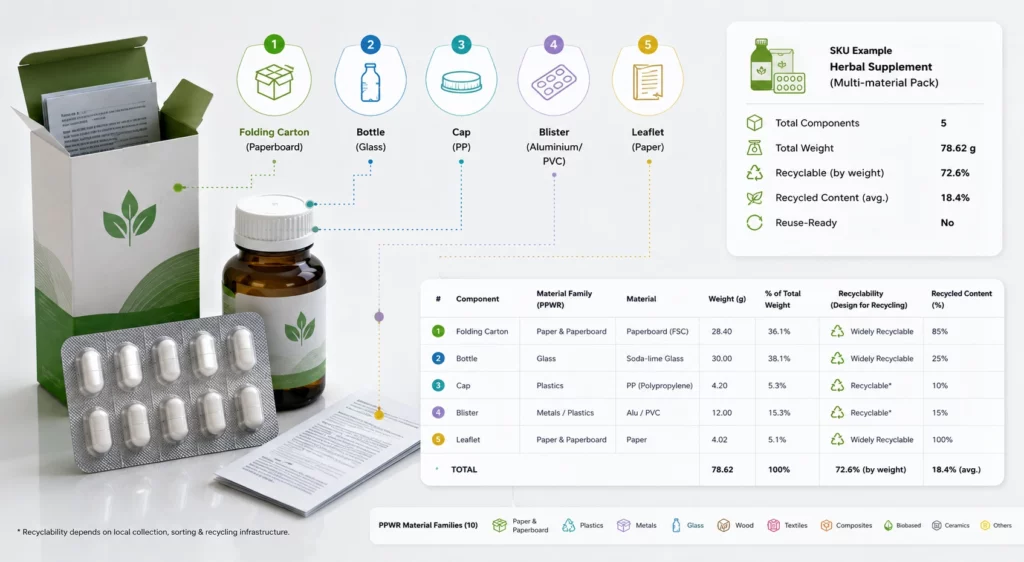
Manufacturers must hold material composition, component weights, recycled content, and technical evidence per component and SKU.
A packaging data management platform turns scattered spec sheets into an audit-ready single source of truth.
Discover how TraceX Packaging Data Management Platform centralizes packaging specifications, supplier documentation, technical dossiers, and compliance evidence into a single source of truth helping you prepare for PPWR with confidence.
Recycled-content minimums — plastic packaging faces binding recycled-content thresholds on a staged timeline.
Packaging minimisation — empty space in e-commerce and grouped packaging is capped (≤40%), which hits corrugated and transport formats first.
Material composition transparency — you must be able to declare what each component is made of, by weight.
Supplier evidence — certificates, test reports, and recycled-content proof have to be collected and kept current.
The 10 Common Packaging Materials Under PPWR
Below are the 10 material families you will encounter most, with the PPWR watch-point and the core data to maintain for each.
Material family
Typical use
PPWR watch-point
Core data to keep
Paper & paperboard
Cartons, labels, wraps
High recyclability; watch coatings & printed-paper scope
Fibre type, coatings, weight
Corrugated cardboard
Shipping cartons, e-commerce
Empty-space ≤40% rule bites here
Board grade, dimensions, recycled %
Plastics (PET/HDPE/LDPE/PP)
Bottles, films, tubs
Recycled-content minimums; grade sensitivity
Polymer ID, additives, recycled %
Glass
Beverage, cosmetics, pharma
Circular but heavy — minimisation pressure
Weight, colour, coatings
Aluminium
Cans, foils, aerosols
Strong recyclate; foil laminates tricky
Alloy, coatings, laminate layers
Steel
Food cans, drums, closures
Durable & recyclable; check internal linings
Grade, coatings, weight
Wood
Pallets, crates
Sustainable-sourcing evidence expected
Species, treatment, reuse status
Flexible (pouches, sachets, laminates)
Snacks, refills
Multi-layer = low recyclability grade
Layer structure, materials, weight
Composite (beverage cartons)
Liquid food & drink
Multi-material — documentation heavy
Material split %, separability
Textile packaging
Reusable bags, covers
Reuse / circular-economy opportunity
Fibre, reuse cycles, coatings
The pattern is clear: single-material rigid formats (glass, aluminium, steel, mono-plastic) tend to grade well, while multi-layer flexibles and composites are where recyclability grades and compliance risk concentrate.
The instinct is to sort PPWR compliance by material. But obligations attach to the packaging component and configuration, not the raw material. One SKU can combine four of the common packaging materials under PPWR at once, a corrugated shipper, an LDPE film, a paper label, and a composite insert, each with its own weight, recycled content, and recyclability grade. Auditors don’t ask “what material is this?” They ask “show me the component-level evidence.” That reframes material selection from a design question into a data-integrity test.
Build a Packaging Inventory Before PPWR Builds Compliance Challenges
How TraceX Simplifies PPWR Packaging Data Management
TraceX PPWR Solutions gives packaging and compliance teams one place to manage every material, component, and configuration. A centralised packaging component library and material repository
Structured packaging configurations linked to each SKU
Supplier collaboration for certificates and recycled-content evidence
Version-controlled technical dossiers and audit-ready documentation
See how TraceX centralises packaging material data and keeps your PPWR documentation audit-ready.
Choosing the right material is only the opening move. Long-term PPWR success depends on maintaining accurate, centralised, audit-ready data for every one of the common packaging materials under PPWR component by component, SKU by SKU. Organisations that digitise packaging information now will be ready as recyclability grades and recycled-content rules tighten toward 2030 and beyond.
Frequently Asked Questions (FAQ’s)
What are the most common packaging materials under PPWR?
Paper and paperboard, corrugated cardboard, plastics (PET, HDPE, LDPE, PP), glass, aluminium, steel, wood, flexible packaging, composites, and textile packaging all in scope under Regulation (EU) 2025/40.
Which packaging materials are easiest to recycle?
Single-material rigid formats glass, aluminium, steel, and mono-material plastics like PET generally grade best. Multi-layer flexibles and composites are the hardest.
Does PPWR apply to all packaging materials?
Yes. PPWR applies to all packaging placed on the EU market regardless of material, though obligations differ by material and component.
What packaging material information should manufacturers maintain?
Material composition, component weights, packaging configuration, recycled content, supplier certificates, test reports, and Declaration of Conformity evidence.
How do composite materials affect PPWR compliance?
Composites combine materials that are hard to separate, so they carry heavier documentation needs and typically lower recyclability grades.
What documentation is required for different packaging materials?
Technical specifications, recycled-content proof, supplier certificates, test reports, and a Declaration of Conformity per packaging unit.
Can AI help manage packaging material compliance?
Yes a packaging data management platform centralises material and component data, tracks recycled content, and keeps documentation audit-ready across thousands of SKUs.
Start using TraceX
Transparency, Trust, & Success for your Climate Journey.
We use cookies on our website to give you the most relevant experience by remembering your preferences and repeat visits. By clicking “Accept All”, you consent to the use of ALL the cookies. However, you may visit "Cookie Settings" to provide a controlled consent.
This website uses cookies to improve your experience while you navigate through the website. Out of these, the cookies that are categorized as necessary are stored on your browser as they are essential for the working of basic functionalities of the website. We also use third-party cookies that help us analyze and understand how you use this website. These cookies will be stored in your browser only with your consent. You also have the option to opt-out of these cookies. But opting out of some of these cookies may affect your browsing experience.
Necessary cookies are absolutely essential for the website to function properly. These cookies ensure basic functionalities and security features of the website, anonymously.
Cookie
Duration
Description
cookielawinfo-checkbox-analytics
11 months
This cookie is set by GDPR Cookie Consent plugin. The cookie is used to store the user consent for the cookies in the category "Analytics".
cookielawinfo-checkbox-functional
11 months
The cookie is set by GDPR cookie consent to record the user consent for the cookies in the category "Functional".
cookielawinfo-checkbox-necessary
11 months
This cookie is set by GDPR Cookie Consent plugin. The cookies is used to store the user consent for the cookies in the category "Necessary".
cookielawinfo-checkbox-others
11 months
This cookie is set by GDPR Cookie Consent plugin. The cookie is used to store the user consent for the cookies in the category "Other.
cookielawinfo-checkbox-performance
11 months
This cookie is set by GDPR Cookie Consent plugin. The cookie is used to store the user consent for the cookies in the category "Performance".
viewed_cookie_policy
11 months
The cookie is set by the GDPR Cookie Consent plugin and is used to store whether or not user has consented to the use of cookies. It does not store any personal data.
Functional cookies help to perform certain functionalities like sharing the content of the website on social media platforms, collect feedbacks, and other third-party features.
Performance cookies are used to understand and analyze the key performance indexes of the website which helps in delivering a better user experience for the visitors.
Analytical cookies are used to understand how visitors interact with the website. These cookies help provide information on metrics the number of visitors, bounce rate, traffic source, etc.
Advertisement cookies are used to provide visitors with relevant ads and marketing campaigns. These cookies track visitors across websites and collect information to provide customized ads.
Download the 2026 Traceability Scorecard and Benchmark Your Supply Chain Across 10 Critical Capabilities.
Download our eBook
Don’t Wait for an Audit to Find Your EUDR Gaps
The 2026 Simplification Package changes how HS codes, DDS pass-through and geolocation rules apply to you. Get the free guide and 20-point readiness checklist before enforcement catches you unprepared.