Batch Traceability: How It Works, Why It Matters, and How to Get It Right
Published
, 8 minute read
Share this article
Quick summary: Batch traceability explained — how batch IDs speed recalls, prove FSMA 204 and GS1 compliance, and the questions buyers should ask before choosing a system.
Batch traceability is the ability to track a specific batch or lot of food a group of units produced together across every stage of the supply chain using a unique batch ID. It links each finished product back to its raw materials, production run, dates and handling, so if a problem surfaces you can isolate exactly the affected units instead of pulling everything. For food businesses, batch traceability is the foundation of fast recalls, quality control and regulatory compliance. This guide answers the questions buyers ask before choosing a system.
Key takeaways
Batch traceability tracks a defined batch or lot of food across the supply chain using a unique batch ID (also called a lot number).
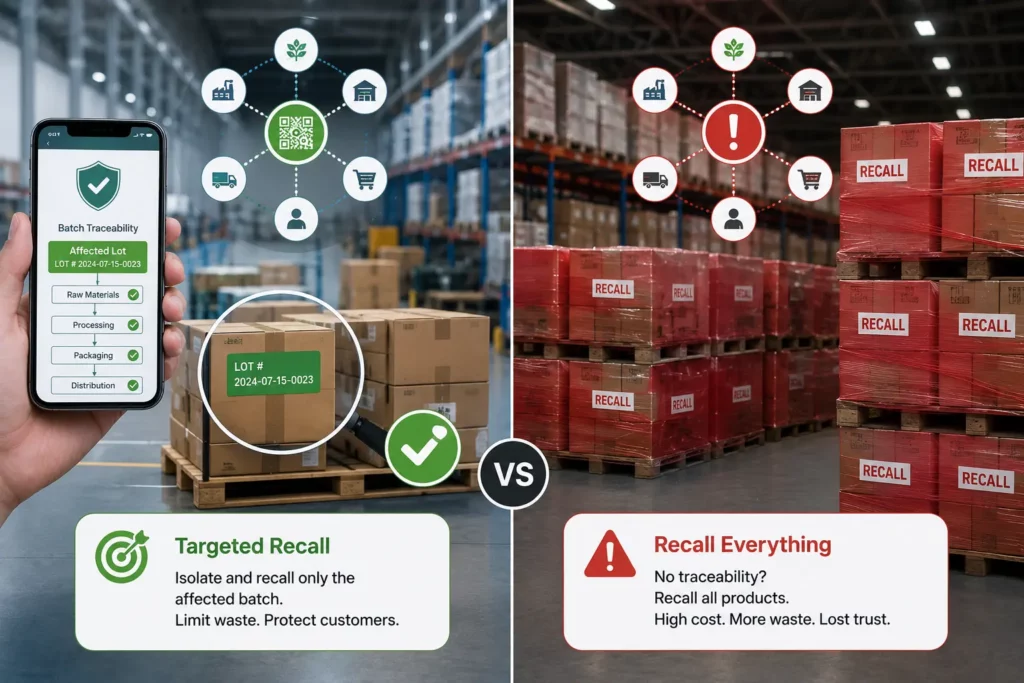
It enables targeted recalls isolating affected lots instead of recalling all product cutting cost and brand damage.
It underpins compliance with FSMA 204 (compliance date 20 July 2028), HACCP and GS1 standards.
Batch IDs are captured with barcodes, QR codes or RFID and linked to production date, location, ingredients and suppliers.
The main hurdles are interoperability, legacy systems and standardisation solved with a shared digital platform.
A strong system links each batch ID back to the farm or supplier of origin for full farm-to-fork visibility.
Ready to Trace Every Batch From Source to Sale?
See how TraceX connects raw materials, processing, quality checks and shipments to give you complete batch-level visibility.
Batch traceability is the practice of assigning a unique ID to each batch of food and using it to track that batch through production, processing and distribution.
A batch or lot is a group of products made together under similar conditions, and the batch ID differentiates it by production location, time and ingredients used. Because every record (raw materials, dates, handling and quality checks) is tied to that ID, batch traceability turns a scatter of documents into one connected history you can query in seconds, both forward to the customer and backward to the source.
How does batch traceability work?
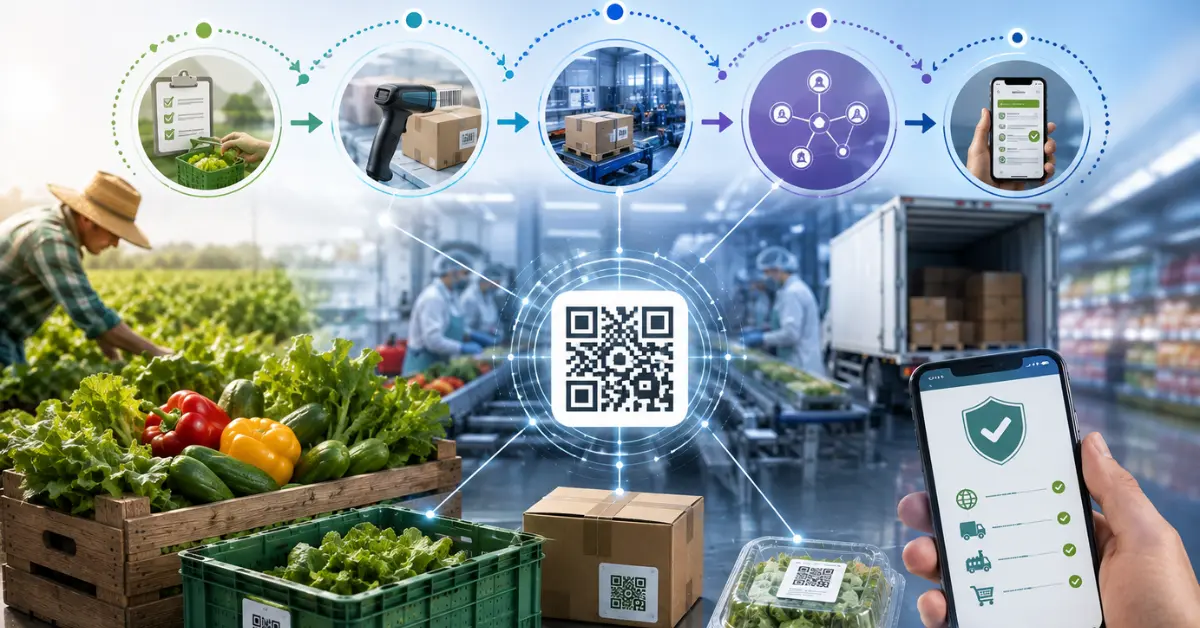
Batch traceability works by capturing a unique batch ID at each critical step and linking every record to it.
Assign — give each production run a unique batch/lot ID (letters, numbers or symbols).
Capture — encode the ID in a barcode, QR code or RFID tag on packaging for automated scanning.
Link — connect the ID to production date, location, ingredients, suppliers and quality data.
Retrieve — query the ID to pull the batch’s full history across the chain on demand.
Can You Trace Your Supply Chain From Source to End Product?Discover how digital supply chain traceability can connect suppliers, materials, batches and transactions to improve visibility, compliance and operational control.
Why does batch traceability matter for food businesses?
Batch traceability matters because it protects public health, product quality and brand reputation while satisfying regulators.
Four benefits drive adoption: food safety (rapid identification and recall of affected products in an outbreak), quality control (monitor production parameters batch by batch and catch deviations early), regulatory compliance (meet FSMA, HACCP and GS1 requirements), and consumer confidence (the origin and handling transparency buyers increasingly expect). Together they turn traceability from a cost centre into a risk-and-reputation safeguard.
Is Your Food Supply Chain Ready for the Next Food Safety Challenge?Discover how digital traceability can improve food safety, connect supply-chain data and help businesses respond faster to quality and contamination risks.
→ Read the Complete Guide to Food Safety
How does batch traceability speed up a food recall?
Batch traceability speeds up recalls by letting you pinpoint and remove only the affected batches not your entire product line.
Without batch-level records, a single contamination event forces a broad, expensive recall because you can’t prove which units are safe. With a batch ID, you trace the compromised lot to its source, isolate it, and leave unaffected stock on shelves reducing waste, cost and reputational damage while removing risk from the market fast. Faster, narrower recalls are the clearest ROI of batch traceability.
Does batch traceability help with FSMA 204 and GS1 compliance?
Yes batch traceability provides the lot-level records that FSMA 204, HACCP and GS1 standards require.
The FDA’s FSMA 204 Food Traceability Rule (compliance date 20 July 2028) requires traceability lot codes and Key Data Elements captured at Critical Tracking Events for foods on the Food Traceability List. GS1 standards the lot/batch number, GTIN and EPCIS event data give those identifiers a common, interoperable format across trading partners. Batch traceability is how you generate that evidence and retrieve it within the 24-hour window regulators and buyers expect.
Is Your Supply Chain Ready for GS1 Traceability Standards?Learn how GS1 traceability can connect products, batches and supply-chain events to improve visibility, compliance and end-to-end traceability.
What are the challenges of batch traceability and how do you solve them?
The main challenges of batch traceability are interoperability, legacy systems and inconsistent standards all solved by a shared digital platform.
Interoperability — incompatible systems create data gaps; common GS1 standards fix the handoffs.
Legacy / manual records — paper or siloed tools are hard to integrate; a digital platform centralises them.
Cost for small producers — scanner and RFID hardware can be prohibitive; mobile-first, cloud tools lower the barrier.
Cross-border standardisation — varying rules complicate global trade; a configurable platform maps to each market.
How Can Custom Batch IDs Close Crop Traceability Gaps?Discover how a leading organic agribusiness used TraceX to connect crops from planting to harvest, improve data visibility and strengthen quality, compliance and yield tracking.
How does the TraceX platform deliver batch traceability?
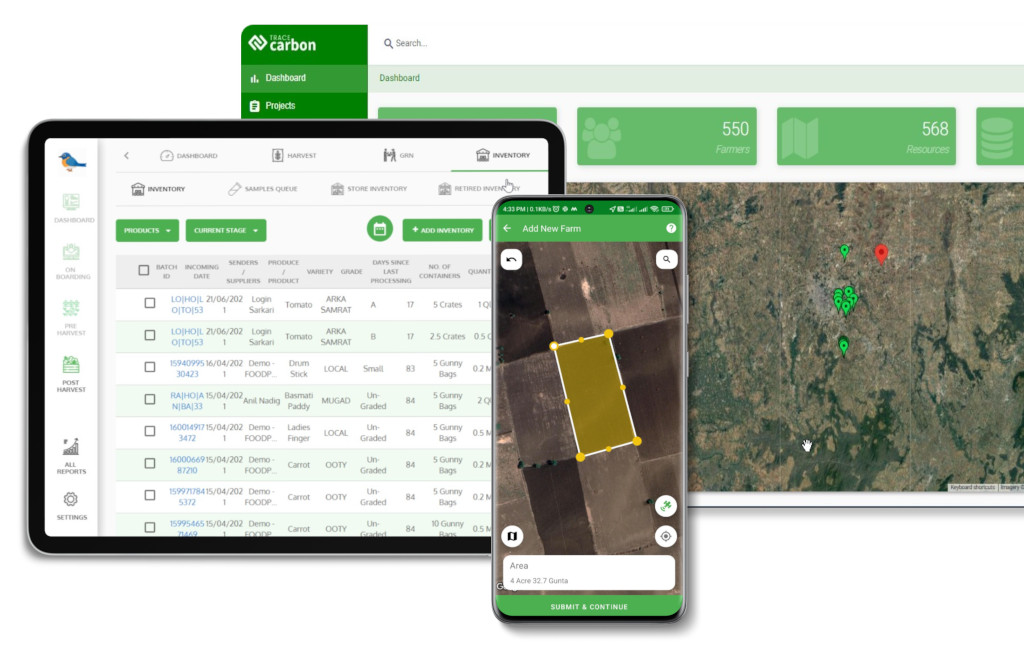
The TraceX Traceability platform delivers batch traceability with customisable batch IDs, supplier-linked records, and built-in labelling and printing
You can define the structure of each batch ID and embed farm or supplier details, so every batch links directly to its origin. Unique code IDs and batch code IDs act as digital fingerprints for individual products and whole batches, while integrated label management and on-demand printing generate compliant, GS1-ready labels without manual data entry keeping capture accurate at the point it matters most.
“Batch traceability is only as strong as the discipline of the ID. Get the batch ID right unique, captured automatically, linked to origin and every downstream recall, audit and buyer question becomes a query instead of a fire drill.”
See how customisable batch IDs, origin linkage and on-demand labelling get you audit-ready batch by batch.
Manual batch records vs. platform-based batch traceability
The same lot, tracked two very different ways.
Dimension
Manual (paper / spreadsheets)
TraceX batch traceability
Batch ID assignment
Ad hoc, inconsistent formats
Customisable, standardised
Data capture
Manual entry, error-prone
QR
Recall trace-back
Days of cross-referencing
Affected lot isolated in seconds
Origin linkage
Rarely tied to farm/supplier
Every batch linked to its source
Compliance records
Scramble to assemble at audit
FSMA 204 / GS1-ready on demand
Consumer proof
Label with no verifiable story
Scannable batch provenance
Buyer’s checklist: choosing a batch traceability system
Confirm any platform you shortlist can do all seven.
Assign and customise batch / lot IDs to your product and compliance needs
Capture IDs automatically via barcode, QR code or RFID
Link each batch back to its farm or supplier of origin
Trace any batch forward and backward in seconds
Produce FSMA 204 / GS1-aligned lot-level records on demand
Integrate with your existing ERP and labelling / printing
Scale across products, sites and smallholder suppliers
Frequently Asked Questions
What is a batch ID or lot number?
A batch ID (or lot number) is a unique identifier assigned to a group of food products made together under similar conditions. It links those units to their production date, location, ingredients and quality records so the batch can be tracked and traced across the supply chain.
Is batch traceability the same as batch-level traceability?
Yes the terms are used interchangeably. Both describe tracking food at the level of a defined batch or lot, rather than as an undifferentiated bulk, so a specific group of units can be isolated when needed.
What is the difference between tracking and tracing a batch?
Tracking follows a batch forward through the supply chain to its destination, while tracing works backward to identify its origin and inputs. Batch traceability supports both directions from a single batch ID.
What technologies are used for batch traceability?
Batch IDs are typically captured with barcodes, QR codes or RFID tags, stored in a traceability platform or ERP, and increasingly secured on blockchain for tamper-proof, shared records across partners.
Is batch traceability mandatory?
In many markets, yes. The FDA’s FSMA 204 Food Traceability Rule (compliance date 20 July 2028) requires lot-level records for listed foods, HACCP expects batch identification, and buyers often mandate GS1 lot codes ahead of any legal deadline.
How small a batch can be traced?
As small as your production and labelling process allows down to a single production run, shift or even a sub-lot. Finer batches mean narrower, cheaper recalls, balanced against the effort of capturing more IDs.
How does batch traceability build consumer trust?
By linking a scannable code on the pack to the batch’s verified origin, handling and certifications, so shoppers can confirm claims like “organic” or “single-origin” rather than take the label on faith.
Start using TraceX
Transparency, Trust, & Success for your Climate Journey.
We use cookies on our website to give you the most relevant experience by remembering your preferences and repeat visits. By clicking “Accept All”, you consent to the use of ALL the cookies. However, you may visit "Cookie Settings" to provide a controlled consent.
This website uses cookies to improve your experience while you navigate through the website. Out of these, the cookies that are categorized as necessary are stored on your browser as they are essential for the working of basic functionalities of the website. We also use third-party cookies that help us analyze and understand how you use this website. These cookies will be stored in your browser only with your consent. You also have the option to opt-out of these cookies. But opting out of some of these cookies may affect your browsing experience.
Necessary cookies are absolutely essential for the website to function properly. These cookies ensure basic functionalities and security features of the website, anonymously.
Cookie
Duration
Description
cookielawinfo-checkbox-analytics
11 months
This cookie is set by GDPR Cookie Consent plugin. The cookie is used to store the user consent for the cookies in the category "Analytics".
cookielawinfo-checkbox-functional
11 months
The cookie is set by GDPR cookie consent to record the user consent for the cookies in the category "Functional".
cookielawinfo-checkbox-necessary
11 months
This cookie is set by GDPR Cookie Consent plugin. The cookies is used to store the user consent for the cookies in the category "Necessary".
cookielawinfo-checkbox-others
11 months
This cookie is set by GDPR Cookie Consent plugin. The cookie is used to store the user consent for the cookies in the category "Other.
cookielawinfo-checkbox-performance
11 months
This cookie is set by GDPR Cookie Consent plugin. The cookie is used to store the user consent for the cookies in the category "Performance".
viewed_cookie_policy
11 months
The cookie is set by the GDPR Cookie Consent plugin and is used to store whether or not user has consented to the use of cookies. It does not store any personal data.
Functional cookies help to perform certain functionalities like sharing the content of the website on social media platforms, collect feedbacks, and other third-party features.
Performance cookies are used to understand and analyze the key performance indexes of the website which helps in delivering a better user experience for the visitors.
Analytical cookies are used to understand how visitors interact with the website. These cookies help provide information on metrics the number of visitors, bounce rate, traffic source, etc.
Advertisement cookies are used to provide visitors with relevant ads and marketing campaigns. These cookies track visitors across websites and collect information to provide customized ads.
Download the 2026 Traceability Scorecard and Benchmark Your Supply Chain Across 10 Critical Capabilities.
Download our eBook
Don’t Wait for an Audit to Find Your EUDR Gaps
The 2026 Simplification Package changes how HS codes, DDS pass-through and geolocation rules apply to you. Get the free guide and 20-point readiness checklist before enforcement catches you unprepared.