EUDR Recycled Fibre: Virgin vs Recovered Paper Explained
Published
, 9 minute read
Share this article
Quick summary: Understand how EUDR applies to virgin and recovered fibre, mixed paper inputs and recycled paper products. Learn what paper manufacturers need to trace.
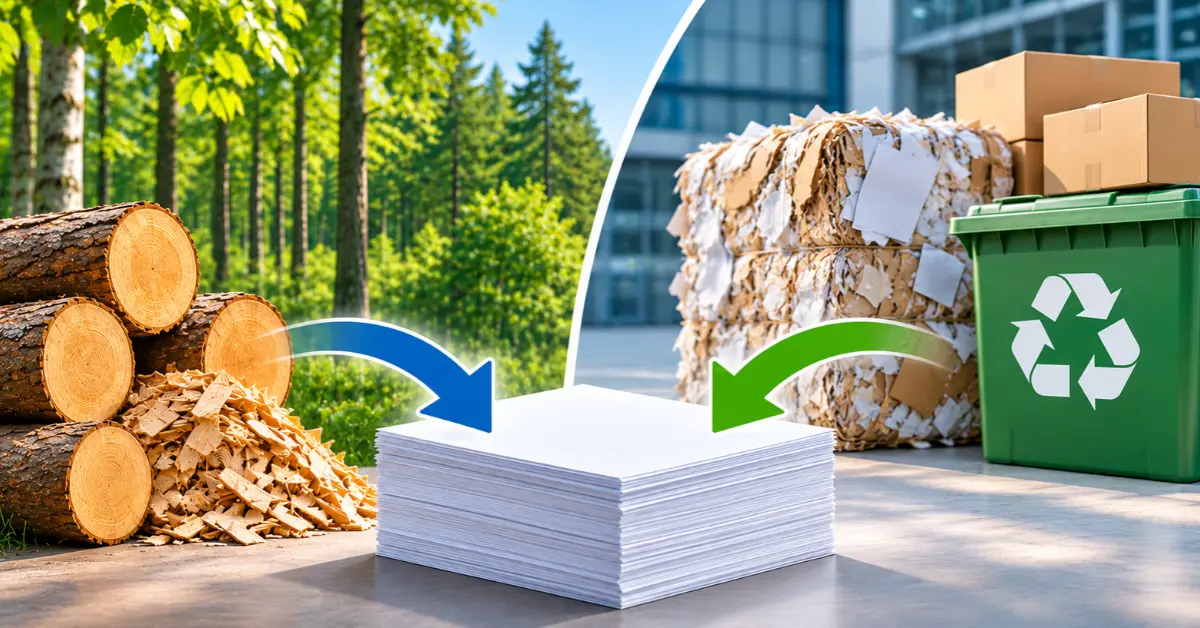
The growing use of recycled fibre in paper and packaging is often discussed in terms of sustainability, resource efficiency and circularity. But the EUDRRecycled Fibre introduces another dimension to the conversation: the traceability requirements associated with virgin and recovered fibre can be different.
For paper manufacturers, packaging producers and converters supplying the European market, this distinction deserves attention.
Under the EUDR, relevant wood-derived products may need to be supported by information demonstrating that the wood was legally produced and that it was not sourced from land subject to deforestation after 31 December 2020.
However, qualifying materials that have completed their lifecycle and would otherwise have been discarded as waste may fall outside the Regulation’s scope.
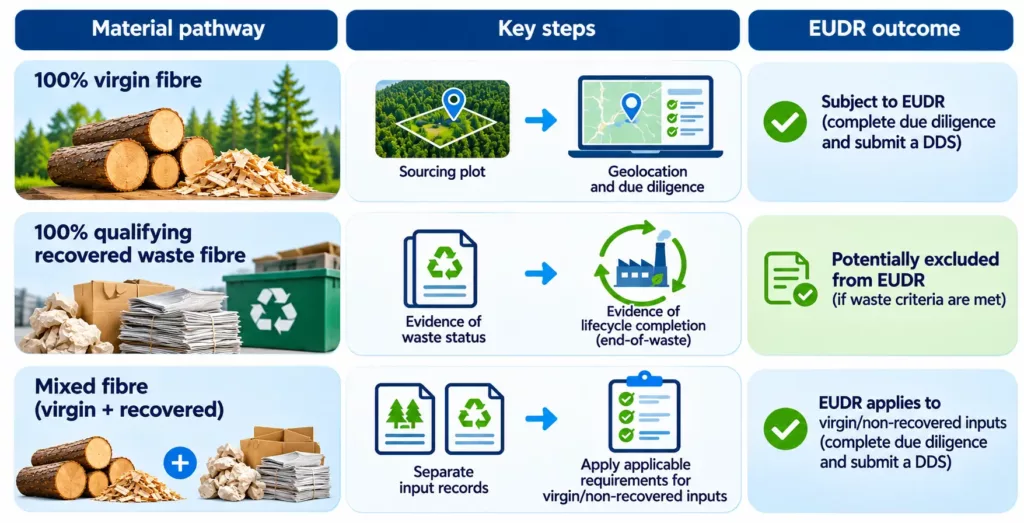
This creates an important distinction between virgin fibre and genuinely recovered fibre.
Key Takeaways
Virgin fibre and recovered fibre are treated differently: Paper made from virgin wood fibre may fall within EUDR scope if the finished product is listed under Annex I and meets the applicable classification requirements.
Qualifying recovered paper may be excluded: Paper products made entirely from material that has completed its lifecycle and would otherwise have been discarded as waste may qualify for the EUDR waste exclusion.
Not all recycled or recovered material is automatically exempt: Manufacturing by-products, production scrap and other residual materials do not automatically qualify as waste under the EUDR.
Mixed-fibre products require careful assessment: Where a paper product contains both recovered and virgin fibre, the virgin-wood component may still trigger EUDR requirements, depending on the product and its classification.
Product classification matters: Businesses must check the exact CN code and Annex I description to determine whether their paper, pulp or packaging products are covered by the regulation.
Evidence is essential: Manufacturers should maintain records of fibre composition, supplier information, material origin and supporting documentation to demonstrate the status of recovered and virgin inputs.
Traceability should extend to raw materials: Paper manufacturers need visibility into their wood and pulp sourcing, including the origin of relevant virgin-fibre inputs and the documentation supporting recovered-material claims.
Download our eBook
Assess your EUDR readiness, uncover data gaps, and take proactive steps towards stronger compliance.
Why virgin fibre requires a different traceability approach
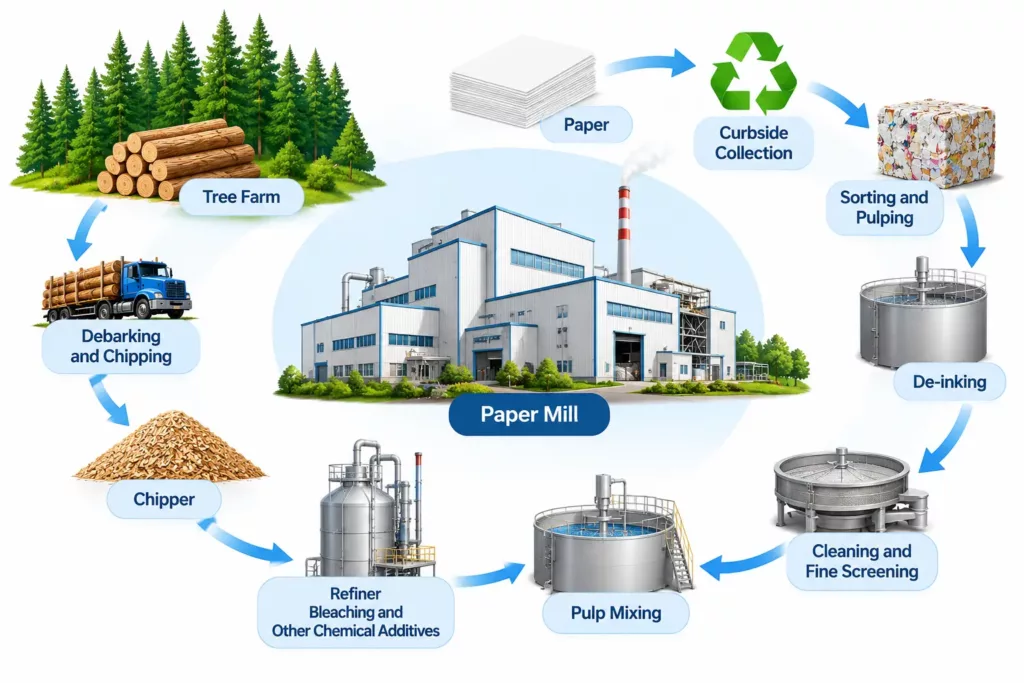
Virgin fibre originates from freshly harvested wood. Where the resulting product falls within the EUDR’s scope, businesses must be able to establish the relevant sourcing information and meet applicable due diligence requirements.
For manufacturers using virgin pulp or wood fibre, this means maintaining visibility into the upstream supply chain, including:
Original sourcing locations and plot-level geolocation.
Supplier and forest-source information.
Evidence supporting legal production.
Deforestation-risk assessment records.
Links between incoming raw materials and finished products.
The challenge becomes more complex when fibre is sourced through multiple suppliers, mills, pulp producers and intermediaries.
Manufacturers need to maintain a traceable connection between the relevant wood inputs and the products manufactured from them.
Why genuinely recovered fibre may be treated differently
Recovered fibre comes from paper and paper products that have already been used and discarded as waste.
Examples may include qualifying recovered paper collected after use and processed into recycled pulp or paperboard.
The EUDR provides an exclusion for goods produced entirely from material that has completed its lifecycle and would otherwise have been discarded as waste.
This means qualifying recovered-waste material may fall outside the Regulation’s scope.
However, the distinction is based on the material’s actual status and origin not simply the label ‘recycled’ or ‘recovered’.
Manufacturing by-products do not automatically qualify as waste. Businesses must assess whether the material meets the applicable definition under EU waste legislation.
Understand what falls within the scope of the EUDR. Explore the covered commodities, products, CN codes and key exemptions to determine whether your business and supply chain are subject to the regulation.
What happens when virgin and recovered fibre are mixed?
This is where the distinction becomes particularly relevant for paper manufacturers.
Consider a mill producing packaging paperboard using a combination of recovered fibre and virgin kraft pulp.
The recovered fibre may qualify for the EUDR waste exclusion, provided it meets the applicable conditions. However, the virgin fibre does not become exempt simply because it is blended with recycled material.
The European Commission’s guidance clarifies that where a product contains non-recycled material, the relevant requirements apply to that material, which must be traced back to its plot of origin through geolocation.
For manufacturers, this creates a need to understand the composition of incoming fibre and maintain records that distinguish between the different material sources.
A practical illustration:
Scenario A: 100% qualifying recovered fibre
A paper mill produces containerboard entirely from recovered paper that has completed its lifecycle and qualifies as waste under the applicable rules.
The product may fall within the EUDR exclusion.
Scenario B: Recovered fibre blended with virgin pulp
A mill uses 80% qualifying recovered fibre and 20% virgin kraft pulp.
The recovered component may qualify for the exclusion, while the virgin component remains subject to applicable EUDR requirements.
These percentages are illustrative, not regulatory thresholds.
The key consideration is not the proportion of recycled content alone. It is whether the material qualifies for the exclusion and whether the remaining relevant material can be traced appropriately.
Why this matters for paper and packaging manufacturers
For manufacturers, this distinction can influence how sourcing information is collected, maintained and connected to production records.
A business using virgin fibre may need a stronger upstream geolocation and due diligence workflow.
A business using qualifying recovered fibre may need a different approach to documenting material origin and demonstrating why the exclusion applies.
For manufacturers using mixed inputs, both workflows may need to operate together.
This becomes especially important when:
Multiple suppliers provide different grades of recovered paper.
Virgin pulp is blended with recycled fibre.
Incoming materials are consolidated before production.
Fibre composition changes between production batches.
Finished paperboard is supplied to packaging converters.
Customers request evidence of material origin and regulatory status.
The challenge is therefore not only identifying whether a material is recycled. It is maintaining reliable information about what entered production and how it was used.
Supplier onboarding: Maintain supplier profiles, sourcing information and supporting documentation.
Material classification: Record whether incoming fibre is virgin, recovered post-consumer material or another material category, supported by appropriate evidence.
Goods receipt: Assign unique identifiers to incoming pulp, recovered paper and other fibre inputs.
Production tracking: Connect raw material inputs to manufacturing orders and production batches.
Material reconciliation: Record quantities consumed, recovered-fibre content and virgin-fibre inputs.
Finished-goods traceability: Link production batches to finished paper, paperboard and packaging products.
This creates a structured record of material movement and helps compliance teams identify which inputs require further EUDR assessment.
Does recovered fibre create a commercial advantage?
It would be premature to describe the EUDR exclusion as a major economic advantage for recovered fibre.
The economics of recycled paper continue to depend on collection infrastructure, material quality, contamination, processing yield, energy consumption, logistics and market demand.
However, the regulatory distinction may create an additional consideration when manufacturers evaluate their sourcing and production models.
A mill using entirely qualifying recovered fibre may have a different EUDR documentation pathway from one relying on virgin fibre. A manufacturer blending both materials needs to manage the applicable requirements for each input.
For packaging manufacturers and converters, understanding this distinction can improve supplier engagement, sourcing visibility and the way material information is passed between businesses.
Managing virgin and recovered fibre through spreadsheets and disconnected production systems can make it difficult to establish a consistent view of material origin and usage.
Digital traceability can help manufacturers:
Maintain structured supplier and material records.
Distinguish virgin and recovered fibre inputs.
Connect incoming materials with production batches.
Track material consumption across manufacturing stages.
Maintain supporting documents and compliance evidence.
Provide relevant sourcing information to downstream customers.
TraceX EUDR Solutions helps businesses connect supplier onboarding, procurement, inventory, manufacturing and batch-level traceability through digital workflows.
For paper and packaging manufacturers, this can support better visibility into material movement and help organise the information needed for EUDR assessments.
TraceX helps businesses organise supplier data, sourcing locations, deforestation risk assessments and material traceability across their supply chains.
Conclusion: The future of paper traceability is material-specific
The EUDR does not treat all fibre inputs in the same way.
Virgin fibre and qualifying recovered waste can follow different regulatory pathways. Where both are used in a finished product, manufacturers need to understand the composition of their inputs and identify which materials remain subject to applicable due diligence requirements.
For paper mills, packaging manufacturers and converters, the practical priority is clear: establish material-level visibility, maintain reliable sourcing records and connect raw material inputs to production and finished goods.
The question is no longer simply whether a product contains recycled fibre. It is whether the business can demonstrate where each relevant material came from and why a particular EUDR requirement or exclusion applies.
Frequently Asked Questions
1. Is recycled paper automatically exempt from EUDR?
No. Using recycled fibre does not automatically exempt a paper product from EUDR. The exemption applies to qualifying waste materials that have completed their lifecycle and would otherwise have been discarded. Businesses must assess the material’s origin, status and product classification before claiming an exemption.
2. Does EUDR apply to paper products containing both virgin and recycled fibre?
Potentially, yes. If a paper product contains virgin wood fibre alongside recovered material, the virgin-fibre component may trigger EUDR obligations. Businesses should assess the product’s exact CN code, fibre composition and applicable Annex I requirements rather than assuming that a recycled-content claim provides a complete exemption.
3. How can manufacturers prove that recovered paper qualifies for the EUDR waste exclusion?
Manufacturers should maintain supporting evidence showing that the recovered material has completed its lifecycle and would otherwise have been discarded as waste. Useful records may include supplier declarations, material specifications, purchase records, waste documentation and processing records. The evidence should support the actual status and origin of the material.
4. Are paper mill production scraps and manufacturing by-products exempt from EUDR?
Not automatically. Manufacturing residues, production offcuts and by-products should not be treated as qualifying waste simply because they are reused or recycled. Their status must be assessed against the EUDR waste exclusion and the circumstances in which they were generated.
5. How can paper manufacturers manage EUDR compliance when sourcing both virgin and recovered fibre?
Manufacturers should maintain separate and traceable records for virgin and recovered fibre inputs, collect relevant supplier and origin information, validate product classifications and retain evidence supporting any waste-exclusion claims. A digital traceability system can help connect supplier records, sourcing locations, raw-material batches and finished products, making due diligence and audit preparation more manageable.
Start using TraceX
Transparency, Trust, & Success for your Climate Journey.
We use cookies on our website to give you the most relevant experience by remembering your preferences and repeat visits. By clicking “Accept All”, you consent to the use of ALL the cookies. However, you may visit "Cookie Settings" to provide a controlled consent.
This website uses cookies to improve your experience while you navigate through the website. Out of these, the cookies that are categorized as necessary are stored on your browser as they are essential for the working of basic functionalities of the website. We also use third-party cookies that help us analyze and understand how you use this website. These cookies will be stored in your browser only with your consent. You also have the option to opt-out of these cookies. But opting out of some of these cookies may affect your browsing experience.
Necessary cookies are absolutely essential for the website to function properly. These cookies ensure basic functionalities and security features of the website, anonymously.
Cookie
Duration
Description
cookielawinfo-checkbox-analytics
11 months
This cookie is set by GDPR Cookie Consent plugin. The cookie is used to store the user consent for the cookies in the category "Analytics".
cookielawinfo-checkbox-functional
11 months
The cookie is set by GDPR cookie consent to record the user consent for the cookies in the category "Functional".
cookielawinfo-checkbox-necessary
11 months
This cookie is set by GDPR Cookie Consent plugin. The cookies is used to store the user consent for the cookies in the category "Necessary".
cookielawinfo-checkbox-others
11 months
This cookie is set by GDPR Cookie Consent plugin. The cookie is used to store the user consent for the cookies in the category "Other.
cookielawinfo-checkbox-performance
11 months
This cookie is set by GDPR Cookie Consent plugin. The cookie is used to store the user consent for the cookies in the category "Performance".
viewed_cookie_policy
11 months
The cookie is set by the GDPR Cookie Consent plugin and is used to store whether or not user has consented to the use of cookies. It does not store any personal data.
Functional cookies help to perform certain functionalities like sharing the content of the website on social media platforms, collect feedbacks, and other third-party features.
Performance cookies are used to understand and analyze the key performance indexes of the website which helps in delivering a better user experience for the visitors.
Analytical cookies are used to understand how visitors interact with the website. These cookies help provide information on metrics the number of visitors, bounce rate, traffic source, etc.
Advertisement cookies are used to provide visitors with relevant ads and marketing campaigns. These cookies track visitors across websites and collect information to provide customized ads.