EUDR Compliance for Wood Exporters: Your Plan Before 30 December 2026
Published
, 8 minute read
Share this article
Quick summary: EUDR compliance for wood exporters: deadlines, geolocation, species and legality data your EU buyers need before 30 December 2026, plus a software checklist.
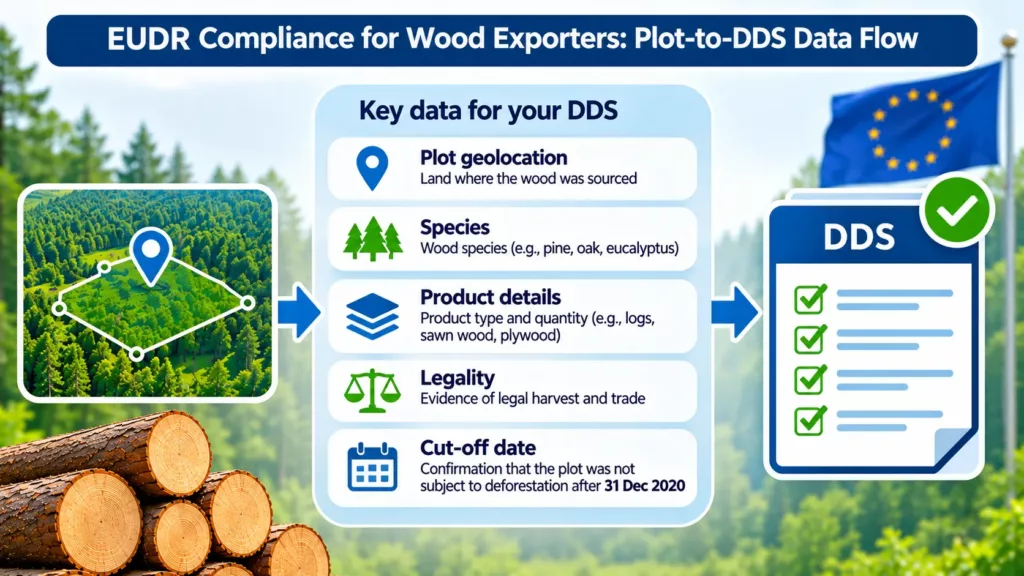
EUDR compliance for wood exporters means proving that every timber, pulp, paper or wooden furniture shipment entering or leaving the EU comes from land not deforested or degraded after 31 December 2020, was harvested legally, and traces to geolocated plots. From 30 December 2026, the operator files a due diligence statement (DDS), built on plot coordinates, species and legality evidence from its suppliers.
KEY TAKEAWAYS
Wood products already covered by the old EU Timber Regulation (EUTR) must comply from 30 December 2026, whatever the company’s size.
Exporters outside the EU rarely file the DDS, but EU buyers cannot file without your geolocation, species and legality data.
EU-based companies exporting wood out of the EU are operators and need a DDS at export.
FSC or PEFC certification supports risk assessment but does not replace geolocation or the DDS.
If you ship sawn timber, plywood, pulp or wooden furniture to Europe, your buyers are already asking for plot polygons and species lists. This guide sets out what EUDR compliance for wood exporters requires, which deadline applies to you, and how to close the data gaps that stall most shipments.
Download our eBook
Assess your EUDR readiness, uncover data gaps, and take proactive steps towards stronger compliance.
EUDR Compliance for Wood Exporters: What the Regulation Requires
The EUDR, Regulation (EU) 2023/1115, sets four conditions every in-scope wood product must meet before it can be sold in or exported from the EU:
Deforestation-free: the land was not converted from forest after 31 December 2020.
No forest degradation: a wood-specific test; no primary or naturally regenerating forest converted into plantation after the cut-off.
Legal: harvested under the laws of the country of production.
Declared: covered by a due diligence statement in the EUDR Information System.
In plain language, EUDR compliance for wood exporters is the ability to show, shipment by shipment, which plot each log came from and that the land behind it stayed forest. Annex I covers logs, sawn wood, veneer, plywood, fibreboard, pulp, paper and wooden furniture, among others. Printed products left the scope in December 2025, and Delegated Regulation (EU) 2026/2102 removed bamboo, rattan, used goods and packaging that only carries another product.
EUDR Compliance Deadlines for Wood Exporters
Wood has less time than most commodities because of its history under the EUTR:
30 December 2026: large and medium operators, plus all traders and downstream operators.
30 December 2026: micro and small operators placing timber products already covered by the EUTR.
30 June 2027: other micro and small operators established as such by 31 December 2024.
30 December 2026: the EUTR is repealed and the EUDR takes over.
As of November 2026, no proposal to change these dates has been published, and the Commission’s May 2026 review kept the timetable. For EUDR compliance for wood exporters, that means planning for 30 December 2026 whatever your size.
EUDR Rules for Wood Exporters Outside the EU
If you sell from Brazil, Indonesia, Ghana or Vietnam to an EU importer, the importer is usually the operator and files the DDS. You carry no direct filing duty, but your buyer cannot file without your data, so EUDR compliance for wood exporters outside the EU is a condition of keeping the contract.
EUDR Rules for Wood Exporters Inside the EU
The EUDR also covers products leaving the EU. A Finnish sawmill or a Swedish pulp producer shipping to Asia is an operator at the point of export, must submit a DDS, and presents its reference number to customs.
Annex II of the EUDR lists what a DDS must contain, and wood carries extra requirements:
Product description, HS code and quantity.
Common name and full scientific name of every species.
Country of production and geolocation of every plot of land.
Date or time range of harvest.
Evidence that the wood is deforestation-free and legally harvested.
Most of the work in EUDR compliance for wood exporters happens here, long before anyone logs in to the EU Information System.
EUDR Geolocation for Timber Plots
Plots over four hectares need a polygon; smaller plots can use a single point. For wood, the plot is the harvest area, such as a concession block, and the Information System accepts GeoJSON files.
EUDR Legality Evidence for Wood
Legality covers land use rights, forest management and environmental rules, third-party and indigenous rights, labour and human rights, and tax, trade and customs law. Harvest permits, concession licences and transport permits are the usual proof.
EUDR Requirements for Mixed-Species Wood Products
Plywood, particleboard and pulp often combine several species from several sources. Each species and each source plot must be declared, and wood of unknown origin cannot be mixed into a compliant batch.
EUDR COMPLIANCE FOR WOOD AND PAPER: Understand how the EUDR impacts wood and paper supply chains, including product scope, wood species identification, geolocation, deforestation checks and due diligence requirements. Explore the key steps to strengthen traceability and prepare your wood supply chain for EUDR compliance.
EUDR Compliance Gaps That Stall Wood Exporters
Four gaps cause most delays in EUDR compliance for wood exporters:
Treating certification as compliance. FSC or PEFC certificates support risk assessment but do not replace geolocation or the DDS.
Maps that cannot be uploaded. Concession boundaries held as PDFs or paper maps must be digitised and checked first.
Losing the plot link at the yard. Once logs from several concessions are stacked together, plot traceability is gone.
Scattered legality documents. Permits buried in email threads slow every buyer request.
A certificate tells your buyer how a forest is managed. A DDS needs to know exactly which plot each log came from.
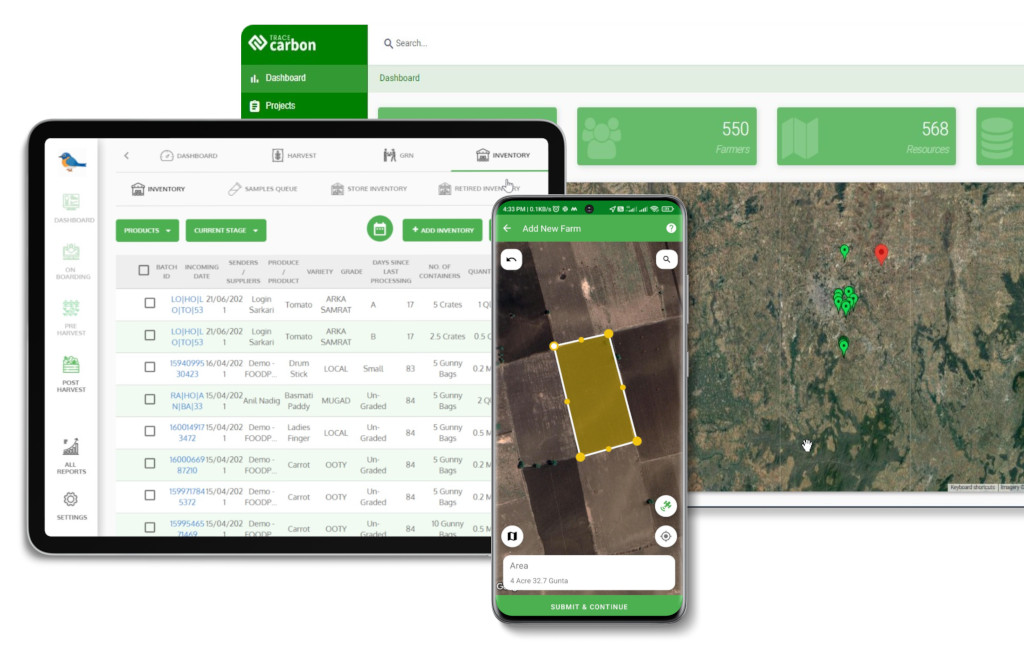
TraceX’s EUDR compliance solution, is built around the data a timber DDS depends on. Its mobile app works offline in 15 languages. The solution validates polygons as GeoJSON, checks plots against satellite deforestation data, links species and legality documents to each plot, and packages the DDS data your EU buyer needs. TraceX supports EUDR clients globally, and typical onboarding takes four weeks.
Start a 15-day free trial with full platform access and no credit card.
EUDR Compliance for Wood Exporters: Manual Tracking vs a Platform
Spreadsheets work for a few concessions but break as plots, species and buyers multiply:
Manual tracking relies on spreadsheets, PDFs and email threads.
A platform links plots, species, documents and shipments in one record.
Task
Manual tracking
Compliance platform
Plot geolocation
Coordinates typed or traced from PDFs; format errors found by the buyer
Polygons captured in the field and validated as GeoJSON before sharing
Deforestation check
Occasional satellite image checks, if any
Plots checked against satellite deforestation data and the 2020 cut-off
Species and mixing
Tracked per invoice; plot link lost at the yard
Species and source plots carried through each batch
Legality evidence
Spread across email and agents
Stored against each plot and supplier
Buyer requests
Rebuilt for every shipment
Shareable DDS data package per shipment
Record keeping
Files scattered; five-year retention hard to prove
Central audit trail kept for five years
For EUDR compliance for wood exporters with dozens of concessions or mixed-species products, the manual approach usually fails at the sawmill yard, not in the forest.
EUDR Compliance Software Checklist for Wood Exporters
Use these questions when you evaluate software for EUDR compliance for wood exporters:
Does it capture polygons offline in remote concessions?
Does it validate GeoJSON before files reach your buyer?
Can it record common and scientific species names per batch?
Does it trace mixed-species products through processing?
Does it check plots against the 2020 cut-off and forest degradation?
Can it store harvest permits and legality evidence against each plot?
Can it hand DDS data to EU buyers in their format?
Does it meet security standards such as ISO 27001 and SOC 2?
TraceX is GDPR, ISO 27001, SOC 1 and SOC 2 compliant, and Maruszkin Law Firm, an EU environmental law specialist, validated its EUDR legal methodology.
EUDR Compliance for Wood Exporters: Next Steps
With 30 December 2026 only weeks away, the fastest win in EUDR compliance for wood exporters is fixing plot and species data now:
Map every harvest plot in GeoJSON.
Collect species and legality evidence per plot.
Agree the data format with each EU buyer.
Frequently Asked Questions
Do wood exporters outside the EU need to file a due diligence statement?
Usually not. The EU importer that places the wood on the market is the operator and files the DDS. EUDR compliance for wood exporters outside the EU still matters commercially, because the importer depends on your geolocation, species and legality data.
Does the EUDR cover wooden pallets and packaging?
Packaging used only to support, protect or carry another product is out of scope under Delegated Regulation (EU) 2026/2102. Pallets or crates sold as products in their own right remain in scope.
What geolocation format do EU buyers expect?
The EUDR Information System accepts GeoJSON. Validating files before you send them avoids rejected submissions and keeps EUDR compliance for wood exporters on schedule.
Start using TraceX
Transparency, Trust, & Success for your Climate Journey.
We use cookies on our website to give you the most relevant experience by remembering your preferences and repeat visits. By clicking “Accept All”, you consent to the use of ALL the cookies. However, you may visit "Cookie Settings" to provide a controlled consent.
This website uses cookies to improve your experience while you navigate through the website. Out of these, the cookies that are categorized as necessary are stored on your browser as they are essential for the working of basic functionalities of the website. We also use third-party cookies that help us analyze and understand how you use this website. These cookies will be stored in your browser only with your consent. You also have the option to opt-out of these cookies. But opting out of some of these cookies may affect your browsing experience.
Necessary cookies are absolutely essential for the website to function properly. These cookies ensure basic functionalities and security features of the website, anonymously.
Cookie
Duration
Description
cookielawinfo-checkbox-analytics
11 months
This cookie is set by GDPR Cookie Consent plugin. The cookie is used to store the user consent for the cookies in the category "Analytics".
cookielawinfo-checkbox-functional
11 months
The cookie is set by GDPR cookie consent to record the user consent for the cookies in the category "Functional".
cookielawinfo-checkbox-necessary
11 months
This cookie is set by GDPR Cookie Consent plugin. The cookies is used to store the user consent for the cookies in the category "Necessary".
cookielawinfo-checkbox-others
11 months
This cookie is set by GDPR Cookie Consent plugin. The cookie is used to store the user consent for the cookies in the category "Other.
cookielawinfo-checkbox-performance
11 months
This cookie is set by GDPR Cookie Consent plugin. The cookie is used to store the user consent for the cookies in the category "Performance".
viewed_cookie_policy
11 months
The cookie is set by the GDPR Cookie Consent plugin and is used to store whether or not user has consented to the use of cookies. It does not store any personal data.
Functional cookies help to perform certain functionalities like sharing the content of the website on social media platforms, collect feedbacks, and other third-party features.
Performance cookies are used to understand and analyze the key performance indexes of the website which helps in delivering a better user experience for the visitors.
Analytical cookies are used to understand how visitors interact with the website. These cookies help provide information on metrics the number of visitors, bounce rate, traffic source, etc.
Advertisement cookies are used to provide visitors with relevant ads and marketing campaigns. These cookies track visitors across websites and collect information to provide customized ads.