EUDR Wood: What Furniture, Plywood, MDF & Flooring Makers Must Do
Published
, 10 minute read
Share this article
Quick summary: EUDR wood compliance for manufacturers: even if you sell plywood, MDF, furniture or flooring — not logs — you must trace each wood input back to the forest plot.
EUDR wood compliance applies to finished and semi-finished products plywood, MDF and fibreboard, veneer, furniture, doors, joinery, flooring and wooden packaging not just to logs and sawn timber. Whether you are in scope is decided by your product’s Combined Nomenclature (CN) code in Annex I, not by whether your business ever handles a forest. If your product is listed, you must trace every wood input back through your bill of materials to the plot of land it was harvested from, prove it was deforestation-free after 31 December 2020, and back it with a Due Diligence Statement (DDS). The obligation applies from 30 December 2026 for large and medium operators.
Key takeaways for wood product manufacturers
Scope follows the CN code, not the raw material. A product is in scope only if its code is listed in Annex I but plywood, MDF, particle board, veneer, furniture, joinery and wooden packaging all are.
“We sell products, not logs” is not an exemption. EUDR wood obligations reach back through your bill of materials to the forest, however many processing steps sit in between.
Your role sets your paperwork. Importing wood inputs makes you an operator who files a full DDS; buying inputs already placed on the EU market makes you a downstream operator who references the upstream DDS number.
Composite and multi-origin products are the hard part. A single cabinet can combine panels from several suppliers and countries each in-scope wood input needs its own geolocation trail.
Some things dropped out of scope. Printed books were removed by Regulation (EU) 2025/2650; recycled/reclaimed wood, second-hand furniture and accessory packaging are excluded.
December 2026 is approaching. Is your supply chain actually ready?
Move from spreadsheets and fragmented supplier data to a traceable, audit-ready EUDR workflow with TraceX.
EUDR wood scope is set by your product code, not your raw material
EUDR wood coverage is decided one way: does your product’s eight-digit CN code appear in Annex I? There is no de minimis threshold by volume or value, and you cannot self-select a friendlier code. If the code is listed, the rules apply whatever your product is made from. The most relevant listings for manufacturers include:
Wooden furniture — CN 9401 and 9403, plus prefabricated buildings of wood (9406).
Wooden packaging — CN 4415 (crates, cases, pallets) when placed on the market as a product in its own right, not as accessory packing.
A few important carve-outs: bamboo is classified as a non-wood forest product and is out of scope (though a bamboo-branded item with an MDF core stays in scope for its wood component), and products made entirely from recycled or reclaimed wood fall under the waste exemption. If you are unsure, map each SKU to its CN code against the current Annex I
Are You Using the Right HSN Codes for EUDR?Your product classification can determine whether it falls within EUDR scope. Learn how to identify the relevant HSN/CN codes and avoid costly scope and compliance mistakes.
Finished products, forest origin: what EUDR wood traceability demands
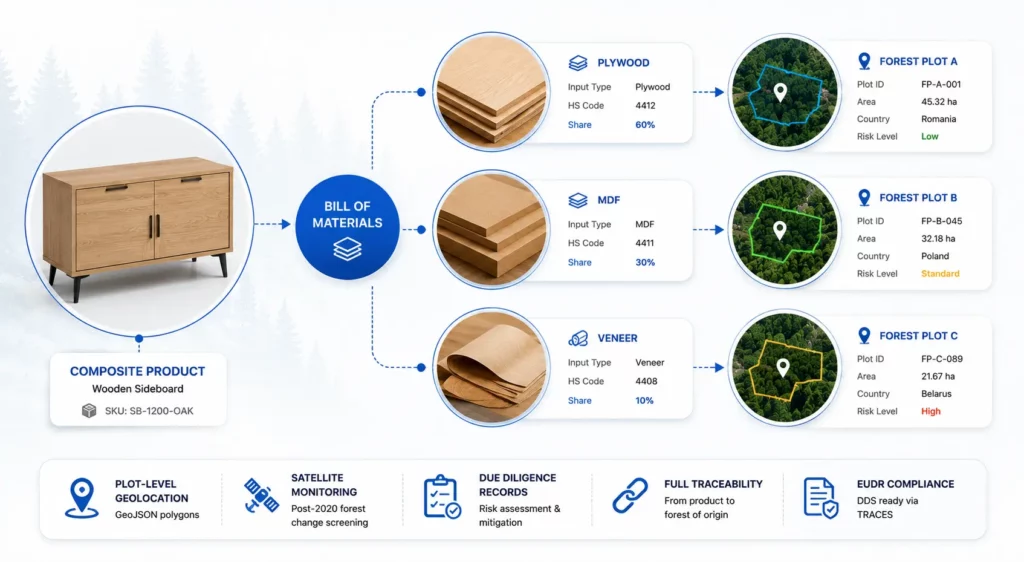
This is the mental shift for manufacturers. You may sell a laminated door or a flat-pack wardrobe, but EUDR wood compliance treats that product as a container of forest-risk material. To satisfy it, three evidence chains must resolve for every in-scope input:
Geolocation — the plot of land each wood component came from (a single point under 4 hectares; a GeoJSON polygon at 4 hectares or more).
Deforestation-free proof — satellite-verifiable evidence that the plot was not cleared or degraded after 31 December 2020.
Legality — harvest permits and documentation showing the wood was produced lawfully in its country of origin.
The complication for wood products is composition. A single piece of furniture might combine a plywood carcass from one country, an MDF back panel from another, and a solid-wood frame from a third each with its own supplier, its own plots, and its own paperwork. EUDR wood traceability means holding all of those threads together and tying them to the specific batch you place on the market. When one input can’t be traced, the whole product is exposed.
Operator or downstream operator? Your EUDR wood obligations depend on it
Not every business in the wood chain carries the same load. The July 2026 simplification confirmed a two-tier structure that matters enormously for manufacturers:
Operator (first placement / import): if you import wood inputs or finished goods into the EU, or are the first to place them on the market, you must run full due diligence and file a DDS in the EU Information System (TRACES).
Downstream operator: if you buy inputs already placed on the EU market, your obligations are lighter you can reference the original DDS reference number rather than rebuild the diligence from scratch.
This is why a supplier’s paperwork matters so much. A furniture maker importing plywood from outside the EU is an operator with the full EUDR wood burden; the same maker buying EU-placed plywood is a downstream operator who needs a valid upstream DDS reference. Knowing which role you occupy for each input and collecting the right evidence for it is the difference between a smooth filing and a blocked shipment.
Who Is Responsible Under EUDR?From operators and traders to authorised representatives, understanding your role is the first step toward knowing your due diligence obligations and compliance responsibilities.
Read our complete guide to EUDR Roles & Responsibilities.
A supplier certificate is not a DDS reference number.
The most common gap we see in wood-product supply chains is manufacturers who collect FSC or PEFC certificates from suppliers and assume the job is done. Certification supports your risk assessment but under EUDR wood rules it is not a substitute for geolocation, and a certificate is not a DDS reference number. If you are a downstream operator, what you actually need from each supplier is the reference number of a valid, filed Due Diligence Statement tied to the exact material you bought. Start asking suppliers for that number now; the ones who can’t produce it are your compliance risk.
Is FSC-Certified Wood Automatically EUDR Compliant?FSC certification can provide valuable supply chain evidence but it doesn’t replace the EUDR due diligence process. Learn what FSC certification covers, what additional evidence you may need, and how to assess your wood supply chain for EUDR.
The enforcement calendar is fixed, and the Commission has confirmed there will be no further delay:
Milestone
Date
Large & medium operators / traders
30 December 2026
Micro & small operators (general)
30 June 2027
Micro & small operators — timber sector
30 December 2026 (no SME deferral)
Newly added Annex I product codes
30 December 2027
Deforestation cut-off date
31 December 2020
One nuance worth flagging: the 13 July 2026 delegated act that reshaped Annex I is adopted but not yet in force it is in a two-month scrutiny period before Official Journal publication. Treat its scope changes as settled in substance, but re-confirm the exact CN codes for your products against the final text before you rely on them. For most furniture, panel and joinery makers, the core wood codes are unchanged; the additions and removals mainly affect other commodities.
EUDR wood compliance: manual vs. a connected platform
For a manufacturer juggling dozens of suppliers and hundreds of SKUs, the gap between spreadsheets and a connected platform is widest exactly where audits happen.
Compliance task
Manual / spreadsheets
Connected platform (TraceX )
SKU-to-CN-code scoping
Manual lookups, easy to misclassify
Bulk SKU mapping against current Annex I
Bill-of-materials tracing
Inputs tracked in disconnected files
Component-level trace to plot origin
Supplier DDS references
Chased by email, often missing
Collected and validated against each input
Deforestation screening
Plot-by-plot manual checks
Automated screening vs. post-2020 loss data
DDS generation
Rebuilt per shipment, rejection-prone
Structured DDS for the EU Information System
Audit readiness
Reconstructed under pressure
Query-ready evidence with 5-year retention
Buyer’s checklist: choosing an EUDR wood solution
Evaluating software to manage EUDR wood compliance across a product catalogue? Pressure-test each option:
Can it map your full SKU list to CN codes and flag which products are in scope under the current Annex I?
Does it trace at the bill-of-materials level, so composite products resolve to every wood input’s origin?
Can it collect, store and validate supplier DDS reference numbers for downstream-operator filings?
Does it distinguish operator vs. downstream-operator obligations per input automatically?
Does it screen plots against recognised post-2020 deforestation datasets?
Can it generate a DDS in the format the EU Information System (TRACES) expects, with the HS code and net-mass quantity?
Will it scale across many suppliers and countries without manual re-keying?
How TraceX supports EUDR wood compliance
TraceX’s EUDR Solutions, built for the reality that most wood businesses sell finished goods, not raw material. For furniture, flooring, joinery, door, plywood and packaging manufacturers, it aims to connect the product you ship to the forest it came from:
Scope with confidence — map SKUs to CN codes against the current Annex I and flag in-scope wood products.
Trace the bill of materials — resolve composite products to every in-scope input and its plot of origin].
Manage DDS references — collect and validate upstream DDS numbers for downstream-operator filings.
File cleanly — generate structured DDS output aligned to the EU Information System to cut rejections.
The outcome manufacturers want is straightforward: keep EU market access, stop chasing supplier paperwork by email, and turn EUDR wood compliance into a repeatable part of production rather than a shipment-by-shipment scramble.
See bill-of-materials traceability run on your own product catalogue.
Does EUDR apply if I only sell finished wood products, not logs?
Yes. EUDR wood scope is determined by your product’s CN code in Annex I, not by whether you handle raw timber. Plywood, MDF, furniture, doors, joinery and flooring are all listed, so finished-goods makers are firmly in scope.
Is plywood covered by the EUDR?
Yes. Plywood and veneered panels fall under CN 4412, one of the wood product codes listed in Annex I. Importing or first-placing plywood on the EU market triggers full due diligence.
Is MDF or particle board in scope?
Yes. Fibreboard, including MDF, is CN 4411, and particle board and OSB are CN 4410 both are in-scope EUDR wood products requiring traceability to the forest plot.
Is furniture covered by EUDR?
Wooden furniture under CN 9401 and 9403 is in scope, as are prefabricated wooden buildings (9406). Furniture whose finished CN code is not listed may be out of scope even if it contains wood always check the code.
What is the difference between an operator and a downstream operator?
An operator imports or first places a product on the EU market and must file a full DDS. A downstream operator buys products already on the market and can instead reference the upstream DDS number.
Are recycled wood or second-hand products covered?
No. Products made entirely from recycled or reclaimed wood, and genuine second-hand goods such as antique furniture, fall under the waste exemption and are out of EUDR scope.
When must wood product manufacturers comply?
From 30 December 2026 for large and medium operators, and 30 June 2027 for most micro and small operators. Products newly added to Annex I by the July 2026 delegated act apply from 30 December 2027.
Start using TraceX
Transparency, Trust, & Success for your Climate Journey.
We use cookies on our website to give you the most relevant experience by remembering your preferences and repeat visits. By clicking “Accept All”, you consent to the use of ALL the cookies. However, you may visit "Cookie Settings" to provide a controlled consent.
This website uses cookies to improve your experience while you navigate through the website. Out of these, the cookies that are categorized as necessary are stored on your browser as they are essential for the working of basic functionalities of the website. We also use third-party cookies that help us analyze and understand how you use this website. These cookies will be stored in your browser only with your consent. You also have the option to opt-out of these cookies. But opting out of some of these cookies may affect your browsing experience.
Necessary cookies are absolutely essential for the website to function properly. These cookies ensure basic functionalities and security features of the website, anonymously.
Cookie
Duration
Description
cookielawinfo-checkbox-analytics
11 months
This cookie is set by GDPR Cookie Consent plugin. The cookie is used to store the user consent for the cookies in the category "Analytics".
cookielawinfo-checkbox-functional
11 months
The cookie is set by GDPR cookie consent to record the user consent for the cookies in the category "Functional".
cookielawinfo-checkbox-necessary
11 months
This cookie is set by GDPR Cookie Consent plugin. The cookies is used to store the user consent for the cookies in the category "Necessary".
cookielawinfo-checkbox-others
11 months
This cookie is set by GDPR Cookie Consent plugin. The cookie is used to store the user consent for the cookies in the category "Other.
cookielawinfo-checkbox-performance
11 months
This cookie is set by GDPR Cookie Consent plugin. The cookie is used to store the user consent for the cookies in the category "Performance".
viewed_cookie_policy
11 months
The cookie is set by the GDPR Cookie Consent plugin and is used to store whether or not user has consented to the use of cookies. It does not store any personal data.
Functional cookies help to perform certain functionalities like sharing the content of the website on social media platforms, collect feedbacks, and other third-party features.
Performance cookies are used to understand and analyze the key performance indexes of the website which helps in delivering a better user experience for the visitors.
Analytical cookies are used to understand how visitors interact with the website. These cookies help provide information on metrics the number of visitors, bounce rate, traffic source, etc.
Advertisement cookies are used to provide visitors with relevant ads and marketing campaigns. These cookies track visitors across websites and collect information to provide customized ads.
Download the 2026 Traceability Scorecard and Benchmark Your Supply Chain Across 10 Critical Capabilities.
Download our eBook
Don’t Wait for an Audit to Find Your EUDR Gaps
The 2026 Simplification Package changes how HS codes, DDS pass-through and geolocation rules apply to you. Get the free guide and 20-point readiness checklist before enforcement catches you unprepared.