Battery Passport Access Levels: Who Can Access What Information in a Battery DPP?
Published
, 9 minute read
Share this article
Quick summary: Battery Passport access levels explained: what the public, repairers, recyclers and EU authorities can see under Regulation 2023/1542, and how to prepare.
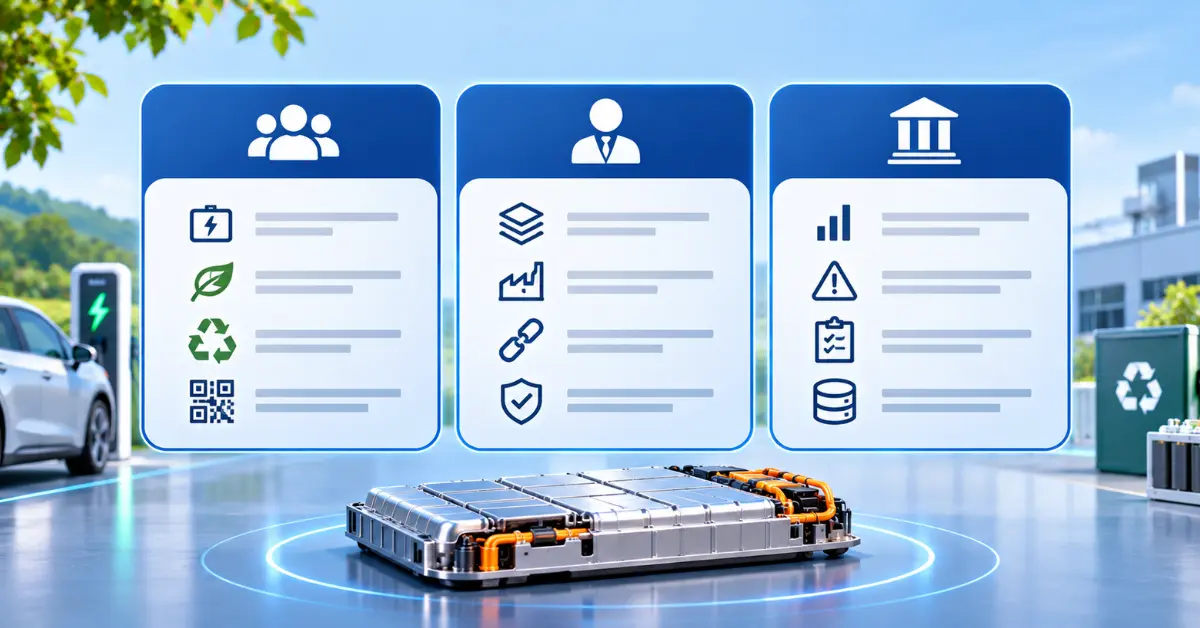
Battery Passport access levels decide who can read which data in an EU battery passport. Under Article 77(2) and Annex XIII of Regulation (EU) 2023/1542, there are three tiers: public information on the battery model, information for persons with a legitimate interest such as repairers, remanufacturers and recyclers, and information reserved for notified bodies, market surveillance authorities and the European Commission. The passport becomes mandatory on 18 February 2027 for LMT batteries, industrial batteries above 2 kWh and electric vehicle batteries.
Key takeaways
Three tiers, set per data point: public, legitimate interest and authorities only (Annex XIII, points 1 to 4).
Detailed composition, dismantling data and individual battery data such as state of health are not public.
Test reports proving compliance are visible only to notified bodies, market surveillance authorities and the Commission.
The implementing act naming “persons with a legitimate interest” was due 18 August 2026 and is still pending, but the 2027 obligation stands.
Manufacturers should classify every data point, map it to a role and build configurable permissions now.
Download our eBook
Explore the key steps, challenges and considerations for building a reliable Battery Passport strategy.
Battery Passport Access Levels: Why Not All Battery Data Is Public
One passport serves consumers, circular economy operators and regulators, so access has to be tiered.
Public data supports informed buying decisions.
Technical data supports repair, reuse and recycling.
Compliance evidence supports enforcement.
Battery Passport access levels exist because a single battery passport has to serve very different readers. A consumer comparing e-bikes, a recycler planning a disassembly line and a market surveillance authority checking a test report may all scan the same QR code, but they should not all see the same data.
Regulation (EU) 2023/1542 handles this with tiered access. Under Article 77(1), the passport applies from 18 February 2027 to every light means of transport (LMT) battery, every industrial battery above 2 kWh and every electric vehicle battery placed on the EU market or put into service. Article 77(2) splits the content into battery model data and individual battery data, and Annex XIII assigns each data point to an audience. Those assignments are the Battery Passport access levels every manufacturer must build into its passport.
This is where Battery DPP data privacy and circularity meet. Publish too much and you expose cathode chemistry or test results to competitors. Restrict too much and repairers and recyclers cannot do the work the regulation is designed to enable.
A battery passport is not one document. It is one record with three reading levels.
Explore the regulatory requirements, data obligations and traceability measures businesses need to prepare for Battery DPP compliance.
Battery Passport Access Levels Explained: The Three Tiers
Annex XIII maps every battery passport data point to one of three audiences.
Public access: general battery model information.
Legitimate interest: detailed technical and individual battery data.
Restricted access: test reports and compliance evidence.
Access level
Who can access it?
Information available
Annex XIII
Public access
General public, including consumers, fleet buyers and investors
General battery model information: manufacturer, category, chemistry, rated capacity, carbon footprint, recycled content, hazardous substances, end-of-life guidance
Point 1
Legitimate interest
Repairers, remanufacturers, second-life operators, recyclers and other eligible persons (plus the Commission and authorities)
Detailed composition, part numbers and spare part sources, dismantling information, safety measures, and individual battery data
Points 2 and 4
Restricted access
Notified bodies, market surveillance authorities and the European Commission
Test reports proving compliance with the Regulation
Point 3
Battery Passport data visibility is decided per data point, not per passport. Access must be free of charge and follow the rights set in Annex XIII and the Article 77(9) implementing act, so one battery record will show a different view to each reader. Getting Battery Passport access levels right therefore starts at field level.
Battery DPP Information Requirements at Each Access Level
Battery DPP information requirements differ by tier, and each tier has a clear intended user.
Public model data for buyers and the public.
Restricted model and individual data for circular operators.
Authority-only evidence for enforcement.
Public Battery Passport Data Visibility
The first of the Battery Passport access levels, point 1 of Annex XIII, covers model-level information: manufacturer identification, battery category, chemistry, weight, rated capacity, carbon footprint, recycled content shares, hazardous substances, critical raw materials and guidance on collection and end-of-life handling. Example: a logistics fleet buyer compares the carbon footprint and rated capacity of two forklift battery models before signing a procurement contract.
Battery DPP Data Access for Legitimate Interest Holders
Battery DPP data access at this tier covers two groups. Point 2 covers sensitive model data: detailed cathode, anode and electrolyte composition, part numbers and contacts for spare parts, dismantling information such as exploded diagrams, disassembly sequences and required tools, plus safety measures. Point 4 covers individual battery data, including state of health, battery status (original, repurposed, re-used, remanufactured or waste), charge cycles, negative events such as accidents, and operating conditions. Example: a second-life operator checks the state of health of an EV pack before repurposing it for stationary storage.
Restricted Battery Passport Information for Authorities
Point 3 holds the results of test reports proving compliance. Example: a market surveillance authority reviews durability test results during a conformity check, without those results becoming visible to competitors.
What Data Goes into a Battery Digital Product Passport?
Battery Passport Legitimate Interest: Who Qualifies?
The Regulation defines purposes, not a named list, and the list is still pending.
Repair and maintenance providers
Remanufacturers and second-life (repurposing) operators
Recyclers
Other eligible stakeholders under the implementing act
The Battery Passport legitimate interest tier is built around circular economy purposes: dismantling, composition and safety data for operators who repair, remanufacture, repurpose or recycle batteries. Article 77(9) required the Commission to adopt an implementing act by 18 August 2026 naming these persons and setting how far they may download, share, publish and re-use the data. That deadline passed without adoption, and the Commission now targets Q4 2026.
The 18 February 2027 obligation does not move. Manufacturers should treat the legitimate interest tier, the least settled of the Battery Passport access levels, as a configurable role whose rules can be updated once the act lands, rather than hard-coding a list of approved parties.
Design the legitimate interest tier as a role you can reconfigure, not a list you will have to rebuild.
See how controlled access works in practice
See a battery passport rendered for the public, a recycler and an authority from one record.
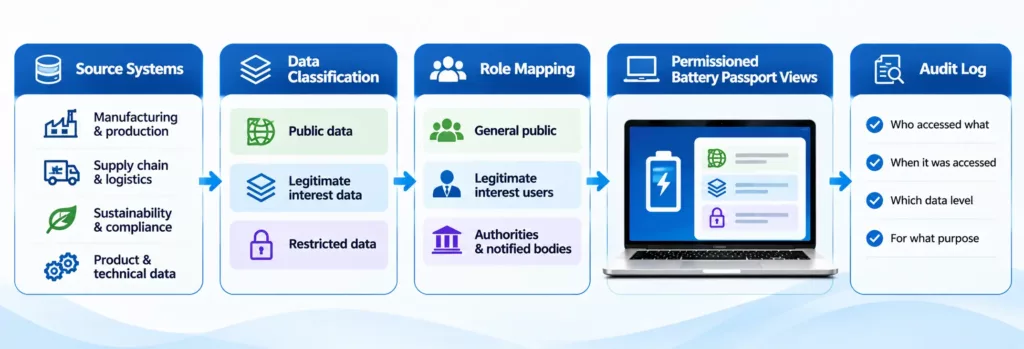
Battery Passport Access Rights: How Access Control Works
Article 78 requires the passport to be secure, interoperable and permission-based.
Authentication and identification
User permissions
Data visibility
Secure information sharing
Article 78 sets the technical design rules behind Battery Passport access rights. Rights to access, introduce, modify or update information must be restricted according to Annex XIII and the implementing act, and the system must protect data integrity, security and privacy. In practice, enforcing Battery Passport access levels rests on four controls:
Authentication and identification: a reader is verified before restricted data loads; public data needs no login.
User permissions: each verified role (recycler, notified body) is granted specific data groups.
Data visibility: the passport renders only the fields that role may see.
Secure information sharing: downloads and exports are logged and limited to permitted use.
Battery DPP Data Privacy Challenges for Manufacturers
The hard part is balancing openness for circularity against protection of know-how.
Protecting commercially sensitive information: detailed chemistry and test results are core IP.
Sharing technical information with authorised stakeholders: dismantling data must reach the right recycler, quickly.
Managing different access permissions: roles, verification and revocation multiply across markets.
Keeping information updated: state of health and battery status change through the battery’s life, and the passport must follow it, including when responsibility moves to a remanufacturer or repurposer.
Each challenge grows with volume, because Battery Passport access levels apply to every individual battery, not just every model.
Does it map every Annex XIII data point to an access tier?
Can legitimate interest rules be changed without redevelopment?
Does it verify a reader’s role before showing restricted data?
Are access, update and export events logged for audit?
Can it transfer responsibility when a battery is remanufactured or repurposed?
Is it interoperable with the EU DPP registry and open standards?
Frequently Asked Questions
What are Battery Passport access levels?
Battery Passport access levels are the three tiers set by Article 77(2) and Annex XIII of Regulation (EU) 2023/1542: public information, information for persons with a legitimate interest, and information reserved for notified bodies, market surveillance authorities and the Commission.
Is state of health data public in a battery passport?
No. State of health, charge cycles and negative events are individual battery data under point 4 of Annex XIII, available only to persons with a legitimate interest.
Who counts as a person with a legitimate interest?
The Regulation defines purposes centred on repair, remanufacturing, repurposing and recycling. The named list will come from the Article 77(9) implementing act, which missed its 18 August 2026 deadline and is targeted for Q4 2026.
Who can see battery test reports?
Only notified bodies, market surveillance authorities and the European Commission, under point 3 of Annex XIII.
Does the missing implementing act delay the battery passport?
No. The battery passport obligation in Article 77(1) applies from 18 February 2027 regardless.
Start using TraceX
Transparency, Trust, & Success for your Climate Journey.
We use cookies on our website to give you the most relevant experience by remembering your preferences and repeat visits. By clicking “Accept All”, you consent to the use of ALL the cookies. However, you may visit "Cookie Settings" to provide a controlled consent.
This website uses cookies to improve your experience while you navigate through the website. Out of these, the cookies that are categorized as necessary are stored on your browser as they are essential for the working of basic functionalities of the website. We also use third-party cookies that help us analyze and understand how you use this website. These cookies will be stored in your browser only with your consent. You also have the option to opt-out of these cookies. But opting out of some of these cookies may affect your browsing experience.
Necessary cookies are absolutely essential for the website to function properly. These cookies ensure basic functionalities and security features of the website, anonymously.
Cookie
Duration
Description
cookielawinfo-checkbox-analytics
11 months
This cookie is set by GDPR Cookie Consent plugin. The cookie is used to store the user consent for the cookies in the category "Analytics".
cookielawinfo-checkbox-functional
11 months
The cookie is set by GDPR cookie consent to record the user consent for the cookies in the category "Functional".
cookielawinfo-checkbox-necessary
11 months
This cookie is set by GDPR Cookie Consent plugin. The cookies is used to store the user consent for the cookies in the category "Necessary".
cookielawinfo-checkbox-others
11 months
This cookie is set by GDPR Cookie Consent plugin. The cookie is used to store the user consent for the cookies in the category "Other.
cookielawinfo-checkbox-performance
11 months
This cookie is set by GDPR Cookie Consent plugin. The cookie is used to store the user consent for the cookies in the category "Performance".
viewed_cookie_policy
11 months
The cookie is set by the GDPR Cookie Consent plugin and is used to store whether or not user has consented to the use of cookies. It does not store any personal data.
Functional cookies help to perform certain functionalities like sharing the content of the website on social media platforms, collect feedbacks, and other third-party features.
Performance cookies are used to understand and analyze the key performance indexes of the website which helps in delivering a better user experience for the visitors.
Analytical cookies are used to understand how visitors interact with the website. These cookies help provide information on metrics the number of visitors, bounce rate, traffic source, etc.
Advertisement cookies are used to provide visitors with relevant ads and marketing campaigns. These cookies track visitors across websites and collect information to provide customized ads.
Other uncategorized cookies are those that are being analyzed and have not been classified into a category as yet.
WhatsApp us
Download our eBook
Is Your Battery Supply Chain Ready for EU DPP Mandates?
The EU Battery Regulation sets strict data, carbon footprint, and circularity requirements. Download our comprehensive guide to understand key deadlines, technical standards, and the roadmap to achieve compliance without disrupting operations.
Get your free trial
Request for a Demo Session
Download your Battery Passport Access Levels: Who Can Access What Information in a Battery DPP? here
Download your Battery Passport Access Levels: Who Can Access What Information in a Battery DPP? here
Download your Battery Passport Access Levels: Who Can Access What Information in a Battery DPP? here