TRACES vs EUDR Compliance Software: What Is the Difference?
Published
, 8 minute read
Share this article
Quick summary: Understand the difference between the EU’s EUDR Information System (TRACES) and EUDR compliance software for supplier data, geolocation, risk assessment, traceability, and DDS workflows.
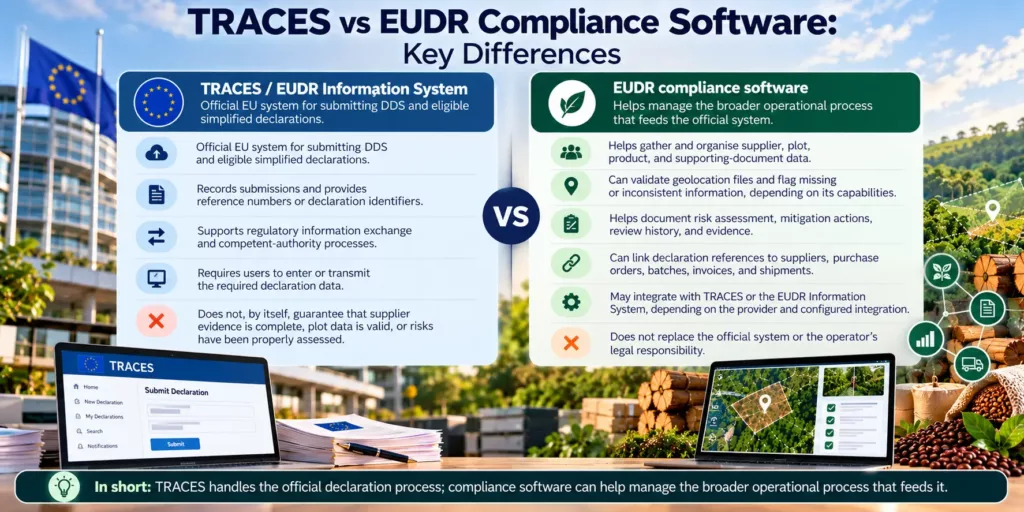
TRACES and EUDR compliance software serve different purposes. The EU’s EUDR Information System, accessed through TRACES NT, is the official system for submitting Due Diligence Statements (DDS) and eligible simplified declarations and receiving declaration references or identifiers. EUDR compliance software helps businesses organise the wider work needed to prepare for compliance, such as collecting supplier information, validating plot geolocation, managing evidence, assessing risks, tracking corrective actions, and connecting declarations to products and shipments. The official system supports regulatory submissions; a compliance platform can help manage the data and workflows behind them. Third-party software is not generally mandatory, and it does not transfer an operator’s legal responsibility.
Key Takeaways: TRACES vs EUDR Compliance Software
TRACES and EUDR compliance software serve different purposes.
TRACES is not a complete supply chain management solution.
Data readiness is critical.
Compliance software can streamline preparation.
The right choice depends on supply chain complexity.
Technology supports compliance but does not replace responsibility.
Choose tools based on your needs.
Download our eBook to assess your EUDR readiness, uncover data gaps, and take proactive steps towards stronger compliance.
TRACES NT is the European Commission’s online platform that includes the EUDR Information System. Operators or authorised representatives where permitted use the system to submit a DDS before placing relevant products on the EU market or exporting them. Eligible micro and small primary operators may use the simplified declaration process where the legal conditions are met.
The Information System records submissions and assigns the relevant reference number or declaration identifier. These identifiers help connect declarations to products and support information sharing with competent authorities and relevant supply-chain participants.
TRACES is an official regulatory submission system. It does not replace every internal process a business may need to collect supplier data, verify documents, coordinate teams, monitor plots, manage risk assessments, or connect compliance evidence with procurement and shipment records.
Learn how the EU Information System works, how to submit Due Diligence Statements (DDS), and how compliance software can simplify the process.
EUDR compliance software is a business tool that helps companies manage the information and activities needed to meet their obligations under the EU Deforestation Regulation. Depending on the platform, capabilities may include supplier onboarding, plot mapping, geolocation file validation, document collection, deforestation monitoring, legality evidence management, risk assessment, mitigation workflows, traceability, and declaration-reference management.
Some platforms offer integrations or APIs that exchange data with the EU Information System. Integration capabilities differ by provider and may require configuration, credentials, or technical work. Confirm exactly what a vendor supports instead of assuming every product can submit, retrieve, or update every type of declaration automatically.
The central distinction is that compliance software supports a company’s internal process, while TRACES is the official destination for regulatory submission. A platform can help prepare and organise data, but the operator must ensure the information is accurate and the required due diligence has been completed.
Is TRACES Free? Do You Need Paid EUDR Software?
The European Commission provides the EUDR Information System for regulatory submissions. Businesses do not have to purchase third-party software simply because they are subject to EUDR. Whether a company needs a separate platform is an operational decision based on the scale and complexity of its supply chain.
A business with a small number of suppliers and straightforward records may be able to manage its internal data using existing tools and submit declarations through the official system. A company managing hundreds of suppliers, many production plots, multiple commodities, frequent shipments, or several internal teams may find manual tracking difficult to control.
The comparison is not simply free versus paid. It is the cost and risk of managing data manually versus the value of better validation, traceability, collaboration, evidence retrieval, and fewer repeated follow-ups. Assess software based on actual workflow requirements, implementation effort, integration needs, support, and total cost not just a feature list.
When Does EUDR Compliance Software Add Value?
Supplier data is scattered. Supplier profiles, plot files, certificates, invoices, and declarations may sit in different folders or systems. A central workflow helps teams find current information and identify gaps.
Geolocation files need validation. Incorrect coordinates, invalid polygons, duplicate plots, or mismatches between plots and suppliers can delay assessment. Tools that validate geospatial data can flag issues for review.
Risk assessments need evidence. Teams need to document the information considered, risk conclusions, mitigation steps, and reasons for decisions. Workflow and audit-trail features can help maintain this record.
References must match transactions. DDS references need to be connected to the correct products and records. Linking references with product codes, purchase orders, invoices, quantities, and shipments reduces manual matching.
Multiple teams share responsibility. Procurement, sustainability, compliance, suppliers, and logistics teams need clear tasks and handoffs. Notifications and status tracking can reduce reliance on email follow-ups.
Evidence must be retrieved quickly. A structured system can help assemble records for internal review or requests from competent authorities. It cannot guarantee compliance, but it can improve the organisation and accessibility of supporting evidence.
Missed Our Webinar on EUDR Beyond DDS? Catch the Recording!
Watch the webinar recording to understand what lies beyond DDS filing and how to strengthen your EUDR compliance workflow.
Can it manage supplier onboarding and collect required information from multiple suppliers?
Does it validate geospatial formats used in our workflows?
Can we connect suppliers, plots, products, batches, and shipments?
How does it support risk assessment evidence and mitigation tracking?
Can it store and search DDS references or simplified declaration identifiers?
Does it integrate with the EUDR Information System, and exactly which functions are supported?
Can it integrate with our ERP, procurement, or logistics systems?
Can users export records and maintain a clear history of changes and decisions?
What implementation, training, support, security, and ongoing costs apply?
Request a demonstration using a representative supplier-to-shipment workflow. Test how the platform handles missing geolocation, inconsistent supplier records, duplicate plots, and a declaration reference that does not match a shipment not just an ideal scenario.
A Practical EUDR Workflow: Use the Right Tool for Each Job
Collect supplier and production information using a controlled workflow.
Validate plot geolocation and supporting documents.
Assess deforestation and legality risks, and document mitigation where required.
Confirm that the relevant product meets the applicable requirements before proceeding.
Prepare and submit the required DDS or eligible simplified declaration through the EUDR Information System.
Record the returned reference or identifier and connect it to the relevant product and transaction.
Keep records accessible and update the workflow when information changes or a concern is raised.
TRACES remains the official submission route. Compliance software can make the steps before and after submission easier to manage, especially across complex supply chains.
How TraceX Supports EUDR Compliance Workflows
TraceX helps businesses bring supplier onboarding, plot-level geolocation, traceability, risk assessment, and compliance evidence into a more connected workflow. Teams can use structured supplier data and validation processes to identify gaps earlier, coordinate follow-ups, and connect compliance information to relevant products and transactions.
For organisations evaluating software, the priority should be fit with their operating model: supplier volumes, commodity mix, data quality, shipment frequency, existing systems, and reporting needs. Ask for a walkthrough of the workflows you need, including any TRACES or EUDR Information System integration requirements, and confirm which capabilities are available in the proposed configuration.
TRACES and EUDR compliance software are complementary, not interchangeable. TRACES is the official EU system for declarations; a compliance platform can help businesses manage supplier data, geolocation, evidence, risk assessment, and traceability processes needed to support those submissions. The right approach depends on the size and complexity of your supply chain, but every operator remains responsible for fulfilling its applicable legal obligations.
Frequently Asked Questions
Is TRACES the same as EUDR compliance software?
No, TRACES is not same as EUDR Compliance software. TRACES NT includes the official EUDR Information System for regulatory submissions. EUDR compliance software supports the broader internal work of collecting and managing data and evidence.
Can a company comply with EUDR using TRACES alone?
No, TRACES alone will not suffice.The system can be used to submit declarations, but companies still need to gather required information, conduct due diligence where applicable, assess and mitigate risk, and maintain supporting records. Whether additional software is useful depends on business complexity.
Is third-party EUDR software mandatory?
No, third party EUDR software is not mandatory. Businesses must meet their legal obligations and may choose tools that help them do so.
Can EUDR software submit DDS automatically?
Some providers may offer integrations or API-based submission capabilities. Confirm the exact functions, setup requirements, and limitations with the vendor and current EU technical documentation.
Does a DDS reference prove a product is compliant?
DDS Reference need not prove that product is compliant. A reference confirms that a declaration was submitted and recorded in the Information System. It does not remove the operator’s responsibility for the accuracy of the information and the due diligence behind it.
Start using TraceX
Transparency, Trust, & Success for your Climate Journey.
We use cookies on our website to give you the most relevant experience by remembering your preferences and repeat visits. By clicking “Accept All”, you consent to the use of ALL the cookies. However, you may visit "Cookie Settings" to provide a controlled consent.
This website uses cookies to improve your experience while you navigate through the website. Out of these, the cookies that are categorized as necessary are stored on your browser as they are essential for the working of basic functionalities of the website. We also use third-party cookies that help us analyze and understand how you use this website. These cookies will be stored in your browser only with your consent. You also have the option to opt-out of these cookies. But opting out of some of these cookies may affect your browsing experience.
Necessary cookies are absolutely essential for the website to function properly. These cookies ensure basic functionalities and security features of the website, anonymously.
Cookie
Duration
Description
cookielawinfo-checkbox-analytics
11 months
This cookie is set by GDPR Cookie Consent plugin. The cookie is used to store the user consent for the cookies in the category "Analytics".
cookielawinfo-checkbox-functional
11 months
The cookie is set by GDPR cookie consent to record the user consent for the cookies in the category "Functional".
cookielawinfo-checkbox-necessary
11 months
This cookie is set by GDPR Cookie Consent plugin. The cookies is used to store the user consent for the cookies in the category "Necessary".
cookielawinfo-checkbox-others
11 months
This cookie is set by GDPR Cookie Consent plugin. The cookie is used to store the user consent for the cookies in the category "Other.
cookielawinfo-checkbox-performance
11 months
This cookie is set by GDPR Cookie Consent plugin. The cookie is used to store the user consent for the cookies in the category "Performance".
viewed_cookie_policy
11 months
The cookie is set by the GDPR Cookie Consent plugin and is used to store whether or not user has consented to the use of cookies. It does not store any personal data.
Functional cookies help to perform certain functionalities like sharing the content of the website on social media platforms, collect feedbacks, and other third-party features.
Performance cookies are used to understand and analyze the key performance indexes of the website which helps in delivering a better user experience for the visitors.
Analytical cookies are used to understand how visitors interact with the website. These cookies help provide information on metrics the number of visitors, bounce rate, traffic source, etc.
Advertisement cookies are used to provide visitors with relevant ads and marketing campaigns. These cookies track visitors across websites and collect information to provide customized ads.
Download the 2026 Traceability Scorecard and Benchmark Your Supply Chain Across 10 Critical Capabilities.
Download our eBook
Don’t Wait for an Audit to Find Your EUDR Gaps
The 2026 Simplification Package changes how HS codes, DDS pass-through and geolocation rules apply to you. Get the free guide and 20-point readiness checklist before enforcement catches you unprepared.