Farm Documentation Requirements: How EU, UK and US Regulations Are Changing
Published
, 14 minute read
Share this article
Quick summary: Learn how EU, UK and US rules are changing farm documentation requirements, from geolocation and supplier evidence to traceability records and audit readiness.
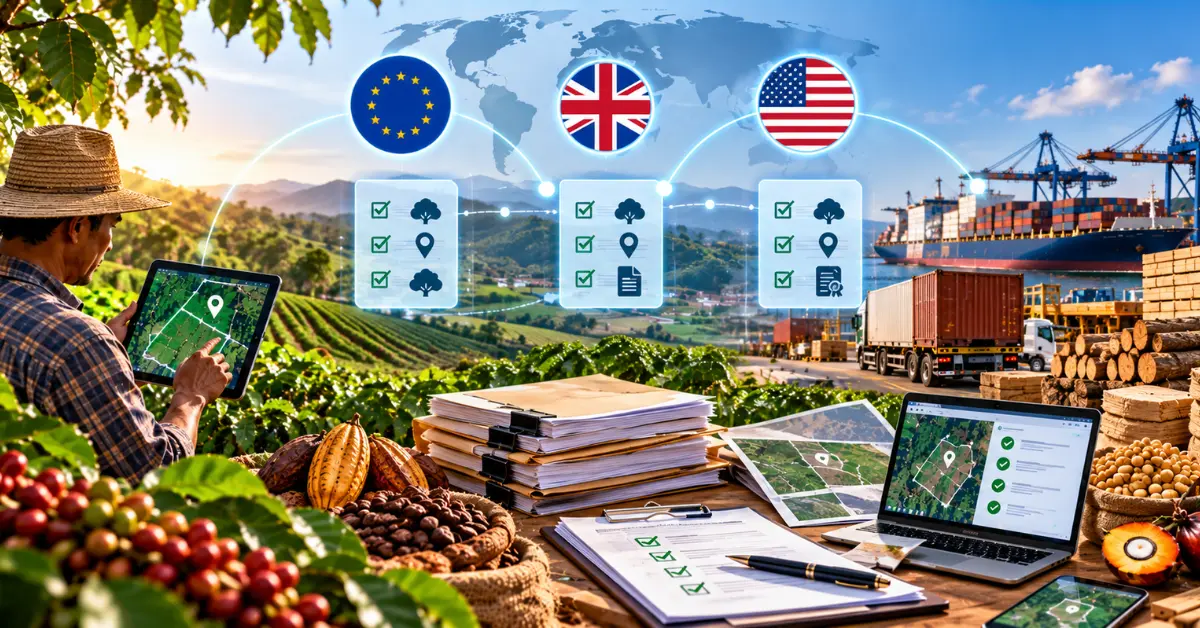
Farm documentation is no longer just paperwork. For companies sourcing agricultural commodities across international markets, it is becoming a foundation for supply-chain transparency, risk assessment and defensible compliance decisions.
Compliance and sustainability teams are often expected to answer questions that start at farm level: Where was a commodity produced? Which supplier or plot is connected to a shipment? What evidence supports a legality, deforestation, food-safety or labour-related claim? Can the business retrieve the relevant records quickly and explain how it assessed them?
The EU, UK and US do not impose one universal set of farm documentation rules. Their requirements differ in scope and purpose. Yet the direction of travel is clear: businesses need more reliable information, better links between records and products, and processes for assessing evidence rather than simply collecting files.
Key Takeaways: Farm Documentation Requirements Across the EU, UK and US
Farm documentation is essential for compliance
Regulatory requirements differ by market
Accurate farm geolocation matters
Supplier certificates alone may not be sufficient
Manual documentation creates challenges at scale
Centralised digital records improve visibility
Prepare documentation before audits
Digital compliance tools can simplify management
Book a sustainable sourcing consultation with TraceX
Identify gaps in your current processes and explore practical ways to improve supply-chain transparency, sustainability, and compliance readiness.
Three operational pressures are driving the change.
First, regulations and buyer expectations increasingly ask businesses to demonstrate how they reached a compliance decision.
Second, supply chains can involve cooperatives, aggregators, processors, traders and exporters, making it difficult to connect a final shipment to its origin.
Third, spreadsheet-based systems become harder to maintain as supplier networks and reporting needs grow.
A certificate may be useful evidence, but it does not automatically answer every question a regulator or customer may ask. Depending on the applicable framework, teams may also need underlying supplier details, plot or location information, transaction records, batch links, risk assessments, corrective actions, or evidence that a document is valid and relevant to the product in question.
Managing farm records, tracking supplier information, and maintaining accurate plot-level data are essential for building a compliant and transparent agricultural supply chain.
1. The EU: farm origin, geolocation and evidence behind due diligence
The EU Deforestation Regulation (EUDR) is a prominent example of regulation that makes origin data and evidence central to market access for covered commodities and products. Its scope includes cattle, cocoa, coffee, oil palm, rubber, soy and wood, along with specified derived products in the regulation’s product annex.
For relevant products within scope, operators must collect information, assess risk and meet the applicable due-diligence requirements before placing products on the EU market or exporting them. The EUDR framework includes geolocation information for production plots and information intended to demonstrate that products are deforestation-free and produced in accordance with relevant legislation in the country of production. Exact duties depend on the company’s role and the product.
As of 9 October 2026, the European Commission states that the regulation is scheduled to apply from 30 December 2026 for large and medium-sized operators and for micro and small operators already covered by the EU Timber Regulation, and from 30 June 2027 for other micro and small operators. Businesses should confirm their classification, role, product scope and the latest official guidance before relying on these dates.
What this means for documentation teams
Maintain accurate supplier and producer identities, with clear links between suppliers, farms or plots, commodities and relevant shipments.
Collect and validate geolocation data where required; establish a process for correcting missing, inconsistent or invalid plot information.
Keep supporting evidence organised so the team can explain the risk assessment and the basis for its conclusion.
Track relevant due-diligence references and related records against the products and transactions to which they apply.
The practical lesson is that a folder of certificates is not a substitute for traceability. The evidence needs to be relevant to the product and supply chain being assessed, and the company must understand what the evidence does and does not establish.
EUDR compliance goes beyond collecting supplier documents. Businesses need reliable plot-level geolocation, supply chain traceability, deforestation-risk assessment, and verifiable evidence to support their due diligence obligations.
2. The UK: distinguish existing timber rules from developing forest-risk proposals
The UK position needs careful treatment because not every announced policy is already an operative legal requirement. In Great Britain, the UK Timber Regulation continues to require operators placing timber and timber products on the market to exercise due diligence to avoid placing illegally harvested timber on the market. The process includes gathering information about the timber and its supply, assessing risk, and taking steps to mitigate risk where necessary. Traders must retain information that identifies their suppliers and, where applicable, the traders to whom they supplied products.
Separately, the UK Environment Act 2021 contains a framework for due diligence relating to forest-risk commodities, but implementing details depend on secondary legislation. In June 2026, the UK Government published its approach and said it was considering how to strengthen rules for commodities such as cocoa, coffee, soy, palm oil and rubber. As of the date of this article, these proposals should not be described as though a complete new regime is already in force across Great Britain. Northern Ireland is a distinct case because the EUDR is scheduled to apply there from the end of 2026.
Navigating UK Timber Regulation requirements involves more than collecting supplier certificates. Businesses need reliable timber-origin information, risk-based due diligence, effective risk mitigation, and organised records to demonstrate compliance.
For timber covered by UK rules, preserve supplier identity, product and species information, harvest-country information, legality evidence and the reasoning behind risk assessment and mitigation.
Monitor official UK announcements and implementation details before designing controls around proposed forest-risk commodity rules.
Keep records flexible enough to add new data fields or evidence requirements without rebuilding the entire supplier database.
For cross-market businesses, the key is to separate what the law currently requires from what customers request and what future rules may require. A well-designed documentation process can prepare for change, but the article or internal procedure should not present a proposal as an enacted obligation.
3. The US: traceability and forced-labour evidence are different use cases
In the United States, farm documentation requirements depend heavily on the product and the regulatory issue. Two examples illustrate why a single generic checklist is not enough.
Food traceability for certain foods
The FDA’s Food Traceability Rule applies to covered persons who manufacture, process, pack or hold foods on the Food Traceability List, subject to applicable exemptions. It requires records containing key data elements linked to specified critical tracking events, such as harvesting, cooling, initial packing, shipping, receiving and transformation. Covered businesses also need a traceability plan; for farms growing covered foods, that plan includes a farm map identifying relevant growing areas.
The rule is not a universal requirement for every farm or every agricultural product. As of 9 October 2026, FDA states that Congress directed the agency not to enforce the rule before 20 July 2028, and FDA intends to comply. Businesses should check the FDA’s current guidance and assess whether their food and activities are covered. The delay is not a reason to ignore existing food-safety or recordkeeping obligations.
Forced-labour and import traceability
The Uyghur Forced Labor Prevention Act (UFLPA) creates a rebuttable presumption that goods mined, produced or manufactured wholly or in part in the Xinjiang Uyghur Autonomous Region, or by entities on the UFLPA Entity List, are prohibited from entering the United States unless the statutory requirements for an exception are met. In practice, importers may need to assemble detailed supply-chain documentation to establish where goods and inputs originated and to respond to a detention or enforcement inquiry.
This is not the same as a general farm-documentation mandate applying to all US agricultural suppliers. Rather, it shows how origin records, supplier identities, transaction documents and traceability across multiple tiers can become critical when a shipment raises forced-labour concerns. Importers should follow current CBP guidance and obtain specialist advice for case-specific submissions.
What this means for documentation teams
For covered foods, connect relevant tracking events and required data elements to traceability lots and supporting business records.
For forced-labour risk, map suppliers and input origins far enough upstream to support the applicable review; keep records consistent across invoices, bills of materials, shipping documents and supplier declarations.
Define which records are required by law, which are needed for a customer’s due diligence, and which are maintained as internal risk controls.
The US examples reinforce a broader point: the right evidence depends on the risk and rule in question. A generic supplier certificate may not provide the lot-level data needed for food traceability or the upstream origin evidence needed for a forced-labour review.
What documentation teams should organise across markets
There is no single document pack that guarantees compliance in every market. However, many organisations can improve readiness by structuring records into a consistent set of categories, then mapping each category to the legal requirements and buyer commitments that actually apply.
Supplier and producer identity: legal entity, supplier relationships, producer or cooperative records, and verification status.
Farm and location data: farm address, plot or field identifiers, geolocation or maps where required, and a process for validating updates.
Commodity and production records: commodity, variety where relevant, harvest or production period, quantity, and related transaction information.
Supporting evidence: permits, certificates, declarations, legality documents and other source records, with expiry dates and applicability clearly tracked.
Traceability links: links between farms, suppliers, collection points, batches or lots, processing steps, invoices and shipments.
Risk assessment and follow-up: risk factors considered, sources checked, decisions made, mitigation steps, responsible owners and dates.
Retention and retrieval: record owner, storage location, version history, retention period and a reliable way to retrieve evidence for an audit or authority request.
The goal is not to collect every possible document from every farm. It is to define what is relevant, obtain accurate information from the right party, validate it proportionately to risk, and maintain a clear connection between the evidence and the product or activity it supports.
Hypothetical example: an exporter serving three markets
Consider a hypothetical exporter that sources coffee and other agricultural products from several cooperatives. It sells to customers in the EU, UK and US. Supplier certificates arrive by email, farmer lists sit in spreadsheets, plot files are stored in different folders, and shipment records are maintained by a separate operations team.
When an EU customer asks for information connected to relevant coffee plots, the compliance team cannot quickly determine which plot file belongs to which supplier and shipment. A UK buyer requests evidence of origin and supplier checks, but the supporting documents are spread across several systems. A US customer asks for traceability details for a specific food lot or upstream origin evidence, and the team has to reconstruct the chain manually.
The exporter may possess many documents, yet still struggle to demonstrate how they relate to the shipment under review. The gap is not simply the absence of paperwork; it is the absence of dependable connections between supplier identity, farm records, supporting evidence, product batches and commercial transactions.
The exporter begins consolidating digital farmer profiles, supplier records, plot data, certificates and supporting documents in one system. It links farm and supplier information to collection events and batches, establishes validation checks for geolocation and required fields, and assigns responsibility for resolving gaps. Compliance staff can then retrieve a traceable evidence trail and identify missing information earlier.
This change does not automatically make every shipment compliant. The team still needs to determine which rules apply, assess the evidence and follow the relevant legal process. But a connected system makes the work more consistent, easier to review and less dependent on searching through individual inboxes.
Why spreadsheets and manual collection become difficult to scale
Spreadsheets can be useful for pilots and small supplier groups. Problems arise when different teams maintain separate versions, identifiers are inconsistent, files are updated without a clear history, or the business cannot tell whether a certificate applies to a particular farm, product or period. Manual collection also makes it harder to spot missing records before a shipment or audit deadline.
A digital traceability system should not simply turn paper forms into online forms. It should help teams connect records, validate data, manage changes, identify gaps and retrieve evidence. A practical system can include:
Digital farmer profiles and centralised supplier records.
Farm geolocation and plot-level mapping, with validation and correction workflows.
Digital collection and storage of certificates and supporting documents.
Traceability across suppliers, farms and product batches.
Audit-ready evidence and compliance reporting.
These capabilities help teams manage documentation as a process rather than a last-minute request. They also make it easier to reuse reliable supplier information where appropriate, while preserving the distinct requirements of each market and regulation.
How TraceX can help
TraceX Sustainable Sourcing Solutions helps businesses organise farm and supplier information, manage plot-level geolocation, maintain supporting documents, trace products across suppliers and batches, and prepare audit-ready compliance evidence. These capabilities can help compliance and sustainability teams identify gaps earlier and manage documentation more consistently across complex agricultural supply chains.
Want to understand where your farm documentation process has gaps?
Assess your farm documentation and traceability needs across the markets you serve.
Conclusion: build farm documentation around evidence, not paperwork
Farm documentation requirements are changing because companies are increasingly expected to explain the origin of products, connect evidence across supply chains and show how they assessed risk. The details differ across the EU, UK and US: EUDR focuses on covered commodities and deforestation-related due diligence; UK timber rules require due diligence against illegal harvesting, while wider forest-risk proposals are developing; and US requirements include specific food-traceability and forced-labour contexts.
The practical response is not to assume that one certificate or one checklist will satisfy every obligation. Teams should identify the rules that apply, collect the right information, verify it, connect it to farms and products, and keep it retrievable. Compliance should start at farm level not when an audit or shipment deadline arrives.
Frequently Asked Questions
What are farm documentation requirements?
Farm documentation requirements are the records and evidence businesses maintain to demonstrate information about farms, farmers, production practices, product origin, and compliance with applicable legal or customer requirements. Depending on the market and commodity, these may include farmer details, land records, geolocation data, supplier documents, and production records.
How do farm documentation requirements differ across the EU, UK, and US?
Requirements vary depending on the regulation, commodity, product, and business role. EU businesses may need to meet requirements under frameworks such as EUDR. UK businesses must consider applicable UK legislation, while US businesses may face requirements relating to areas such as food safety, agricultural imports, or product-specific laws. Not every requirement applies to every farm or business.
What documents should businesses collect from farmers and suppliers?
Depending on the product and applicable regulations, businesses may need to collect:
Farmer and supplier identification details
Farm ownership, land-use, or production records, where relevant
Farm geolocation coordinates or plot boundaries, where required
Product origin and harvest information
Relevant licences, certificates, and legality documents
Procurement, transaction, and batch traceability records
Supporting evidence for sustainability or compliance claims
The exact documentation should be determined by the applicable legal requirements and the business’s supply-chain risks.
Why are Excel sheets and PDFs challenging for farm compliance?
Spreadsheets and PDFs can become difficult to manage when businesses work with many farmers, suppliers, commodities, and markets. Information may be duplicated, documents may become outdated, and connecting farm-level evidence to specific products or shipments can require significant manual effort. A centralised digital system can improve data consistency, accessibility, and traceability.
How can TraceX help businesses manage farm documentation requirements?
TraceX helps businesses digitise farmer profiles, centralise supplier documents, map farm plots, connect farm-level records with supply-chain transactions, and organise evidence for compliance reporting and audits. These capabilities can support documentation management across complex agricultural supply chains, while businesses remain responsible for determining and meeting their applicable legal obligations.
Start using TraceX
Transparency, Trust, & Success for your Climate Journey.
We use cookies on our website to give you the most relevant experience by remembering your preferences and repeat visits. By clicking “Accept All”, you consent to the use of ALL the cookies. However, you may visit "Cookie Settings" to provide a controlled consent.
This website uses cookies to improve your experience while you navigate through the website. Out of these, the cookies that are categorized as necessary are stored on your browser as they are essential for the working of basic functionalities of the website. We also use third-party cookies that help us analyze and understand how you use this website. These cookies will be stored in your browser only with your consent. You also have the option to opt-out of these cookies. But opting out of some of these cookies may affect your browsing experience.
Necessary cookies are absolutely essential for the website to function properly. These cookies ensure basic functionalities and security features of the website, anonymously.
Cookie
Duration
Description
cookielawinfo-checkbox-analytics
11 months
This cookie is set by GDPR Cookie Consent plugin. The cookie is used to store the user consent for the cookies in the category "Analytics".
cookielawinfo-checkbox-functional
11 months
The cookie is set by GDPR cookie consent to record the user consent for the cookies in the category "Functional".
cookielawinfo-checkbox-necessary
11 months
This cookie is set by GDPR Cookie Consent plugin. The cookies is used to store the user consent for the cookies in the category "Necessary".
cookielawinfo-checkbox-others
11 months
This cookie is set by GDPR Cookie Consent plugin. The cookie is used to store the user consent for the cookies in the category "Other.
cookielawinfo-checkbox-performance
11 months
This cookie is set by GDPR Cookie Consent plugin. The cookie is used to store the user consent for the cookies in the category "Performance".
viewed_cookie_policy
11 months
The cookie is set by the GDPR Cookie Consent plugin and is used to store whether or not user has consented to the use of cookies. It does not store any personal data.
Functional cookies help to perform certain functionalities like sharing the content of the website on social media platforms, collect feedbacks, and other third-party features.
Performance cookies are used to understand and analyze the key performance indexes of the website which helps in delivering a better user experience for the visitors.
Analytical cookies are used to understand how visitors interact with the website. These cookies help provide information on metrics the number of visitors, bounce rate, traffic source, etc.
Advertisement cookies are used to provide visitors with relevant ads and marketing campaigns. These cookies track visitors across websites and collect information to provide customized ads.
Download the 2026 Traceability Scorecard and Benchmark Your Supply Chain Across 10 Critical Capabilities.
Download our eBook
Don’t Wait for an Audit to Find Your EUDR Gaps
The 2026 Simplification Package changes how HS codes, DDS pass-through and geolocation rules apply to you. Get the free guide and 20-point readiness checklist before enforcement catches you unprepared.