Contract Farming Management Software: How Agribusinesses Can Manage Farmers, Contracts, Inputs and Harvests
Published
, 12 minute read
Share this article
Quick summary: Discover how contract farming management software helps agribusinesses manage farmers, digital agreements, inputs, crop plans, field activities, harvests, procurement and traceability at scale.
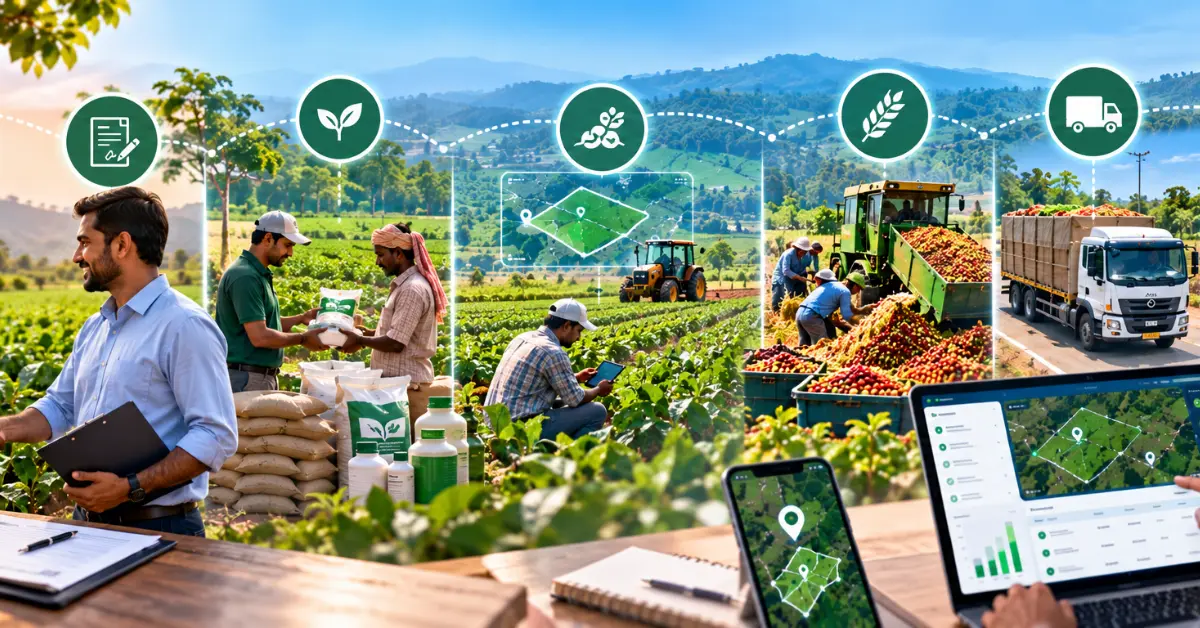
Contract Farming Management Software enables agribusinesses to manage farmers, contracts, crop activities, procurement, and traceability from farm to market. Contract farming gives agribusinesses a structured way to work with farmers before a crop is harvested. The model can improve supply planning, quality control, farmer support and procurement visibility. But managing thousands of contracted farmers through spreadsheets, paper agreements, phone calls and disconnected systems quickly becomes difficult.
This is where contract farming management software becomes valuable. Instead of treating farmer registration, contracts, crop plans, input distribution, field monitoring and harvest procurement as separate activities, a digital platform connects them into one operating workflow.
For an agribusiness, the objective is not simply to store farmer information digitally. The objective is to create a reliable relationship between the farmer, contracted crop, farm or plot, agreement, production plan, inputs, field activities, harvest and purchase transaction.
This connected model gives procurement, field teams, sustainability teams, quality teams and management a common view of contract farming performance.
Key Takeaways
Centralize Farmer Management
Digitize Contract Management
Streamline Input Distribution
Improve Crop Planning
Monitor Farm Activities
Track Harvests Digitally
Connect Procurement with Farm Data
Strengthen Traceability
Improve Farmer Performance Visibility
Enable Data-Driven Decisions
Reduce Manual Processes
Build Scalable Contract Farming Operations
Discover how TraceX Farm Management helps agribusinesses digitize farmer onboarding, contracts, crop planning, input distribution, field activities, harvests, procurement, and traceability through one connected platform.
Contract farming management software is a digital platform designed to help agribusinesses manage the complete lifecycle of contract farming relationships.
It typically covers farmer onboarding, farm and plot mapping, contract or agreement management, crop planning, input allocation, field activities, inspections, expected yield, harvest collection, procurement and reporting.
The most useful systems go beyond farmer databases. They connect operational events to the commercial agreement. For example, a farmer may be contracted to cultivate a specific crop on a defined plot during a particular production period. The system can associate the farmer with the agreement, planned acreage, input allocation, expected yield and eventual procurement quantity.
This creates a digital record that can answer questions such as:
Which farmers are under contract?
Which plots are associated with each contract?
What crop and quantity were committed?
Which inputs were issued?
Which field activities were completed?
What yield was expected?
How much was actually harvested and purchased?
Which batches contain produce from contracted farmers?
That visibility is the foundation of scalable contract farming management.
Explore how digital contract farming helps businesses manage farmers, contracts, inputs, crop activities, procurement, harvests, and traceability while improving visibility and operational efficiency. Read the Full Blog →
Why Agribusinesses Struggle to Manage Contract Farming at Scale
Contract farming becomes operationally complex as the number of farmers, crops, regions and collection points increases.
A common problem is fragmented information. Farmer details may sit in one spreadsheet, agreements in another folder, input records in a warehouse system and procurement data in an ERP. Field officers may maintain additional information on mobile devices or paper forms.
This creates several challenges:
Difficulty keeping farmer records accurate and current
Manual creation and tracking of farmer agreements
Limited visibility into contracted acreage and crop commitments
Poor tracking of inputs issued to individual farmers
Difficulty monitoring field activities
Unreliable yield forecasts
Mismatch between contracted quantities and actual procurement
Slow reconciliation of farmer deliveries and payments
Limited traceability from purchased produce back to farms
Difficult preparation of customer, audit and sustainability evidence
Contract farming management software addresses these challenges by creating a shared digital workflow where each operational event is connected to the correct farmer and contract.
Discover how agribusinesses can address fragmented farmer data, inconsistent farm practices, procurement challenges, limited visibility, and traceability gaps to build more efficient and transparent contract farming operations.Read the Full Blog →
Key Features of Contract Farming Management Software
A scalable contract farming platform should support the entire farmer-to-procurement lifecycle.
1. Farmer Registration and Master Data
Create unique farmer profiles with contact information, location, farm associations, crops and relevant documents. A governed farmer master reduces duplicates and gives every department a consistent reference.
2. Farm and Plot Mapping
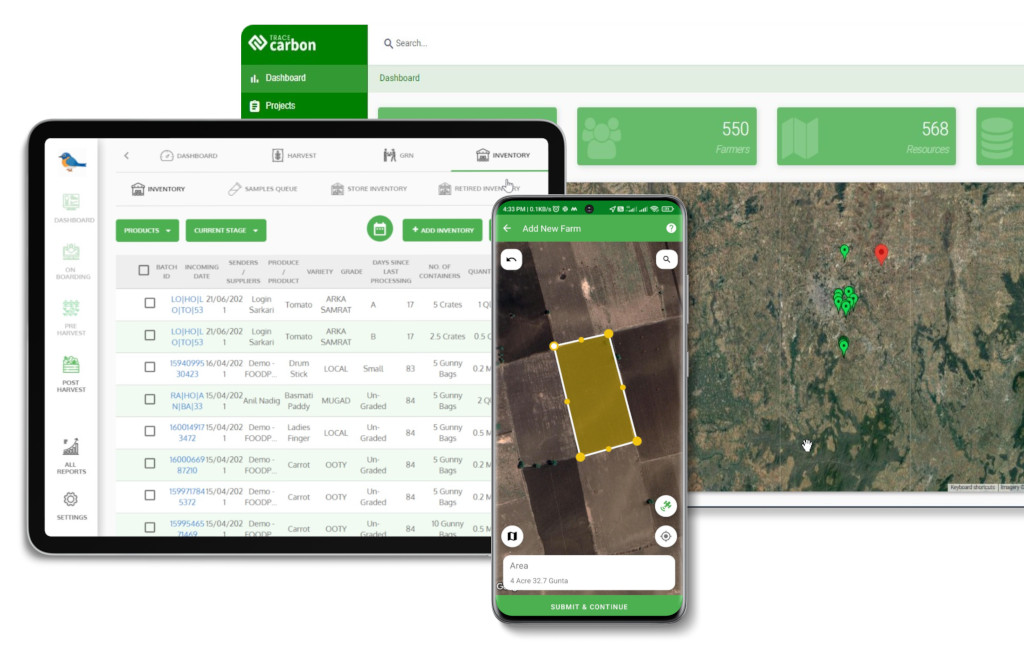
Associate farmers with farms and individual plots. Geospatial records provide greater visibility into where contracted production occurs and can support traceability and applicable sustainability requirements.
3. Digital Contract and Agreement Management
Contracts can be linked directly to farmer records, production cycles and crop plans. Key fields may include crop, acreage, expected quantity, pricing mechanism, delivery terms, input arrangements and agreement status.
Streamline Farmer Agreements with TraceX. Discover how TraceX helps agribusinesses digitize contract generation, automate business rules, align farmer agreements with sustainability requirements, and strengthen compliance and operational accountability.Read the Full Case Study →
4. Crop Planning
Field teams can create production plans for contracted crops, including acreage, planting period, expected yield and target harvest window. This helps procurement teams anticipate future supply.
5. Input Management
Track seeds, fertilizers, crop-protection products and other inputs allocated or distributed to contracted farmers. Inputs can be linked to specific farmers, plots, crops and production cycles.
6. Field Activity and Monitoring
Capture visits, inspections, agronomic observations and other activities through mobile workflows. Managers can identify exceptions and prioritize field interventions.
7. Yield Estimation
Expected yield can be calculated or recorded at farmer, plot, crop and regional levels. Comparing expected and actual yield helps procurement teams understand supply gaps early.
8. Harvest and Procurement Management
Harvest records can be connected to farmer contracts and procurement transactions. This creates a clear relationship between what was contracted, what was produced and what was purchased.
9. Traceability
The platform should connect farm origin with collection, batches, processing and finished products where required. This is especially important for export-oriented agribusinesses.
10. Dashboards and Reporting
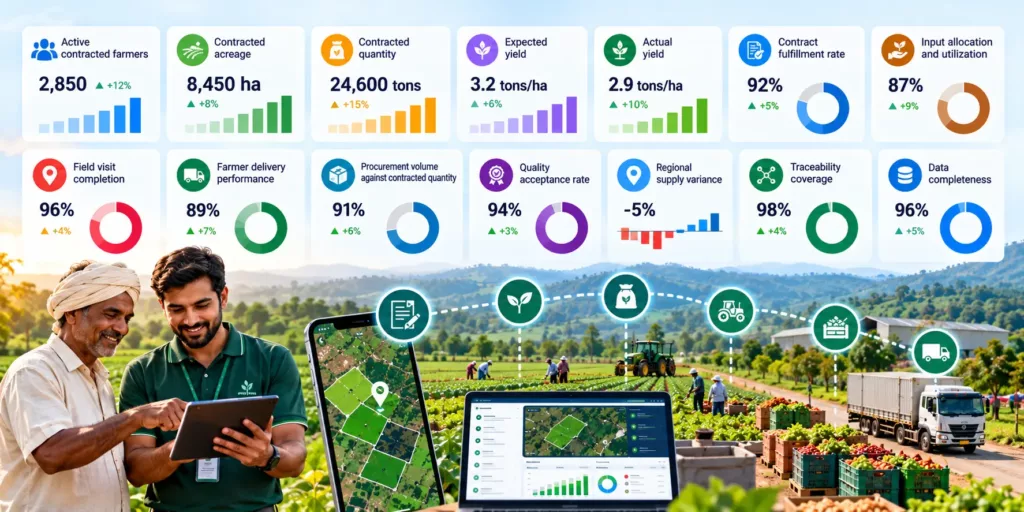
Management dashboards can show contracted acreage, expected supply, input distribution, field activity completion, harvest performance, procurement and exceptions.
Discover how digital contract farming platforms help agribusinesses streamline farmer onboarding, manage farm and crop data, monitor field activities, simplify procurement, and strengthen end-to-end traceability.Read the Full Blog →
How Contract Farming Management Software Works: End-to-End Workflow
A practical workflow begins before planting and continues through procurement.
Step 1: Register the Farmer
Create a unique farmer profile and capture relevant farm, location and production information.
Step 2: Map the Farm or Plot
Record the farm or plot associated with the contracted production. This provides a geographic foundation for the relationship.
Step 3: Create the Agreement
Capture the commercial terms, crop, acreage, expected quantity, production period, pricing structure and relevant obligations.
Step 4: Create the Crop Plan
Record planned production activities, planting dates, expected yield and target harvest period.
Step 5: Allocate Inputs
Record which inputs are issued or recommended to the farmer and associate them with the relevant crop cycle.
Step 6: Monitor Production
Field teams record visits, inspections, crop progress and exceptions.
Step 7: Estimate Yield
Use acreage, crop information, field observations and historical data to estimate expected production.
Step 8: Record Harvest
Capture actual harvested quantities and link them to the farmer and production cycle.
Step 9: Procure the Crop
Connect procurement transactions to the relevant farmer and contract. This enables comparison between committed and delivered quantities.
Step 10: Trace and Report
Where required, connect procurement lots to batches, processing and shipments while generating management and compliance reports.
TraceX Contract Farm Management Software helps agribusinesses digitize and manage contract farming operations from farmer onboarding to harvest and procurement. It enables teams to manage farmer profiles, agreements, crop plans, inputs, field activities, harvests, procurement, and traceability through one connected platform. With real-time farm-level data and workflow automation, TraceX improves operational visibility, farmer engagement, compliance, and end-to-end traceability across contract farming programs.
Managing contract farmers through spreadsheets and disconnected records?
Explore how TraceX can help digitize farmer onboarding, agreements, farm and plot data, crop planning, input distribution, field monitoring, harvest and procurement while creating a connected foundation for traceability and export requirements.
Contract farming management software can significantly improve procurement planning because it connects planned supply with actual field performance.
Instead of waiting for farmers to deliver crops before identifying supply gaps, procurement teams can monitor contracted acreage, expected yield, crop progress and harvest timing.
For example, if an agribusiness has contracts covering 10,000 hectares, the business can compare expected production against procurement targets by region. If field observations indicate lower-than-expected production in one area, procurement teams can respond earlier by adjusting collection plans or sourcing requirements.
This changes procurement from a reactive activity into a more data-driven planning process.
Benefits for Farmer Management and Field Teams
Field teams often become the bridge between the agribusiness and its contracted farmers. Without a structured system, they may spend significant time maintaining records rather than managing field performance.
A mobile-enabled platform can give field officers access to farmer profiles, contracts, crop plans and previous visits. They can record observations at the point of activity and synchronize information into the central system.
Managers can then identify incomplete visits, production exceptions, missing data or farmers requiring intervention.
This improves consistency while reducing the dependency on paper forms and manual consolidation.
Connecting Contracts to Traceability
One of the strongest reasons to digitize contract farming is the ability to connect commercial commitments with physical product movement.
A contract should not remain an isolated PDF. It can become part of a connected supply-chain record:
This relationship makes it easier to investigate product origin and demonstrate sourcing history.
For businesses serving export markets, the same data foundation can also support applicable sustainability, customer due-diligence and traceability programs. Geolocation, production period, farmer identity, harvest and procurement relationships can be maintained as structured records rather than reconstructed when a request arrives.
Contract Farming Management Software and ERP: Do They Replace Each Other?
In most enterprises, contract farming management software does not need to replace the ERP.
The ERP can remain the system of record for financial transactions, purchase orders, inventory, accounting and logistics. A specialized farm and contract management layer can manage farmer relationships, farm data, crop plans, field activities, inputs, harvest and origin traceability.
Integration connects these systems so that the organization can maintain operational specialization without creating disconnected silos.
This approach is particularly useful for large agribusinesses that already have enterprise systems but need more granular visibility at the farm level.
How to Choose Contract Farming Management Software
Agribusinesses should evaluate platforms based on the complexity of their operating model rather than selecting a solution based only on the number of features.
First, examine the data model. Can the platform connect farmer, farm, plot, contract, crop, harvest and procurement records?
Second, evaluate field usability. Can field officers capture information quickly from mobile devices in real operating conditions?
Third, assess geospatial capabilities if farm or plot-level traceability is important.
Fourth, evaluate integration. The platform should be able to connect with ERP, procurement, inventory and logistics systems.
Fifth, assess scalability. A system designed for a few hundred farmers may not be appropriate for tens of thousands of farmers across multiple regions.
Finally, consider future requirements. The platform should be capable of supporting traceability, sustainability data, customer evidence and applicable regulatory workflows as the business evolves.
A Practical Roadmap to Digitize Contract Farming
A phased approach helps agribusinesses move quickly without trying to digitize everything at once.
Phase 1: Clean and digitize farmer master data.
Phase 2: Map farms and plots and establish unique identifiers.
Phase 3: Digitize contracts and connect them to farmers and production cycles.
Phase 4: Introduce crop planning, input distribution and field monitoring.
Phase 5: Add yield estimation and harvest management.
Phase 6: Connect procurement transactions to farmer and contract records.
Phase 7: Extend traceability from farms to batches, processing and shipments.
Phase 8: Integrate with ERP and other enterprise systems.
Phase 9: Build management dashboards and exception-based workflows.
This progression creates value at every stage while building toward a connected contract farming operating model.
Conclusion: Turn Contract Farming Into a Connected Digital Workflow
Contract farming can provide agribusinesses with greater supply visibility and stronger farmer relationships, but only when the underlying information is managed effectively.
Contract farming management software brings together the operational and commercial elements of the model: farmer registration, farm mapping, agreements, crop planning, inputs, field monitoring, yield estimation, harvest and procurement.
The biggest opportunity is not simply eliminating spreadsheets. It is creating connected data that allows an agribusiness to move from a farmer record to a contract, from a contract to production, from production to harvest and from harvest to the purchased batch.
For organizations managing large farmer networks, this digital connection can improve procurement planning, operational control, traceability and readiness for increasingly data-driven customer and sustainability requirements.
The right contract farming management software should therefore be viewed as an operating layer for the agricultural supply chain not merely a farmer database.
Frequently Asked Questions
What is contract farming management software?
Contract farming management software is a digital platform that helps agribusinesses manage farmers, contracts, crop plans, inputs, field activities, harvests and procurement through connected workflows.
Who uses contract farming management software?
Typical users include procurement teams, field officers, agronomists, farmer relationship teams, sustainability teams, quality teams, supply-chain managers and business leaders.
Can contract farming software manage digital farmer agreements?
Yes. A suitable platform can link agreements to farmer profiles, plots, crops, production periods, quantities, pricing or delivery terms and relevant supporting records.
Can it track inputs provided to farmers?
Yes. Inputs such as seeds, fertilizers and crop-protection products can be recorded against farmers, plots and crop cycles, providing better visibility into input allocation and utilization.
Can contract farming software support yield estimation?
Yes. Digital records of acreage, crop plans, historical production, field observations and harvests can support more structured yield estimation and supply forecasting.
Does contract farming management software support traceability?
It can. When farmer, plot, harvest and procurement records are linked to batches and downstream processing, the platform can provide farm-to-product traceability.
Can it integrate with an ERP?
A modern platform should be capable of integrating with ERP and other enterprise systems, allowing the farm and contract layer to manage granular agricultural data while the ERP continues to handle procurement, inventory, finance and logistics.
Start using TraceX
Transparency, Trust, & Success for your Climate Journey.
We use cookies on our website to give you the most relevant experience by remembering your preferences and repeat visits. By clicking “Accept All”, you consent to the use of ALL the cookies. However, you may visit "Cookie Settings" to provide a controlled consent.
This website uses cookies to improve your experience while you navigate through the website. Out of these, the cookies that are categorized as necessary are stored on your browser as they are essential for the working of basic functionalities of the website. We also use third-party cookies that help us analyze and understand how you use this website. These cookies will be stored in your browser only with your consent. You also have the option to opt-out of these cookies. But opting out of some of these cookies may affect your browsing experience.
Necessary cookies are absolutely essential for the website to function properly. These cookies ensure basic functionalities and security features of the website, anonymously.
Cookie
Duration
Description
cookielawinfo-checkbox-analytics
11 months
This cookie is set by GDPR Cookie Consent plugin. The cookie is used to store the user consent for the cookies in the category "Analytics".
cookielawinfo-checkbox-functional
11 months
The cookie is set by GDPR cookie consent to record the user consent for the cookies in the category "Functional".
cookielawinfo-checkbox-necessary
11 months
This cookie is set by GDPR Cookie Consent plugin. The cookies is used to store the user consent for the cookies in the category "Necessary".
cookielawinfo-checkbox-others
11 months
This cookie is set by GDPR Cookie Consent plugin. The cookie is used to store the user consent for the cookies in the category "Other.
cookielawinfo-checkbox-performance
11 months
This cookie is set by GDPR Cookie Consent plugin. The cookie is used to store the user consent for the cookies in the category "Performance".
viewed_cookie_policy
11 months
The cookie is set by the GDPR Cookie Consent plugin and is used to store whether or not user has consented to the use of cookies. It does not store any personal data.
Functional cookies help to perform certain functionalities like sharing the content of the website on social media platforms, collect feedbacks, and other third-party features.
Performance cookies are used to understand and analyze the key performance indexes of the website which helps in delivering a better user experience for the visitors.
Analytical cookies are used to understand how visitors interact with the website. These cookies help provide information on metrics the number of visitors, bounce rate, traffic source, etc.
Advertisement cookies are used to provide visitors with relevant ads and marketing campaigns. These cookies track visitors across websites and collect information to provide customized ads.
Download the 2026 Traceability Scorecard and Benchmark Your Supply Chain Across 10 Critical Capabilities.
Download our eBook
Don’t Wait for an Audit to Find Your EUDR Gaps
The 2026 Simplification Package changes how HS codes, DDS pass-through and geolocation rules apply to you. Get the free guide and 20-point readiness checklist before enforcement catches you unprepared.