Challenges of Contract Farming & How to Overcome Them
Published
, 7 minute read
Share this article
Quick summary: Challenges of contract farming - from unfair contracts and payment delays to compliance and quality gaps - and how digital traceability solves each one.
The biggest challenges of contract farming are opaque, one-sided contracts; delayed payments; rising compliance demands (EUDR, FSMA, ESG); and supply chain and quality inefficiencies. Each traces back to manual, paper-based coordination between buyers and thousands of dispersed smallholders – and each is directly solvable with digital contracts, automated payments, geo-tagged farm records, and end-to-end traceability.
Contract farming is often sold as the future of sustainable, secure sourcing – so why do so many farmers and agribusinesses still struggle with it? On paper it promises guaranteed markets, stable prices, and better inputs. In practice, the real challenges of contract farming come down to trust, timing, compliance, and coordination. Get those wrong and you inherit disputes, delayed exports, and unstable supply. Get them right and contract farming becomes a genuine competitive advantage.
For context on scale: more than 475 million farms worldwide operate on less than two hectares. Those small farms hold only about 12% of the world’s farmland but produce an estimated 80% of the food in Asia and sub-Saharan Africa (FAO). Coordinating output from that many small, dispersed producers is exactly where the challenges of contract farming become hardest to manage at scale.
Key Takeaways
Contract farming is a buyer-farmer agreement fixing quantity, quality, price, and delivery in advance.
The four core challenges are unfair contracts, payment delays, compliance pressure, and supply chain and quality gaps.
Nearly every problem is rooted in manual coordination, paper records, and missing traceability.
Digital contracts, automated payments, geo-tagged records, and traceability solve them at scale.
A fit-for-purpose farm management platform turns fragile programs into audit-ready, deforestation-ready supply chains.
TraceX Farm Management Platform brings your entire farm-to-procurement workflow into one connected platform
Giving you better visibility, control, and traceability across your grower network.
Contract farming is a formal agreement in which a farmer agrees to produce and supply a set crop or livestock product to a buyer under pre-agreed terms for quality, quantity, price, and delivery. The farmer keeps ownership of the produce; the buyer guarantees a market and often supplies inputs.
The appeal is mutual. Farmers gain guaranteed market access for smallholders, advance inputs, and reduced price risk. Buyers gain consistent volume, predictable quality, and a traceable source of raw material. The model only works, however, when both sides trust the terms and can see the same data – which is precisely where the problems begin.
The 4 Biggest Challenges of Contract Farming
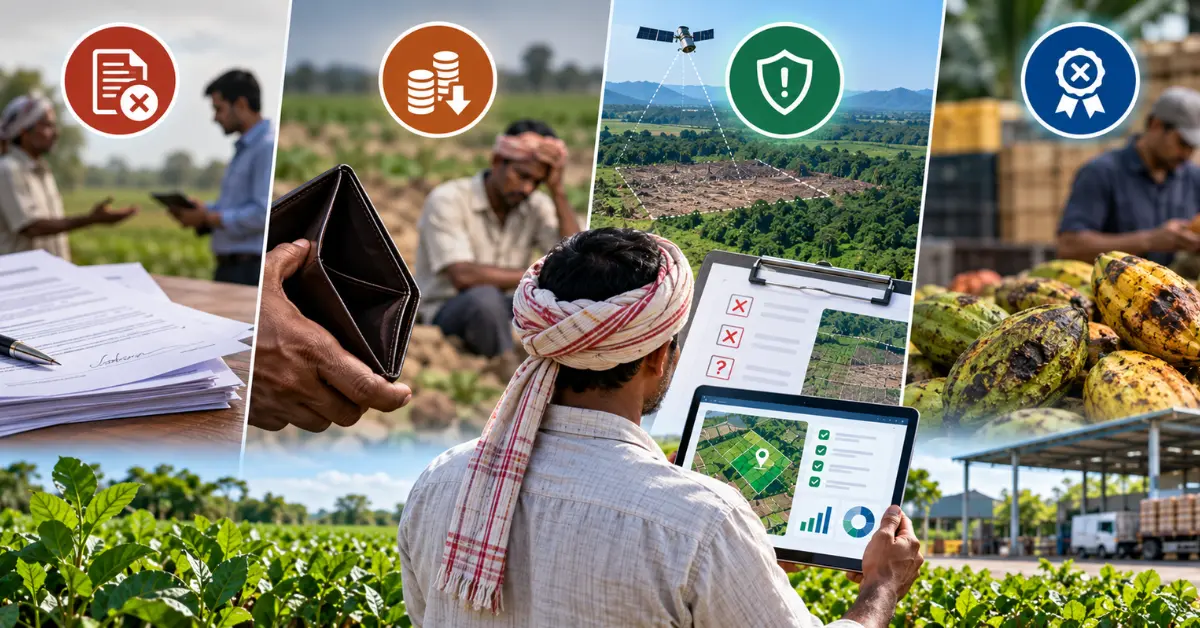
The core challenges of contract farming cluster into four: (1) opaque, one-sided contracts; (2) payment delays and financial instability; (3) compliance pressure from EUDR, FSMA and ESG rules; and (4) supply chain and quality inefficiencies. Left unmanaged, they ripple into disputes, lost markets, and broken trust.
Opaque, One-Sided Contracts & Lack of Transparency
Farmers often sign contracts they cannot fully see into. Pricing formulas, input costs, and deductions are buried in paperwork, so when the final payment lands short of expectations, trust collapses. Once fair pricing feels arbitrary, farmers side-sell or exit – and the buyer’s supply base erodes.
Understand how businesses can build more transparent and equitable pricing practices that strengthen farmer relationships and create more sustainable supply chains.
Manual approvals, paper invoicing, and reconciliation errors push payments out by weeks. Farmers lose visibility into when and how much they will be paid, which strangles cash flow for the next season’s inputs. Delayed payments are one of the most corrosive challenges of contract farming because they directly break the promise that made the farmer sign up.
Discover how digital farmer payments can help agribusinesses streamline settlements, reduce manual reconciliation, and create greater visibility across the payment lifecycle.
Buyers now inherit strict traceability obligations. The EU Deforestation Regulation (EUDR) applies from 30 December 2026 for large and medium operators and 30 June 2027 for micro and small non-timber operators, and demands geolocation and due diligence at plot level. FSMA and ESG reporting add further data requirements. Most smallholders still keep manual logs, so proving compliance is slow and error-prone.
Supply Chain & Quality Inefficiencies
Inconsistent quality control triggers rejected shipments; poor coordination between farmers and processors creates bottlenecks; and manual tracking makes it hard to trace a batch from farm to gate. Without real-time visibility and a clear chain of custody in agriculture, costs rise and quality slips.
How Digital Traceability Solves the Challenges of Contract Farming
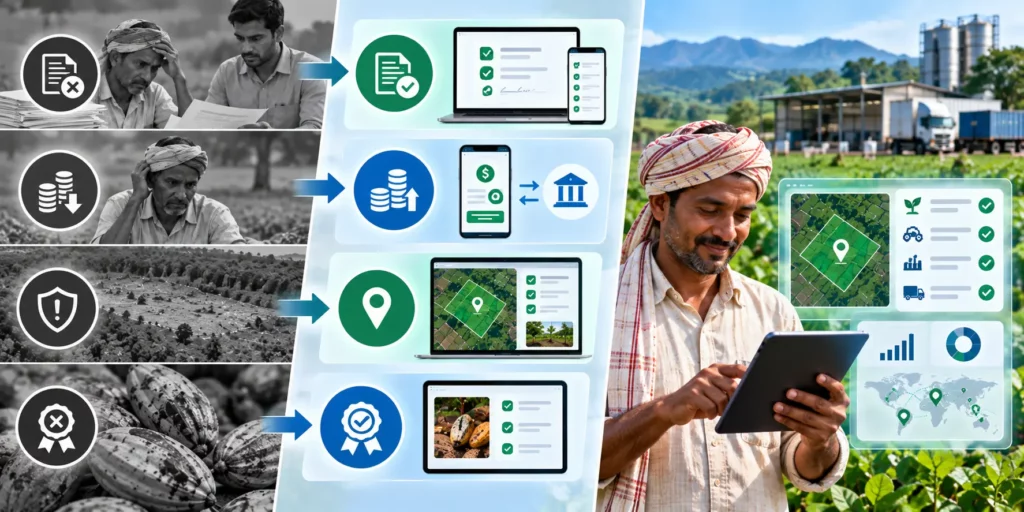
Digital traceability solves the challenges of contract farming by making the same data visible to both sides: smart digital contracts remove pricing ambiguity, automated payments remove delays, geo-tagged records prove compliance, and batch-level traceability protects quality end to end.
The pattern is simple: every pain above is a data problem, and shared, tamper-evident data is the fix. Turning the challenges of contract farming into a working program means putting each of these capabilities in the hands of both buyer and farmer
Transparent digital agreements: pricing, input costs, and deductions are recorded and visible, so payments are predictable and disputes drop.
Automated payments: digital wallet and banking integration gives farmers real-time payment tracking and on-time settlement.
Geo-tagged, audit-ready records: farm-level monitoring and dashboards streamline EUDR and FSMA submissions.
Batch-level traceability: each batch’s journey from farm to processing is recorded, protecting quality and cutting fraud.
The TraceX Farm Management Platform is built to address the challenges of contract farming at scale – unifying automated input distribution, agreement management, procurement, and geo-tagged compliance records in one system . One agribusiness used TraceX Agreement Management and Business Rules to digitize agreements and automate compliance checks, improving transparency and risk management across its supply base.
See how the TraceX Farm Management Platform digitizes agreements, payments, and compliance
Manual vs. Platform: Managing the Challenges of Contract Farming
Managing the challenges of contract farming manually relies on paper, spreadsheets, and trust; a digital platform replaces each with shared, verifiable data – which is what regulators and buyers increasingly require.
Challenge
Manual approach
TraceX platform approach
Contracts
Paper terms, hidden deductions
Transparent digital agreements
Payments
Weeks of delay, disputes
Automated, tracked settlement
Compliance
Manual logs, failed audits
Geo-tagged, audit-ready records
Quality
Rejected batches, no trace
Batch-level traceability
How to Evaluate a Platform for the Challenges of Contract Farming
A platform built for the challenges of contract farming should let you check every box below before you commit:
Digital agreement management with transparent pricing and deductions
Automated, trackable farmer payments with wallet or banking integration
Geo-tagging and plot-level records for EUDR and FSMA readiness
Batch-level traceability from farm to processing
Mobile-first farmer app usable in low-connectivity areas
Procurement, input distribution, and quality capture in one system
Open APIs to connect ERP, finance, and existing supply chain tools
Building a Resilient Future for Contract Farming
The challenges of contract farming are solvable. Price volatility, contract disputes, payment delays, and compliance complexity all shrink when stakeholders share transparent agreements, fair pricing, and traceable data. Investing in the right digital traceability system gives buyers better risk management, farmers timely payments, and both a trust-driven, audit-ready supply chain. The agribusinesses that digitize now will own the deforestation-ready, compliance-ready future of sourcing.
Frequently Asked Questions
What are the biggest challenges of contract farming?
The biggest challenges of contract farming are opaque, one-sided contracts, delayed payments, compliance pressure (EUDR, FSMA, ESG), and supply chain and quality inefficiencies.
Why do contract farming agreements break down?
They break down when farmers cannot see pricing, deductions, or payment timing. The resulting distrust leads to side-selling, disputes, and an eroding supply base.
How does technology solve the challenges of contract farming?
Digital contracts, automated payments, geo-tagged records, and batch-level traceability give buyers and farmers the same verifiable data, removing ambiguity and delay.
Does contract farming need to be EUDR compliant?
If the commodity is in EUDR scope, buyers need plot-level geolocation and due diligence. EUDR applies from 30 December 2026 for large and medium operators.
Do certifications replace EUDR traceability?
No. FSC, RSPO, and Rainforest Alliance support risk mitigation but do not replace EUDR geolocation, due diligence, or plot-level evidence.
What should agribusinesses do to ensure fair contract farming?
Use transparent digital agreements, guarantee timely payments, provide farmer training, and adopt traceability to build an equitable, auditable system.
Start using TraceX
Transparency, Trust, & Success for your Climate Journey.
We use cookies on our website to give you the most relevant experience by remembering your preferences and repeat visits. By clicking “Accept All”, you consent to the use of ALL the cookies. However, you may visit "Cookie Settings" to provide a controlled consent.
This website uses cookies to improve your experience while you navigate through the website. Out of these, the cookies that are categorized as necessary are stored on your browser as they are essential for the working of basic functionalities of the website. We also use third-party cookies that help us analyze and understand how you use this website. These cookies will be stored in your browser only with your consent. You also have the option to opt-out of these cookies. But opting out of some of these cookies may affect your browsing experience.
Necessary cookies are absolutely essential for the website to function properly. These cookies ensure basic functionalities and security features of the website, anonymously.
Cookie
Duration
Description
cookielawinfo-checkbox-analytics
11 months
This cookie is set by GDPR Cookie Consent plugin. The cookie is used to store the user consent for the cookies in the category "Analytics".
cookielawinfo-checkbox-functional
11 months
The cookie is set by GDPR cookie consent to record the user consent for the cookies in the category "Functional".
cookielawinfo-checkbox-necessary
11 months
This cookie is set by GDPR Cookie Consent plugin. The cookies is used to store the user consent for the cookies in the category "Necessary".
cookielawinfo-checkbox-others
11 months
This cookie is set by GDPR Cookie Consent plugin. The cookie is used to store the user consent for the cookies in the category "Other.
cookielawinfo-checkbox-performance
11 months
This cookie is set by GDPR Cookie Consent plugin. The cookie is used to store the user consent for the cookies in the category "Performance".
viewed_cookie_policy
11 months
The cookie is set by the GDPR Cookie Consent plugin and is used to store whether or not user has consented to the use of cookies. It does not store any personal data.
Functional cookies help to perform certain functionalities like sharing the content of the website on social media platforms, collect feedbacks, and other third-party features.
Performance cookies are used to understand and analyze the key performance indexes of the website which helps in delivering a better user experience for the visitors.
Analytical cookies are used to understand how visitors interact with the website. These cookies help provide information on metrics the number of visitors, bounce rate, traffic source, etc.
Advertisement cookies are used to provide visitors with relevant ads and marketing campaigns. These cookies track visitors across websites and collect information to provide customized ads.
Download the 2026 Traceability Scorecard and Benchmark Your Supply Chain Across 10 Critical Capabilities.
Download our eBook
Don’t Wait for an Audit to Find Your EUDR Gaps
The 2026 Simplification Package changes how HS codes, DDS pass-through and geolocation rules apply to you. Get the free guide and 20-point readiness checklist before enforcement catches you unprepared.