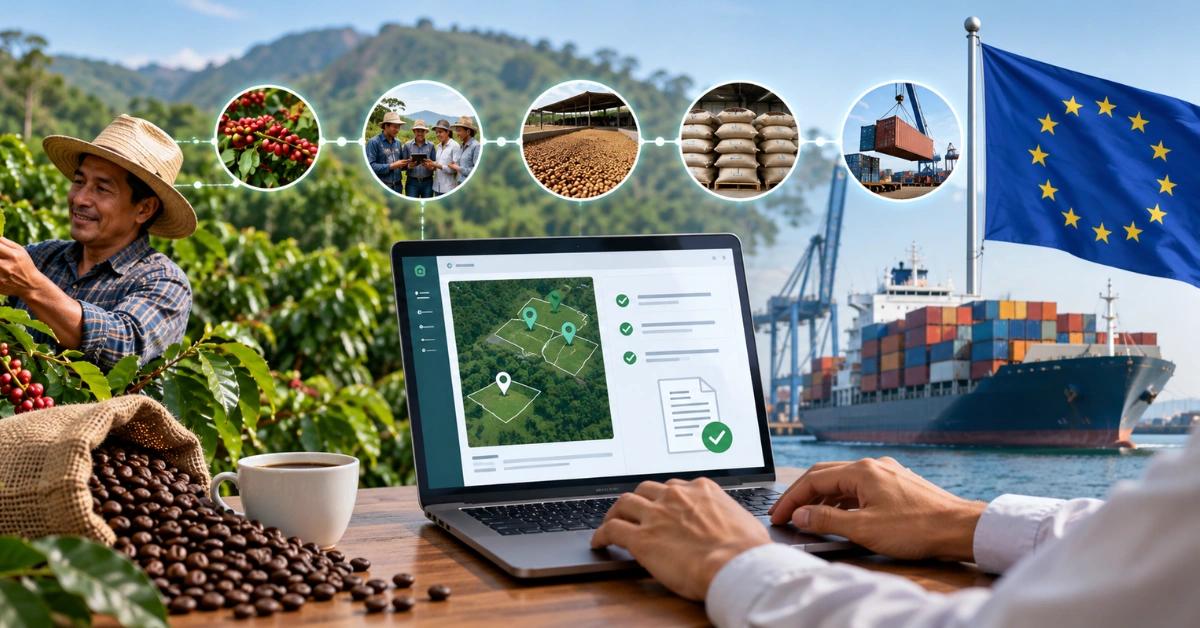
Quick summary: Learn how EUDR DDS automation helps coffee exporters connect farms, geolocation, traceability, risk assessment and evidence into a streamlined compliance workflow.
How to automate farm-level traceability, risk checks, evidence and Due Diligence Statements
EUDR DDS automation for coffee exporters helps transform farm-level supply-chain data into a repeatable compliance workflow. Instead of preparing each Due Diligence Statement manually, exporters can maintain structured producer records, geolocation, coffee lot traceability, risk information and supporting evidence, then use validated data to streamline DDS preparation. The most effective approach starts before the DDS: collect reliable farm data, connect farms to lots and shipments, identify gaps early and maintain an audit-ready evidence trail. This helps coffee exporters scale EUDR compliance as supplier and shipment volumes grow.
EUDR DDS automation for coffee exporters becomes valuable as it is not simply a matter of submitting a Due Diligence Statement (DDS). The real challenge starts much earlier: identifying the farms behind coffee lots, collecting reliable geolocation data, connecting production to shipments, assessing deforestation risk, maintaining supporting evidence and then turning that information into an accurate DDS. As supply networks grow, doing this manually through spreadsheets, emails and disconnected documents becomes difficult to scale.
Instead of treating the DDS as a standalone regulatory form, exporters can build a connected workflow that moves from farmer and farm data to traceability, risk assessment, evidence and reporting. The objective is simple: make the data required for EUDR available, validated and traceable before the shipment reaches the reporting stage.
For coffee businesses supplying the EU, the question is therefore not only “Can we submit a DDS?” It is “Can we reliably produce the data behind every DDS when an EU customer, customs authority or auditor asks for it?”
Key Takeaways
EUDR DDS automation reduces manual compliance work by converting supplier, farm, geolocation and shipment data into structured Due Diligence Statement workflows.
Coffee exporters need farm-level traceability to connect coffee shipments with the plots where the coffee was produced.
Accurate geolocation data is critical for demonstrating that coffee originates from land that meets EUDR deforestation-free requirements.
Supplier data quality directly impacts DDS readiness. Missing farmer details, plot coordinates, production information or supporting evidence can delay submissions.
Automation helps manage large supplier networks by standardising data collection, validation, document management and follow-ups.
DDS preparation should be connected to shipment traceability, allowing exporters to link the relevant coffee lots, suppliers and production plots to each declaration.
A centralised EUDR data platform reduces spreadsheet and email dependency, creating a consistent compliance record across suppliers, farms and shipments.
Risk assessment becomes more scalable when supplier, geolocation and supporting evidence are already structured and accessible.
EUDR readiness is more than generating a DDS. Exporters need an auditable chain of evidence showing how the underlying data was collected, validated and linked to the shipment.
December 2026 is approaching. Is your supply chain actually ready?
Move from spreadsheets and fragmented supplier data to a traceable, audit-ready EUDR workflow with TraceX.
EUDR DDS automation means connecting the operational data generated by the coffee supply chain with the information needed for EUDR due diligence and reporting. Rather than preparing each DDS from scratch, an exporter can maintain structured records for producers, farms, geolocation, coffee lots, suppliers, shipments, risk assessments and evidence, and then use those records to support the DDS workflow.
Automation does not remove the exporter’s due diligence responsibility. Instead, it reduces repetitive data handling, improves consistency and makes it easier to identify missing information before a declaration is submitted.
The Coffee EUDR Data Flow: Farm to DDS
1. Register farmers and suppliers — Create structured producer records and capture relevant supplier information.
2. Map production locations — Capture and validate farm or plot location data in the required format.
3. Connect farms to coffee lots — Record how coffee moves from farms through collection, aggregation, processing and export.
4. Validate traceability data — Identify missing, duplicate or inconsistent records before they reach the reporting stage.
5. Perform due diligence and risk checks — Bring together relevant information and evidence used to assess EUDR risk.
6. Build the evidence chain — Link supporting documents, declarations and assessment results to the relevant supply-chain records.
7. Prepare the DDS — Use validated product and traceability data to streamline Due Diligence Statement preparation and submission workflows.
Why Coffee Exporters Struggle With EUDR DDS Preparation
Fragmented farmer data — Coffee exporters may source through farmers, cooperatives, collection centres, aggregators and intermediaries. Supplier records can sit in different systems or spreadsheets, making it difficult to establish one consistent producer record.
Missing or inconsistent geolocation — EUDR traceability depends on linking relevant production to its location. In practice, exporters may receive incomplete coordinates, inconsistent formats or location information that is difficult to validate.
Lot-to-farm traceability gaps — Knowing a farmer exists is different from proving which farms contributed to a particular coffee lot. Mixing and aggregation can make this connection difficult when traceability is not captured at the right points.
Manual risk and evidence management — Deforestation checks, legality evidence, supplier declarations and other supporting records can become scattered across emails, folders and spreadsheets. Reconstructing the evidence chain later is slow.
DDS preparation at shipment scale — As shipment volumes increase, manually copying farm, product and traceability information into reporting workflows creates duplicate work and increases the risk of errors.
Ensure every coffee shipment can be traced from export lot to supplier to farm plot, with the data and evidence needed for EUDR compliance.
For coffee exporters, farm-level data is one of the most important foundations of an EUDR workflow. A company may know its supplier, cooperative or exporter partner, but that does not automatically provide the production-location information needed to establish traceability. The operational challenge is collecting location information consistently across potentially large farmer networks and keeping it connected to the coffee that eventually enters an EU-bound shipment.
A digital workflow can help standardize location capture, validate records and flag gaps before the exporter reaches the DDS stage. This changes the process from “find the coordinates when the shipment is ready” to “maintain traceable farm data throughout the supply chain.”
EUDR compliance starts with accurate, verifiable geolocation data. From capturing farm polygons and validating coordinates to linking plots with commodities and Due Diligence Statements, every location must be traceable and audit-ready.
From Coffee Lot to Shipment: Why Traceability Matters
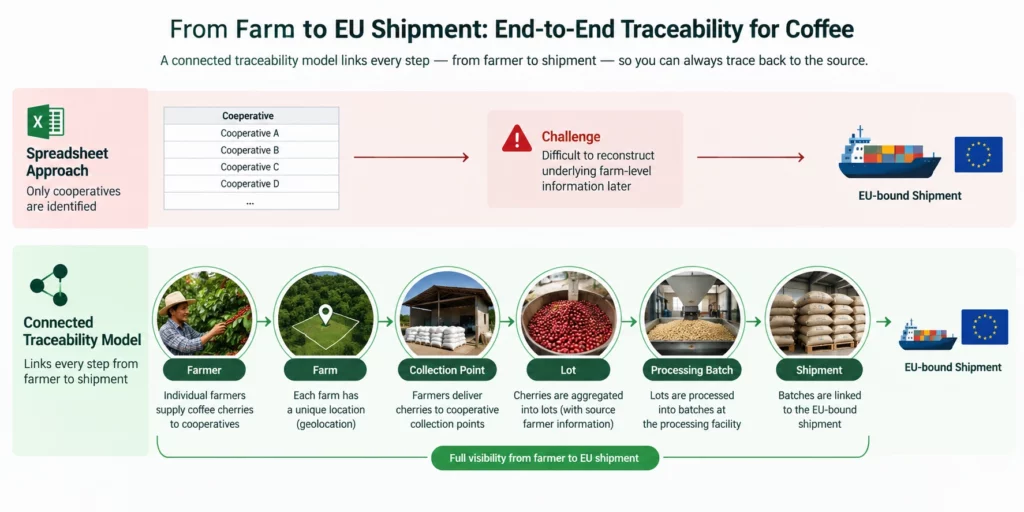
Consider a coffee exporter sourcing from several cooperatives. Each cooperative aggregates coffee from hundreds of farms before the coffee reaches a processing facility. If an EU-bound shipment is prepared using a spreadsheet that only identifies the cooperatives, the exporter may struggle to reconstruct the underlying farm-level information later. A connected traceability model can link farmer → farm → collection point → lot → processing batch → shipment. This gives the exporter a structured chain of custody that can support EUDR due diligence and make the source of the information easier to understand and verify.
EUDR compliance requires more than knowing your suppliers. Businesses need to connect origin, geolocation, commodities, transactions, and compliance evidence across the supply chain.
A common mistake is to think of automation as automatically filling in the final regulatory form. The bigger opportunity is to automate the data preparation that happens before the form exists. Supplier onboarding, farmer registration, geolocation collection, document management, traceability, validation and risk workflows all contribute to the quality of the final DDS.
If the underlying data is incomplete, automation can simply produce an incomplete declaration faster. Good EUDR DDS automation therefore combines workflow automation with data validation and exception management. Teams should be able to see which farms are missing coordinates, which suppliers have incomplete documentation, which lots cannot be traced to their source and which records require review.
From collecting supplier and geolocation data to conducting risk assessment, mitigation, and submitting the Due Diligence Statement, every step needs to be accurate, connected, and audit-ready.
Is Your EUDR DDS Workflow Ready for Compliance?
What Coffee Exporters Should Look for in an EUDR DDS Automation Platform
Farmer and supplier onboarding with structured data capture
Plot-level or production-location mapping and geolocation validation
Lot, batch and shipment traceability
Document and evidence management
Deforestation and land-use risk assessment workflows
Data-quality checks and exception alerts
Traceability from EU-bound shipment back to production source
Centralized compliance records and audit trails
Integration with ERP, procurement, traceability or other enterprise systems
Support for EUDR DDS preparation and connected reporting workflows
Real-World Example: An EU-Bound Coffee Shipment
Imagine an exporter preparing a shipment containing coffee sourced from three cooperatives. Each cooperative works with a different set of farmers. In a manual process, the compliance team may collect spreadsheets from each cooperative, request missing GPS information by email, consolidate files, perform checks, identify missing evidence and finally prepare the DDS. Any change to the shipment can trigger another round of reconciliation.
With an automated workflow, the exporter can maintain farmer and farm records continuously, associate production with lots, identify gaps before shipment creation and reuse validated information when preparing the EUDR reporting package. The result is not simply faster DDS preparation; it is a more controlled process for proving where the coffee came from and what due diligence was performed.
How TraceX Helps Coffee Exporters Automate EUDR DDS Workflows
TraceX EUDR Solutions helps coffee supply chains connect farmer and supplier data, production locations, traceability and compliance workflows in one digital environment. Exporters can organize farm-level information, capture and validate geolocation data, connect coffee movement to lots and shipments, manage supporting evidence and build a traceable compliance record. This helps teams move away from shipment-by-shipment spreadsheet preparation toward a repeatable EUDR workflow that can scale across suppliers and volumes.
For organizations already using ERP, procurement or supply-chain systems, the objective is not to create another isolated data silo. The EUDR workflow should connect operational data with compliance requirements so that the same underlying records can support traceability, risk assessment and reporting.
Ready to Automate Your Coffee EUDR DDS Workflow?
Connect farmer data, farm geolocation, coffee traceability, due diligence evidence and EUDR reporting in one workflow. Reduce manual DDS preparation and build a stronger compliance foundation for your EU-bound coffee supply chain.
EUDR DDS Automation: A Practical Readiness Checklist
Do we know the farms or production locations behind our EU-bound coffee?
Can we validate and maintain the relevant geolocation data?
Can we connect farms to lots and lots to shipments?
Can we identify missing supplier or producer information before export?
Can we link due diligence evidence to the relevant supply-chain records?
Can we reproduce the evidence behind a DDS without searching multiple spreadsheets and folders?
Can the workflow scale when farmer, supplier and shipment volumes increase?
Frequently Asked Questions (FAQ’s)
What is EUDR DDS automation for coffee exporters?
It is a connected digital workflow that helps coffee exporters organize supplier and farm data, geolocation, traceability, due diligence evidence and DDS preparation instead of managing each step manually.
Why is coffee farm geolocation important for EUDR?
Farm or production-location information helps establish the origin of relevant coffee and supports the traceability and due diligence process required for EU-bound products.
Can EUDR DDS automation replace due diligence?
No. Automation supports the process by organizing data, applying workflow controls and reducing manual work. The operator remains responsible for carrying out the required due diligence.
What data should coffee exporters prepare before creating a DDS?
The exporter should establish the relevant product, producer or supplier, production-location, traceability and due diligence information required for its EUDR workflow, along with supporting evidence.
How can coffee exporters reduce DDS errors?
Use structured data capture, validation rules, traceability links and exception management before preparing the declaration.
Can TraceX connect coffee farms to shipments?
TraceX is designed to connect farm and supplier information with traceability and shipment workflows, helping exporters maintain an end-to-end compliance record.
Start using TraceX
Transparency, Trust, & Success for your Climate Journey.
We use cookies on our website to give you the most relevant experience by remembering your preferences and repeat visits. By clicking “Accept All”, you consent to the use of ALL the cookies. However, you may visit "Cookie Settings" to provide a controlled consent.
This website uses cookies to improve your experience while you navigate through the website. Out of these, the cookies that are categorized as necessary are stored on your browser as they are essential for the working of basic functionalities of the website. We also use third-party cookies that help us analyze and understand how you use this website. These cookies will be stored in your browser only with your consent. You also have the option to opt-out of these cookies. But opting out of some of these cookies may affect your browsing experience.
Necessary cookies are absolutely essential for the website to function properly. These cookies ensure basic functionalities and security features of the website, anonymously.
Cookie
Duration
Description
cookielawinfo-checkbox-analytics
11 months
This cookie is set by GDPR Cookie Consent plugin. The cookie is used to store the user consent for the cookies in the category "Analytics".
cookielawinfo-checkbox-functional
11 months
The cookie is set by GDPR cookie consent to record the user consent for the cookies in the category "Functional".
cookielawinfo-checkbox-necessary
11 months
This cookie is set by GDPR Cookie Consent plugin. The cookies is used to store the user consent for the cookies in the category "Necessary".
cookielawinfo-checkbox-others
11 months
This cookie is set by GDPR Cookie Consent plugin. The cookie is used to store the user consent for the cookies in the category "Other.
cookielawinfo-checkbox-performance
11 months
This cookie is set by GDPR Cookie Consent plugin. The cookie is used to store the user consent for the cookies in the category "Performance".
viewed_cookie_policy
11 months
The cookie is set by the GDPR Cookie Consent plugin and is used to store whether or not user has consented to the use of cookies. It does not store any personal data.
Functional cookies help to perform certain functionalities like sharing the content of the website on social media platforms, collect feedbacks, and other third-party features.
Performance cookies are used to understand and analyze the key performance indexes of the website which helps in delivering a better user experience for the visitors.
Analytical cookies are used to understand how visitors interact with the website. These cookies help provide information on metrics the number of visitors, bounce rate, traffic source, etc.
Advertisement cookies are used to provide visitors with relevant ads and marketing campaigns. These cookies track visitors across websites and collect information to provide customized ads.
Download the 2026 Traceability Scorecard and Benchmark Your Supply Chain Across 10 Critical Capabilities.
Download our eBook
Don’t Wait for an Audit to Find Your EUDR Gaps
The 2026 Simplification Package changes how HS codes, DDS pass-through and geolocation rules apply to you. Get the free guide and 20-point readiness checklist before enforcement catches you unprepared.