EUDR Enforcement Readiness: What Dry-Run Inspections Reveal About Passing Your First Check
Published
, 9 minute read
Share this article
Quick summary: EUDR enforcement readiness is about proving, not promising. Dry-run inspections show that authorities will test whether businesses can retrieve shipment-level evidence, link it to geolocated sourcing plots, and defend every due diligence conclusion with complete documentation.
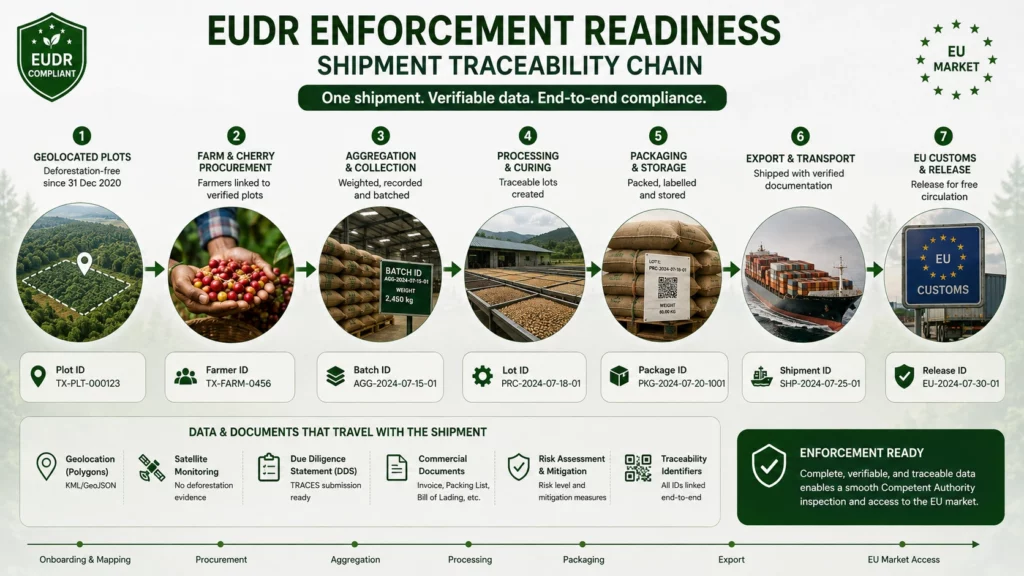
EUDR enforcement readiness is an operator’s proven ability to produce shipment-specific due diligence evidence on demand during a Competent Authority inspection. Based on 2025 dry runs led by German, Belgian, Dutch and French authorities, readiness is judged not on whether you own a due diligence system, but on whether you can trace one individual shipment from a geolocated plot of land to EU customs and produce the full documented paper trail behind your compliance conclusion.
The EUDR (Regulation (EU) 2023/1115, as amended by (EU) 2025/2650) applies from 30 December 2026 for large and medium operators, and 30 June 2027 for micro and small operators.
Key takeaways
Inspectors test the shipment, not the system a due diligence system that exists only on paper fails the check.
Authorities expect the full underlying evidence and analysis, not outcome statements or executive summaries.
You must show an unbroken link: specific shipment → geolocation in the DDS → deforestation-free and legality evidence.
Legality due diligence means understanding the production-country laws and mapping them to EUDR criteria.
Certification, service providers and online platforms support due diligence but never replace your own documented conclusion.
See What PPWR Actually Requires from You
Every product line has different obligations. In a quick demo, see how TraceX maps your packaging portfolio to specific PPWR requirements no ambiguity.
Why EUDR enforcement readiness is now the real deadline
EUDR enforcement readiness is the difference between an operator that has built a due diligence system and one that can prove it works when an inspector asks. For most teams, the mental deadline has been 30 December 2026 the date the EUDR starts to apply for large and medium operators. But the dry runs run by four national authorities in 2025 shifted the conversation from what the regulation requires to how it will actually be enforced. That shift is what makes enforcement readiness the deadline that really matters.
Here is the pain most compliance leads are feeling right now: they have a polished due diligence policy, a DDS workflow, and geolocation data flowing in and they still have no idea whether it would survive a real check. The regulation itself is clear enough. What was missing was a concrete picture of what a Competent Authority will ask for on inspection day. The dry runs supplied exactly that picture, and it is more demanding than most systems are built for.
What EUDR enforcement readiness looks like inside an inspection
EUDR enforcement readiness is measured one shipment at a time. During the dry runs, authorities did not audit the due diligence system in the abstract they picked one or a few specific shipments covered by a Due Diligence Statement and asked the operator to walk the evidence for exactly those consignments. As one authority summed it up, operators cannot hide behind a general due diligence system; they are expected to produce evidence directly relevant to the specific shipment selected for inspection.
The expectation is a complete “paper trail”: not just the conclusion that a shipment was compliant, but all the underlying data and the documented reasoning that led there. One inspector’s framing was blunt they are not worried about receiving too much information; they are worried when information is missing. In other words, EUDR enforcement readiness rewards operators who can show their working.
Understand the Role of EUDR Competent Authorities Read our guide to EUDR Competent Authorities and what businesses should expect.
A relatable example: the coffee importer who had a system but no story
Picture “Nordic Bean Co.,” a mid-sized coffee importer. It has a due diligence SOP, a DDS for every consignment, and plot geolocations from its cooperatives. An inspector selects one October shipment and asks a simple question: prove this container is deforestation-free and legal. Nordic Bean can show a green dashboard status but it cannot quickly produce the datasets used, the false positives it resolved in the 2020 forest-cover map, the yield check for those plots, or the records mapping the beans back through the mill and warehouse without mixing. The system exists; the shipment-level story does not. That gap is precisely where EUDR enforcement readiness is won or lost.
Five gaps that break EUDR enforcement readiness
The dry runs and pilot inspections surfaced a recurring set of shortcomings. Treat these as the pain points to design against each maps to a capability your system needs before December 2026.
Paper-only due diligence. A system that is documented but not embedded in day-to-day procurement and supplier onboarding fails. Authorities expect due diligence to be a continuous, living process applied to every quantity placed on the market including automated deforestation monitoring of sourcing plots after onboarding.
Summaries instead of evidence. Outcome statements and executive summaries are not proof. Inspectors want the raw datasets, methodologies and documented analysis behind each conclusion.
A broken shipment-to-plot link. If you cannot connect the specific shipment to the geolocations in its DDS and to the deforestation-free and legality evidence, traceability is incomplete and so is your readiness.
Legality treated as an afterthought. Operators must understand the laws of the production country and keep an overview of them mapped to the EUDR’s legality criteria land tenure, environmental and forestry law, labour and human rights (including FPIC), tax, anti-corruption, and trade rules. Country risk classification alone does not answer the legality question.
Over-delegation to platforms. Service providers and online tools can support due diligence, but risk assessment cannot be outsourced wholesale. You must understand their datasets and methods, verify their evidence, and reach your own documented conclusion.
EUDR enforcement readiness for smallholder and data-poor supply chains
A data-poor supply chain is not an excuse for weak due diligence. For sourcing bases built on large numbers of smallholders, authorities accept a risk-based approach as one put it during the dry runs, you don’t need an audit on every farmer, but you are expected to have audits in every risky region. Where per-farmer documentation is missing, proxy information cooperative-level records, local NGO reports can support your analysis, provided you document how the risk-based approach was applied and which evidence you relied on. Building readiness here is about defensible, well-documented judgement, not about collecting the impossible.
EUDR enforcement readiness is a retrieval problem, not a policy problem
Here is the non-obvious thesis running through every dry-run insight: by inspection day, EUDR enforcement readiness stops being a policy question and becomes a retrieval question. The regulation is written. Your policy is written. What decides the outcome is whether, when an inspector names one shipment out of thousands, you can retrieve the geolocations, the deforestation-free analysis, the legality mapping, the mixing-risk evidence and the final reasoning in minutes, as one coherent file.
Most compliance programmes are optimised for the wrong thing. They invest in policy design and in collecting data at onboarding, then store the evidence scattered across spreadsheets, supplier emails, PDF certificates and a separate geolocation tool. That architecture can produce a compliant conclusion. It cannot reliably produce the conclusion’s evidence on demand. Readiness is therefore less about knowing the law and more about how your data is linked, stored and retrievable at shipment level. The operators who treat it as an information-architecture problem one shipment, one retrievable evidence package will pass. The ones who treat it as a paperwork exercise will scramble.
How TraceX Helps
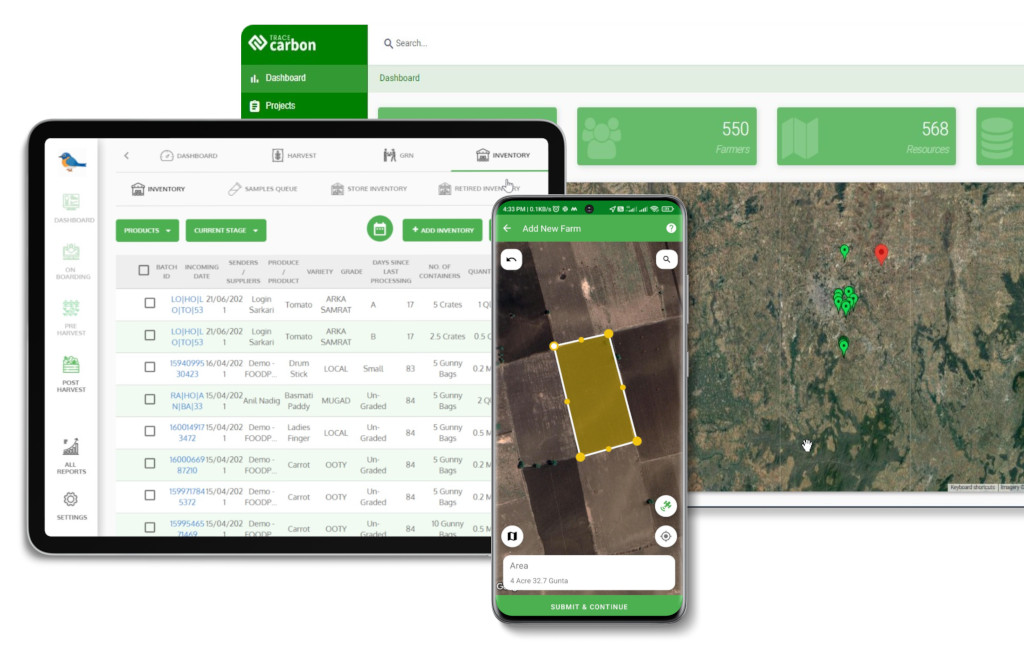
Passing an EUDR inspection starts long before an authority requests evidence. TraceX EUDR solutions help businesses stay inspection-ready with end-to-end traceability, GPS-verified farm mapping, defensible deforestation risk assessments, legality documentation, automated evidence management, and DDS-ready records. By centralizing compliance data and maintaining an audit-ready digital trail, TraceX enables organizations to confidently prepare for dry-run assessments, customer audits, and regulatory inspections.
See how TraceX assembles a single-shipment evidence package on demand the exact capability EUDR enforcement readiness depends on.
EUDR enforcement readiness: manual approach vs. a purpose-built system
How the two approaches hold up against the specific demands surfaced in the dry runs. Capability claims below are bracketed pending product-team verification.
Inspection demand
Spreadsheets + point tools
TraceX
Produce evidence for one named shipment
Manual reassembly across files; hours to days
Single-shipment evidence package retrievable on demand
Shipment → geolocation → evidence link
Links live in people’s heads / email threads
Persistent linkage across DDS, plots and documents
Integrated plot monitoring with documented alerts and resolutions
Legality mapped to production-country law
Ad hoc, rarely documented
Structured legality mapping and record-keeping
Continuous, embedded due diligence
Point-in-time; re-run manually
Ongoing monitoring embedded in onboarding and procurement
Your EUDR enforcement readiness checklist
Use this to stress-test your own programme against the dry-run standard before December 2026:
We can select any single shipment and produce its full evidence package on demand.
Our evidence includes underlying datasets and analysis, not just conclusions.
Each shipment links cleanly to its DDS geolocations and compliance evidence.
We maintain an overview of production-country law mapped to EUDR legality criteria.
We can explain and verify any third-party platform’s datasets and methods we rely on.
Our smallholder / data-poor sourcing has a documented risk-based approach and proxy evidence.
Due diligence is embedded in onboarding and procurement, with ongoing plot monitoring.
Frequently Asked Questions (FAQ’s)
What is EUDR enforcement readiness?
It is an operator’s demonstrated ability to satisfy a Competent Authority inspection by producing shipment-specific due diligence evidence the traceability, deforestation-free and legality proof, and documented reasoning for consignments the inspector selects.
When does EUDR enforcement start?
The EUDR applies from 30 December 2026 for large and medium operators and 30 June 2027 for micro and small operators, under Regulation (EU) 2023/1115 as amended by (EU) 2025/2650.
What do Competent Authorities actually ask for during a check?
Based on 2025 dry runs, they select specific shipments and request the complete paper trail: the datasets and methods used, geolocation handling and false-positive resolution, legality mapping, evidence of no mixing with non-compliant products, and the operator’s conclusion.
Is having a due diligence system enough for EUDR enforcement readiness?
No. A system on paper is not enough. Authorities test whether it was actually applied to individual shipments and whether you can produce the evidence behind each conclusion.
How does EUDR enforcement readiness work for smallholder supply chains?
A risk-based approach is accepted: prioritise audits in risky regions and use documented proxy evidence (cooperative records, NGO reports) where per-farmer documentation is unavailable, showing how the approach was applied.
Can I rely on certification or a third-party platform to be inspection-ready?
They can support due diligence but cannot replace it. You must assess a scheme’s alignment with the EUDR, understand any platform’s datasets and methods, verify their evidence, and reach your own documented conclusion.
What is the fastest way to close an EUDR enforcement readiness gap?
Run an internal dry run: pick a real shipment, try to assemble its full evidence package on demand, and fix whatever you cannot retrieve. That single exercise exposes most readiness gaps.
Start using TraceX
Transparency, Trust, & Success for your Climate Journey.
We use cookies on our website to give you the most relevant experience by remembering your preferences and repeat visits. By clicking “Accept All”, you consent to the use of ALL the cookies. However, you may visit "Cookie Settings" to provide a controlled consent.
This website uses cookies to improve your experience while you navigate through the website. Out of these, the cookies that are categorized as necessary are stored on your browser as they are essential for the working of basic functionalities of the website. We also use third-party cookies that help us analyze and understand how you use this website. These cookies will be stored in your browser only with your consent. You also have the option to opt-out of these cookies. But opting out of some of these cookies may affect your browsing experience.
Necessary cookies are absolutely essential for the website to function properly. These cookies ensure basic functionalities and security features of the website, anonymously.
Cookie
Duration
Description
cookielawinfo-checkbox-analytics
11 months
This cookie is set by GDPR Cookie Consent plugin. The cookie is used to store the user consent for the cookies in the category "Analytics".
cookielawinfo-checkbox-functional
11 months
The cookie is set by GDPR cookie consent to record the user consent for the cookies in the category "Functional".
cookielawinfo-checkbox-necessary
11 months
This cookie is set by GDPR Cookie Consent plugin. The cookies is used to store the user consent for the cookies in the category "Necessary".
cookielawinfo-checkbox-others
11 months
This cookie is set by GDPR Cookie Consent plugin. The cookie is used to store the user consent for the cookies in the category "Other.
cookielawinfo-checkbox-performance
11 months
This cookie is set by GDPR Cookie Consent plugin. The cookie is used to store the user consent for the cookies in the category "Performance".
viewed_cookie_policy
11 months
The cookie is set by the GDPR Cookie Consent plugin and is used to store whether or not user has consented to the use of cookies. It does not store any personal data.
Functional cookies help to perform certain functionalities like sharing the content of the website on social media platforms, collect feedbacks, and other third-party features.
Performance cookies are used to understand and analyze the key performance indexes of the website which helps in delivering a better user experience for the visitors.
Analytical cookies are used to understand how visitors interact with the website. These cookies help provide information on metrics the number of visitors, bounce rate, traffic source, etc.
Advertisement cookies are used to provide visitors with relevant ads and marketing campaigns. These cookies track visitors across websites and collect information to provide customized ads.
Download the 2026 Traceability Scorecard and Benchmark Your Supply Chain Across 10 Critical Capabilities.
Download our eBook
Don’t Wait for an Audit to Find Your EUDR Gaps
The 2026 Simplification Package changes how HS codes, DDS pass-through and geolocation rules apply to you. Get the free guide and 20-point readiness checklist before enforcement catches you unprepared.