ERP Integration for PPWR: Automate Packaging Compliance Data From the Source
Published
, 11 minute read
Share this article
Quick summary: Automating PPWR compliance starts with the data already sitting in your ERP. This guide explains how ERP integration helps packaging, compliance, and sustainability teams replace manual spreadsheets with accurate, audit-ready reporting for EU packaging obligations.
ERP integration for PPWR connects your ERP system (SAP, Oracle, Microsoft Dynamics, NetSuite) directly to a packaging compliance platform, so the packaging data PPWR requires material composition, unit weights, recycled content, recyclability class, and units placed on each EU market flows automatically from item masters, BOMs, and sales records into EPR registrations, PPWR reports, and audit files. It replaces spreadsheet exports and manual re-keying with a validated, always-current data pipeline.
ERP integration for PPWR is the fastest way to turn the EU Packaging and Packaging Waste Regulation from a quarterly fire drill into a background process. In plain language, it means connecting the system where your packaging data already lives your ERP to the system that has to report it, so compliance data is pulled automatically instead of re-typed manually.
The PPWR (Regulation (EU) 2025/40) replaces the old Packaging Directive and, from 12 August 2026, applies directly in every EU member state. It obliges producers, importers, and distance sellers to know and prove exactly what their packaging is made of, how much of it they place on each market, whether it meets recyclability and recycled-content requirements, and what Extended Producer Responsibility (EPR) fees they owe. That proof is built from data your teams already maintain in SAP, Oracle, Dynamics, or NetSuite: item masters, bills of materials, supplier records, and sales volumes.
The problem is the gap between the two systems. This guide explains how the integration closes that gap, what a manual process costs you, how the integration works technically, and how to evaluate a platform including how TraceX PPWR Solutions approaches it.
Key Takeaways
PPWR compliance is a data problem before it is a legal problem and most of the data already sits in your ERP.
Manual exports from ERP to spreadsheets break at scale: every SKU, packaging component, and market combination multiplies the reporting burden.
ERP integration for PPWR automates data capture at source: item masters, BOMs, procurement, and sales volumes map to PPWR data fields.
Integrated pipelines cut reporting preparation time by [X]% and reduce data errors that trigger EPR fee corrections and audit findings.
Evaluate platforms on connector depth, field mapping, validation logic, multi-market EPR output, and audit trail not just dashboards.
See What PPWR Actually Requires from You
Every product line has different obligations. In a quick demo, see how TraceX maps your packaging portfolio to specific PPWR requirements — no ambiguity.
ERP Integration for PPWR: Why Packaging Compliance Is Now an ERP Problem
PPWR turns packaging attributes that were once optional metadata into regulated, reportable data points. This section covers:
The specific data PPWR obliges you to hold and report
Why the ERP is the natural system of record for that data
The gap that appears when compliance runs outside the ERP
PPWR data requirements: what regulators will actually ask for
PPWR obligations attach to data most companies have never consolidated. Depending on your role in the chain, you must be able to report or evidence. Packaging weight and material composition per component (plastic, paper, glass, metal, composite)
Recycled content share for plastic packaging against 2030/2040 targets
Recyclability performance grade of each packaging format
Units and tonnage placed on each individual EU member state market
Packaging minimization evidence (empty-space and weight/volume justification)
Harmonized labeling data and, over time, links to digital product information
Is Your Packaging Data Ready for PPWR?
PPWR compliance depends on accurate, centralized packaging data—from material composition and supplier declarations to technical documentation and Declarations of Conformity.
Why the ERP is the system of record for packaging compliance
Every one of those data points has a natural home in the ERP. Material composition lives in item masters and BOMs. Packaging weights sit in logistics and unit-of-measure records. Supplier declarations attach to procurement. Units placed on market are simply sales and shipment lines filtered by destination country. No other system in your stack holds all of it which is exactly why exporting it into spreadsheets is where compliance programs go wrong.
The integration gap: where PPWR programs break
Compliance teams rarely have ERP access, so they request extracts. Extracts go stale the day they are produced. Packaging changes a lighter film, a new supplier, a redesigned carton update the ERP but not the compliance spreadsheet. By the next EPR reporting cycle, the numbers no longer match physical reality, and every discrepancy is either an over-payment or an audit finding.
PPWR compliance fails in the gap between the ERP that knows the truth and the spreadsheet that reports it.
PPWR Compliance Challenges Without ERP Integration
Running PPWR reporting manually creates predictable failure modes. The three that hurt most:
SKU-level data fragmentation across systems and teams
Multi-market EPR reporting effort that scales with every country entered
Supplier evidence that never connects to the products it describes
Ready to Achieve PPWR Compliance?
Understanding the regulation is only the first step. Building a compliant packaging program requires the right processes, documentation, supplier collaboration, and packaging data.
A mid-size consumer goods company can easily manage 2,000–10,000 SKUs, each with primary, secondary, and transport packaging. That is tens of thousands of packaging components whose weights and materials must be current. Maintained by hand, teams report spending hours per month reconciling ERP extracts against packaging specifications time that produces no compliance improvement, only data hygiene.
Multi-market EPR reporting under PPWR
EPR fees are calculated per member state, per material, per tonnage and increasingly eco-modulated, meaning poorly recyclable packaging pays more. Each market has its own producer registry, format, and cadence. Without automation, every new EU market you sell into adds another manual reporting workstream, and errors compound: misclassified material in the ERP becomes a wrong fee in five countries at once.
Supplier declarations that live in inboxes
Recycled-content claims and material certificates arrive from packaging suppliers as PDFs in email. Under PPWR, those documents are your evidence base. If they are not linked to the ERP items they cover, you cannot answer the auditor’s simplest question: prove that this SKU’s plastic tray contains the recycled share you reported.
Navigate PPWR with Confidence
Preparing for PPWR requires more than understanding the regulation it requires a clear implementation strategy.
How ERP Integration for PPWR Works: From Connector to Compliance Report
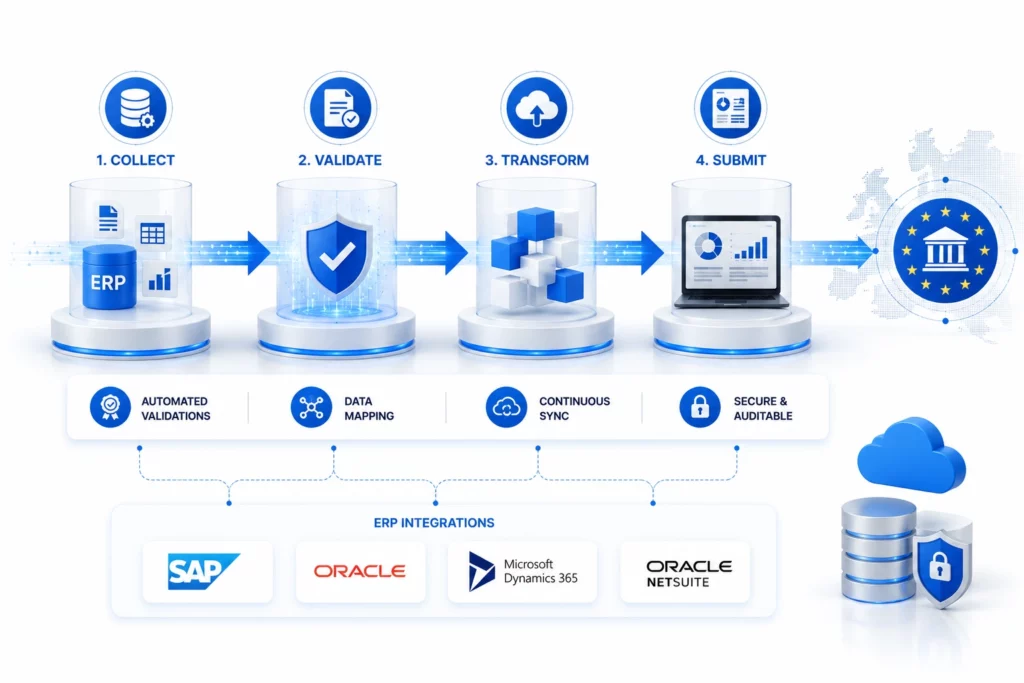
Technically, the integration is a four-stage pipeline. In summary:
Connect: API or middleware link to SAP, Oracle, Dynamics, NetSuite
Map: ERP fields translated to PPWR data categories
Validate: automated checks catch gaps and impossible values
Report: EPR registrations, PPWR reports, and audit files generated on schedule
Step 1 — Connecting the ERP
Modern compliance platforms connect through native APIs (e.g., SAP OData/BAPI, Oracle REST, Dynamics Dataverse, NetSuite SuiteTalk), middleware/iPaaS, or scheduled flat-file sync where IT policy requires it. Read-only access is standard: the platform pulls item masters, BOMs, purchase orders, and sales lines without writing back. Typical initial setup runs weeks depending on ERP customization.
Step 2 — Mapping ERP fields to PPWR data points
Field mapping is where domain expertise matters. Material group codes map to PPWR material categories; unit-of-measure and packaging hierarchy records map to component weights; sales order destination countries map to per-market placed-on-market volumes; supplier and batch records map to recycled-content evidence. Good platforms ship with pre-built PPWR mapping templates so you are configuring, not building.
Step 3 — Validation and gap detection
Automated validation is the payoff manual processes can never match: flagging SKUs with missing packaging weights, material codes that do not translate to a PPWR category, recycled-content claims without supplier evidence, or country volumes that disagree with shipment records. Instead of discovering gaps during an audit, you discover them in a work queue.
Step 4 — Automated PPWR and EPR reporting
With clean, mapped, validated data, report generation becomes an output rather than a project: per-market EPR declarations in the format each registry expects, eco-modulated fee calculations, recyclability and recycled-content summaries, and a full audit trail from every reported figure back to the ERP transaction it came from.
Manual vs Automated: ERP Integration for PPWR Compared
Dimension
Manual (spreadsheet exports)
ERP-integrated PPWR compliance
Data freshness
Stale from the moment of export; drifts until next cycle
Continuous or scheduled sync; always reflects current ERP state
Reporting effort per market
Grows linearly — each registry is a new manual workstream
Marginal new market is a configuration, not a project
Error handling
Errors found by auditors or registries after submission
Validation rules catch gaps before reports are generated
Supplier evidence
PDFs in inboxes, disconnected from SKUs
Declarations linked to items, batches, and reported figures
EPR fee accuracy
Over/under-payment risk from misclassified materials
Eco-modulated fees computed from validated material data
Audit readiness
Reconstruction project under deadline pressure
One-click trail from reported figure to source transaction
Team time
[X hours/month] on reconciliation and re-keying
Reduced to exception handling — reported savings of [X]%
Benefits of ERP Integration for PPWR Compliance Teams
Single source of truth: compliance, procurement, and sustainability teams argue about actions, not numbers.
Lower EPR fees, legitimately: accurate material classification and recyclability data prevents over-declaration; eco-modulation rewards data you can actually prove.
Design feedback loop: packaging engineers see the fee and recyclability impact of design choices while they are still in the ERP as draft BOMs.
Regulatory resilience: when implementing acts refine PPWR requirements, you update a mapping not 40 spreadsheets.
DPP readiness: the same structured packaging data positions you for ESPR Digital Product Passports without a second data project.
How to Evaluate ERP Integration for PPWR Platforms: 7 Buyer Criteria
Use these criteria in vendor demos in this order, because failures at the top cannot be fixed downstream:
1. Connector depth: native, maintained connectors for your ERP and version not a generic CSV importer relabelled as an integration.
2. PPWR field coverage: pre-built mapping for material categories, weights, recycled content, recyclability grades, and per-market volumes.
3. Validation logic: configurable rules that detect gaps and contradictions before submission, with a workflow to resolve them.
4. Multi-market EPR output: report formats for every member state registry you sell into, updated as registries change.
5. Supplier evidence handling: can it ingest and link supplier declarations to items ideally parsing documents automatically?
6. Audit trail: every reported figure traceable to its ERP source record, exportable for auditors.
7. Adjacent regulation coverage: PPWR rarely arrives alone check EUDR, ESPR/DPP, and CSRD support so you are not buying a point solution per regulation.
Buy the data pipeline, not the dashboard. Any tool can chart numbers; few can prove where they came from.
ERP Integration for PPWR With TraceX
TraceX PPWR Solutions is built API-first to plug into existing ERP and procurement systems, which is exactly the architecture PPWR demands. Applied to packaging compliance, that means:
Read-only connectors pull item masters, BOMs, procurement, and sales data from SAP, Oracle, Dynamics, and NetSuite [confirm current connector list with product team]
Agentic AI document parsing extracts material composition and recycled-content evidence from supplier emails and PDFs, and links them to the right ERP items automatically
Validation queues surface missing packaging data before reporting deadlines, not after
Audit-ready reporting with one-click export (PDF, XML, CSV), with every figure traceable to source
One platform across PPWR, EUDR, and ESPR Digital Product Passports — the same supplier and ERP data pipeline serves all three
The PPWR Brief to Share with Your Leadership
Need to get stakeholders aligned? This handbook gives you the risks, timelines, and requirements in a format built to drive internal decisions.
It is the connection between your ERP system and a packaging compliance platform so that PPWR-required data material composition, weights, recycled content, recyclability, and placed-on-market volumes is captured automatically from ERP records instead of manually exported and re-keyed.
Which ERP systems can be integrated for PPWR reporting?
Any ERP with API or export capability: SAP (ECC and S/4HANA), Oracle, Microsoft Dynamics 365, NetSuite, and industry-specific systems via middleware. The connector matters less than the field mapping and validation built on top of it.
When do PPWR obligations start applying?
PPWR entered into force in February 2025 and its main obligations apply from [verify: 12 August 2026], with staged requirements (recyclability grading, recycled-content targets, reuse targets) phasing in through 2030 and beyond. Individual member state EPR registration duties already apply. [Verify all dates before publication.]
Does ERP integration replace an EPR compliance scheme membership?
No. You still register with producer responsibility organizations in each market. Integration automates the data and declarations you submit to them — accurately and on time — but does not replace the legal registration itself.
How long does PPWR ERP integration take to implement?
With pre-built connectors and PPWR mapping templates, typical implementations run weeks: connection and access in week one, field mapping and validation configuration next, then a parallel-run reporting cycle before cutover. Heavily customized ERPs take longer.
What does automated PPWR reporting cost compared to manual?
Compare platform subscription against the loaded cost of manual reconciliation hours, EPR fee corrections, and audit exposure. For multi-market sellers, the crossover point typically arrives within the first reporting year [replace with sourced ROI data].
Start using TraceX
Transparency, Trust, & Success for your Climate Journey.
We use cookies on our website to give you the most relevant experience by remembering your preferences and repeat visits. By clicking “Accept All”, you consent to the use of ALL the cookies. However, you may visit "Cookie Settings" to provide a controlled consent.
This website uses cookies to improve your experience while you navigate through the website. Out of these, the cookies that are categorized as necessary are stored on your browser as they are essential for the working of basic functionalities of the website. We also use third-party cookies that help us analyze and understand how you use this website. These cookies will be stored in your browser only with your consent. You also have the option to opt-out of these cookies. But opting out of some of these cookies may affect your browsing experience.
Necessary cookies are absolutely essential for the website to function properly. These cookies ensure basic functionalities and security features of the website, anonymously.
Cookie
Duration
Description
cookielawinfo-checkbox-analytics
11 months
This cookie is set by GDPR Cookie Consent plugin. The cookie is used to store the user consent for the cookies in the category "Analytics".
cookielawinfo-checkbox-functional
11 months
The cookie is set by GDPR cookie consent to record the user consent for the cookies in the category "Functional".
cookielawinfo-checkbox-necessary
11 months
This cookie is set by GDPR Cookie Consent plugin. The cookies is used to store the user consent for the cookies in the category "Necessary".
cookielawinfo-checkbox-others
11 months
This cookie is set by GDPR Cookie Consent plugin. The cookie is used to store the user consent for the cookies in the category "Other.
cookielawinfo-checkbox-performance
11 months
This cookie is set by GDPR Cookie Consent plugin. The cookie is used to store the user consent for the cookies in the category "Performance".
viewed_cookie_policy
11 months
The cookie is set by the GDPR Cookie Consent plugin and is used to store whether or not user has consented to the use of cookies. It does not store any personal data.
Functional cookies help to perform certain functionalities like sharing the content of the website on social media platforms, collect feedbacks, and other third-party features.
Performance cookies are used to understand and analyze the key performance indexes of the website which helps in delivering a better user experience for the visitors.
Analytical cookies are used to understand how visitors interact with the website. These cookies help provide information on metrics the number of visitors, bounce rate, traffic source, etc.
Advertisement cookies are used to provide visitors with relevant ads and marketing campaigns. These cookies track visitors across websites and collect information to provide customized ads.
Download the 2026 Traceability Scorecard and Benchmark Your Supply Chain Across 10 Critical Capabilities.
Download our eBook
Don’t Wait for an Audit to Find Your EUDR Gaps
The 2026 Simplification Package changes how HS codes, DDS pass-through and geolocation rules apply to you. Get the free guide and 20-point readiness checklist before enforcement catches you unprepared.