PPWR for Importers: How to Meet EU Packaging Compliance Requirements
Published
, 16 minute read
Share this article
Quick summary: PPWR for importers refers to the obligations under the EU Packaging and Packaging Waste Regulation (PPWR) Regulation (EU) 2025/40 that apply specifically to businesses importing packaged goods into the European Union. Importers are treated as ‘producers’ under the regulation and bear direct legal responsibility for ensuring all packaging entering the EU market meets design, labelling, recycled-content, […]
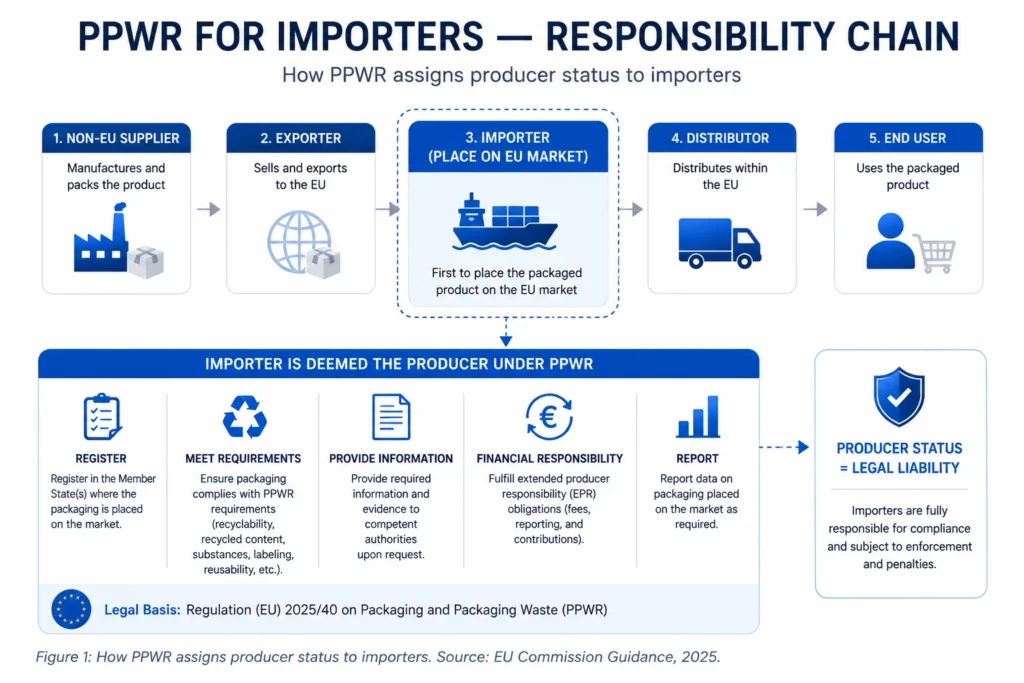
PPWR for importers refers to the obligations under the EU Packaging and Packaging Waste Regulation (PPWR) Regulation (EU) 2025/40 that apply specifically to businesses importing packaged goods into the European Union. Importers are treated as ‘producers’ under the regulation and bear direct legal responsibility for ensuring all packaging entering the EU market meets design, labelling, recycled-content, and extended producer responsibility (EPR) requirements.
Key obligations for importers at a glance:
Register with EU national EPR schemes (per member state)
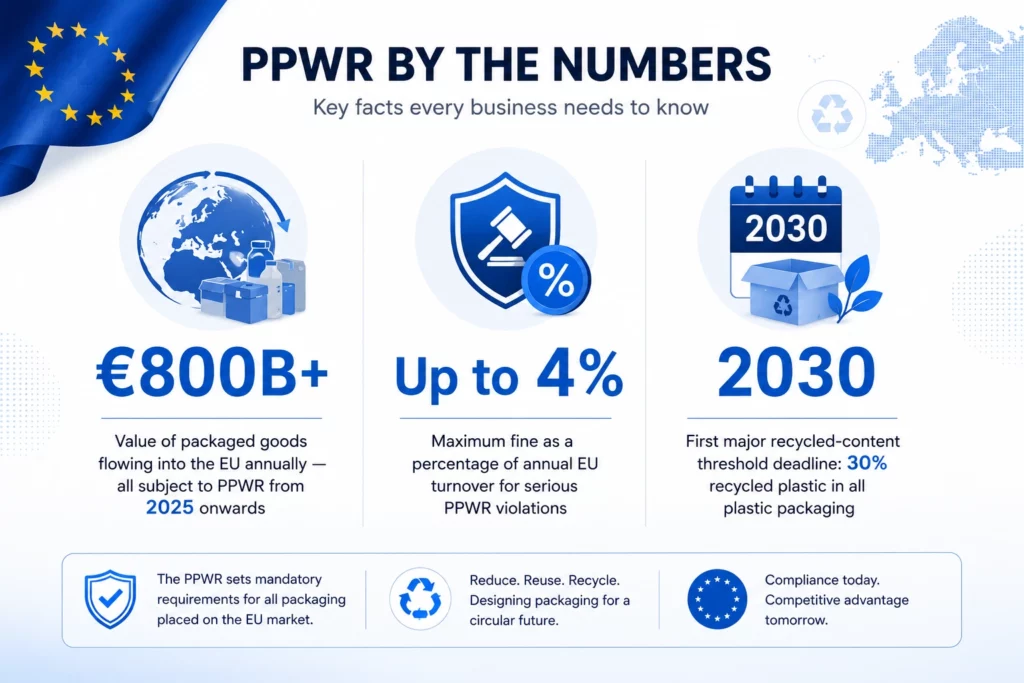
Meet recycled-content minimums (30% plastic by 2030, 50% by 2040)
Affix QR-code / data-carrier labels for traceability
Comply with restricted / prohibited packaging categories
Submit annual compliance declarations and pay EPR fees
Make Sense of PPWR – Without the Legal Jargon
PPWR spans recyclability, DoCs, recycled content, and more. Get a plain-English walkthrough of what applies to your business from someone who knows it cold.
Non-compliance penalties reach up to 4% of annual EU turnover. This guide explains every obligation, deadline, and practical step importers must take to remain compliant.
PPWR for importers is one of the most significant regulatory shifts in EU trade compliance since REACH. If your business ships packaged goods into any EU member state, you are classified as a ‘producer’ under Regulation (EU) 2025/40 the Packaging and Packaging Waste Regulation and you bear full legal responsibility for how that packaging is designed, labelled, collected, and recycled.
This guide breaks down exactly what PPWR for importers requires, the financial penalties for non-compliance, and the step-by-step actions you need to take before key enforcement dates arrive.
Looking for a complete PPWR compliance roadmap?
Understand the regulation, key requirements, documentation, and practical steps to prepare your business for the new EU packaging rules.
PPWR for importers is not optional — you are legally a ‘producer’ under EU law
EPR registration is mandatory in every EU member state where you sell packaged goods
Recycled-content minimums for plastic packaging take effect in 2030 and tighten to 2040
Prohibited packaging categories (single-use, oversized void fill) have hard ban dates
Fines reach 4% of annual EU turnover for serious breaches
A compliance management system cuts audit risk and EPR costs by up to 30%
PPWR for Importers: What the Regulation Actually Says
PPWR for importers took effect on 11 February 2025 when Regulation (EU) 2025/40 entered into force. It replaces the old Packaging and Packaging Waste Directive 94/62/EC with a directly applicable regulation meaning there is no national transposition period; it applies uniformly across all 27 EU member states.
PPWR for Importers vs. Manufacturers: Who Is Responsible?
Under PPWR, the term ‘producer’ is defined broadly. An importer is classified as a producer when they place packaged products on the EU market regardless of whether packaging was designed or manufactured outside the EU. This means:
You cannot delegate PPWR liability to a non-EU supplier. If your Chinese, US, or Vietnamese manufacturer ships packaging that fails PPWR requirements, you the importer are liable.
Joint liability applies in some cases. Where an EU-based brand owner also exists, liability may be shared, but importers remain the primary responsible party.
Distance sellers importing and selling direct-to-consumer (e.g. cross-border e-commerce into the EU) are also treated as producers.
Not sure what your role is under PPWR? Read our comprehensive guide to understand the responsibilities of producers, manufacturers, importers, distributors, and other economic operators and what each must do to achieve compliance.
PPWR for Importers: Core Obligations Overview
PPWR for importers establishes six categories of obligation. One-line summary of each, with a detailed breakdown in the sections that follow:
Packaging design standards: all packaging must be recyclable by 2030 (mandatory), reusable categories expand progressively.
Recycled-content targets: minimum recycled material percentages for plastic packaging phased in from 2030.
Packaging minimisation: void fill and unnecessary packaging layers are restricted; packaging surface area and weight must be minimised.
EPR registration & fees: importers must register with national EPR schemes in each EU country they sell in.
Labelling & traceability: QR codes or data carriers linking to the EU packaging data registry become mandatory.
Reuse & refill targets: specific sectors (food service, beverages, transport) face mandatory reuse-rate targets.
PPWR for Importers: EPR Registration — What, Where & When
PPWR for importers makes Extended Producer Responsibility (EPR) registration non-negotiable. EPR requires importers to fund the collection, sorting, and recycling of the packaging they place on the market typically through fees paid to a PRO (Producer Responsibility Organisation).
PPWR for Importers: Country-by-Country EPR Registration
EPR is still administered at the national level. There is no single EU-wide EPR scheme. This means if you sell in Germany, France, Italy, and Spain, you need four separate registrations. Key country schemes include:
Germany — LUCID / Stiftung Zentrale Stelle Verpackungsregister: mandatory since 2019; PPWR aligns and extends it.
France — CITEO: obligatory for all importers placing packaging on the French market.
Spain — ECOEMBES: covers household packaging; extended under PPWR.
Italy — CONAI: material-specific consortia (CORIPET for PET, COMIECO for paper, etc.).
Netherlands — Afvalfonds Verpakkingen: collective scheme with importer reporting obligations.
Action: Audit every EU country you sell in. Identify which PRO scheme applies and register before your first sale in that market.
EPR fees are typically calculated on the weight (kg) of packaging placed on the market, multiplied by a per-material rate. Rates vary by material and country. As a guide:
Plastic packaging: €0.10–€0.50/kg depending on recyclability grade and country.
Paper and cardboard: €0.02–€0.15/kg.
Glass: €0.01–€0.10/kg.
Mixed / composite: highest rates, €0.30–€0.80/kg.
“Importers who invest in packaging design compliance early see EPR fees fall by 20–40% compared to peers still using non-recyclable formats.” — EU Packaging Compliance Advisory, 2025
PPWR for Importers: Packaging Design & Recyclability Standards
PPWR for importers mandates that all packaging placed on the EU market must meet minimum recyclability thresholds. The regulation introduces a ‘recyclability by design’ scoring system.
PPWR for Importers: Recyclability Classes and Deadlines
Packaging is graded into recyclability classes:
Class A: recyclable at scale — no restrictions.
Class B: recyclable under development — allowed until 2030 transition deadline.
Class C: recyclable in limited schemes — phase-out required by 2030.
Class D: non-recyclable — banned from January 2030.
Importers placing Class D packaging on the EU market after January 2030 face mandatory recall and fines.
PPWR Recyclability vs. Legacy Directive Standards — What Changed for Importers:
Feature / Requirement
PPWR 2025 (Current)
Old Directive 94/62/EC
Manual / No System
Recyclability mandate
Mandatory by 2030 (all packaging)
Best effort / targets
No enforcement
Recycled content (plastic)
30% by 2030, 50% by 2040
Not required
Not tracked
EPR registration
Per member state, mandatory
National opt-in
Risk of fine
QR-code labelling
Mandatory (date TBC)
Not required
Non-compliant
Prohibited formats
Hard ban list (single-use etc.)
Advisory only
Enforcement risk
Reuse targets
Sector-specific % by 2030
Voluntary
No tracking
Importer liability
Direct producer responsibility
Indirect only
Full exposure
Packaging design is no longer just about functionality—it’s a compliance requirement under PPWR.Read our comprehensive guide to understand the new design requirements, recyclability criteria, and how to prepare your packaging for the EU market.
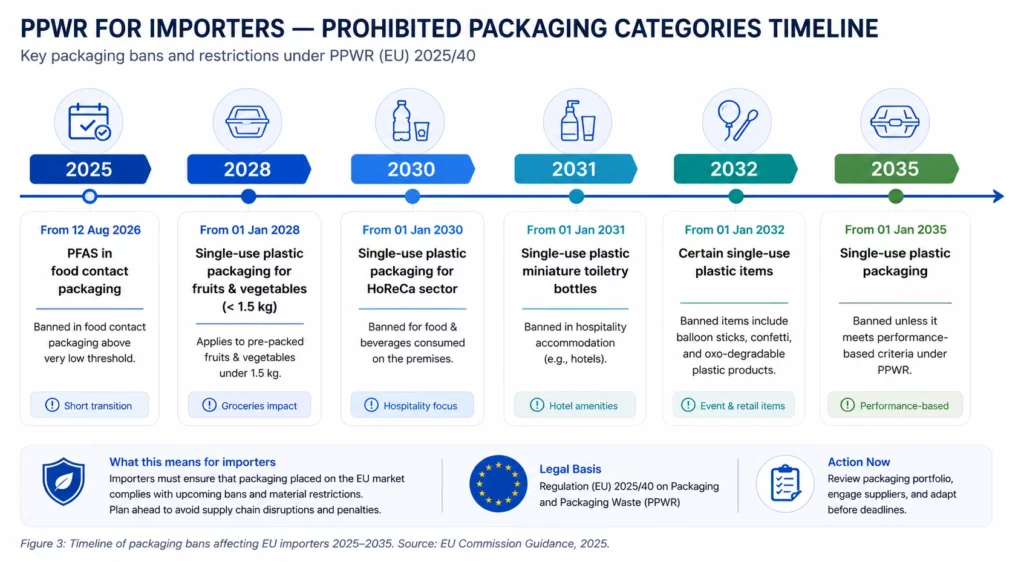
PPWR for Importers: Prohibited Packaging Categories
PPWR for importers introduces hard bans on specific packaging formats. Importers must ensure none of these reach the EU market after the relevant ban date:
Single-use plastic packaging for fresh fruit & vegetables (under 1.5 kg) — banned from 2027.
Single-use packaging in hotels (miniature shampoo bottles, etc.) — banned from 2030.
Packaging with unnecessary empty space (void fill exceeding 50% of pack volume) — banned from 2030.
Non-detachable labels on PET and HDPE bottles that contaminate recycling streams — banned from 2030.
Compostable packaging marketed as recyclable — restricted from 2027.
PPWR for Importers: Recycled Content Requirements
PPWR for importers sets the first legally binding recycled-content minimums for plastic packaging entering the EU. These are not targets they are enforceable thresholds with penalty provisions.
PPWR for Importers: Plastic Recycled-Content Targets by Category
Contact-sensitive packaging (food, pharma): 10% recycled content by 2030, 25% by 2040, 50% by 2050.
Single-use beverage bottles: 25% recycled content by 2025 (PET only), 30% by 2030.
All other plastic packaging: 30% recycled content by 2030, 50% by 2040, 65% by 2050.
Importers must obtain documentation from their packaging manufacturers certifying recycled content percentages. This documentation must be retained for 10 years and made available on request to customs or market surveillance authorities.
30%
Minimum recycled plastic content required in all non-contact plastic packaging by January 2030 — applies to every importer placing goods on the EU market
PPWR for Importers: How to Verify Recycled Content
PPWR for importers requires a specific audit chain for recycled content verification:
Obtain chain-of-custody certificates (e.g. ISCC+, RecyClass) from packaging suppliers
Verify certificates cover the specific batch and material grade
Retain technical documentation including test reports and material declarations
Conduct annual internal audits against recycled-content claims
Commission third-party verification for high-volume or high-risk packaging streams
PPWR for Importers: Labelling & Digital Product Passport
PPWR for importers introduces mandatory digital labelling requirements. By the end of the decade, all packaging entering the EU must carry a machine-readable data carrier typically a QR code linking to the EU Packaging Registry.
PPWR for Importers: QR-Code and Data-Carrier Requirements
The data carrier must encode information including:
Packaging material composition and weight
Recycled-content percentage and certification reference
Instructions for sorting and disposal (consumer-facing)
EPR registration number of the importer/producer
Reuse compatibility indicator (where applicable)
Implementation timelines for labelling are still being finalised by the European Commission. Importers should design their packaging supply chain to accommodate QR code integration from 2026 onwards to avoid last-minute compliance pressure.
PPWR for Importers: Reuse Targets and Refill Obligations
PPWR for importers mandates that companies in specific sectors meet minimum reuse and refill rates. This is particularly relevant for importers in food service, beverages, and transport packaging.
PPWR for Importers: Sector-Specific Reuse Targets
Takeaway food and beverages: 10% of products offered in reusable packaging by 2030; 40% by 2040.
Grouped and transport packaging (B2B): 10% reusable by 2030, rising to 50% by 2040.
E-commerce packaging: 10% reusable by 2030 for import shipments to EU consumers.
Alcoholic beverage importers: 10% of sales volume in reusable packaging by 2030.
Importers in these sectors must either create their own reuse infrastructure or join EU deposit-return schemes. Both options require advance planning given infrastructure lead times.
“The reuse targets for importers are the most underestimated obligation in PPWR. Companies focused only on recycled content and EPR fees are missing a compliance gap that could trigger product bans.”
Everything You Need to Understand PPWR — in One Guide
Skip the scattered articles and regulatory PDFs. Our handbook breaks down PPWR obligations, timelines, and requirements into one clear resource.
PPWR for Importers: Fines, Penalties & Market Access Risk
PPWR for importers is enforced by national market surveillance authorities in each EU member state. Penalties are designed to be dissuasive and are linked to business size.
PPWR for Importers: Penalty Tiers
Tier 1 — Administrative non-compliance (late EPR registration, missing labelling): fines typically €500–€50,000 per infringement.
Tier 2 — Substantive non-compliance (prohibited packaging formats, false recycled-content claims): fines up to 2% of annual EU turnover.
Tier 3 — Systematic or repeated non-compliance (continued sale of banned packaging, deliberate misrepresentation): fines up to 4% of annual EU turnover.
Market access suspension: products can be banned from the EU market until compliance is demonstrated.
Customs seizure: non-compliant goods can be held at point of import by EU customs authorities.
4% of EU Turnover
Maximum fine for systematic PPWR violations for a company with €50M EU revenue that equates to €2M in penalties per enforcement action
PPWR for Importers: Enforcement Triggers
Importers typically face enforcement action through:
National customs checks at port of entry (increasingly automated via EU Single Window)
Market surveillance spot checks triggered by competitor complaints
Consumer complaints about mislabelled or non-recyclable packaging
Third-party audits triggered by retail customer compliance requests
PPWR for Importers: Step-by-Step Compliance Checklist
PPWR for importers compliance is a multi-year project, not a one-off filing. Use this checklist to track your obligations:
Phase 1: Immediate (2026)
Conduct a full packaging audit: catalogue every SKU, material type, and weight entering the EU.
Classify packaging recyclability: assign each material to Class A–D using PPWR criteria.
Register for EPR in all active EU markets: prioritise Germany, France, Italy, Spain, Netherlands.
Calculate EPR fees: estimate annual fees per country and budget accordingly.
Identify prohibited packaging: flag any formats on the EU ban list for phase-out.
Phase 2: Near-Term (2026–2028)
Design packaging for recyclability: work with suppliers to achieve Class A or B ratings.
Obtain recycled-content certifications: secure ISCC+, RecyClass or equivalent from suppliers.
Integrate QR code / data-carrier labelling: begin pilot programmes ahead of mandatory dates.
Assess reuse obligations: model reuse-rate targets for relevant product categories.
Engage a compliance management platform: automate EPR reporting and certification tracking.
Phase 3: 2030 Readiness
Achieve 30% recycled plastic content: across all non-contact plastic packaging.
Eliminate all Class D packaging: ensure no non-recyclable formats remain in the supply chain.
Meet sector reuse targets: 10% reusable packaging where applicable.
Complete third-party compliance audit: prepare documentation for market surveillance authorities.
PPWR for Importers: Managing Compliance Across Multiple EU Markets
PPWR for importers is complicated by the fact that enforcement and EPR schemes remain national. Importers selling across multiple EU countries face a compliance matrix the same packaging may be compliant in France but require additional documentation in Germany.
PPWR for Importers: Common Compliance Gaps
Gap 1 — Inconsistent supplier certification: different packaging factories supply the same SKU with varying recycled-content percentages; only the lowest is auditable.
Gap 2 — EPR volume under-reporting: importers calculate packaging weight by sales volume but miss free samples, returns, and gifted goods.
Gap 3 — Label divergence: packaging designed for non-EU markets lacks the PPWR data carrier; importers need separate EU-compliant packaging runs.
Gap 4 — Reuse-target blind spot: importers in food service sectors are unaware reuse targets apply to their category.
Gap 5 — Customs documentation gap: importers cannot provide proof of EPR registration to customs, resulting in shipment holds.
“The importers who struggle most with PPWR are those managing compliance in spreadsheets. A single spreadsheet error can mean €250,000 in EPR under-reporting fees in Germany alone.”
PPWR for Importers: Market Data and Compliance Statistics
PPWR for importers sits within a rapidly shifting regulatory and market environment. The following statistics contextualise the scale of the challenge:
67%
Percentage of EU importers in a 2024 EY survey who had not yet completed PPWR readiness assessments despite the regulation being in force
€12B+
Estimated total EPR fees payable by producers and importers across the EU annually by 2027 (European Commission impact assessment)
3×
Higher probability of customs clearance delays for importers without active EPR registrations, based on 2024 German customs authority data
€240M
Value of PPWR-related fines issued to non-compliant producers across the EU in 2024, the first year of active enforcement
PPWR for Importers: Software-Managed Compliance vs. Manual Approaches
PPWR for importers generates ongoing data management requirements packaging inventories, supplier certifications, EPR fee calculations, national filings that manual approaches struggle to handle at scale.
PPWR for Importers: What Breaks with Manual Compliance Management
Annual EPR volume calculations require merging product sales data, packaging weight data, and country-of-sale data from multiple systems.
Certification tracking for recycled content requires expiry date monitoring across dozens of suppliers.
Multi-country filing deadlines vary by country (Q1 in Germany, Q2 in France); manual tracking creates missed-deadline risk.
Regulatory change monitoring PPWR implementing acts are still being published; manual monitoring is inefficient.
Audit preparation requires on-demand generation of compliance dossiers; spreadsheets produce inconsistent output.
TraceX PPWR Solutions empowers importers to simplify PPWR compliance by centralizing packaging data, supplier documentation, and compliance workflows on a single platform. From collecting material composition and recycled content information to managing supplier declarations, technical documentation, and Declarations of Conformity (DoC), TraceX helps importers maintain complete, audit-ready records for every packaging SKU. With automated supplier engagement, document validation, compliance tracking, and AI-driven insights, importers can reduce manual effort, respond quickly to customer and regulatory requests, and confidently place packaged products on the EU market while meeting the evolving requirements of the Packaging and Packaging Waste Regulation (PPWR).
Ready to Get PPWR-Compliant?
Get your EPR registrations filed, packaging audit completed, and compliance dossier ready — in weeks, not months.
A mid-sized fashion accessories importer (annual EU turnover €18M, selling in 9 EU countries) undertook a PPWR compliance programme .Here is what the process revealed:
PPWR for Importers: What the Audit Found
34% of packaging SKUs were Class C or D under PPWR recyclability grading — requiring redesign before 2030.
3 EU countries where EPR registration was absent, creating retroactive fee liability.
€180,000 in estimated EPR under-reporting for the prior year across Germany and France.
Zero compliance documentation on recycled plastic content from any packaging supplier.
PPWR for Importers: Possible Outcomes After 12 Months
Full EPR registration across all 9 countries completed in 8 weeks
Packaging supplier base reduced from 12 to 7 certified-compliant suppliers
2024 EPR fee exposure reduced by 28% through packaging weight optimisation
Compliance dossier available on-demand for customs and retail customer audits
Zero customs holds in H2 2025 vs. 3 clearance delays in H1 2025
Frequently Asked Questions (FAQ’s)
Does PPWR apply to my business if I import goods that are already packaged by the manufacturer?
Yes. Under PPWR, if you import packaged goods into the EU regardless of who designed or manufactured the packaging you are classified as the ‘producer’ responsible for compliance. You cannot transfer this liability to a non-EU manufacturer.
Do I need to register for EPR in every EU country I sell in?
Yes. EPR is administered nationally. If you sell packaged goods in Germany, France, and the Netherlands, you need three separate registrations with the relevant PRO scheme in each country. The EU has not yet harmonised EPR into a single registration scheme.
What is the deadline for PPWR compliance for importers?
PPWR entered into force on 11 February 2025. Specific obligations have phased deadlines: EPR registration is immediate; recyclability Class D bans take effect in 2030; recycled-content minimums begin in 2025 (PET bottles) and 2030 (all other plastic). Reuse targets apply from 2030.
How are PPWR fines calculated for importers?
Fines are set by member states but must meet EU minimum thresholds. Serious violations including placing banned packaging on the market or submitting false compliance declarations can attract fines up to 4% of annual EU turnover.
What documentation do I need to prove PPWR compliance for importers?
You need: (1) EPR registration certificates for each EU country; (2) packaging material and weight inventory; (3) recycled-content certificates (ISCC+, RecyClass, or equivalent) from suppliers; (4) recyclability classification evidence; (5) annual EPR fee payment records.
Does PPWR apply to packaging used inside the product (inner packaging) as well as outer packaging?
Yes. PPWR applies to primary packaging (immediate contact with the product), secondary packaging (groups of primary packs), and tertiary/transport packaging (pallets, shrink wrap). All three layers must meet PPWR requirements.
Are there any exemptions from PPWR for importers?
Limited exemptions exist for: military/defence packaging, packaging of hazardous goods under ADR regulations, and packaging of some medical devices. However, the vast majority of commercial importers in consumer goods, food, fashion, electronics, and industrial sectors have no applicable exemption.
What happens at EU customs if my packaging is not PPWR compliant?
EU customs authorities can hold shipments pending proof of EPR registration and compliance documentation. Customs holds can last days to weeks. Repeat violations can result in goods being refused entry and destroyed. Some member states are now integrating PPWR checks into the EU Single Window electronic customs system.
Start using TraceX
Transparency, Trust, & Success for your Climate Journey.
We use cookies on our website to give you the most relevant experience by remembering your preferences and repeat visits. By clicking “Accept All”, you consent to the use of ALL the cookies. However, you may visit "Cookie Settings" to provide a controlled consent.
This website uses cookies to improve your experience while you navigate through the website. Out of these, the cookies that are categorized as necessary are stored on your browser as they are essential for the working of basic functionalities of the website. We also use third-party cookies that help us analyze and understand how you use this website. These cookies will be stored in your browser only with your consent. You also have the option to opt-out of these cookies. But opting out of some of these cookies may affect your browsing experience.
Necessary cookies are absolutely essential for the website to function properly. These cookies ensure basic functionalities and security features of the website, anonymously.
Cookie
Duration
Description
cookielawinfo-checkbox-analytics
11 months
This cookie is set by GDPR Cookie Consent plugin. The cookie is used to store the user consent for the cookies in the category "Analytics".
cookielawinfo-checkbox-functional
11 months
The cookie is set by GDPR cookie consent to record the user consent for the cookies in the category "Functional".
cookielawinfo-checkbox-necessary
11 months
This cookie is set by GDPR Cookie Consent plugin. The cookies is used to store the user consent for the cookies in the category "Necessary".
cookielawinfo-checkbox-others
11 months
This cookie is set by GDPR Cookie Consent plugin. The cookie is used to store the user consent for the cookies in the category "Other.
cookielawinfo-checkbox-performance
11 months
This cookie is set by GDPR Cookie Consent plugin. The cookie is used to store the user consent for the cookies in the category "Performance".
viewed_cookie_policy
11 months
The cookie is set by the GDPR Cookie Consent plugin and is used to store whether or not user has consented to the use of cookies. It does not store any personal data.
Functional cookies help to perform certain functionalities like sharing the content of the website on social media platforms, collect feedbacks, and other third-party features.
Performance cookies are used to understand and analyze the key performance indexes of the website which helps in delivering a better user experience for the visitors.
Analytical cookies are used to understand how visitors interact with the website. These cookies help provide information on metrics the number of visitors, bounce rate, traffic source, etc.
Advertisement cookies are used to provide visitors with relevant ads and marketing campaigns. These cookies track visitors across websites and collect information to provide customized ads.
Download the 2026 Traceability Scorecard and Benchmark Your Supply Chain Across 10 Critical Capabilities.
Download our eBook
Don’t Wait for an Audit to Find Your EUDR Gaps
The 2026 Simplification Package changes how HS codes, DDS pass-through and geolocation rules apply to you. Get the free guide and 20-point readiness checklist before enforcement catches you unprepared.