Digital Sustainability for CSOs: A Guide to Traceability, Compliance and ESG
Published
, 8 minute read
Share this article
Quick summary: Explore digital sustainability for CSOs and learn how traceability, compliance, farm-level data, DMRV and connected supply-chain systems support actionable ESG strategy.
Digital sustainability for CSOs is becoming less about producing sustainability reports and more about turning sustainability data into operational decisions. Chief Sustainability Officers are increasingly expected to understand what is happening across suppliers, farms, procurement networks, production systems and environmental programmes and to demonstrate measurable progress to leadership, customers, regulators and other stakeholders.
The challenge is that sustainability information is often fragmented across spreadsheets, ERP systems, supplier portals, audits, certifications and disconnected digital tools. A digital sustainability strategy brings these data points together so sustainability teams can move from periodic reporting to continuous visibility, traceability, compliance and performance management.
For CSOs, the goal is not simply to collect more data. It is to build a reliable information foundation that connects sustainability priorities with the business processes that influence them.
Key Takeaways
Make Sustainability Data-Driven
Strengthen Supply Chain Visibility
Connect Procurement and Sustainability
Improve Supplier Transparency
Use Farm-Level Data
Build Traceability as Infrastructure
Strengthen Regulatory Compliance
Enable Carbon and Scope 3 Management
Digitize MRV Processes
Monitor Sustainability KPIs
Create an Audit-Ready Evidence Trail
Move from Reporting to Action
Get expert guidance on building a data-driven sustainability strategy, improving supply-chain visibility, strengthening traceability, and managing sustainability performance with digital solutions.
The exact metrics depend on the company’s industry, sustainability strategy and regulatory obligations. However, CSOs commonly need visibility across several layers: supplier performance, sourcing locations, environmental indicators, traceability, regulatory compliance, emissions and progress against sustainability targets.
The important consideration is not only which KPIs are reported, but whether the underlying data can be traced to a reliable source. A sustainability dashboard is only as useful as the data supporting it.
Why Fragmented Sustainability Data Is a Problem
When sustainability information is distributed across different systems, CSOs may spend significant time collecting, cleaning and reconciling data instead of analysing it. Supplier information may sit in procurement systems, farm information in spreadsheets, emissions data in specialist tools, and compliance evidence in shared folders.
Fragmentation also makes it difficult to establish a consistent view of performance. A CSO may know that a supplier has submitted sustainability information, but not whether that information is connected to a specific sourcing location, product batch or procurement transaction.
Discover how digital transformation helps businesses connect sustainability data, improve supply-chain visibility, strengthen traceability, streamline compliance, and turn sustainability goals into measurable business action.
Digital sustainability helps address this by creating structured connections between data sources and business processes.
Connecting Procurement, Supply Chain and Sustainability
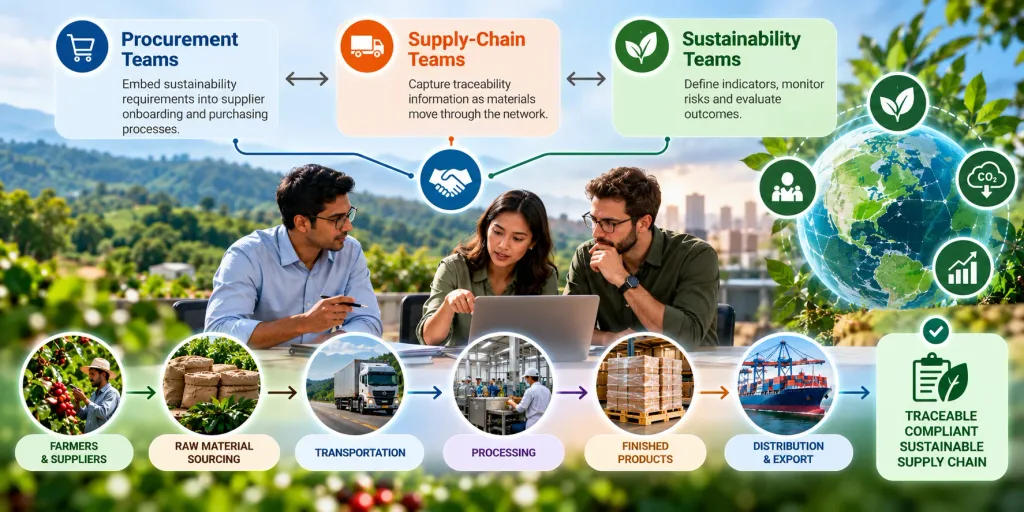
Sustainability cannot operate as an isolated function. Procurement decisions influence supplier selection, sourcing regions, materials and environmental performance. Supply-chain teams manage the movement and transformation of products. Sustainability teams define requirements, monitor risks and measure performance.
A connected digital sustainability approach allows these functions to work from shared information. For example, procurement can see supplier sustainability requirements, supply-chain teams can connect materials to their sources, and sustainability teams can assess performance and compliance using the same underlying records.
Discover how digital procurement solutions help businesses streamline supplier management, automate purchasing workflows, improve data accuracy, strengthen traceability, and connect procurement with compliance and supply-chain operations.
For agribusinesses and companies sourcing agricultural commodities, sustainability visibility often starts at the farm or production site. Supplier-level data alone may not explain where a commodity was produced or which practices were followed.
Farm-level information can include farmer profiles, plot boundaries, crop details, production activities, sourcing records and relevant sustainability indicators. Connecting this information with supplier and procurement records helps CSOs understand sustainability performance closer to the source.
This is particularly important where businesses need to demonstrate responsible sourcing, manage environmental risks or respond to customer and regulatory requirements.
Discover how capturing accurate farm-level sustainability data helps businesses improve traceability, monitor farming practices, measure sustainability performance, and strengthen responsible sourcing.
Traceability is more than knowing where a product came from. It can provide the data infrastructure that connects sustainability information across the supply chain.
When products can be traced from suppliers and sourcing locations through procurement, processing and distribution, sustainability teams can associate environmental and social information with actual supply-chain flows. This creates a stronger foundation for risk assessment, responsible sourcing and compliance.
For CSOs, traceability can therefore move sustainability data from a reporting exercise into an operational capability.
EUDR and Regulatory Compliance
Regulatory requirements are another reason digital sustainability is becoming important for CSOs. The EU Deforestation Regulation (EUDR), for example, requires relevant businesses to perform due diligence covering information collection, risk assessment and, where necessary, risk mitigation.
For businesses dealing with relevant commodities and products, this can require supplier information, production geolocation, evidence of legality, risk assessment results and supporting documentation. Managing this information manually can become difficult as supplier networks and sourcing locations grow.
A digital compliance workflow can connect supplier onboarding, geolocation, risk assessment, documentation and traceability, helping sustainability and compliance teams maintain a more structured evidence trail.
Carbon and DMRV
Carbon management adds another layer of data requirements. CSOs may need to understand emissions across operations, suppliers, farms, products or specific sustainability programmes. In agricultural supply chains, this can require data from farms and sourcing networks rather than only corporate facilities.
Digital Measurement, Reporting and Verification (DMRV) can help organisations structure measurement processes, capture evidence, monitor indicators and support verification. When DMRV is connected to traceability and farm-level data, sustainability teams can better understand where environmental performance is coming from and where improvement efforts may be needed.
Sustainability Performance Dashboards
A sustainability dashboard should do more than display attractive charts. It should help CSOs answer business questions: Which suppliers have incomplete data? Where are sustainability risks concentrated? Which sourcing regions require attention? Are sustainability programmes improving performance? Which compliance actions remain open?
Effective dashboards combine data from relevant operational workflows and present it in a way that supports prioritisation. This allows CSOs to move from manually compiling reports to monitoring performance more continuously.
How CSOs Can Work with Procurement and Supply-Chain Teams
Digital sustainability becomes more effective when CSOs work closely with procurement and supply-chain leaders. Procurement teams can embed sustainability requirements into supplier onboarding and purchasing processes. Supply-chain teams can capture traceability information as materials move through the network. Sustainability teams can define indicators, monitor risks and evaluate outcomes.
The CSO’s role is therefore increasingly cross-functional: establishing the sustainability framework while ensuring that the required data is captured through everyday business processes.
Moving from Sustainability Reporting to Operational Sustainability
Traditional sustainability reporting is often periodic: data is collected, consolidated and presented at the end of a reporting cycle. Operational sustainability takes a different approach. It embeds sustainability information into procurement, supplier management, farm management, traceability, compliance and supply-chain decisions.
This shift helps businesses respond to sustainability risks earlier and create clearer accountability for action. Instead of asking only, ‘What was our sustainability performance last year?’, CSOs can help the organisation ask, ‘Where are the risks today, what action is required, and can we demonstrate the evidence?’
How TraceX Supports Digital Sustainability for CSOs
TraceX Sustainability Solutions provides digital solutions that help organisations connect farm-level and supplier data with traceability, sustainability and compliance workflows. Teams can use structured data from sourcing networks to support supplier visibility, traceability, risk assessment, EUDR due diligence and sustainability monitoring.
By connecting operational data with sustainability requirements, TraceX helps CSOs build a more consistent evidence base across the supply chain and reduce dependence on fragmented manual processes.
Discover how TraceX helps sustainability teams connect supplier data, farm-level information, traceability, EUDR compliance, DMRV and sustainability performance through digital workflows.
Digital sustainability for CSOs is ultimately about connecting strategy with execution. Sustainability goals become more actionable when the data behind them is connected to procurement, suppliers, farms, products, traceability, compliance and environmental performance.
For organisations managing complex agricultural and global supply chains, the next stage of sustainability is not simply better reporting. It is building the digital infrastructure needed to measure, trace, verify and act on sustainability performance across the business.
Frequently Asked Questions (FAQ’s)
What is digital sustainability for CSOs?
Digital sustainability for CSOs refers to using connected digital systems and data to manage sustainability performance, supply-chain visibility, traceability, compliance and environmental programmes.
Why is traceability important for digital sustainability?
Traceability connects products and materials to suppliers and sourcing locations, creating a structured foundation for sustainability monitoring, risk management and compliance evidence.
How can CSOs improve sustainability data management?
CSOs can improve data management by connecting sustainability information with procurement, supplier, farm, supply-chain and compliance workflows instead of relying on disconnected spreadsheets and documents.
How does EUDR fit into digital sustainability?
EUDR creates requirements around information collection, risk assessment and risk mitigation for relevant products. Digital workflows can help structure supplier data, geolocation, evidence and assessment records.
What should a sustainability dashboard measure?
The right metrics depend on the organisation, but dashboards can include supplier performance, sourcing risks, traceability coverage, compliance status, emissions indicators and progress against sustainability targets.
Start using TraceX
Transparency, Trust, & Success for your Climate Journey.
We use cookies on our website to give you the most relevant experience by remembering your preferences and repeat visits. By clicking “Accept All”, you consent to the use of ALL the cookies. However, you may visit "Cookie Settings" to provide a controlled consent.
This website uses cookies to improve your experience while you navigate through the website. Out of these, the cookies that are categorized as necessary are stored on your browser as they are essential for the working of basic functionalities of the website. We also use third-party cookies that help us analyze and understand how you use this website. These cookies will be stored in your browser only with your consent. You also have the option to opt-out of these cookies. But opting out of some of these cookies may affect your browsing experience.
Necessary cookies are absolutely essential for the website to function properly. These cookies ensure basic functionalities and security features of the website, anonymously.
Cookie
Duration
Description
cookielawinfo-checkbox-analytics
11 months
This cookie is set by GDPR Cookie Consent plugin. The cookie is used to store the user consent for the cookies in the category "Analytics".
cookielawinfo-checkbox-functional
11 months
The cookie is set by GDPR cookie consent to record the user consent for the cookies in the category "Functional".
cookielawinfo-checkbox-necessary
11 months
This cookie is set by GDPR Cookie Consent plugin. The cookies is used to store the user consent for the cookies in the category "Necessary".
cookielawinfo-checkbox-others
11 months
This cookie is set by GDPR Cookie Consent plugin. The cookie is used to store the user consent for the cookies in the category "Other.
cookielawinfo-checkbox-performance
11 months
This cookie is set by GDPR Cookie Consent plugin. The cookie is used to store the user consent for the cookies in the category "Performance".
viewed_cookie_policy
11 months
The cookie is set by the GDPR Cookie Consent plugin and is used to store whether or not user has consented to the use of cookies. It does not store any personal data.
Functional cookies help to perform certain functionalities like sharing the content of the website on social media platforms, collect feedbacks, and other third-party features.
Performance cookies are used to understand and analyze the key performance indexes of the website which helps in delivering a better user experience for the visitors.
Analytical cookies are used to understand how visitors interact with the website. These cookies help provide information on metrics the number of visitors, bounce rate, traffic source, etc.
Advertisement cookies are used to provide visitors with relevant ads and marketing campaigns. These cookies track visitors across websites and collect information to provide customized ads.
Download the 2026 Traceability Scorecard and Benchmark Your Supply Chain Across 10 Critical Capabilities.
Download our eBook
Don’t Wait for an Audit to Find Your EUDR Gaps
The 2026 Simplification Package changes how HS codes, DDS pass-through and geolocation rules apply to you. Get the free guide and 20-point readiness checklist before enforcement catches you unprepared.