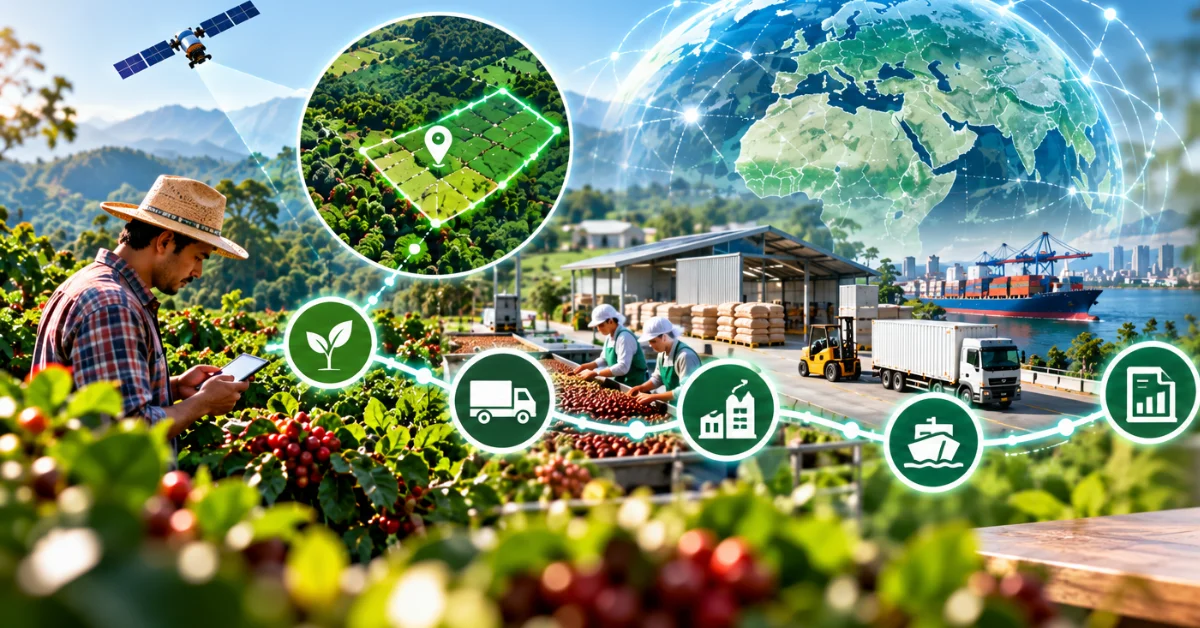
Digital Transformation for Achieving Sustainability Goals
Published
, 7 minute read
Share this article
Quick summary: Digital transformation for sustainability turns supplier and farm data into audit-ready proof for CSRD, CSDDD and buyers. See the 4-layer stack and checklist.
Digital transformation for sustainability is the shift from spreadsheets, emails and paper records to connected systems that capture sustainability data at source, trace it through the supply chain, verify it and report it. It matters because regulators, auditors and buyers now ask for evidence, not intentions. Done well, one dataset serves CSRD reporting, due diligence, certifications and customer questionnaires.
Key takeaways
96% of CEOs say innovation and technology are essential to sustainability goals, yet only 27% are considering digital tools for tracking and measurement.
Omnibus I narrowed the CSRD to companies with over 1,000 employees and €450m turnover from FY2027, but their suppliers still receive data requests.
The digital sustainability stack has four layers: capture, connect and trace, verify, and report.
Digital transformation for sustainability succeeds when data is captured once at source and reused for every report.
Discover how TraceX helps businesses centralize sustainability data, strengthen traceability, monitor supply-chain performance, and turn sustainability goals into measurable action.
What Is Digital Transformation for Sustainability?
It is replacing manual, fragmented sustainability processes with connected digital systems that produce verifiable data.
Digital transformation for sustainability means using software, mobile data capture, traceability, remote sensing and analytics to measure and manage environmental and social performance across operations and supply chains. It is not going paperless or buying a dashboard. It is redesigning how sustainability data is collected, who owns it and how it flows to decisions and disclosures.
For food, agri and consumer goods companies, most of the impact and most of the data gaps sit upstream, with thousands of farms and suppliers. That is where the transformation has to start.
It is also different from making IT itself greener. Energy-efficient data centres and lean software matter, but digital transformation for sustainability is about using data to change how materials are sourced, produced and verified across the value chain.
Why Digital Transformation for Sustainability Matters in 2026
Leaders agree on the goal, but few have the tools to measure progress, while evidence requirements keep rising.
The UN Global Compact-Accenture 2025 CEO Study, covering nearly 2,000 CEOs in 128 countries, found 88% see a stronger business case for sustainability than five years ago and 99% plan to maintain or expand commitments. Yet while 96% say innovation and technology are essential, only 27% are considering digital tools to track and measure sustainability. That gap is where programmes stall.
Regulation is narrower but sharper. The Omnibus I Directive, published in February 2026, limits the CSRD to companies with more than 1,000 employees and €450 million turnover from financial year 2027, and the CSDDD to the very largest companies from July 2029. Smaller suppliers gain a cap on what they must share, but large customers still need credible value-chain data. Sector rules such as the EUDR add plot-level evidence for specific commodities. Digital transformation for sustainability is how companies answer all of these requests from one evidence base instead of separate projects.
Digital Transformation for Sustainability: The Four-Layer Stack
Layer 1: Capture Sustainability Data at Source
Mobile apps and supplier portals record farm locations, practices, inputs, certificates and social indicators where they happen, with timestamps and geotags. Offline capture and local languages decide whether field staff actually use the tools.
Discover how capturing accurate farm-level sustainability data helps businesses improve traceability, monitor farming practices, measure sustainability performance, strengthen responsible sourcing, and make better supply-chain decisions. Read the Full Blog
Layer 2: Connect Suppliers and Trace Materials
Supplier onboarding, lot and batch traceability and ERP integration link each shipment to its sources, so claims follow the product.
Layer 3: Verify and Analyse
Satellite monitoring, risk scoring and carbon calculations test the data and turn it into decisions. Unverified data is just a more expensive spreadsheet.
Layer 4: Report and Disclose
The same dataset feeds ESRS disclosures, due diligence statements, certification audits and buyer questionnaires, without re-collecting it each time.
Common Barriers to Digital Transformation for Sustainability
Digital transformation for sustainability is rarely blocked by software. The common barriers are organisational and upstream:
Fragmented suppliers: thousands of smallholders and tier-2 suppliers with no digital records.
Siloed tools: separate systems for procurement, quality, certification and ESG that never reconcile.
Estimates over evidence: spend-based averages instead of primary data.
Report-first projects: dashboards built before the source data exists.
The result is a forced trade-off: hire more people to chase data every reporting cycle, or publish numbers no one can defend in an audit.
Digital Transformation for Sustainability in Practice
A tobacco exporter serving regulated markets used the TraceX platform to replace fragmented manual processes. It digitally onboarded 1,000 farmers with verified KYC and agreements, captured geotagged labour and environmental records, and linked procurement and payments to lots for audit-ready traceability. The programme shows digital transformation for sustainability working from the first mile, where most supply chain risk sits.
The practical lesson for any company is to start narrow. Pick one high-risk commodity or region, digitise source data there, prove the reporting value, then scale the same model to the next supply base.
How the TraceX Platform Supports Digital Transformation for Sustainability
Instead of stitching together a survey tool, a traceability spreadsheet and a separate ESG reporting system, sustainability, procurement and compliance teams work from the same records. That shared foundation is what lets a company answer an auditor, a regulator and a customer with consistent numbers.
Farm and supplier digitisation with mobile, offline-capable data capture
Farm-to-fork traceability at lot and batch level, with ERP integration
Sustainability verification using geolocation and satellite checks
Carbon and Scope 3 tracking through DMRV tools
Compliance reporting for EUDR, ESG disclosures and buyer requests
We see digital transformation for sustainability fail when it starts with the report. It works when it starts with the farmer, the plot and the lot, because every disclosure downstream is only as credible as that first record.
See how the TraceX platform captures, traces, verifies and reports sustainability data from farm to disclosure.
Manual processes collect data for one report; a platform builds a reusable evidence base.
Requirement
Manual approach
TraceX platform
Supplier data
Emailed spreadsheets each cycle
Supplier and farm profiles updated at source
Origin and traceability
Declarations and invoices
Lot-level links to farms and plots
Verification
Annual audits, samples
Geolocation and satellite checks
Carbon data
Spend-based estimates
Activity data from farm records
Reporting
Rebuilt for every request
One dataset, multiple report formats
Buyer Checklist for Digital Sustainability Platforms
Use these questions when evaluating a platform for digital transformation for sustainability:
Can it capture data from smallholders and suppliers offline, in local languages?
Does it trace materials at lot or batch level, not just supplier level?
Can it verify claims with geolocation and satellite data?
Does it calculate carbon from activity data, not only spend?
Can one dataset produce CSRD, due diligence and certification outputs?
Does it integrate with your ERP and procurement systems?
Can suppliers below CSRD thresholds share data within the value-chain cap?
Frequently Asked Questions (FAQ’s)
What is digital transformation for sustainability?
Digital transformation for sustainability is the use of connected digital systems to capture, trace, verify and report environmental and social data across operations and supply chains, replacing manual and fragmented processes.
Why do companies need digital tools for sustainability?
Regulators, auditors and buyers now expect evidence. Digital tools capture primary data at source and make it reusable across reports, reducing cost and audit risk.
Who must report under the CSRD after Omnibus I?
From financial year 2027, EU companies with more than 1,000 employees and over €450 million net turnover, plus certain large non-EU groups.
Do suppliers below the CSRD threshold still need sustainability data?
Yes. Their customers still need value-chain data, although suppliers with up to 1,000 employees can decline requests beyond the voluntary standard.
What technologies support digital sustainability?
Mobile data capture, traceability software, satellite monitoring, blockchain records, carbon accounting and ERP integration.
Where should a company start?
Start with source data for your highest-risk materials or suppliers, then add traceability, verification and reporting in that order.
How long does implementation take?
It depends on supplier numbers and integrations. Most programmes phase by commodity or region.
Start using TraceX
Transparency, Trust, & Success for your Climate Journey.
We use cookies on our website to give you the most relevant experience by remembering your preferences and repeat visits. By clicking “Accept All”, you consent to the use of ALL the cookies. However, you may visit "Cookie Settings" to provide a controlled consent.
This website uses cookies to improve your experience while you navigate through the website. Out of these, the cookies that are categorized as necessary are stored on your browser as they are essential for the working of basic functionalities of the website. We also use third-party cookies that help us analyze and understand how you use this website. These cookies will be stored in your browser only with your consent. You also have the option to opt-out of these cookies. But opting out of some of these cookies may affect your browsing experience.
Necessary cookies are absolutely essential for the website to function properly. These cookies ensure basic functionalities and security features of the website, anonymously.
Cookie
Duration
Description
cookielawinfo-checkbox-analytics
11 months
This cookie is set by GDPR Cookie Consent plugin. The cookie is used to store the user consent for the cookies in the category "Analytics".
cookielawinfo-checkbox-functional
11 months
The cookie is set by GDPR cookie consent to record the user consent for the cookies in the category "Functional".
cookielawinfo-checkbox-necessary
11 months
This cookie is set by GDPR Cookie Consent plugin. The cookies is used to store the user consent for the cookies in the category "Necessary".
cookielawinfo-checkbox-others
11 months
This cookie is set by GDPR Cookie Consent plugin. The cookie is used to store the user consent for the cookies in the category "Other.
cookielawinfo-checkbox-performance
11 months
This cookie is set by GDPR Cookie Consent plugin. The cookie is used to store the user consent for the cookies in the category "Performance".
viewed_cookie_policy
11 months
The cookie is set by the GDPR Cookie Consent plugin and is used to store whether or not user has consented to the use of cookies. It does not store any personal data.
Functional cookies help to perform certain functionalities like sharing the content of the website on social media platforms, collect feedbacks, and other third-party features.
Performance cookies are used to understand and analyze the key performance indexes of the website which helps in delivering a better user experience for the visitors.
Analytical cookies are used to understand how visitors interact with the website. These cookies help provide information on metrics the number of visitors, bounce rate, traffic source, etc.
Advertisement cookies are used to provide visitors with relevant ads and marketing campaigns. These cookies track visitors across websites and collect information to provide customized ads.
Download the 2026 Traceability Scorecard and Benchmark Your Supply Chain Across 10 Critical Capabilities.
Download our eBook
Don’t Wait for an Audit to Find Your EUDR Gaps
The 2026 Simplification Package changes how HS codes, DDS pass-through and geolocation rules apply to you. Get the free guide and 20-point readiness checklist before enforcement catches you unprepared.