Digital Farmer Payments: From Procurement to Transparent Settlements
Published
, 11 minute read
Share this article
Quick summary: Learn how digital farmer payments connect procurement, quantity, quality, pricing and settlements to improve transparency, efficiency and farmer trust.
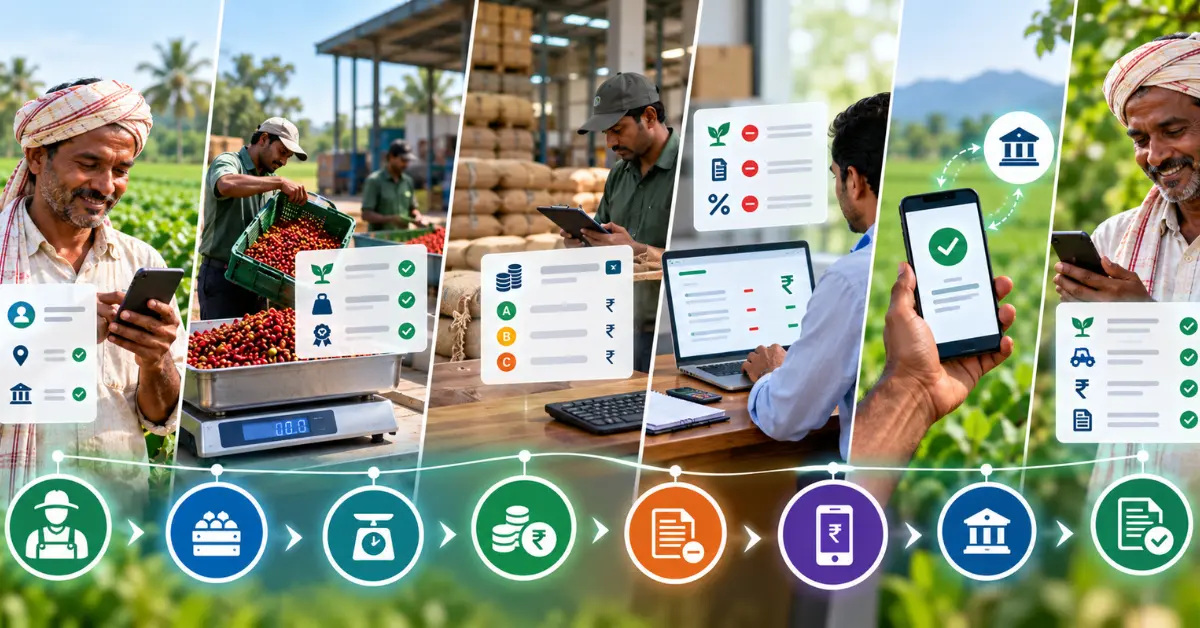
Digital farmer payments are electronic payments made by agricultural buyers to farmers or producer groups for produce supplied, typically through bank accounts, mobile money or other digital financial services. But a strong digital payment process is about more than moving money electronically. It connects the payment to the underlying procurement transaction who supplied the produce, what quantity was received, what quality was recorded, what price or rate was applied, what deductions were made, and what amount was finally settled. The World Bank notes that digital agricultural payments can improve transparency and provide greater visibility into where and when farmers are paid, while reducing some risks and costs associated with cash payments.
Key Takeaways
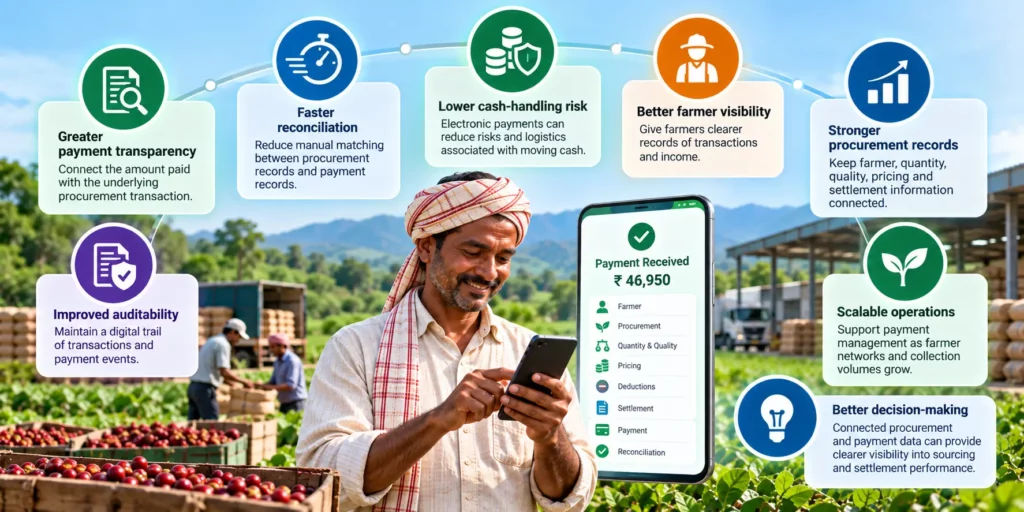
Digital farmer payments connect procurement directly with transparent settlements, creating a clear financial trail from farmgate purchase to payment.
Farmer payments should not be managed in isolation. Linking farmer, quantity, quality, agreed price, deductions, procurement and payment records reduces manual reconciliation.
Digital procurement creates the foundation for accurate payments by capturing transactions at the point of purchase and connecting them to farmer records.
Transparent pricing builds farmer trust. Pre-agreed prices, quality parameters and clearly recorded deductions help reduce payment disputes.
Digital farmer payments reduce manual errors and delays caused by paper-based records, spreadsheets and disconnected procurement and finance systems.
Quality-linked payments become easier to manage when accepted quantities, grades and applicable deductions are digitally captured.
A connected payment workflow improves traceability by linking the chain from Farmer → Procurement → Quantity → Quality → Price → Settlement → Payment.
Digital records strengthen financial accountability by providing a centralized and verifiable history of farmer transactions.
Faster settlements can improve farmer relationships, particularly when farmers have greater visibility into what they supplied, what they earned and when they were paid.
Digital payments turn farmer transactions into valuable supply-chain data, helping businesses improve procurement visibility, reconciliation, reporting and operational decision-making.
The goal is not simply to digitize the payment. It is to create a transparent connection between what the farmer supplied and what the farmer was ultimately paid.
For agribusinesses, digital farmer payments can become part of a broader farm-to-market traceability system, connecting procurement and financial records with farmer, crop and supply-chain data.
TraceX Farm Management Solutions help digitize agribusinesses.
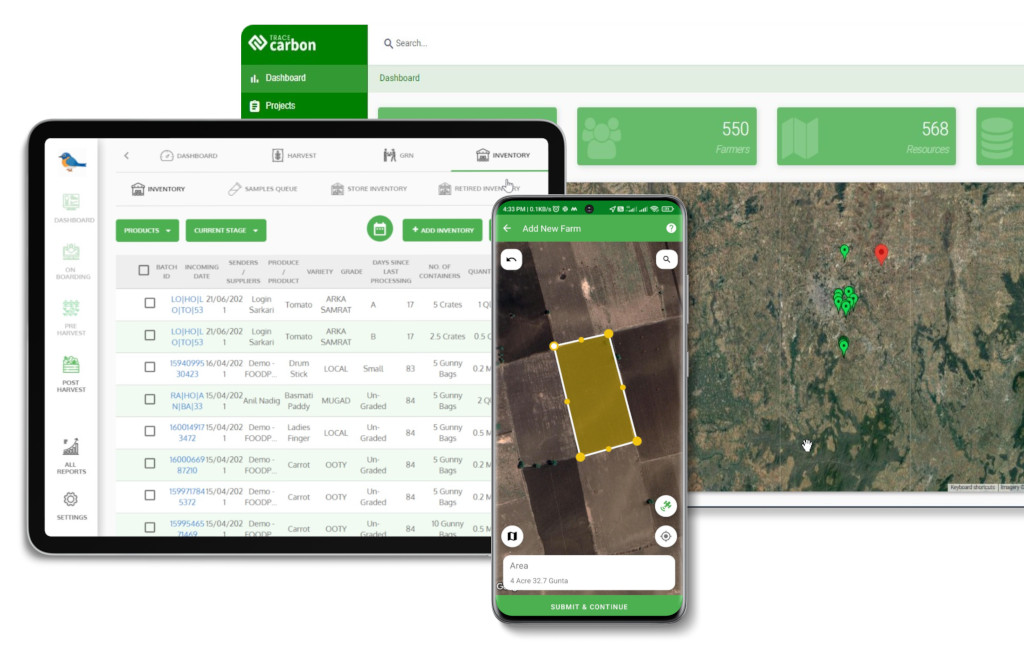
Managing farmers, crops, field activities, inputs, harvests, and procurement across a growing network can quickly become complex. TraceX help digitize these workflows, improve operational visibility, streamline farmer engagement, and build traceability from farm to procurement.
For many agricultural businesses, farmer payment is the final step in a much longer process. A farmer is registered, a crop is planned, produce is delivered, weight and quality are checked, the transaction is recorded, deductions may be applied, and payment is calculated. When these steps happen across paper records, spreadsheets, messaging apps and separate finance systems, reconciliation can become slow and error-prone.
Digital farmer payments create an opportunity to connect the commercial transaction with the farmer record. This can make it easier for buyers to understand what they owe, why they owe it, and whether the payment has been completed. For farmers, clearer records can improve visibility into income and reduce the need to repeatedly visit collection points or payment offices where digital payment infrastructure is available.
Digital farmer agreements can strengthen this process by clearly capturing agreed pricing, crop details, quality parameters, and payment terms upfront. When these agreements are digitally linked to procurement and payment records, businesses can create a more transparent connection between what was agreed, what was supplied, and what was ultimately paid.
Farmer agreements create clarity around pricing, crop commitments, quality parameters, inputs, and payment terms before procurement begins. Learn how digital farmer agreements can strengthen farmer relationships, improve procurement transparency, and create a reliable record from agreement to final settlement.
Imagine a farmer receives ₹42,500 in their account. The payment arrived, but can they easily understand how the amount was calculated? Was it based on 2,500 kg at a particular rate? Was a quality premium included? Was an input advance deducted? Was transportation deducted?
A digital transaction proves that money moved. A connected payment record explains the transaction.
This distinction matters for agribusinesses managing thousands of farmers. The goal should not simply be to replace cash with electronic transfers. It should be to build a transparent chain from procurement to settlement.
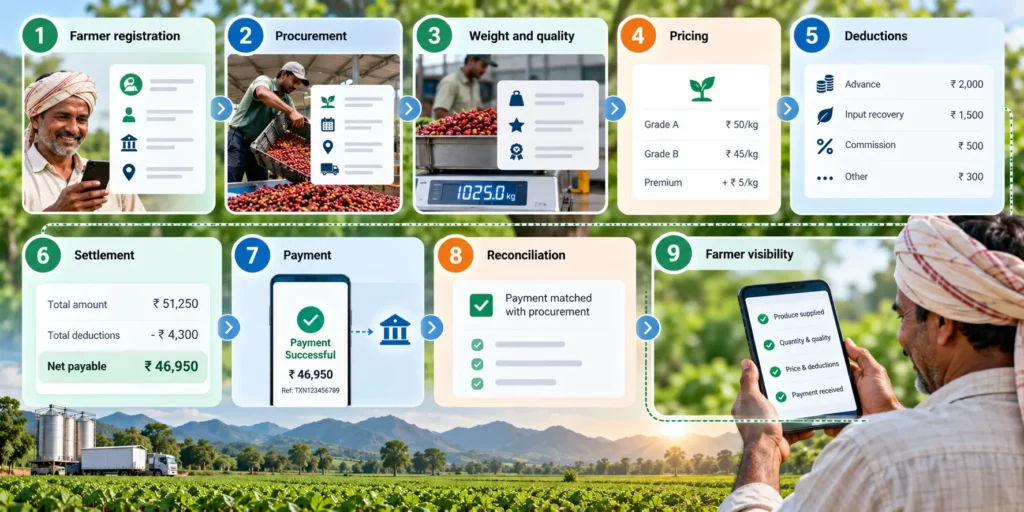
How Digital Farmer Payments Work in a Connected Workflow
Farmer registration → Maintain a digital farmer profile and relevant payment details.
Procurement → Record produce supplied, date, location and transaction.
Weight and quality → Capture quantity and applicable quality parameters.
Pricing → Apply the agreed price, grade, premium or incentive.
Deductions → Record advances, input recovery, commissions or other agreed deductions.
Settlement → Calculate the net amount payable.
Payment → Initiate or record the digital payment.
Reconciliation → Match the payment with the underlying procurement transaction.
Farmer visibility → Provide a clear transaction or payment record where the operating model supports it.
Discover how digital procurement can streamline farmer transactions, improve data accuracy, strengthen traceability, and connect procurement from the farmgate to payment.
A food processor works with 2,000 potato growers. Farmers deliver potatoes to collection centres, where weight and quality are recorded. Under a manual process, procurement records may be maintained separately from the farmer ledger and finance records. A connected digital workflow can associate the farmer, crop, delivery, quantity, grade, agreed rate, deductions and final settlement. The payment record can then be reconciled against the actual procurement transaction rather than treated as an isolated bank transfer.
Make Farmer Agreements More Traceable
Farmer agreements are more than contracts they create the foundation for transparent and traceable procurement. See how McPatel Foods digitized farmer registration, agreements, and procurement workflows to improve visibility across its potato supply chain.
A coffee buyer purchases from multiple farmers through collection points. Quality grades affect the price. Digital farmer payments can connect the farmer profile with the delivery, weight, quality grade, price calculation and final payment, making it easier to explain why farmers received different amounts.
Effective farmer profiling goes beyond basic registration. Build a clearer picture of your farmers, farms, crops, production capacity, and sourcing activities to improve procurement planning, farmer engagement, and supply-chain traceability.
A buyer provides seeds or inputs to contracted farmers and recovers an agreed amount from produce payments. A digital settlement workflow can record the input advance, procurement quantity, applicable price, deduction and net payment, creating a clearer transaction history.
Example 4: Cooperative procurement
A cooperative aggregates produce from hundreds of members and sells it to a processor. Digital records can help preserve the relationship between aggregate procurement and farmer-level transactions, depending on the cooperative’s operating model and payment responsibilities.
Example 5: Quality-linked payment
A fruit processor pays farmers according to grade, size, moisture or other quality parameters. If quality is recorded digitally at procurement, the pricing logic can be connected to the settlement. The payment record can show the transaction context rather than only the final amount.
Example 6: Multiple collection centres
A large agribusiness operates collection centres across several regions. A central digital procurement and payment record can reduce manual reconciliation of paper receipts and help finance teams identify outstanding settlements.
Example 7: Payment dispute
A farmer believes the payment is lower than expected. With disconnected records, the business may search paper receipts, spreadsheets and messages. With a connected transaction record, the team can review delivery, quantity, quality, price, deductions and settlement history more quickly.
Managing farmer advances, input support, procurement transactions, deductions, and settlements across thousands of contract farmers can quickly become complex. Discover how a global leaf tobacco company centralized and automated farmer-level financial workflows to improve transparency, streamline reconciliation, and generate timely settlement reports.
The most useful way to think about digital farmer payments is as the final link in a procurement workflow. A transparent settlement should be explainable from the transaction that created it.
Who supplied the produce?
What was supplied?
When and where was it delivered?
How much was accepted?
What quality or grade was recorded?
What price or rate was applied?
What premiums or incentives were included?
What deductions were made and why?
What was the gross amount?
What was the net amount payable?
When was the payment initiated or completed?
Not every business will use every field, and payment rules differ by commodity and contract. The principle is simple: the payment should remain connected to the commercial event that generated it.
How TraceX Can Support Digital Farmer Payments
TraceX Farm Management and procurement workflows can help agribusinesses connect farmer records with crop activities, procurement transactions, quantities, quality information and settlement processes. Instead of managing farmer profiles, procurement records and payment-related information as disconnected records, businesses can create a more connected digital workflow from farmer onboarding and sourcing through procurement and settlement. This can help reduce manual reconciliation, improve visibility into farmer transactions, support consistent record-keeping, and provide a stronger audit trail across the procurement lifecycle.
The objective is not simply to digitize the final payment instruction. It is to connect the payment to the farmer and the transaction that created it so procurement teams, finance teams and farmers can work from a clearer record.
Ready to Make Farmer Payments More Transparent?
Connect farmer records, procurement, quantities, quality, pricing and settlements in a more structured digital workflow with TraceX Farm Management and procurement capabilities.
It can be tempting to treat farmer payments as a finance-system problem. But the amount paid to a farmer originates much earlier in the supply chain. It begins with the farmer relationship, contract or sourcing arrangement, continues through procurement and quality assessment, and ends with settlement.
That makes digital farmer payments a cross-functional workflow involving sourcing, field teams, procurement, quality, finance and farmer engagement.
The World Bank has highlighted that digitizing agricultural payments can strengthen supply-chain transparency and provide visibility into where and when farmers are paid. FAO likewise identifies digital technologies such as mobile payments as tools that can help address bottlenecks in agricultural value chains.
What Businesses Should Look for in a Digital Farmer Payment Process
Farmer identity linked to procurement records
Digital capture of quantity and quality at collection
Configurable pricing and settlement rules
Transparent recording of deductions and adjustments
Integration or reconciliation with finance/payment systems
Payment status tracking
Farmer-level transaction history
Exception and dispute visibility
Audit trail across procurement and settlement
Ability to scale across farmers, crops, locations and collection centres
The Bigger Opportunity: Payments as Supply-Chain Data
A farmer payment can tell an agribusiness more than how much money left its account. When connected to procurement data, it can help explain sourcing volumes, farmer participation, crop performance, pricing outcomes and settlement patterns.
This is where payment digitization becomes strategically valuable. The business moves from simply processing payments to creating a more transparent digital record of the commercial relationship between farmers and buyers.
That record can support better farmer engagement, procurement planning, financial reconciliation and supply-chain visibility provided the underlying data is accurate and the technology is designed around the actual operating workflow.
Conclusion
Digital farmer payments are more than a faster way to transfer money. When connected to procurement and settlement workflows, they can create a clearer, more transparent record of the commercial relationship between an agribusiness and its farmers.
Because a payment is not truly transparent just because it is digital. It is transparent when the transaction behind the payment can be understood.
Frequently Asked Questions
What are digital farmer payments?
Digital farmer payments are electronic payments made by agricultural buyers to farmers or producer groups for produce supplied, typically through bank accounts, mobile money or other digital financial services. A strong process also connects the payment to procurement and settlement records.
Why should agribusinesses digitize farmer payments?
Digitalization can reduce some costs and risks associated with cash handling, improve payment visibility, support faster reconciliation and create clearer transaction records. Benefits depend on local infrastructure and adoption.
How do digital farmer payments improve transparency?
They can connect the payment to the farmer, delivery, quantity, quality, pricing, deductions and settlement record, making it easier to understand how the final amount was calculated.
Can digital farmer payments support farmer trust?
They can, particularly when farmers can see or receive a clear record of what was supplied, how it was priced and what was paid. Trust also depends on transparent contracts, consistent quality assessment and reliable payment practices.
Can digital farmer payments integrate with procurement?
Yes. The strongest model connects farmer onboarding, procurement, quantity, quality, pricing and settlement, and can reconcile payment status with the underlying procurement transaction.
Are digital farmer payments the same as mobile money?
No. Mobile money is one channel through which a digital payment can be delivered. Digital farmer payment management is broader: it includes transaction data, pricing, deductions, settlement workflow, payment status and reconciliation.
What challenges can businesses face when digitizing farmer payments?
Connectivity, digital literacy, account ownership, regulatory requirements, payment-provider coverage and adoption can affect implementation. These barriers vary by market.
Start using TraceX
Transparency, Trust, & Success for your Climate Journey.
We use cookies on our website to give you the most relevant experience by remembering your preferences and repeat visits. By clicking “Accept All”, you consent to the use of ALL the cookies. However, you may visit "Cookie Settings" to provide a controlled consent.
This website uses cookies to improve your experience while you navigate through the website. Out of these, the cookies that are categorized as necessary are stored on your browser as they are essential for the working of basic functionalities of the website. We also use third-party cookies that help us analyze and understand how you use this website. These cookies will be stored in your browser only with your consent. You also have the option to opt-out of these cookies. But opting out of some of these cookies may affect your browsing experience.
Necessary cookies are absolutely essential for the website to function properly. These cookies ensure basic functionalities and security features of the website, anonymously.
Cookie
Duration
Description
cookielawinfo-checkbox-analytics
11 months
This cookie is set by GDPR Cookie Consent plugin. The cookie is used to store the user consent for the cookies in the category "Analytics".
cookielawinfo-checkbox-functional
11 months
The cookie is set by GDPR cookie consent to record the user consent for the cookies in the category "Functional".
cookielawinfo-checkbox-necessary
11 months
This cookie is set by GDPR Cookie Consent plugin. The cookies is used to store the user consent for the cookies in the category "Necessary".
cookielawinfo-checkbox-others
11 months
This cookie is set by GDPR Cookie Consent plugin. The cookie is used to store the user consent for the cookies in the category "Other.
cookielawinfo-checkbox-performance
11 months
This cookie is set by GDPR Cookie Consent plugin. The cookie is used to store the user consent for the cookies in the category "Performance".
viewed_cookie_policy
11 months
The cookie is set by the GDPR Cookie Consent plugin and is used to store whether or not user has consented to the use of cookies. It does not store any personal data.
Functional cookies help to perform certain functionalities like sharing the content of the website on social media platforms, collect feedbacks, and other third-party features.
Performance cookies are used to understand and analyze the key performance indexes of the website which helps in delivering a better user experience for the visitors.
Analytical cookies are used to understand how visitors interact with the website. These cookies help provide information on metrics the number of visitors, bounce rate, traffic source, etc.
Advertisement cookies are used to provide visitors with relevant ads and marketing campaigns. These cookies track visitors across websites and collect information to provide customized ads.
Download the 2026 Traceability Scorecard and Benchmark Your Supply Chain Across 10 Critical Capabilities.
Download our eBook
Don’t Wait for an Audit to Find Your EUDR Gaps
The 2026 Simplification Package changes how HS codes, DDS pass-through and geolocation rules apply to you. Get the free guide and 20-point readiness checklist before enforcement catches you unprepared.