Supply Chain Visibility: Why Real-Time Data Now Decides Compliance and Market Access
Published
, 7 minute read
Share this article
Quick summary: Supply chain visibility explained: the 4 maturity levels, why real-time data now matters for EUDR, food safety and buyers, and how to evaluate a platform.
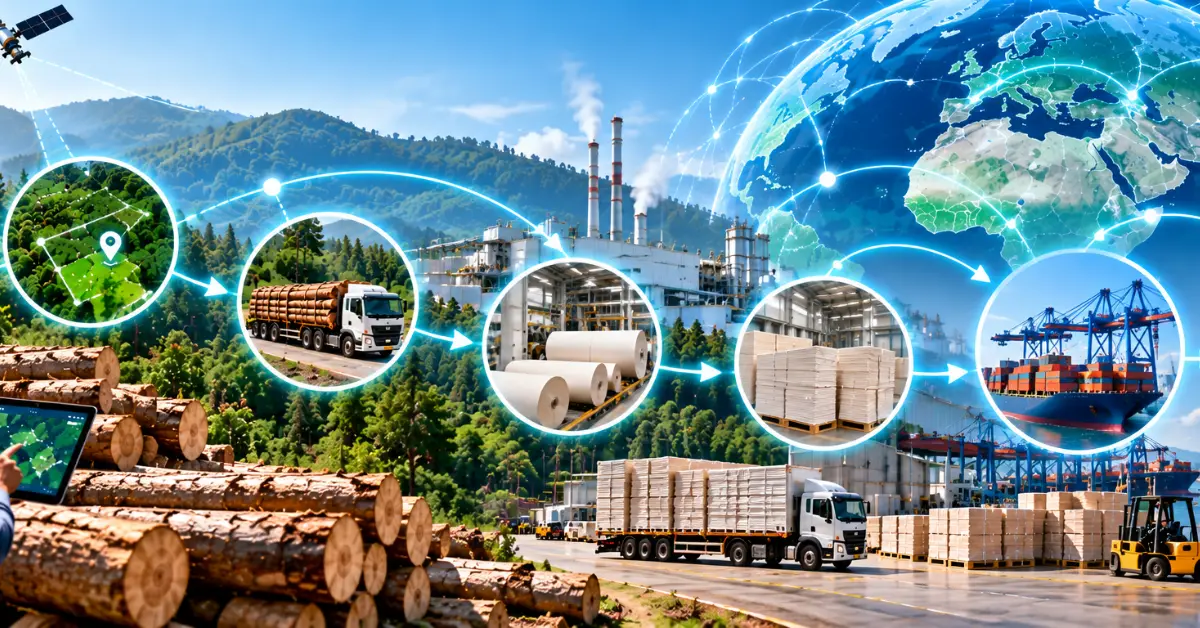
Supply chain visibility is the ability to see where products, materials and suppliers are, where they came from and whether they meet requirements, across every tier from origin to customer. Real-time supply chain visibility captures events as they happen rather than in monthly reports, so teams can catch risks before a shipment leaves. It now underpins EUDR due diligence, food safety traceability and buyer audits.
Key takeaways
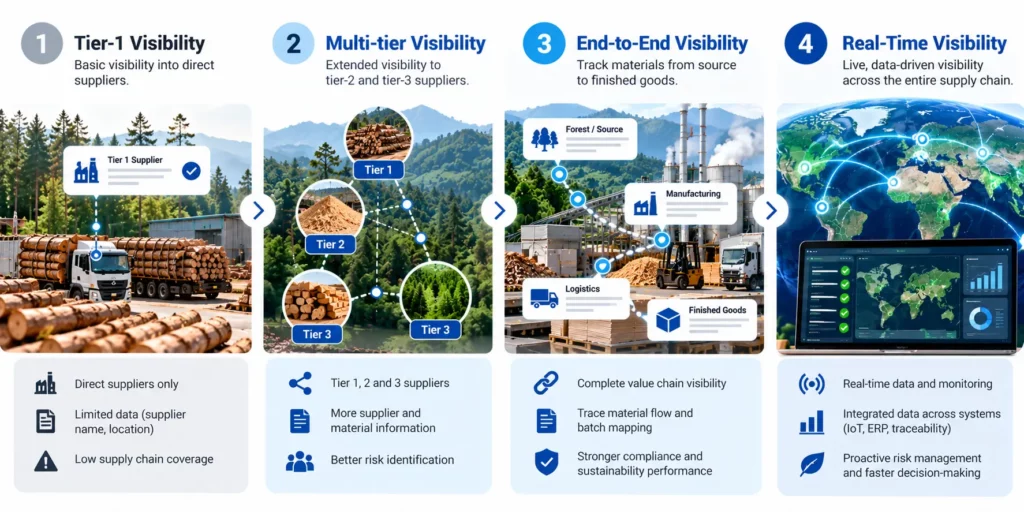
Supply chain visibility has four maturity levels: tier-1, multi-tier, origin and lot, and real-time event-driven.
Most compliance failures start upstream, at traders and aggregators that tier-1 data never shows.
EUDR applies from 30 December 2026 for large and medium operators, with plot-level geolocation required for each relevant product.
A visibility platform should capture data at source, link it to lots and raise alerts, not just refresh dashboards.
Get expert guidance on traceability, sustainability data, supply-chain visibility, compliance, and digital sustainability strategies tailored to your business needs
It is knowing, with evidence, what is moving through your supply chain, where it came from and whether it complies.
Supply chain visibility covers three questions: where is it now, where did it come from, and can we prove it meets requirements? Most companies can answer the first for finished goods. Far fewer can answer the second and third for raw materials sourced through traders, cooperatives and processors.
Real-time supply chain visibility adds speed. Instead of periodic reports that describe what already happened, data is captured as events occur: a harvest, a weighment, a blend, a dispatch. That is the difference between finding a problem and preventing one.
It also helps to separate three related terms. Traceability is the record linking a lot to its sources. Transparency is what you choose to share with buyers and consumers. Supply chain visibility is the operational view that uses traceability data to monitor status and risk across the chain.
Supply Chain Visibility Maturity: The Four Levels
Level 1, tier-1 suppliers: you know who you buy from, backed by invoices and declarations.
Level 2, multi-tier mapping: you can name the traders, aggregators and processors behind each supplier.
Level 3, origin and lot level: every shipment links to specific farms, plots and batches.
Level 4, real-time and event-driven: events stream in as they happen, with automated risk alerts and audit-ready records.
Many systems call themselves real-time but only refresh a dashboard monthly. True Level 4 supply chain visibility is event-driven and continuous.
Why Supply Chain Visibility Matters Now
Regulations demand proof, buyers want source-level data, and the biggest risks sit upstream.
Visibility for Regulation: Proof, Not Declarations
The EU Deforestation Regulation applies from 30 December 2026 for large and medium operators and from 30 June 2027 for most micro and small operators, and the Commission confirmed in May 2026 that there will be no further delay. Operators must link each relevant product to the geolocation of the plots where it was produced. In the US, FSMA 204 requires additional traceability records for foods on the Food Traceability List, and UFLPA presumes goods linked to Xinjiang are made with forced labour unless importers prove otherwise.
Visibility for Buyers: Source-Level Data
Buyers now ask for verifiable, source-level data rather than supplier self-declarations, and they favour suppliers who can answer audit requests quickly. The shift is from tier-1 lists to farm, plot or origin-level traceability, and from static PDFs to live, auditable records that can be checked at any point in the contract.
Discover how structured plot data management helps businesses capture accurate farm and plot information, validate geolocation, improve supply-chain visibility, support compliance, and build reliable farm-to-market traceability. Read the Full Blog
Visibility for Risk: Look Upstream
Mixed batches, undocumented intermediaries and unmapped farms can invalidate legality and sustainability claims. Without supply chain visibility beyond tier 1, companies discover these issues at the border or in an audit, when the cost is highest. A single uncertified lot blended at an aggregation point can taint an entire container, and the paperwork will not reveal it until someone asks for plot-level evidence.
Core Features of a Supply Chain Visibility Platform
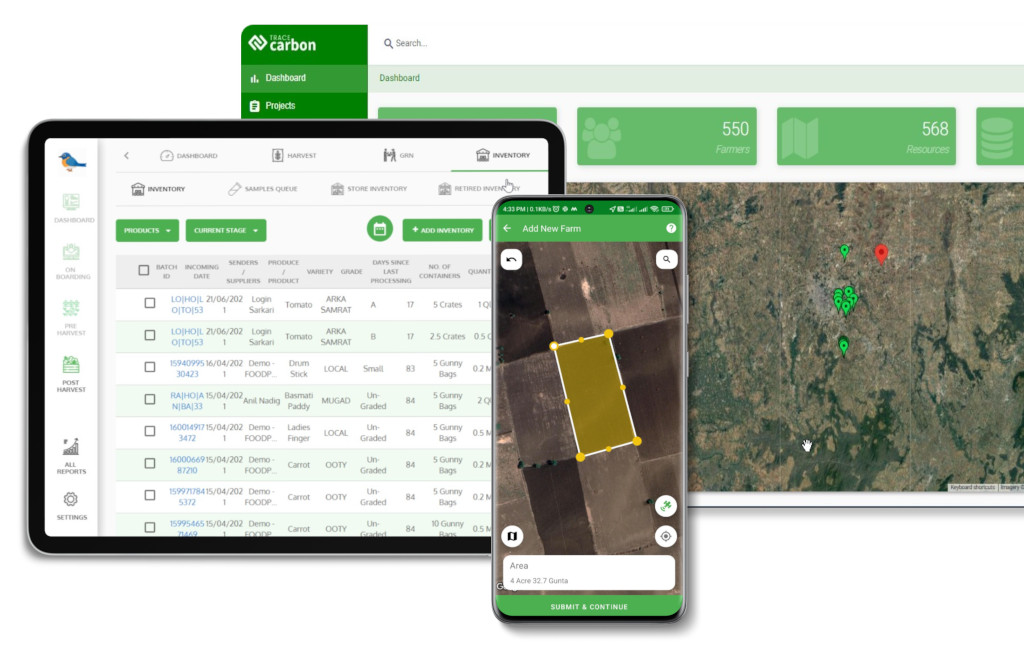
Field updates over messaging apps, supplier spreadsheets and last-minute buyer requests are what most teams live with today. A platform replaces that with a shared system where each event is recorded once and reused. The TraceX Sustainable Sourcing platform covers the following:
Centralised supplier and geolocation data: supplier profiles, certificates and farm polygons in one system
Event capture at source: mobile apps, connected weighing scales and QR codes that record procurement, weight and origin as they happen
Lot and batch traceability: chain-of-custody records through aggregation, processing and export
Risk scoring and alerts: satellite and benchmark checks that flag issues near sourcing areas
Tamper-evident records and automated reporting: blockchain-backed audit trails; for EUDR, TraceX prepares due diligence statements for submission to the EU Information System
Dashboards do not create supply chain visibility; source data does. We see programmes succeed when the first record is captured at the farm gate or collection point, because every downstream view inherits its accuracy.
See your supply chain before your auditor does
See how the TraceX platform delivers source-level, real-time supply chain visibility
Organic India used the TraceX platform to digitise farm management, track regenerative practices, optimise procurement and validate quality certifications, gaining supply chain visibility from field to finished product. A spice technology company similarly moved from limited visibility to verified, farmer-linked data using TraceX blockchain traceability.
The practical route to better supply chain visibility is incremental: map one high-risk material beyond tier 1, digitise the first collection point, connect lots through processing, then switch on alerts and reporting.
Manual processes show the past; a platform shows the present and proves the past.
Need
Manual approach
TraceX platform
Supplier and origin data
Spreadsheets, emailed files
Central supplier and plot profiles
Procurement events
Paper slips, end-of-week entry
App and connected-scale capture with QR
Chain of custody
Invoices per tier
Lot-level links through processing
Risk detection
Audits, NGO reports
Automated risk scoring and alerts
Regulatory submissions
Manual collation each shipment
Generated from existing records
Supply Chain Visibility Platform Checklist
Use these questions to evaluate any supply chain visibility software:
Can it capture data offline at farms and collection points?
Does it map suppliers beyond tier 1 to farms and plots?
Does it link lots and batches through blending and processing?
Are records time-stamped and tamper-evident?
Does it raise risk alerts automatically, not only show dashboards?
Can it produce EUDR, FSMA 204 and buyer-audit outputs from one dataset?
Does it integrate with your ERP and logistics systems?
Frequently Asked Questions
What is supply chain visibility?
Supply chain visibility is the ability to track products, materials and suppliers across every tier, from origin to customer, with verifiable data on location, source and compliance status.
What is real-time supply chain visibility?
It means capturing supply chain events as they happen, such as harvests, weighments and shipments, instead of relying on periodic reports, so issues are detected before they escalate.
What is the difference between visibility and traceability?
Visibility is the broad view of status and risk across the chain; traceability is the record that links a specific product or lot back to its origins. Strong visibility depends on traceability.
How does supply chain visibility support EUDR compliance?
It links each product to plot geolocation, supplier records and risk assessments, which operators need for due diligence statements from 30 December 2026.
Which industries need supply chain visibility most?
Food, agriculture, cocoa, coffee, palm oil, rubber, timber, textiles and any sector facing origin, safety or forced-labour rules.
What technologies enable it?
Mobile data capture, connected scales, QR codes, IoT sensors, satellite monitoring, blockchain records and ERP integration.
How do I start improving supply chain visibility?
Map your highest-risk materials beyond tier 1, digitise data capture at the first collection point, then add lot traceability and alerts.
Start using TraceX
Transparency, Trust, & Success for your Climate Journey.
We use cookies on our website to give you the most relevant experience by remembering your preferences and repeat visits. By clicking “Accept All”, you consent to the use of ALL the cookies. However, you may visit "Cookie Settings" to provide a controlled consent.
This website uses cookies to improve your experience while you navigate through the website. Out of these, the cookies that are categorized as necessary are stored on your browser as they are essential for the working of basic functionalities of the website. We also use third-party cookies that help us analyze and understand how you use this website. These cookies will be stored in your browser only with your consent. You also have the option to opt-out of these cookies. But opting out of some of these cookies may affect your browsing experience.
Necessary cookies are absolutely essential for the website to function properly. These cookies ensure basic functionalities and security features of the website, anonymously.
Cookie
Duration
Description
cookielawinfo-checkbox-analytics
11 months
This cookie is set by GDPR Cookie Consent plugin. The cookie is used to store the user consent for the cookies in the category "Analytics".
cookielawinfo-checkbox-functional
11 months
The cookie is set by GDPR cookie consent to record the user consent for the cookies in the category "Functional".
cookielawinfo-checkbox-necessary
11 months
This cookie is set by GDPR Cookie Consent plugin. The cookies is used to store the user consent for the cookies in the category "Necessary".
cookielawinfo-checkbox-others
11 months
This cookie is set by GDPR Cookie Consent plugin. The cookie is used to store the user consent for the cookies in the category "Other.
cookielawinfo-checkbox-performance
11 months
This cookie is set by GDPR Cookie Consent plugin. The cookie is used to store the user consent for the cookies in the category "Performance".
viewed_cookie_policy
11 months
The cookie is set by the GDPR Cookie Consent plugin and is used to store whether or not user has consented to the use of cookies. It does not store any personal data.
Functional cookies help to perform certain functionalities like sharing the content of the website on social media platforms, collect feedbacks, and other third-party features.
Performance cookies are used to understand and analyze the key performance indexes of the website which helps in delivering a better user experience for the visitors.
Analytical cookies are used to understand how visitors interact with the website. These cookies help provide information on metrics the number of visitors, bounce rate, traffic source, etc.
Advertisement cookies are used to provide visitors with relevant ads and marketing campaigns. These cookies track visitors across websites and collect information to provide customized ads.
Download the 2026 Traceability Scorecard and Benchmark Your Supply Chain Across 10 Critical Capabilities.
Download our eBook
Don’t Wait for an Audit to Find Your EUDR Gaps
The 2026 Simplification Package changes how HS codes, DDS pass-through and geolocation rules apply to you. Get the free guide and 20-point readiness checklist before enforcement catches you unprepared.