Circular Agriculture: Why the Loop Only Counts If You Can Measure It
Published
, 9 minute read
Share this article
Quick summary: Circular agriculture is taught as five principles, but a loop you can’t measure is just a story. See how measurement turns closed loops into premiums, carbon and proof.
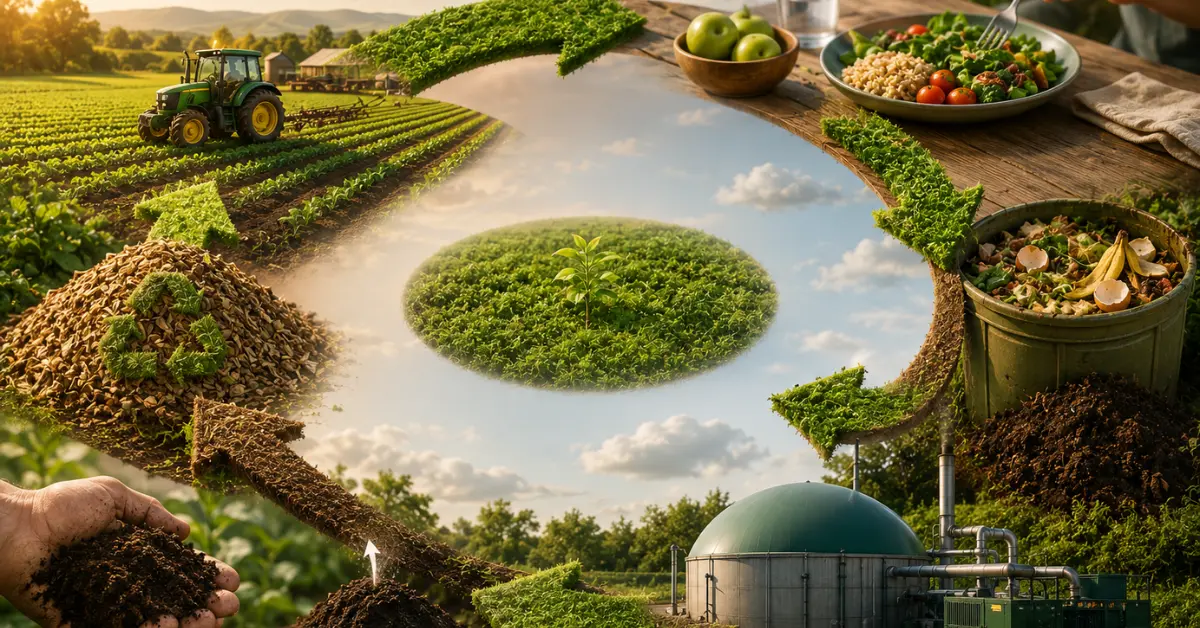
Circular agriculture is a way of producing food that closes resource loops replacing the linear “take, make, dispose” model with one where nutrients, biomass, water and energy are reused within the system. It rests on five principles: safeguard agro-ecosystem health, avoid wasting essential resources, prioritise biomass for food before feed or fuel, recycle unavoidable residues, and use renewable energy. But the principle beneath all five is measurement: a loop you can’t quantify is a story, not a system. Circularity only becomes real and monetisable as premiums, carbon credits or verified sustainability claims when the recycled nutrients, displaced inputs and avoided emissions are measured and travel with the product.
Key Takeaways
It’s a loop, not a linear line. Circular farming replaces “take, make, dispose” with a closed system where one chain’s residue is another’s feedstock.
Five principles, one meta-principle. Safeguard, avoid, prioritise biomass, recycle, use renewables but none of them delivers value you can’t measure.
The world leader proves the point. The Netherlands runs circular agriculture on an annual nutrient-cycling assessment measurement is the method, not an afterthought.
Measurement is what monetises circularity. Recycled nutrients and avoided emissions only become premiums, carbon credits or ESG proof once quantified and traceable.
Can you prove your circular claims — or just describe them?
See how TraceX measures nutrient, input and emission flows so circular practices become verifiable value.
What Circular Agriculture Really Means — and Its Five Principles
Circular agriculture is a farming model that closes resource loops instead of running them in a straight line. Conventional agriculture is linear: it extracts inputs fossil fuels, mined phosphate, synthetic nitrogen, imported feed produces food, an discards the losses as waste and emissions. This model redesigns that flow so nutrients, biomass, water and energy are reused within the system, and the residue of one chain becomes the feedstock of another.
Beyond the slogans, the most rigorous framing (adapted from Muscat and colleagues) sets out five principles:
Safeguard agro-ecosystems. Don’t use soils, water or biodiversity beyond their regenerative capacity, and don’t pollute the air with avoidable emissions.
Avoid wasting essential resources. Prevent nutrient losses and cut resource-intensive inputs such as synthetic fertiliser, because nothing recycles perfectly.
Prioritise biomass for food first. Use scarce biomass for human food before diverting it to feed, materials or energy the biomass value pyramid.
Recycle unavoidable residues. Return nutrients to the soil through compost, manure and digestate rather than letting them leak away.
Use renewable energy. Power the system with renewables biogas, solar while minimising total energy use.
The Principle Beneath the Principles: You Can’t Close a Loop You Can’t Measure
Here is what the listicles miss. Every one of those five principles is a claim about a flow nutrients recycled, inputs avoided, emissions prevented, biomass cascaded. And a flow you don’t measure is a flow you can’t manage, prove or sell. A farm can compost, rotate crops and spread manure and still have no idea whether its nutrient loop is actually closing or quietly leaking. In circular farming, the gap between circular-in-principle and circular-in-proof is data.
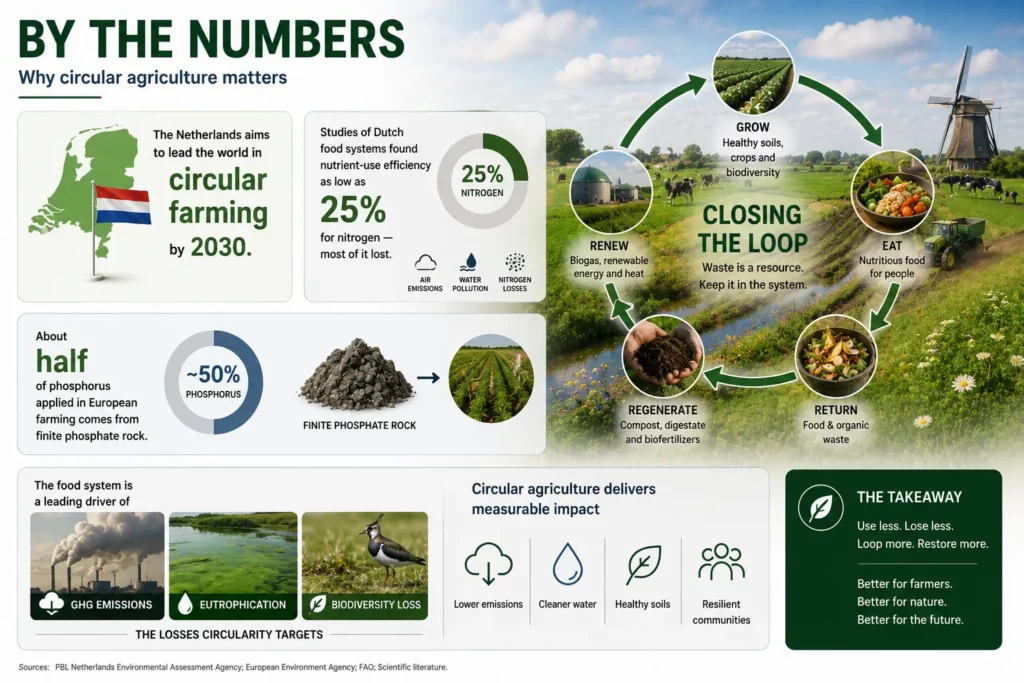
The country furthest down this road makes the point for us. The Netherlands set out to lead the world in circularity by 2030 and it operationalises that ambition through measurement, running an annual nutrient-cycling assessment on dairy farms to track exactly how much nitrogen and phosphorus is cycled versus lost. Studies of Dutch food systems have found nutrient-use efficiency as low as 25%, which is only visible because someone measured it. You cannot improve a loop you have never quantified.
There’s a commercial edge to this too. A circular practice creates economic value only when the saving travels with the product: the recycled nutrient, the displaced fossil input, the avoided emission. That is what turns circularity into a price premium, a carbon credit, or a verified claim a buyer’s ESG and Scope 3 reporting will accept. Loops that aren’t measured break at the farm gate the agronomy may be sound, but the value never leaves the field. The blunt version: you can’t close, or sell, a loop you can’t measure.
Circular Agriculture in the Real World
These examples show circularity working and why measurement decides whether it delivers.
A nation runs on nutrient accounting — the Netherlands
The Dutch circular-farming vision targets closed nutrient cycles, cleaner water and lower emissions by 2030. Crucially, it is enforced through measurement: the annual nutrient-cycling assessment turns “close the loop” into a number each farm has to report. The country’s nitrogen crisis is, at heart, an accounting problem too much nitrogen entering the system relative to what leaves in product. Measurement is what makes the imbalance actionable.
Manure, unravelled into products — nutrient recovery
Dutch projects now ‘unravel’ manure into distinct products: biogas for energy, recognised nitrogen fertiliser, mineral phosphate, potassium concentrate and soil improver. It is a textbook closed loop but the payoff (renewable energy generated, mined phosphate displaced) only counts on a balance sheet when each output stream is quantified.
Closing the phosphorus loop — a finite-resource story
Around half of the phosphorus applied in European agriculture comes from mined phosphate rock, a finite resource. Recovering and recycling phosphorus is one of the highest-value loops in circular farming yet you can only claim the displacement of virgin phosphate if you can measure how much recycled phosphorus you actually returned to the field.
Turning crop residue into value — coffee, cocoa and rice
Coffee pulp, cocoa pod husk and rice straw are usually burned or dumped, wasting biomass and polluting air. Valorising them into compost, biochar, feed or energy closes the residue loop. For a brand, that becomes a marketable sustainability claim only when the residue diverted and the emissions avoided are measured and traceable back to the farm.
Transform Crop Residues into Sustainable Opportunities
Discover how effective crop residue management can improve soil health, reduce emissions, enhance farm productivity, and support sustainable agricultural practices.
If measurement is the meta-principle, then operationalising circularity means instrumenting the loops. A platform built for this should do six things.
Measure nutrient and input flows. Track nitrogen, phosphorus, water and energy in and out at plot and farm level, so cycling and losses become visible numbers.
Quantify avoided inputs and emissions. Turn recycled nutrients and displaced fossil inputs into calculated savings ready for carbon and ESG accounting.
Digitise residue and by-product valorisation. Record how much residue is diverted from burning or dumping into compost, biochar, feed or energy.
Attach circularity data to the product. Carry the loop’s metrics downstream with the batch, so the value reaches the buyer instead of stopping at the farm gate.
Verify claims for buyers and reporting. Produce auditable evidence that stands up to Scope 3, sustainability and premium-sourcing requirements.
Capture the first mile offline. Record field data in low-connectivity areas so smallholder loops are measured too, not just large farms.
Circular Agriculture Principles: Practice and the Proof Behind Each
Each principle is a practice and a number you must measure to prove it.
Soil organic carbon, biodiversity indicators, GHG per unit of output
Avoid wasting resources
Prevent nutrient loss; cut synthetic fertiliser
Nitrogen and phosphorus use efficiency (NUE / PUE); input per output
Prioritise biomass for food
Food first; residues to feed or energy after
Share of biomass to food vs feed/fuel; residue utilisation rate
Recycle residues
Compost, manure-to-fertiliser, digestate
% of nutrients recycled on-farm; fertiliser displaced
Use renewable energy
Biogas from manure, solar drying
Renewable share of energy; fossil energy avoided
How TraceX Enables Circular Agriculture
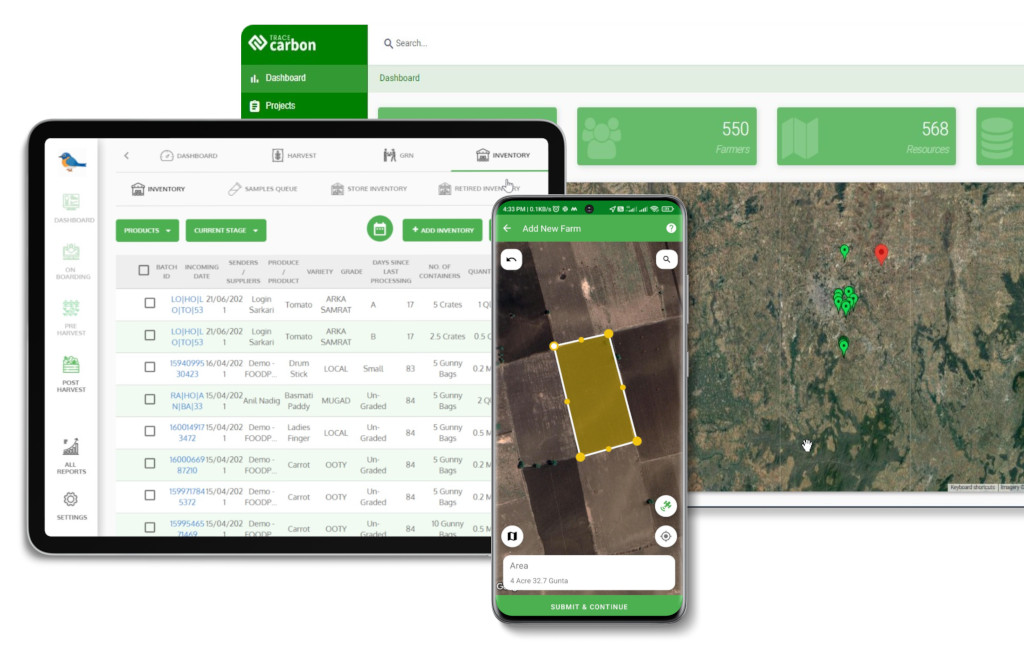
TraceX empowers organizations to transition from traditional farming practices to circular agriculture by digitizing farm operations, improving resource efficiency, and enabling end-to-end traceability across the agricultural value chain. The platform captures field-level data on crop production, soil health, water usage, input application, crop residue management, and waste utilization, helping farmers and agribusinesses optimize resource use while minimizing environmental impact. Through AI-driven insights, satellite monitoring, and geospatial analytics, TraceX promotes regenerative farming practices, reduces waste, supports carbon sequestration initiatives, and enhances biodiversity. By connecting farmers, processors, brands, and buyers on a unified digital platform, TraceX enables transparent supply chains, verifies sustainable farming practices, and provides the data needed to meet evolving sustainability regulations, ESG commitments, and consumer expectations. The result is a resilient, low-carbon agricultural ecosystem where resources are continuously reused, waste is minimized, and value is created across every stage of the supply chain.
Turn circular agriculture from a story into measurable value.
TraceX measures nutrient, input and emission flows across your supply chain, quantifies avoided inputs and emissions, and carries verifiable circularity data downstream to buyers.
Before you call your operation circular, confirm you can measure it.
✓Nutrient inflows and outflows (N, P) are tracked at plot and farm level.
✓Nutrient-use efficiency and losses are calculated, not assumed.
✓Recycled nutrients and displaced inputs are quantified for carbon/ESG.
✓Residue and by-product valorisation is recorded, not just described.
✓Renewable energy generated and fossil energy avoided are measured.
✓Circularity metrics travel with the product to the buyer.
✓Claims are auditable for Scope 3 and premium-sourcing requirements.
Frequently Asked Questions
What is circular agriculture in simple terms?
It’s farming that closes resource loops reusing nutrients, biomass, water and energy within the system instead of the linear “take, make, dispose” model, so one chain’s residue becomes another’s feedstock.
What are the principles of circular agriculture?
Safeguard agro-ecosystem health, avoid wasting essential resources, prioritise biomass for food before feed or fuel, recycle unavoidable residues, and use renewable energy. Underlying all five is the need to measure the loops.
How is circular agriculture different from regenerative agriculture?
Regenerative agriculture focuses on restoring soil and ecosystem health through practices like cover cropping and reduced tillage. Circular agriculture is broader — it closes resource and nutrient loops across the whole system. They overlap and reinforce each other.
Why does measurement matter so much in circular agriculture?
Because a loop you can’t quantify can’t be improved, proven or monetised. Measuring recycled nutrients, avoided inputs and emissions is what turns circular practices into premiums, carbon credits and verified sustainability claims.
Can smallholders practise circular agriculture?
Yes crop-livestock integration, composting and residue reuse are long-standing smallholder practices. The gap is measurement, which offline-first digital tools can now bring to fragmented, low-connectivity supply chains.
We use cookies on our website to give you the most relevant experience by remembering your preferences and repeat visits. By clicking “Accept All”, you consent to the use of ALL the cookies. However, you may visit "Cookie Settings" to provide a controlled consent.
This website uses cookies to improve your experience while you navigate through the website. Out of these, the cookies that are categorized as necessary are stored on your browser as they are essential for the working of basic functionalities of the website. We also use third-party cookies that help us analyze and understand how you use this website. These cookies will be stored in your browser only with your consent. You also have the option to opt-out of these cookies. But opting out of some of these cookies may affect your browsing experience.
Necessary cookies are absolutely essential for the website to function properly. These cookies ensure basic functionalities and security features of the website, anonymously.
Cookie
Duration
Description
cookielawinfo-checkbox-analytics
11 months
This cookie is set by GDPR Cookie Consent plugin. The cookie is used to store the user consent for the cookies in the category "Analytics".
cookielawinfo-checkbox-functional
11 months
The cookie is set by GDPR cookie consent to record the user consent for the cookies in the category "Functional".
cookielawinfo-checkbox-necessary
11 months
This cookie is set by GDPR Cookie Consent plugin. The cookies is used to store the user consent for the cookies in the category "Necessary".
cookielawinfo-checkbox-others
11 months
This cookie is set by GDPR Cookie Consent plugin. The cookie is used to store the user consent for the cookies in the category "Other.
cookielawinfo-checkbox-performance
11 months
This cookie is set by GDPR Cookie Consent plugin. The cookie is used to store the user consent for the cookies in the category "Performance".
viewed_cookie_policy
11 months
The cookie is set by the GDPR Cookie Consent plugin and is used to store whether or not user has consented to the use of cookies. It does not store any personal data.
Functional cookies help to perform certain functionalities like sharing the content of the website on social media platforms, collect feedbacks, and other third-party features.
Performance cookies are used to understand and analyze the key performance indexes of the website which helps in delivering a better user experience for the visitors.
Analytical cookies are used to understand how visitors interact with the website. These cookies help provide information on metrics the number of visitors, bounce rate, traffic source, etc.
Advertisement cookies are used to provide visitors with relevant ads and marketing campaigns. These cookies track visitors across websites and collect information to provide customized ads.
Download the 2026 Traceability Scorecard and Benchmark Your Supply Chain Across 10 Critical Capabilities.
Download our eBook
Don’t Wait for an Audit to Find Your EUDR Gaps
The 2026 Simplification Package changes how HS codes, DDS pass-through and geolocation rules apply to you. Get the free guide and 20-point readiness checklist before enforcement catches you unprepared.