US Lacey Act 2026: What Phase VII Means for Plant and Timber Importers
Published
, 13 minute read
Share this article
Quick summary: Phase VII expanded the US Lacey Act to almost every plant product. See penalties, due-diligence rules, and how TraceX automates compliance.
The US Lacey Act makes it a federal crime to import any plant or plant product harvested in violation of any US or foreign law even if the importer didn’t know. Phase VII, effective December 1, 2024, extended declaration requirements to virtually every non-composite plant product entering the United States, from furniture and essential oils to musical instruments and boat trim. Compliance now hinges on three operational capabilities: verifying species and harvest country, geolocating the source, and proving ‘due care’ in writing.
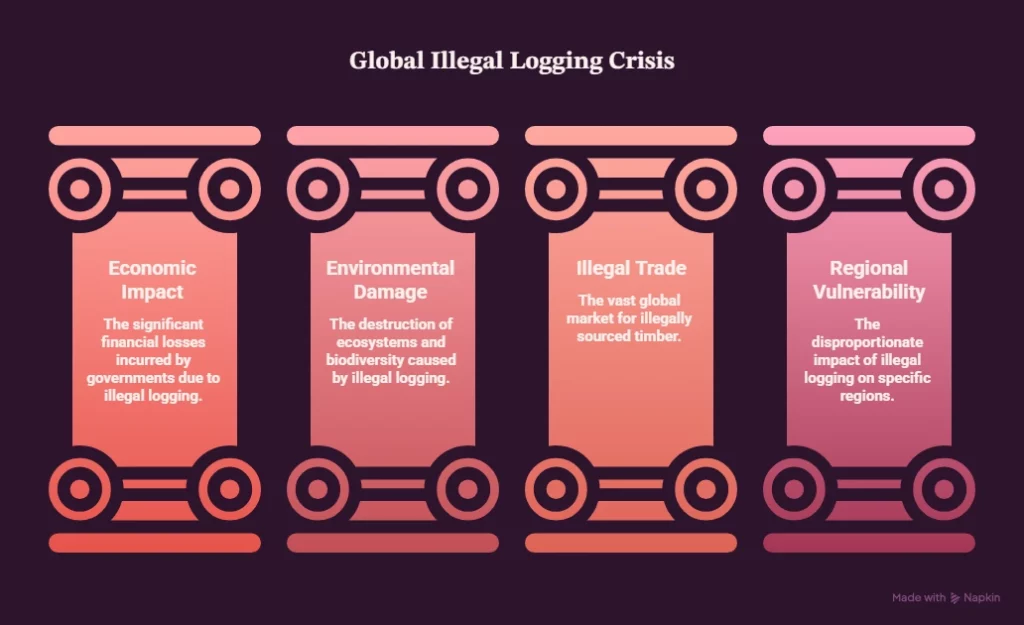
Illegal logging is worth between $50 billion and $152 billion a year between 15% and 30% of all timber traded globally (INTERPOL, 2024).
The United States was the first country in the world to criminalise the import of products containing illegally sourced wood, and as of December 2024, it has the broadest enforcement scope of any timber regulation on the planet broader, even, than the EU Deforestation Regulation.
If you import furniture, cabinets, plywood, paper, essential oils, musical instruments, or anything else made from a plant, you are now operating under the Lacey Act. And the Department of Justice has stopped being quiet about it. This guide walks through the operational workflow supplier onboarding, species verification, geolocation evidence, declaration automation that a Chief Compliance Officer actually needs to stand up.
Key Takeaways
Phase VII expanded Lacey Act declarations to 241 new HTS product headings on December 1, 2024 — covering furniture, sporting goods, cork, tools, boats and more.
Recent enforcement has scaled: from $200K (Global Plywood, 2021) to $6.3M (Boise Cascade, 2026) and 57 months in prison (Hernandez Quintana, 2024). HSI’s new Forest Crimes Program is actively investigating.
Strict liability + extraterritorial reach means certifications alone don’t protect you. Technology GPS polygon mapping, AI-powered species verification, blockchain audit trail is now the practical standard for ‘due care’.
What is the US Lacey Act, and Why is It Suddenly Sharper Than EUDR?
The Lacey Act, originally enacted in 1900, is the oldest wildlife-protection statute in the United States. It was amended in 2008 to cover plants and plant products, including timber. The 2008 amendment made the Lacey Act the world’s first law to extend jurisdiction to the laws of the origin country meaning a US importer can be prosecuted for violating Indonesian forestry law, Brazilian timber-harvest rules, or Ghanaian export permits, even without ever setting foot in those countries.
Two things make the Lacey Act unique:
Strict liability. There is no ‘I didn’t know’ defense for the civil penalty regime. If you imported it and it was illegal somewhere in its history, you are on the hook.
No certification shield. FSC, PEFC, and third-party schemes do not establish legality under the Act. Only actual legality counts. A clean certificate against an illegal harvest is still an illegal harvest.
This is where the Lacey Act diverges from EUDR. EUDR requires a Due Diligence Statement and asks operators to prove deforestation-free sourcing with geolocation. The Lacey Act doesn’t require a DDS but it punishes you criminally if the underlying harvest was illegal. The two regimes overlap heavily, but Lacey punches harder when something has already gone wrong.
What Changed Under Phase VII (Effective December 1, 2024)?
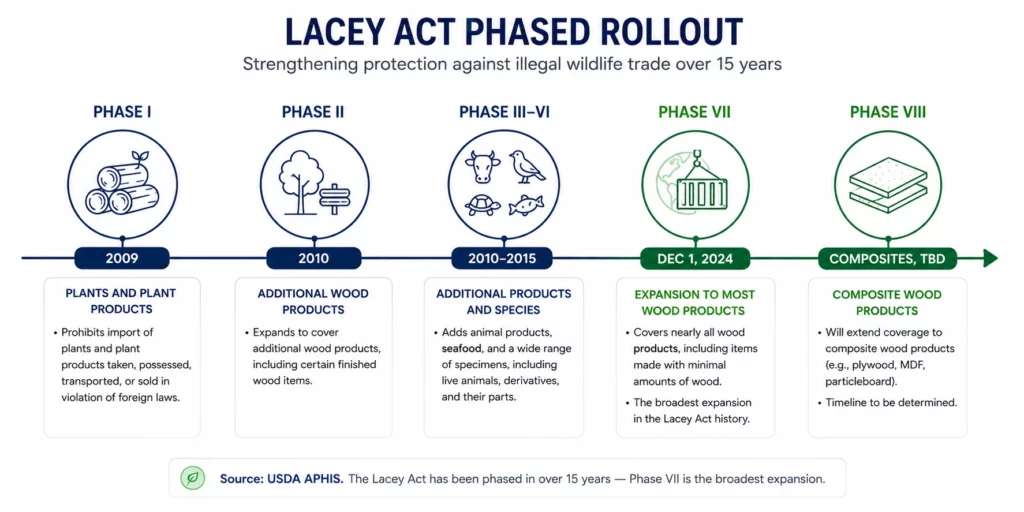
Until December 2024, the Lacey Act declaration requirement covered only about 44% of US wood-product imports by value. The remaining $47 billion in annual imports was technically subject to the prohibition but not the paperwork. Phase VII closes that gap.
As of December 1, 2024, USDA APHIS now requires Lacey Act declarations for 241 newly added HTS product headings essentially every plant-based product that isn’t 100% composite material. Phase VIII, expected to follow, will cover the composites: paper, cardboard, MDF, HDF, and particleboard.
What Now Needs a Declaration That Didn’t Before
Furniture, including kitchen cabinets, vanities, and upholstered pieces with wood frames
The declaration itself sounds simple. Importers must list the scientific genus and species, the country of harvest, the quantity, and the value, for every plant material in the product. For a single sofa with a hardwood frame, cork detailing, and bamboo legs, that may mean three separate species declarations each one requiring source verification.
Phase VII triples the declaration burden for furniture importers. A single SKU may now require species-by-species verification from a supplier two or three tiers upstream exactly the data layer that most ERP systems weren’t built to capture.
How Severe Are the Penalties? Recent Lacey Act Enforcement Cases
Lacey Act penalties scale with two things: the value of the illegal product, and the level of awareness. A negligent importer faces civil penalties up to $10,000 per shipment. A knowing violation is a felony, with maximum fines of $500,000 per organisation and 5 years in prison per count.
Enforcement was quiet for almost a decade after the Lumber Liquidators settlement. That has reversed. The Department of Justice has prosecuted four major timber cases since 2021, and Homeland Security Investigations launched a Forest Crimes Program in 2025.
Recent Enforcement — What It Has Actually Cost Companies
Year
Defendant
Outcome
2015
Lumber Liquidators
$13.15M total fine the largest Lacey Act penalty ever issued. Illegally logged Russian timber laundered through China.
2021
Global Plywood and Lumber Trading LLC
$200K restitution to the Government of Peru + $5K criminal fine. Peruvian Amazon timber, failure to exercise due care.
$110K criminal fine + $250K customs penalty + 3-year probation. False species declarations on Chinese-harvested cabinets falsely labelled as Malaysian.
2026
Boise Cascade
$6.3M fine third enforcement action tied to the Horizon plywood scheme. DOJ said the company was ‘willfully blind’ to illegal origin.
Three signals matter for buyers reading this:
DOJ is targeting downstream buyers, not just smugglers. Boise Cascade was a corporate buyer, not the importer of record. ‘Willful blindness’ is now a prosecutable posture.
False species declarations are a felony lever. The L&D Kitchen case turned on misdeclared species — and the company also evaded $850,000 in customs duties at the same time.
Forest Crimes Program is operational. HSI is actively investigating. New 2026 enforcement actions are expected throughout the year.
What Does Lacey Act ‘Due Care’ Actually Require?
Due care is the operational standard the Lacey Act expects from importers. It is not defined in the statute. Courts and APHIS interpret it as the diligence a ‘reasonably prudent person’ would exercise which scales with the risk profile of the supply chain.
In practice, due care requires four things:
Species verification. You must know and be able to prove the scientific genus and species of every plant material. Mislabelled timber is the single most common Lacey Act violation.
Geographic verification. You must know the country, region, and ideally the harvest concession where the material originated. CITES-listed species require additional permits.
Legal chain-of-custody. Every transfer from harvest to shipment should be documentable. Harvest permits, transport documents, mill records, and export licenses each one a defensible artifact.
Risk-based diligence. Higher-risk geographies (countries with weak forestry governance) require deeper verification. Sourcing from the Russian Far East or the Peruvian Amazon raises the bar.
Illegal logging is estimated to account for 50–90% of total timber production from some tropical forest countries, with Indonesia at 40–60%, Russia at 25%, and Gabon at 70% (GRID-Arendal, citing INTERPOL). Any importer sourcing from these geographies operates in a ‘red flag’ due-care environment.
Most importers approach due care as a documentation exercise collecting PDFs from suppliers and filing them in a shared drive. That doesn’t survive a DOJ subpoena. Due care has become a data problem: structured, queryable, time-stamped, and tamper-resistant.
Lacey Act vs EUDR vs UK Forest Risk Commodities — How Do the Three Regimes Overlap?
If you ship plant or timber products into both the United States and the European Union (and increasingly the United Kingdom), you are now navigating three overlapping but non-identical regimes. Most teams over-build for one and under-build for the others. The data layer is largely the same.
Dimension
US Lacey Act
EU Deforestation Regulation
UK Forest Risk Commodities
Effective date
1900 (plants added 2008, Phase VII Dec 2024)
Dec 30, 2025 (large operators); Jun 2026 (SMEs)
Phased rollout post-2026
Filing requirement
Lacey Act declaration at import (APHIS)
Due Diligence Statement to EU TRACES system
Annual disclosure
Geolocation required
Country of harvest (minimum)
GPS coordinates / polygon for every plot
Risk-assessment level
Liability standard
Strict (civil) / knowing (criminal)
Operator due-diligence
Operator due-diligence
Penalty ceiling
$500K/count + 5 yrs prison + forfeitures
Up to 4% of EU annual turnover
Set per regulation
Certification shield
No
No (must still geolocate)
No
Covers
All plants & plant products
Cattle, cocoa, coffee, palm, rubber, soy, wood
Cattle, cocoa, coffee, palm, rubber, soy
The cheapest path to multi-regime compliance is a single data spine supplier KYC, geolocation, species, transactions that satisfies the strictest regime by design. Building three parallel compliance stacks costs roughly 2.5x more than building one shared one, based on TraceX customer deployments.
Want to see how a single platform handles Lacey, EUDR, and UKFR declarations from one supplier dataset?
Download the TraceX Multi-Regulation Readiness Checklist — a 12-point assessment used by agri-food exporters before peak shipping season.
How Can Technology Close the Lacey Act Compliance Gap?
Until recently, Lacey Act compliance lived in spreadsheets and email attachments. That model breaks at scale. Once an importer is sourcing from more than a handful of suppliers or once a single SKU contains multiple species manual due care becomes both slow and indefensible.
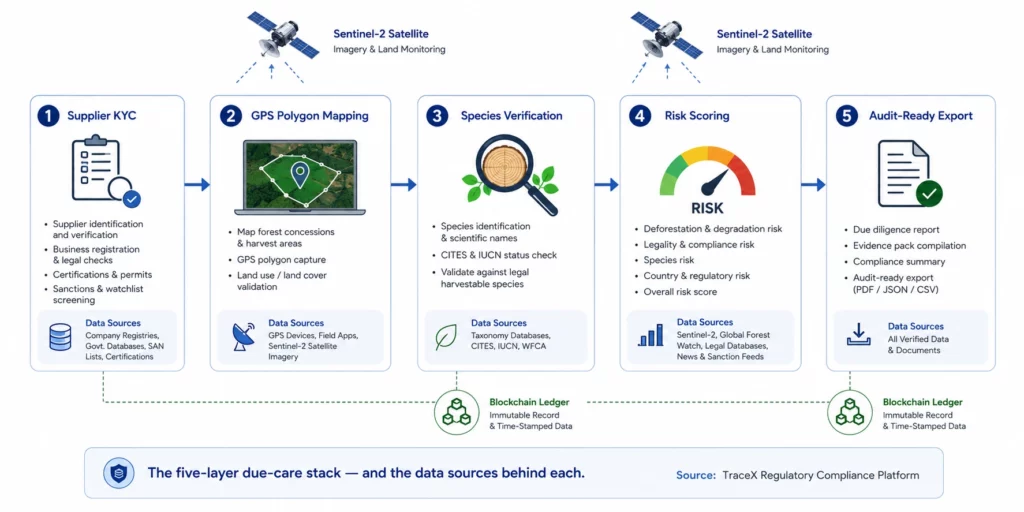
The operational stack that survives a DOJ inquiry has five layers:
1. Digital Supplier Onboarding With KYC Capture
Each supplier — including upstream tiers — is onboarded into a structured profile. Land tenure documents, harvest permits, export licenses, and species declarations are captured at source, not chased after the shipment leaves port. AI-powered document parsing extracts data from supplier emails and PDFs automatically.
2. GPS Polygon Geolocation
Every harvest plot is mapped as a polygon, not a pin. Polygons are validated against authoritative satellite forest-loss datasets (Hansen, JRC, GLAD) to flag any overlap with deforestation events. For Lacey Act purposes, this gives you a defensible ‘country of harvest’ down to the concession level.
As EUDR, Lacey Act, UKFR, and ILPA enforcement intensifies, organizations need more than static documentation they need scalable traceability, supplier verification, geolocation validation, and audit-ready due diligence workflows. Explore how modern forest compliance tools help streamline global regulatory readiness across timber, paper, and agri-commodity supply chains. Read the full blog on Forest Compliance Tools →
3. Species Verification and Chain-of-Custody
Scientific genus and species are captured at harvest, carried through every transfer, and bound to the shipment via blockchain-backed records. Mislabelled species the single most common Lacey Act failure mode get caught before the shipment ever lands at a US port.
As global regulations tighten, timber companies must prove not just legality — but continuous traceability across the entire supply chain. Learn how strong chain-of-custody systems help support EUDR, Lacey Act, UKFR, and ILPA compliance while improving audit readiness and supplier transparency. Read the full blog on Chain of Custody in Timber Supply Chains →
4. Risk Scoring and Continuous Monitoring
Every shipment is risk-scored against country, supplier, species, and recent satellite alerts. A shipment from a high-risk Indonesian concession gets an automatic review queue; a shipment from a low-risk certified Canadian mill clears on autopilot.
5. Audit-Ready Export
When an APHIS inspector or DOJ investigator asks for the file, you produce a single PDF or XML export supplier identity, polygon, satellite overlay, species lab report, transaction ledger, and audit log generated in under a minute, not three weeks.
From supplier onboarding and risk screening to document validation and traceability workflows, Agentic AI is reshaping how organizations manage complex compliance operations at scale. Discover how intelligent, autonomous systems can help reduce manual workload, improve decision-making, and accelerate audit-ready compliance across global supply chains.
What a Lacey-Ready Supply Chain Looks Like (TraceX Workflow)
TraceX customers in the timber, rubber, and furniture export categories are building out the five-layer stack typically in 8 to 12 weeks for a mid-sized operation:
Field layer. Field agents and smallholder suppliers use the TraceX offline-first mobile app to capture geo-tagged harvest plots and upload species and permit documentation in their local language. The app works without connectivity and syncs when it returns.
Verification layer. Agentic AI auto-extracts data from supplier KYC documents, certifications, and transport bills. GPS polygons are cross-validated against Hansen and JRC satellite datasets in real time. Deforestation alerts trigger automatic risk-scoring.
Compliance layer. A blockchain-backed audit trail captures every transaction from farm-gate to shipment. Lacey Act declarations are auto-populated for APHIS submission; EUDR DDS reports auto-submit to the EU TRACES system from the same dataset.
Buyer-facing layer. Dynamic QR codes on finished products give downstream buyers and end consumers a verifiable provenance journey the same data that satisfies the regulator also unlocks premium pricing.
The result: a single platform handles Lacey, EUDR, ESPR, and CSRD obligations from one supplier dataset, with one audit log, instead of three or four parallel compliance stacks.
Frequently Asked Questions (FAQ’s)
Who Enforces the Lacey Act in the United States?
Three agencies share enforcement. USDA APHIS administers the plant-product declaration requirements. US Customs and Border Protection (CBP) inspects shipments at entry. The Department of Justice — through its Environment and Natural Resources Division and Homeland Security Investigations’ new Forest Crimes Program — handles criminal prosecutions.
What Products Are Covered Under Phase VII of the Lacey Act?
Phase VII, effective December 1, 2024, added 241 HTS product headings — essentially every plant-based product that isn’t 100% composite material. This includes furniture, cabinets, sporting goods, cork, essential oils, tools, boats, housewares, and musical instruments.
What Is the Penalty for a Lacey Act Violation?
Civil penalties run up to $10,000 per shipment for negligent violations. Criminal penalties for knowing violations reach $500,000 per organisation per count plus up to 5 years in prison. Recent enforcement has produced fines from $200K (Global Plywood) to $13.15M (Lumber Liquidators), plus forfeitures exceeding $42M in the Horizon scheme.
Does the Lacey Act Apply to Imports From Countries That Have No Forestry Law?
Yes. The Act applies even if the origin country has weak or unenforced forestry law — because the prohibition also covers violations of US law and CITES treaty obligations. In practice, sourcing from countries with limited forest governance raises the ‘due care’ standard rather than lowering it.
How Does the Lacey Act Compare to the EU Deforestation Regulation?
EUDR is broader on commodities (cattle, cocoa, coffee, palm, rubber, soy, wood) and stricter on geolocation evidence requiring GPS polygons for every plot. The Lacey Act is broader on products (all plants and plant products) and stricter on origin-country legality. The data needed for both is largely the same, which is why operators run them on a single platform.
Start using TraceX
Transparency, Trust, & Success for your Climate Journey.
We use cookies on our website to give you the most relevant experience by remembering your preferences and repeat visits. By clicking “Accept All”, you consent to the use of ALL the cookies. However, you may visit "Cookie Settings" to provide a controlled consent.
This website uses cookies to improve your experience while you navigate through the website. Out of these, the cookies that are categorized as necessary are stored on your browser as they are essential for the working of basic functionalities of the website. We also use third-party cookies that help us analyze and understand how you use this website. These cookies will be stored in your browser only with your consent. You also have the option to opt-out of these cookies. But opting out of some of these cookies may affect your browsing experience.
Necessary cookies are absolutely essential for the website to function properly. These cookies ensure basic functionalities and security features of the website, anonymously.
Cookie
Duration
Description
cookielawinfo-checkbox-analytics
11 months
This cookie is set by GDPR Cookie Consent plugin. The cookie is used to store the user consent for the cookies in the category "Analytics".
cookielawinfo-checkbox-functional
11 months
The cookie is set by GDPR cookie consent to record the user consent for the cookies in the category "Functional".
cookielawinfo-checkbox-necessary
11 months
This cookie is set by GDPR Cookie Consent plugin. The cookies is used to store the user consent for the cookies in the category "Necessary".
cookielawinfo-checkbox-others
11 months
This cookie is set by GDPR Cookie Consent plugin. The cookie is used to store the user consent for the cookies in the category "Other.
cookielawinfo-checkbox-performance
11 months
This cookie is set by GDPR Cookie Consent plugin. The cookie is used to store the user consent for the cookies in the category "Performance".
viewed_cookie_policy
11 months
The cookie is set by the GDPR Cookie Consent plugin and is used to store whether or not user has consented to the use of cookies. It does not store any personal data.
Functional cookies help to perform certain functionalities like sharing the content of the website on social media platforms, collect feedbacks, and other third-party features.
Performance cookies are used to understand and analyze the key performance indexes of the website which helps in delivering a better user experience for the visitors.
Analytical cookies are used to understand how visitors interact with the website. These cookies help provide information on metrics the number of visitors, bounce rate, traffic source, etc.
Advertisement cookies are used to provide visitors with relevant ads and marketing campaigns. These cookies track visitors across websites and collect information to provide customized ads.
Download the 2026 Traceability Scorecard and Benchmark Your Supply Chain Across 10 Critical Capabilities.
Download our eBook
Don’t Wait for an Audit to Find Your EUDR Gaps
The 2026 Simplification Package changes how HS codes, DDS pass-through and geolocation rules apply to you. Get the free guide and 20-point readiness checklist before enforcement catches you unprepared.