Supplier Data Collection in EUDR for the Gloves Supply Chain in UK
Published
, 16 minute read
Share this article
Quick summary: Supplier Data Collection in EUDR for the Gloves Industry in the UK: understand data responsibilities, mandatory supplier data, key compliance risks, and how UK exporters, manufacturers, and distributors of rubber-based gloves can meet EUDR requirements to ensure uninterrupted access to EU markets.
Supplier Data Collection in EUDR for the Gloves Industry in the UK has become a critical compliance priority for importers, distributors, and manufacturers handling natural rubber-based products especially those exporting to the EU.
While the UK is no longer part of the EU, it remains a major hub for global trade, healthcare supply chains, and industrial safety equipment, making EUDR compliance essential for maintaining access to EU markets.
The UK plays a key role in:
Medical and surgical gloves
Industrial and protective gloves
Latex and rubber-based PPE
Healthcare and pharmaceutical rubber products
Export-oriented glove distribution to EU markets
Because of its strong import and re-export capabilities, UK companies supplying gloves into the EU must comply with EUDR requirements at the point of EU market entry.
For the gloves industry, EUDR compliance is not just about finished products—it requires full traceability of natural rubber from plantation to product before goods enter the EU.
Read the complete EUDR guide to understand your obligations, required supplier data, and due diligence steps for gloves in the UK.
What Is EUDR and How Does It Apply to the Gloves Industry in the UK?
The EU Deforestation Regulation (EUDR) requires that all relevant commodities—including natural rubber and derived products placed on the EU market—must be:
Deforestation-free
Legally produced
Supported by a Due Diligence Statement (DDS)
In the UK context, EUDR obligations apply to:
Exporters of rubber-based gloves to the EU
UK-based distributors supplying EU markets
Manufacturers exporting finished gloves or rubber inputs
Trading companies acting as intermediaries for EU-bound shipments
The gloves supply chain sources natural rubber from:
Southeast Asia (Thailand, Indonesia, Vietnam, Malaysia)
Africa
Latin America
Even when gloves are manufactured or traded within the UK, EUDR applies when products are placed on the EU market.
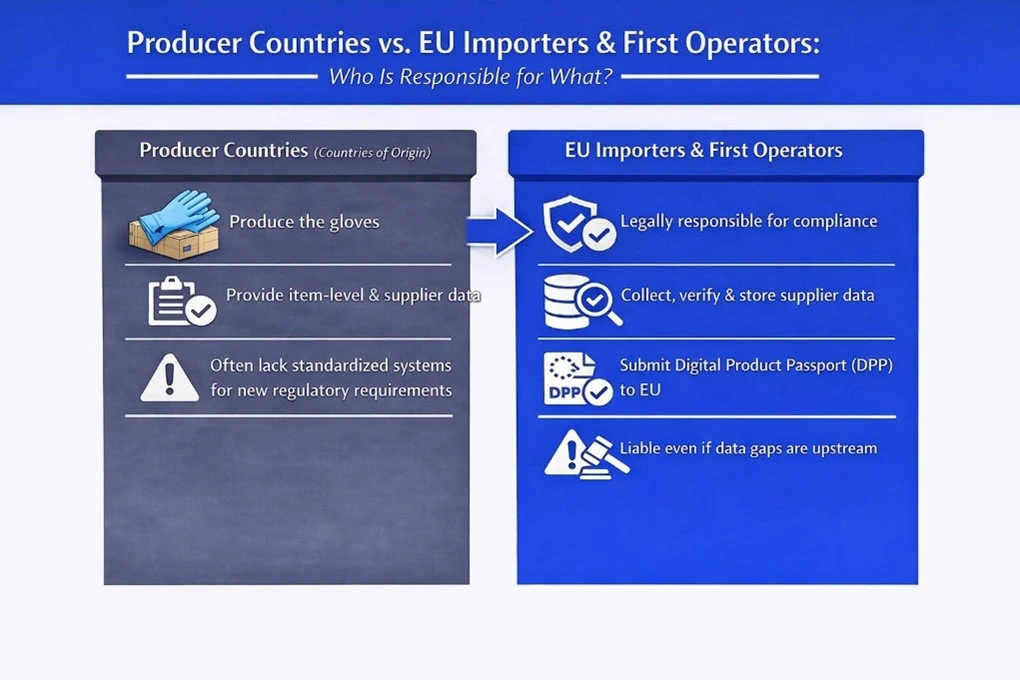
Compliance responsibility sits with the EU-based operator but UK companies must provide complete, verified supplier data to enable compliance.
What EUDR Requires for Gloves in the UK (EU-Bound Supply Chains)
UK companies exporting rubber-based gloves to the EU must ensure:
Natural rubber is not linked to deforestation after 31 December 2020
Compliance with local land-use and production laws in the country of origin
Availability of verified supplier data to support DDS submission by EU operators
Failure to meet these requirements can result in:
Rejection of shipments at EU borders
Delays in customs clearance
Financial penalties for EU partners
Loss of EU buyers and contracts
Supply chain disruptions
For UK exporters, non-compliance does not just affect shipments it can directly impact market access to the EU.
Data Requirements: Why Gloves Compliance in the UK Is Supply-Chain Critical
The UK faces a key challenge: ensuring upstream supplier data is complete and verifiable before goods are exported to the EU.
Companies must collect supplier-level data from global rubber supply chains, including:
Southeast Asia
Africa
Latin America
Required data includes:
Polygon-level geolocation of rubber plantations
Country and region of production
Harvest timelines
Volume traceability linking latex to glove batches
Risk assessment documentation
Risk mitigation evidence
Because EUDR compliance is enforced at EU entry: Incomplete data = rejected shipments and loss of EU market access
Why the UK Gloves Industry Faces Unique EUDR Exposure
The UK’s risk profile differs significantly from EU member states.
Its exposure stems from:
Being a major exporter to EU healthcare and industrial markets
Dependence on global rubber supply chains
Lack of direct control over EU import compliance processes
Reliance on EU-based operators to submit DDS
High regulatory expectations from EU buyers
Unlike EU countries, enforcement does not occur within the UK it occurs at:
EU border entry and market placement
This means: Compliance failures surface when goods reach the EU impacting UK exporters indirectly but immediately.
The Strategic Reality for Gloves Companies in the UK
For UK companies, supplier data collection under EUDR is not just compliance it is a commercial requirement for EU trade continuity.
Key priorities include:
Digitizing supplier onboarding across rubber supply chains
Validating plantation-level geolocation before export
Aligning supplier data with EU DDS requirements
Ensuring batch-level traceability from latex to finished gloves
Providing audit-ready documentation to EU import partners
Because the UK operates outside the EU regulatory framework, companies must ensure data readiness before goods leave the UK.
In the UK Gloves Supply Chain, Compliance Begins Before Export and Is Enforced at EU Entry
For gloves companies exporting to the EU, EUDR compliance requires:
Early-stage supplier data validation
Pre-export risk assessment workflows
Coordination with EU importers and operators
Integration between procurement, compliance, and export logistics systems
Supplier data collection is no longer administrative.
It is a gatekeeping function that determines whether UK gloves can enter and be sold within the EU market.
What Happens if Supplier Data Is Missing or Unverifiable in the UK Gloves Industry?
If supplier data for natural rubber used in gloves is incomplete, inconsistent, or unverifiable, the consequences under EUDR are immediate and commercially significant for UK exporters, manufacturers, and distributors supplying the EU.
Glove shipments may be rejected at EU borders
Exports may be delayed or halted before customs clearance in the EU
EU authorities can impose penalties on import partners
UK companies may face increased scrutiny from EU buyers and regulators
Distributors and EU customers may reject products due to missing or invalid DDS references
Healthcare and industrial supply chains may be disrupted
In the UK where compliance is enforced externally a single missing plantation polygon, unverifiable geolocation, or incomplete supplier dataset can prevent rubber-based gloves from entering the EU market.
Unlike EU import hubs, the UK faces export-level disruption.
If natural rubber inputs are non-compliant: Gloves cannot legally enter or be sold within the EU supply chain.
For UK exporters, compliance failures can cascade into lost contracts, shipment rejections, and restricted EU market access.
Read our blog on Supplier Data Management for EUDR to learn how Dutch cocoa companies can standardize supplier data, validate geolocation, and remain audit-ready without disrupting imports or processing operations.
Explore our guide on Supplier Assessment under EUDR to see how to score cocoa suppliers by deforestation risk, data quality, and traceability before shipments arrive at Dutch ports or contracts are finalized.
Who Must Collect Supplier Data Under EUDR in the UK Gloves Industry?
Under EUDR, the legal obligation to submit a Due Diligence Statement (DDS) lies with the EU-based operator. However, UK companies supplying gloves into the EU must ensure supplier data is complete, accurate, and verifiable to support compliance.
Gloves Exporters Supplying the EU Market
UK companies exporting gloves or natural rubber inputs to the EU must provide complete supplier data to EU importers (first operators).
Verifying deforestation-free sourcing post-31 December 2020
Supporting EU partners with documented risk assessments
Providing traceability from plantation to exported product
Enabling accurate DDS submission by EU importers
Since EU entry triggers compliance: Responsibility for data readiness begins before export from the UK.
Gloves Manufacturers and Converters
Companies in the UK producing or assembling:
Medical gloves
Industrial and safety gloves
Latex-based protective equipment
must ensure that products destined for the EU are supported by compliant supplier data.
They must ensure:
Raw materials are traceable to plantation polygons
Risk assessments are documented and shareable
Supply chain data aligns with EU DDS requirements
Failure to validate supplier data can prevent products from being accepted by EU importers.
Traders and Distribution Companies
The UK has a strong network of trading and distribution companies exporting gloves to the EU.
If you export:
You are part of the upstream supply chain supporting EU operators
If you distribute within the UK only:
EUDR does not apply directly becomes relevant if products are re-exported to the EU
Responsibilities include:
Providing verified supplier data to EU partners
Maintaining traceability to compliant shipments
Retaining supplier and transaction records
Passing required data along the supply chain
Trading gloves without valid supplier data exposes companies to commercial rejection and compliance risks in EU markets.
Downstream Operators in EU Supply Chains (Impact on UK Companies)
EU-based companies sourcing gloves from the UK act as downstream or first operators.
They must:
Verify DDS references
Maintain audit-ready documentation
Ensure traceability to compliant rubber inputs
If supplier data from UK exporters is incomplete:
Shipments may be rejected at EU borders
Contracts may be cancelled
Cross-border trade may be disrupted
UK companies are indirectly exposed to EUDR through their EU customers.
Key Clarification: Legal Responsibility vs Operational Exposure in the UK
Legal Responsibility
Lies with the EU-based operator placing gloves on the EU market
Includes liability for incorrect or incomplete DDS submissions
Operational Exposure
Affects UK exporters, manufacturers, distributors, and suppliers
UK companies must provide accurate upstream data
Missing or poor-quality data can block EU market access
In the UK: If you supply gloves to the EU, your ability to trade depends on EUDR-compliant supplier data.
Mandatory Supplier Data Required for Gloves Under EUDR (UK Export Context)
For rubber-based gloves exported from the UK to the EU, the following data is mandatory:
Polygon-level geolocation of rubber plantations
Country and region of production
Plantation and harvesting details
Harvest timelines
Volume traceability linking latex to glove batches
Risk assessment documentation
Risk mitigation evidence
If even one of these elements is missing or unverifiable, the DDS submitted by EU partners may be invalid preventing legal import and distribution within the EU.
The Synthetic Exemption: Only natural rubber (HS 4001) and its derivatives are in scope. Auditors look for chemical analysis and classification proof to ensure synthetic nitrile or neoprene gloves are not bogged down in EUDR checks, and that blended gloves accurately report their NR percentage.
2. Geolocation & Smallholder Mapping
• GeoJSON Polygons (>4ha) • GPS Center Points (<4ha) • Date of Tapping/Collection • Satellite Baseline (Post-Dec 2020)
The “First-Mile” Hurdle: Over 85% of natural rubber comes from smallholders. Auditors cross-reference the exact GPS coordinates of the rubber trees with high-resolution satellite data to prove no natural forest was cleared after the 2020 cutoff to plant the rubber.
3. Mass Balance & Batch Continuity
• Liquid Latex volume vs. Dry Rubber Content (DRC) • Centrifuging & Processing Yields • Batch ID link to dipping lines • Segregation of compliant latex
Glove manufacturing is a continuous dipping process using massive vats of liquid latex. Auditors check Mass Balance to ensure a factory isn’t outputting more gloves than the biological yield capacity of their verified, mapped smallholder plots allows.
4. Legality & Human Rights
• National Rubber Board registrations • Land Use Permits / Customary rights • Labor Standards & Fair Wage proof • FPIC (where applicable)
Rubber tapping is labor-intensive and highly manual. Auditors strictly verify compliance with local labor laws, fair wages, and land tenure to satisfy the EUDR’s legality requirement, especially in fragmented Southeast Asian supply chains.
Common Supplier Data Gaps in the UK Gloves Supply Chains
Even the most advanced exporters, manufacturers, and healthcare suppliers handling gloves in the UK face EUDR compliance challenges because global rubber supply chains were never designed for plantation-level traceability and regulatory validation.
In practice, most DDS failures affecting rubber-based gloves exported from the UK to the EU can be traced back to recurring supplier data weaknesses.
Fragmented Plantation Sourcing and Multi-Tier Supply Chains
Natural rubber used in gloves often originates from:
Smallholder plantations
Independent farmers and cooperatives
Multiple intermediaries and aggregators
Processing facilities and latex collectors
Complex multi-tier supplier networks
Common issues include:
Inconsistent plantation identifiers
Limited visibility into intermediary aggregation
Mixing of latex from multiple sources
Difficulty linking raw material to specific plantations
For UK glove exporters, this fragmentation creates pre-export data uncertainty, making it difficult to validate compliance before goods are shipped to the EU.
A single shipment of gloves may trace back to hundreds of plantations each requiring verified geolocation and legality documentation.
Paper-Based or Legacy Data Systems at Origin
While the UK operates highly digitized trade and logistics systems, upstream rubber data often remains:
Legacy systems fail to integrate with export, compliance, and EU regulatory workflows creating a gap between plantation-level data and EU entry requirements.
Inconsistent or Low-Quality Geolocation Data
Common issues include:
Point coordinates instead of polygon boundaries
Incomplete or partially mapped plantations
Overlapping or duplicated geolocation data
Coordinates outside valid agricultural zones
Missing harvest timelines
Consequences:
Satellite verification failures
High-risk flags in compliance systems
Delayed or rejected DDS submissions by EU importers
For the UK, poor geolocation data can result in shipment rejection at EU borders, blocking market access.
Polygon-level mapping is essential for EU compliance.
Legal & Documentation Gaps
Supplier documentation often arrives:
In local languages without standardized formats
With inconsistent naming conventions
Without verifiable legal declarations
Using classifications not aligned with EU requirements
Under EUDR: Unclear documentation = compliance risk
For UK exporters, this increases the likelihood of rejection by EU partners and regulatory authorities.
Aggregation That Breaks Traceability
Aggregation is common in rubber supply chains but creates structural compliance risk.
If the link between: plantation → polygon → latex collection → processing → glove production is broken, EUDR compliance cannot be demonstrated.
For UK exporters, traceability must be ensured before export—not reconstructed after EU entry.
How Gloves Companies in the UK Can Structure Supplier Data Collection
EUDR compliance is not about collecting more data it is about collecting validated, export-ready, DDS-compliant data before shipment to the EU.
Turning Supplier Data into EUDR Readiness in the UK Gloves Sector
Supplier data collection is no longer an upstream activity it determines whether rubber-based gloves can enter and be sold within the EU market.
The UK’s exposure lies at the export and EU market access stage.
Companies that:
Digitize supplier onboarding globally
Validate plantation-level geolocation before export
Embed risk assessment into procurement and export workflows
Will ensure smooth EU market access and trade continuity.
Those relying on fragmented data will face:
Shipment rejections at EU borders
DDS failures by EU partners
Loss of contracts and buyers
Supply chain disruptions
Increased regulatory scrutiny
Understand what EUDR Packaging Requirements are. Read our complete guide to EUDR packaging compliance and learn how to protect EU market access.
Explore our guide on EUDR for Operators and Traders to understand legal responsibility, DDS handover, and what checks you must perform before buying or selling coffee in the EU.
Dive into our practical breakdown of EUDR Due Diligence , including required data, risk assessment steps, and how to avoid delays at customs.
FAQs
What supplier data is mandatory for gloves under EUDR in the UK?
UK companies exporting rubber-based gloves to the EU must provide EU importers with complete supplier data, including: supplier identification (KYC), plantation-level polygon geolocation of natural rubber sources, harvesting period, supplied volumes, traceability linking latex to glove batches or finished products, and proof of legal production in the country of origin.
Without this structured data, the EU-based operator cannot validate a Due Diligence Statement (DDS), and gloves cannot be legally imported or placed on the EU market.
Do UK glove companies need plantation-level geolocation data?
Yes, particularly when supplying EU markets. UK exporters must ensure verified plantation-level polygon geolocation data exists to support deforestation-free sourcing requirements under EUDR.
Even when sourcing through intermediaries or EU partners, UK companies must provide traceable and verifiable data to support DDS submissions and maintain supply chain transparency.
Can non-EU suppliers provide EUDR data digitally to glove companies in the UK?
Yes. Suppliers from regions such as Southeast Asia, Africa, and Latin America can provide EUDR-compliant data through structured digital onboarding systems, geospatial mapping tools, and platforms capturing GPS polygon data alongside legal documentation.
Digital submission improves data accuracy, reduces geolocation errors, and minimizes the risk of shipment rejection when exporting to the EU.
How long must supplier data be retained in the UK under EUDR for glove companies?
While the legal retention obligation sits with EU operators, UK exporters should retain due diligence documentation and supplier data for at least five years to align with EUDR expectations and support EU partners during audits or regulatory reviews.
Maintaining accessible records is critical for ensuring uninterrupted trade with EU markets.
What happens if supplier data changes after a DDS is submitted for gloves exported from the UK?
If supplier data changes such as new plantations, updated geolocation boundaries, ownership changes, or revised harvesting volumes the risk assessment must be updated.
Material changes may require the EU operator to submit a new or revised DDS before affected glove shipments can be imported, distributed, or placed on the EU market.
For UK exporters, this means updated data must be communicated promptly to EU partners to avoid shipment delays or rejection.
Start using TraceX
Transparency, Trust, & Success for your Climate Journey.
We use cookies on our website to give you the most relevant experience by remembering your preferences and repeat visits. By clicking “Accept All”, you consent to the use of ALL the cookies. However, you may visit "Cookie Settings" to provide a controlled consent.
This website uses cookies to improve your experience while you navigate through the website. Out of these, the cookies that are categorized as necessary are stored on your browser as they are essential for the working of basic functionalities of the website. We also use third-party cookies that help us analyze and understand how you use this website. These cookies will be stored in your browser only with your consent. You also have the option to opt-out of these cookies. But opting out of some of these cookies may affect your browsing experience.
Necessary cookies are absolutely essential for the website to function properly. These cookies ensure basic functionalities and security features of the website, anonymously.
Cookie
Duration
Description
cookielawinfo-checkbox-analytics
11 months
This cookie is set by GDPR Cookie Consent plugin. The cookie is used to store the user consent for the cookies in the category "Analytics".
cookielawinfo-checkbox-functional
11 months
The cookie is set by GDPR cookie consent to record the user consent for the cookies in the category "Functional".
cookielawinfo-checkbox-necessary
11 months
This cookie is set by GDPR Cookie Consent plugin. The cookies is used to store the user consent for the cookies in the category "Necessary".
cookielawinfo-checkbox-others
11 months
This cookie is set by GDPR Cookie Consent plugin. The cookie is used to store the user consent for the cookies in the category "Other.
cookielawinfo-checkbox-performance
11 months
This cookie is set by GDPR Cookie Consent plugin. The cookie is used to store the user consent for the cookies in the category "Performance".
viewed_cookie_policy
11 months
The cookie is set by the GDPR Cookie Consent plugin and is used to store whether or not user has consented to the use of cookies. It does not store any personal data.
Functional cookies help to perform certain functionalities like sharing the content of the website on social media platforms, collect feedbacks, and other third-party features.
Performance cookies are used to understand and analyze the key performance indexes of the website which helps in delivering a better user experience for the visitors.
Analytical cookies are used to understand how visitors interact with the website. These cookies help provide information on metrics the number of visitors, bounce rate, traffic source, etc.
Advertisement cookies are used to provide visitors with relevant ads and marketing campaigns. These cookies track visitors across websites and collect information to provide customized ads.
Download the 2026 Traceability Scorecard and Benchmark Your Supply Chain Across 10 Critical Capabilities.
Download our eBook
Don’t Wait for an Audit to Find Your EUDR Gaps
The 2026 Simplification Package changes how HS codes, DDS pass-through and geolocation rules apply to you. Get the free guide and 20-point readiness checklist before enforcement catches you unprepared.