Supplier Data Collection in EUDR for the Furniture Supply Chain in Germany
Published
, 18 minute read
Share this article
Quick summary: Supplier Data Collection in EUDR for Furniture Supply Chains in Germany: understand legal responsibilities, mandatory forest-level traceability requirements, common supplier-data gaps, and how German furniture importers and manufacturers can achieve EUDR compliance without disrupting production or EU market access.
Supplier Data Collection in EUDR for Furniture Supply Chains in Germany has quickly become a major compliance priority for furniture importers, manufacturers, retailers, sourcing companies, and wood-product distributors operating across the German market. As one of Europe’s largest furniture manufacturing and consumption hubs, Germany sits at the center of complex global wood and furniture supply chains and therefore within the core enforcement scope of the EU Deforestation Regulation (EUDR).
Germany imports large volumes of:
wooden furniture,
veneer,
plywood,
engineered wood,
particleboard,
hardwood components,
and semi-finished wood materials
from Asia, Africa, Latin America, Eastern Europe, and other EU trading hubs. These products are then:
assembled,
processed,
distributed,
retailed,
or exported across European markets.
As EUDR enforcement approaches, furniture companies operating in Germany must now demonstrate that the wood used in their products is:
deforestation-free,
legally harvested,
fully traceable,
and linked to compliant supplier documentation and geolocation records.
Who This Guide Is For
This guide is designed specifically for:
Furniture importers sourcing wooden products from non-EU countries
Furniture manufacturers using imported wood materials or veneer
Interior and home furnishing brands
Wood-component suppliers and sourcing companies
Retailers selling wood-based furniture products
Procurement, compliance, ESG, and sustainability teams operationalizing EUDR workflows
If your business handles wooden furniture or wood-derived materials entering or moving within Germany, supplier data collection under EUDR is no longer optional it is essential for maintaining EU market access.
Read the complete EUDR guide to clearly understand your obligations, required geolocation data, risk assessment steps, and due diligence requirements.
What Is EUDR and How Does It Apply to Furniture Supply Chains in Germany?
The EU Deforestation Regulation (EUDR) requires companies placing certain commodities, including wood and wood-derived products, on the EU market to prove that products are:
Deforestation-free (not sourced from land deforested after 31 December 2020)
Produced in compliance with the laws of the country of harvest
Covered by a submitted Due Diligence Statement (DDS)
In Germany’s furniture supply chain, responsibility may fall on:
Furniture importers bringing products into the EU
Furniture brands sourcing directly from non-EU manufacturers
Wood-component suppliers acting as first operators
Traders and sourcing intermediaries managing imported wood materials
Even when wood products enter through another EU country before reaching Germany, German furniture companies may still carry downstream compliance exposure depending on sourcing and market-placement structure.
EUDR Requirements for Furniture Supply Chains in Germany
Companies must:
Collect supplier-level and forest plot-level traceability data
Conduct risk assessments covering deforestation and legality exposure
Implement mitigation measures where risks are identified
Submit a Due Diligence Statement before market placement where required
EUDR may apply to a broad range of furniture-related products and materials, including:
Wooden furniture
Veneer and plywood
MDF, particleboard, and fibreboard
Hardwood and softwood components
Wood flooring and decorative panels
Wooden packaging and assembled furnishing systems
What Data Is Required for Furniture Supply Chains Under EUDR in Germany?
For German furniture operators, compliance depends heavily on structured supplier and sourcing data, including:
Precise geolocation coordinates (polygon boundaries) of forest plots
Country and region of harvest
Harvest date or harvesting timeframe
Scientific species name
Volume of timber harvested and supplied
Proof of legal harvesting rights and permits
Traceability linking furniture components back to forest-origin materials
Without verified geolocation and traceability documentation, a valid DDS cannot be submitted.
No traceability = no compliant market access.
Incomplete or inconsistent supplier records may result in:
shipment delays,
customer rejection,
audit exposure,
enforcement risk,
fines,
or reputational damage.
Why Germany Is a High-Exposure Market Under EUDR for Furniture
Germany’s exposure under EUDR stems from several structural factors:
One of Europe’s largest furniture manufacturing and retail markets
Significant imports of tropical hardwood and engineered wood products
Strong reliance on global sourcing ecosystems
Large downstream processing and assembly networks
High regulatory scrutiny and enforcement expectations
Unlike pure trading hubs, Germany combines:
large import volumes,
manufacturing complexity,
and extensive downstream redistribution.
This significantly increases traceability and documentation challenges across furniture supply chains.
Supplier Data Collection Is the Core Compliance Risk for Furniture Companies
For furniture companies in Germany, supplier data collection is no longer just a procurement or sustainability issue it has become the central operational risk under EUDR.
Furniture supply chains are often highly fragmented and may involve:
forest concession owners
logging contractors
veneer manufacturers
plywood mills
furniture assemblers
sourcing agents
exporters
distributors
and EU importers
Many furniture products also combine:
multiple wood species,
different veneer grades,
mixed sourcing regions,
and layered production workflows.
Ensuring:
accurate geolocation polygons,
species verification,
legality documentation,
batch-level traceability,
and supplier-chain continuity
requires structured digital traceability systems — not spreadsheets and disconnected supplier declarations.
Under EUDR, if a furniture company cannot trace wood materials back to specific forest plots and demonstrate legality and deforestation-free sourcing, the product may not legally enter or circulate within the EU market.
For Germany’s furniture sector, supplier data collection has shifted from sustainability reporting to business continuity and regulatory survival.
The companies investing early in:
digital traceability,
supplier onboarding,
geolocation validation,
and audit-ready compliance infrastructure
will be far better positioned to maintain long-term access to European markets.
What Happens if Supplier Data Is Missing or Unverifiable in Germany’s Furniture Supply Chain?
If supplier data for furniture or wood-based furniture components is incomplete, inconsistent, or unverifiable, the consequences under EUDR are immediate and commercially significant for German furniture companies.
This can result in:
Furniture shipments being blocked at German customs or flagged during market surveillance
Wood-based furniture products being prohibited from entering or circulating within the EU market
Fines, enforcement actions, and administrative penalties
Intensified audits by competent authorities
Retailers, distributors, or downstream buyers suspending contracts or sourcing relationships
In practice, a single missing forest plot polygon, incorrect timber species declaration, or unverifiable harvesting permit may invalidate an entire furniture shipment — even if the wood has already been processed into finished products.
For furniture companies in Germany, supplier-data gaps are no longer minor documentation issues.
They are direct business continuity and market-access risks.
Read our blog on Supplier Data Management for EUDR to learn how Dutch coffee companies can standardize supplier data, validate geolocation, and stay audit-ready without slowing imports.
Explore our guide on Supplier Assessment under EUDR to see how to score suppliers by deforestation risk, data quality, and traceability before shipments move through Dutch ports or contracts are signed.
Who Must Collect Supplier Data Under EUDR in Germany’s Furniture Supply Chain?
Under EUDR, any company in Germany placing wooden furniture or wood-derived products on the EU market or trading products without a valid Due Diligence Statement (DDS) reference depends on complete and verifiable supplier data, even when the information originates upstream.
Below is a role-by-role breakdown for Germany’s furniture ecosystem.
Furniture Importers Placing Products on the EU Market
German furniture importers carry significant EUDR responsibility.
If you import:
wooden furniture,
veneer,
plywood,
engineered wood furniture,
or wood components
directly from non-EU countries and place them on the EU market, you are considered a first operator.
This means you must:
Collect supplier- and forest plot-level data
Verify polygon geolocation coordinates and deforestation-free status
Confirm scientific timber species identification
Conduct risk assessments and mitigation measures
Submit a Due Diligence Statement (DDS) before market placement
Even if exporters, manufacturers, or certification bodies provide documentation, legal responsibility remains with the German importer.
Furniture Manufacturers Using Imported Timber
German furniture manufacturers may also become first operators when importing timber or wood-based materials directly from outside the EU.
This applies when companies:
Import wood materials under their own name
Manufacture finished furniture products using imported timber
Place wood-based products on the EU market
In these cases, manufacturers must ensure:
Supplier data is complete and traceable to forest plots
A valid DDS exists before products are sold or distributed
Traceability continuity is maintained across production workflows
Processing timber into furniture does not eliminate EUDR responsibility.
In many cases, it increases traceability complexity due to:
multiple timber inputs,
veneer sourcing,
batch mixing,
and layered manufacturing processes.
Furniture Traders and Distributors
German furniture traders operate under different obligations depending on their role.
If You Import Furniture into the EU
You are a first operator and must:
collect supplier data,
verify traceability,
assess risk,
and submit a DDS.
If You Trade Furniture Already on the EU Market
You become a downstream operator but must still:
verify valid DDS reference numbers
maintain traceability to compliant batches
retain supplier and transaction records for at least five years
Trading furniture without valid DDS continuity creates direct compliance exposure even if the trader never physically handles the product.
First Downstream Operators in Furniture Supply Chains
Companies purchasing furniture after it has already entered the EU market are considered downstream operators.
They do not submit a new DDS if:
a valid DDS reference already exists,
the product remains unchanged,
and traceability continuity is preserved.
However, they must still:
verify DDS validity,
maintain traceability records,
and pass DDS references downstream.
If DDS records are:
missing,
inconsistent,
or unverifiable,
the downstream operator may face:
operational disruption,
customer disputes,
shipment delays,
or regulatory scrutiny.
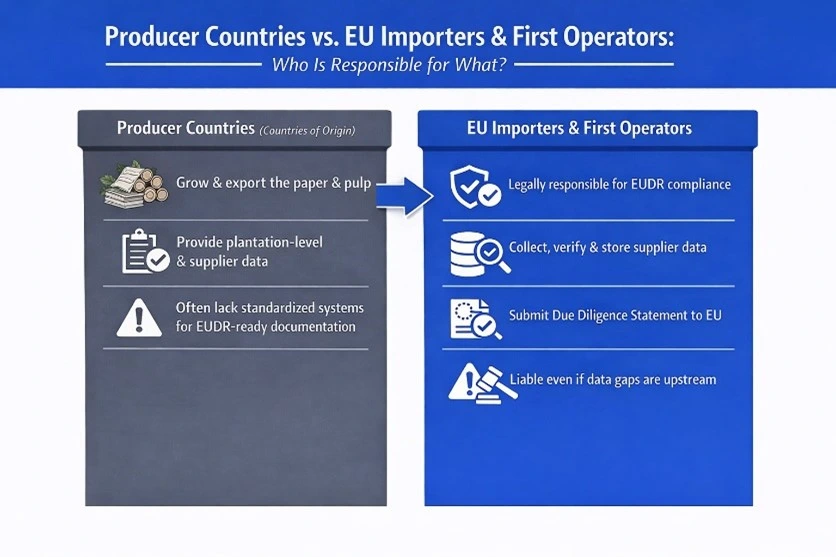
Key Clarification: Legal Responsibility vs Data Dependency
This distinction is often misunderstood across Germany’s furniture ecosystem.
Legal Responsibility
Lies with the first operator placing products on the EU market
Includes liability for inaccurate or misleading information
Cannot be outsourced contractually to suppliers
Data Dependency
Impacts every actor across the furniture supply chain
Manufacturers and retailers rely on upstream sourcing data
A single supplier-data gap may halt production, imports, or retail distribution
In practice: You may not always hold primary legal responsibility — but you remain commercially exposed if supplier traceability is weak.
Mandatory Supplier Data Required for Furniture Under EUDR in Germany
To comply with EUDR, German furniture companies must collect and retain non-negotiable supplier data for all wood-based products entering the EU market.
This includes:
Precise forest plot geolocation polygons
Country and region of harvest
Scientific timber species names
Harvest dates or harvesting periods
Volume and quantity records
Legality documentation and harvesting permits
Traceability linkage between raw timber and finished furniture products
Missing even one of these elements may invalidate a Due Diligence Statement.
Without verified geolocation and legally compliant sourcing documentation, furniture products may not legally enter or remain in the EU market under EUDR.
For Germany’s furniture industry, supplier data collection is no longer a sustainability initiative.
It is rapidly becoming the operational foundation for:
market access,
buyer trust,
compliance readiness,
and long-term supply-chain resilience.
Compliance Pillar
Key Data Points Required
Critical “Why” for Audits
1. Product & Material Composition
• HS/CN Code (e.g., 9403 for wooden furniture) • Material breakdown (e.g., % solid wood vs. veneer/particle board) • Timber species (Scientific name)
Audits verify the accuracy of your product classification. You must prove the wood content is deforestation-free, even if it is just one component of a larger item.
2. Upstream Traceability
• Supplier DDS References (Due Diligence Statements from previous actors) • Batch/Lot ID linking furniture to specific timber shipments
The “Chain of Custody” must be unbroken. If you purchase components, you must link your finished good to the DDS ID provided by your wood supplier.
3. Geolocation & Plot Data
• GeoJSON polygons for all harvested wood sites • GPS coordinates of final processing facilities
Furniture is a complex, multi-sourced product. You must trace the wood back to the precise plot of land, ensuring no part of the assembly originated from deforested areas.
4. Supplier Legality & Risk
• Certificates (FSC/PEFC – helpful but not a replacement for full DDS) • Due Diligence System (DDS) reports • Evidence of human rights/labor law adherence
Furniture supply chains are often fragmented. You must document that every intermediate supplier in the chain has assessed and mitigated risks related to local land use and labor laws.
5. Due Diligence Statement (DDS)
• Combined DDS for the final product • Records retention (5 years post-market entry)
This is the final “passport” for your product. Auditors will test if your DDS is backed by a robust risk assessment of the specific timber species and regions involved.
Common Supplier Data Gaps in Germany’s Furniture Supply Chains
Even highly structured German furniture importers, retailers, and manufacturers face major EUDR challenges because traditional furniture supply chains were never designed for forest plot-level traceability, geolocation validation, or deforestation cut-off verification. In practice, many Due Diligence Statement (DDS) risks stem from recurring supplier-data weaknesses especially where imported timber and wood components feed into large-scale furniture manufacturing.
Fragmented International Sourcing
Furniture products entering Germany are often sourced through:
Multiple timber suppliers across different countries
Veneer and plywood manufacturers using mixed-origin materials
International sourcing agents and intermediaries
Contract manufacturers consolidating components from multiple mills
Multi-species wood inputs used across product lines
The challenge:
Forest plots vary across production cycles
Supplier documentation formats differ significantly by country
Multiple sourcing layers reduce visibility into origin
A single furniture item may contain wood from several forest locations
For German furniture manufacturers operating fast-moving production and retail cycles, fragmented sourcing makes reliable forest-level traceability highly complex.
Legacy Paper Documentation and Non-Standardized Records
Despite Germany’s advanced industrial ecosystem, upstream furniture and timber documentation often still includes:
Audit preparation becomes slow and operationally disruptive
Germany’s strong regulatory oversight means documentation inconsistencies are far more likely to face scrutiny during audits and inspections.
Incomplete or Low-Quality Geolocation Data
Common geolocation issues include:
Point coordinates instead of forest plot polygons
Coordinates covering entire concessions rather than harvest areas
Incorrect mapping formats or coordinate systems
No validation against satellite imagery
The risk:
Inability to verify compliance with the 31 December 2020 deforestation cut-off
Increased classification as “non-negligible risk”
DDS rejection or mandatory mitigation requirements
For German furniture companies, geolocation validation is now one of the most critical technical requirements under EUDR.
Species Declaration and Volume Inconsistencies
Furniture manufacturers frequently work with:
mixed timber species,
veneer combinations,
engineered wood materials,
and layered production inputs.
Common supplier-data gaps include:
Trade names instead of scientific species names
Multiple species grouped under single product declarations
Volume mismatches between sourcing and production records
Transformation losses not reflected in traceability documentation
Under EUDR:
Scientific species identification is mandatory
Declared volumes must align with harvest data
Chain-of-custody records must withstand audits
Even minor inconsistencies may escalate into major compliance exposure.
Processing and Aggregation Complexity
Germany’s furniture industry introduces additional traceability complexity through:
Mixing timber from different forest plots during production
Sourcing semi-finished materials from multiple suppliers
Combining veneer, plywood, MDF, and hardwood components
Batch-tracking systems not aligned with forest-level sourcing data
Once the traceability link between: forest plot → harvest documentation → shipment → manufacturing batch → finished furniture product
is broken, EUDR compliance cannot be demonstrated.
How German Furniture Companies Can Structure Supplier Data Collection
For German furniture companies, EUDR compliance requires a structured and digitally integrated supplier-data strategy especially where imported wood materials feed directly into manufacturing and retail supply chains.
Step 1 – Supplier and Origin Mapping
Begin by identifying EUDR-relevant suppliers.
Actions:
Map suppliers providing non-EU timber or wood-based components
Identify upstream forest concession owners and harvesting operators
Confirm availability of polygon-level geolocation data
Flag mixed-origin materials entering production
Segment suppliers by risk:
High volume + high-risk sourcing region → immediate validation
Moderate risk suppliers → phased verification
Low-volume but high-risk sourcing → remediation or reassessment
Outcome: Compliance efforts focus on areas with the highest operational and regulatory exposure.
Step 2 – Standardized Digital Data Framework
Unstructured supplier data is one of the biggest operational bottlenecks.
Alignment between procurement, compliance, sustainability, and IT teams
Critical insight: If supplier data does not map directly to DDS submission requirements, furniture production and imports may face last-minute disruptions.
Step 3 – Validation and Risk Assessment
Collecting supplier data alone is not enough.
Validation is essential.
Geolocation Validation
Polygon boundary verification
Satellite overlay analysis
Deforestation cut-off screening
Protected-area overlap checks
Legal Compliance Verification
Harvest permit validation
Concession ownership checks
Land-use authorization verification
Supplier Risk Scoring
Country-risk exposure
Data completeness
Traceability complexity
Historical audit performance
High-risk suppliers should be:
flagged before procurement approval,
required to complete corrective actions,
or replaced where risk cannot be mitigated.
Outcome: DDS risks are identified before materials enter production or retail workflows.
How TraceX Supports Germany’s Furniture Supply Chains Under EUDR
TraceX EUDR Compliance Solutions help German furniture importers, manufacturers, and retailers move from fragmented supplier documentation toward structured, audit-ready compliance workflows.
Through digital supplier onboarding, TraceX enables:
supplier KYC collection,
geolocation polygon capture,
legality-document management,
deforestation-risk monitoring,
and AI-powered supplier risk scoring.
Structured EUDR-aligned data outputs support:
DDS workflows,
ERP integration,
manufacturing traceability,
and audit readiness across complex furniture supply chains.
For German furniture companies, TraceX transforms EUDR compliance from a documentation burden into a scalable operational control system.
Build an EUDR-ready furniture supply chain that protects manufacturing continuity and EU market access.
Talk to TraceX experts about automating supplier data collection for wooden furniture under EUDR in Germany.
Explore our guide on EUDR for Operators and Traders to understand legal responsibility, DDS handover, and what checks you must perform before buying or selling coffee in the EU.
Dive into our practical breakdown of EUDR Due Diligence , including required data, risk assessment steps, and how to avoid delays at customs.
FAQs
What supplier data is mandatory for furniture under EUDR in Germany?
German companies placing furniture or wood-derived furniture products on the EU market must collect supplier identification (KYC), forest plot-level geolocation (polygon coordinates), country and region of harvest, harvest timeframe, scientific timber species name, volume supplied, proof of legal harvesting rights, and full traceability linking furniture components back to specific forest plots.
Without this data, a Due Diligence Statement (DDS) cannot be submitted, and furniture products cannot be legally placed on or traded within the EU market.
Do German furniture manufacturers need forest plot-level geolocation data?
Yes — if the furniture manufacturer is the first operator placing imported wood or furniture products on the EU market.
German furniture manufacturers importing timber, veneer, plywood, MDF, or wood components directly from non-EU countries must hold verified forest plot-level geolocation data and conduct documented risk assessments before submitting a DDS.
Manufacturers purchasing furniture or wood materials already placed on the EU market must retain valid DDS references and maintain traceability records.
Can suppliers outside the EU provide EUDR furniture-related wood data digitally?
Yes, and digital submission is strongly recommended.
Non-EU suppliers including forest concession owners, timber exporters, veneer manufacturers, plywood mills, and furniture component suppliers can provide EUDR-compliant data through:
structured digital questionnaires,
forest-mapping tools,
supplier portals,
and platforms capturing GPS polygon data and legality documentation.
Digital supplier data improves validation accuracy and significantly reduces DDS rejection risks for German furniture importers and manufacturers.
How long must supplier data be retained in Germany for furniture products?
Under EUDR, operators in Germany must retain all due diligence documentation and supplier data for at least five years and make it available to competent authorities upon request.
This includes:
geolocation files,
harvesting permits,
legality documentation,
supplier declarations,
risk assessments,
mitigation records,
and DDS references linked to furniture products and wood materials.
What happens if supplier data changes in furniture supply chains?
If supplier data changes such as:
new forest plots,
updated geolocation boundaries,
revised concession ownership,
new timber species declarations,
supplier substitutions,
or volume adjustments
the risk assessment must be updated accordingly.
Material changes may require a new or revised Due Diligence Statement before furniture products linked to the updated sourcing data can be placed on or traded within the EU market.
Failure to update documentation may result in:
audit findings,
shipment delays,
customer disputes,
administrative penalties,
or market-access disruption under EUDR.
Start using TraceX
Transparency, Trust, & Success for your Climate Journey.
We use cookies on our website to give you the most relevant experience by remembering your preferences and repeat visits. By clicking “Accept All”, you consent to the use of ALL the cookies. However, you may visit "Cookie Settings" to provide a controlled consent.
This website uses cookies to improve your experience while you navigate through the website. Out of these, the cookies that are categorized as necessary are stored on your browser as they are essential for the working of basic functionalities of the website. We also use third-party cookies that help us analyze and understand how you use this website. These cookies will be stored in your browser only with your consent. You also have the option to opt-out of these cookies. But opting out of some of these cookies may affect your browsing experience.
Necessary cookies are absolutely essential for the website to function properly. These cookies ensure basic functionalities and security features of the website, anonymously.
Cookie
Duration
Description
cookielawinfo-checkbox-analytics
11 months
This cookie is set by GDPR Cookie Consent plugin. The cookie is used to store the user consent for the cookies in the category "Analytics".
cookielawinfo-checkbox-functional
11 months
The cookie is set by GDPR cookie consent to record the user consent for the cookies in the category "Functional".
cookielawinfo-checkbox-necessary
11 months
This cookie is set by GDPR Cookie Consent plugin. The cookies is used to store the user consent for the cookies in the category "Necessary".
cookielawinfo-checkbox-others
11 months
This cookie is set by GDPR Cookie Consent plugin. The cookie is used to store the user consent for the cookies in the category "Other.
cookielawinfo-checkbox-performance
11 months
This cookie is set by GDPR Cookie Consent plugin. The cookie is used to store the user consent for the cookies in the category "Performance".
viewed_cookie_policy
11 months
The cookie is set by the GDPR Cookie Consent plugin and is used to store whether or not user has consented to the use of cookies. It does not store any personal data.
Functional cookies help to perform certain functionalities like sharing the content of the website on social media platforms, collect feedbacks, and other third-party features.
Performance cookies are used to understand and analyze the key performance indexes of the website which helps in delivering a better user experience for the visitors.
Analytical cookies are used to understand how visitors interact with the website. These cookies help provide information on metrics the number of visitors, bounce rate, traffic source, etc.
Advertisement cookies are used to provide visitors with relevant ads and marketing campaigns. These cookies track visitors across websites and collect information to provide customized ads.
Download the 2026 Traceability Scorecard and Benchmark Your Supply Chain Across 10 Critical Capabilities.
Download our eBook
Don’t Wait for an Audit to Find Your EUDR Gaps
The 2026 Simplification Package changes how HS codes, DDS pass-through and geolocation rules apply to you. Get the free guide and 20-point readiness checklist before enforcement catches you unprepared.