Supplier Data Collection in EUDR for the Coffee Supply Chain in Netherlands
Published
, 15 minute read
Share this article
Quick summary: Supplier Data Collection in EUDR for the Coffee Supply Chain in the Netherlands: understand legal responsibilities, mandatory supplier data, common data gaps, and how Dutch coffee importers and traders can achieve EUDR compliance without disrupting imports or re-exports.
Supplier Data Collection in EUDR for Coffee in the Netherlands has rapidly become a defining compliance challenge for the Dutch coffee sector and for good reason. As one of Europe’s most important coffee entry points, the Netherlands sits directly in the regulatory crosshairs of the EU Deforestation Regulation (EUDR).
The Netherlands is not just a coffee-consuming country. It is a strategic import, storage, trading, and re-export hub for coffee entering Europe. Large volumes of green coffee arrive through Dutch ports, are traded or lightly processed, and then distributed across the EU. This central position means Dutch-based companies are frequently the first EU operators legally responsible for placing coffee on the EU market making EUDR compliance unavoidable.
Who This Guide Is For
This guide is designed specifically for:
Coffee importers managing high volumes through Dutch ports
Traders and distributors handling multi-origin coffee flows
Roasters sourcing green coffee directly or indirectly
Compliance and sustainability teams translating EUDR into operational processes
If your business handles coffee entering or moving through the Netherlands, mastering Supplier Data Collection in EUDR for Coffee in the Netherlands is no longer optional it is the foundation for continued market access.
What Is EUDR and How Does It Apply to the Coffee Supply Chain in the Netherlands?
EUDR is an EU regulation that requires coffee sold in the EU to be proven deforestation-free, and in the Netherlands, responsibility falls heavily on importers, traders, and first operators.
Netherlands coffee imports primarily consist of green coffee beans, positioning the country as Europe’s seventh-largest importer and a key re-export hub via Rotterdam. In 2020, green coffee imports totalled ~176,000 tonnes (4.9% of EU total), stable from 2016; Brazil supplied 29,000 tonnes (16%), Vietnam 9,500 tonnes, with 64% from EU neighbours like Belgium (58%).
Under EUDR, Dutch companies placing coffee on the EU market must prove using supplier and farm-level data that the coffee is not linked to deforestation. Failure to do so can result in blocked shipments, rejected DDS submissions, and penalties.
EUDR applies to coffee in both green and roasted forms. To legally place coffee on the EU market, companies must:
Prove the coffee is deforestation-free (not produced on land deforested after 31 December 2020)
Prove it was produced in compliance with local laws in the country of origin
Submit a Due Diligence Statement (DDS) before the coffee enters or is traded within the EU
For coffee, compliance depends entirely on supplier-level data, including:
Precise farm or plot-level geolocation
Country and region of production
Production and harvest timeframes
Traceability linking shipments back to specific plots
No data = no market access.
Why Is the Netherlands a High-Exposure Country Under EUDR?
The Netherlands plays a unique and highly exposed role in Europe’s coffee supply chain:
One of the largest coffee import gateways in the EU
Home to major ports, warehouses, and trading houses
A critical re-export hub supplying coffee across Europe
Because of this, Dutch-based companies are often the first EU operators placing coffee on the market even when the final destination is another EU country. Under EUDR, this role carries full legal responsibility, regardless of where the coffee is eventually consumed.
In practice, this gives the Netherlands outsized EUDR exposure compared to countries that primarily roast or consume coffee but do not serve as major import and redistribution hubs.
For Dutch coffee companies, supplier data collection is not a back-office task it is the core compliance risk under EUDR.
What Happens if Supplier Data Is Missing or Unverifiable in the Netherlands?
If supplier data is incomplete, inconsistent, or cannot be verified, the consequences under EUDR are immediate and material:
Shipments can be blocked or delayed at Dutch ports and customs
Coffee may be barred from being placed on the EU market
Authorities can impose fines and administrative penalties
Companies face audit exposure and reputational risk
Downstream buyers across the EU may refuse delivery
In practice, a single missing farm geolocation or unclear supplier record can stop an entire container, even if the coffee is destined for another EU country.
Read our blog on Supplier Data Management for EUDR to learn how Dutch coffee companies can standardize supplier data, validate geolocation, and stay audit-ready without slowing imports.
Explore our guide on Supplier Assessment under EUDR to see how to score suppliers by deforestation risk, data quality, and traceability before shipments move through Dutch ports or contracts are signed.
Who Must Collect Supplier Data Under EUDR in the Netherlands?
Under EUDR, any company in the Netherlands that places coffee on the EU market or trades coffee without a valid Due Diligence Statement (DDS) depends on complete, verifiable supplier data, even if that data was collected upstream.
Below is a clear, role-by-role breakdown for the Dutch coffee supply chain.
Coffee Importers Placing Coffee on the EU Market
Coffee importers based in the Netherlands carry the highest EUDR responsibility.
If you import green coffee from outside the EU through Dutch ports and place it on the EU market, you are considered a first operator. This means you must:
Collect supplier- and farm-level data
Verify geolocation and deforestation-free status
Conduct risk assessment and document mitigation measures
Submit the Due Diligence Statement (DDS) before market placement
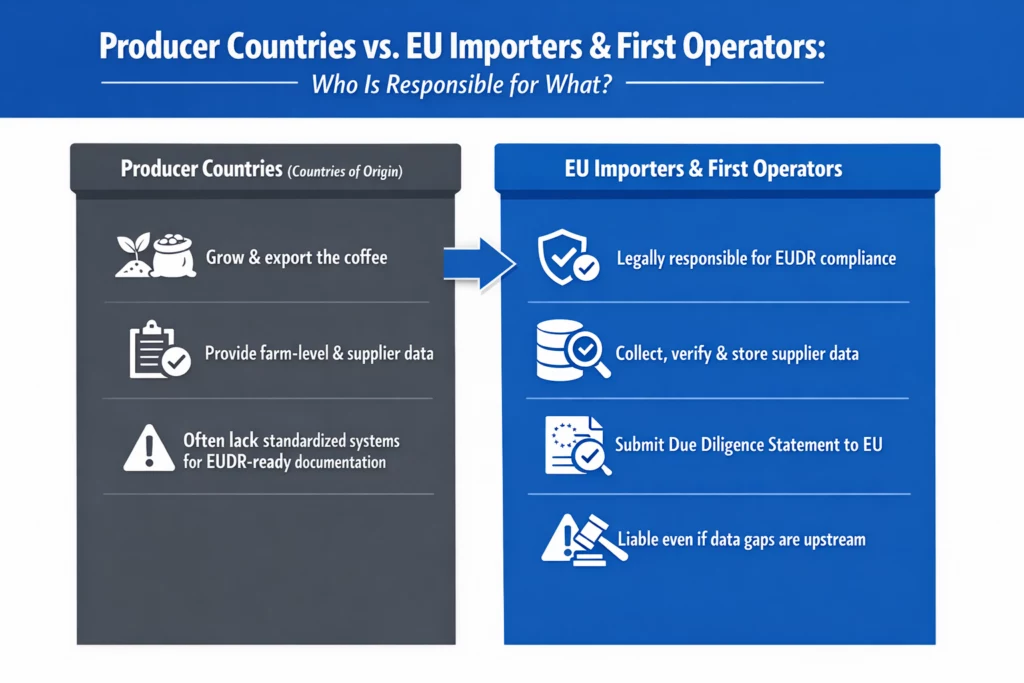
Even if exporters, agents, or cooperatives provide data, legal responsibility remains with the Dutch importer.
Roasters Sourcing Green Coffee Directly
Dutch roasters become first operators under EUDR when they import green coffee themselves.
This applies when roasters:
Buy directly from origin countries
Import green coffee under their own name
Place roasted coffee on the EU market
In these cases, roasters must ensure:
Supplier data is complete and traceable to farm plots
A valid DDS is filed before the product is sold or distributed
Roasting does not reduce EUDR responsibility in many cases, it increases exposure.
Traders and Distributors
If you import coffee into the EU: You are a first operator and must collect and verify supplier data and submit a DDS.
Traders in the Netherlands play different roles depending on how they operate:
If you trade coffee already placed on the EU market: You are a downstream operator, but you must still:
Receive a valid DDS reference
Maintain traceability to the original compliant batch
Retain records for audits
Trading coffee without a valid DDS reference creates direct compliance risk, even if you never touch the physical product.
First Downstream Operators (When DDS Is Passed Along)
Companies that buy coffee after it has already been placed on the EU market are considered downstream operators.
They do not submit a new DDS if:
A valid DDS already exists
The coffee is unchanged
Traceability is preserved
However, they must still:
Verify that a valid DDS exists
Retain supplier and transaction records
Pass DDS references downstream
If the DDS is missing, invalid, or unverifiable, the downstream operator may become de facto responsible.
Key Clarification: Legal Responsibility vs. Data Dependency
This is the most commonly misunderstood aspect of EUDR—especially in the Netherlands’ highly intermediated coffee trade.
Legal Responsibility
Lies with the first operator placing coffee on the EU market
Includes liability for false, missing, or misleading data
Data Dependency
Applies to every actor in the supply chain
Even downstream traders depend on accurate upstream supplier data
A single upstream data gap can block sales, audits, or re-exports across the EU
In practice: You may not be legally responsible but you are still operationally exposed.
Mandatory Supplier Data Required for Coffee Under EUDR
This section outlines the non-negotiable supplier data required to comply with EUDR for coffee moving through or placed on the market in the Netherlands.
Missing even one element can invalidate a Due Diligence Statement and block EU market access.
Compliance Pillar
Key Data Points Required
Critical “Why” for Audits
1. Supplier Identity & KYC
• Full Legal Name & Reg. Number • Physical Address • Country of Production (Origin) • Role: Farmer vs. Coop vs. Exporter
Links coffee to a responsible economic actor. Shipments without a verified actor are non-compliant by default.
2. Geolocation & Plot Data
• GeoJSON Polygons (Mandatory >4ha) • GPS Center Points (Allowed <4ha) • Defined plot boundaries
Polygons are the only way to cross-reference satellite imagery to prove no deforestation occurred after 31 Dec 2020.
3. Harvest & Production
• Harvest Year/Production Period • Exact Volume per Plot/Coop • Traceability to Batch/Lot Number
Prevents “laundering” by ensuring volumes are realistic relative to farm size and regional crop calendars.
Proves coffee wasn’t just deforestation-free but also produced in line with local environmental and labour laws.
Common Supplier Data Gaps in Dutch Coffee Supply Chains
Even highly sophisticated coffee traders and importers in the Netherlands struggle with EUDR because coffee supply chains were never designed for plot-level legal verification. In practice, most Due Diligence Statement (DDS) failures linked to coffee moving through Dutch ports trace back to the same recurring supplier data gaps.
Fragmented Smallholder Sourcing
Coffee entering the Netherlands is often sourced through:
Hundreds or thousands of smallholder farmers
Cooperatives with frequently changing membership
Exporters aggregating coffee from multiple informal producer groups
The challenge:
Farms are small, geographically dispersed, and change over time
Supplier rosters are rarely fixed or fully documented
A single container moving through Rotterdam may represent dozens of farms with uneven data quality
For Dutch traders handling high volumes and fast turnover, this fragmentation makes consistent farm-level data collection extremely difficult especially when shipments are already en route.
Paper-Based Records at Origin
Despite the scale of the Dutch coffee trade, much supplier data at origin still exists as:
Handwritten farm logs
Paper delivery notes
Local spreadsheets with no common structure
Why this breaks under EUDR:
Paper records cannot be reliably validated or audited
Data is often outdated, incomplete, or inconsistent
Manual digitization introduces delays and transcription errors
EUDR requires digital, structured, and verifiable data. Paper-based systems fail quickly when coffee moves at the speed expected in Dutch ports.
Inconsistent Geolocation Formats
Geolocation data supplied to Dutch importers and traders often includes:
Single GPS points instead of farm or plot polygons
Mixed coordinate formats (decimal vs degrees/minutes/seconds)
Batches and lots not traceable back to specific plots
Once the link between farm → plot → volume → shipment is broken, EUDR compliance cannot be demonstrated regardless of commercial contracts.
How Dutch Coffee Companies Can Structure Supplier Data Collection
For coffee companies in the Netherlands, EUDR compliance is not about collecting more data it’s about collecting the right data, in the right sequence, from the right actors. Below is a practical, job-to-be-done framework used by Dutch importers, traders, and roasters.
Step 1 – Supplier Mapping & Prioritization
Start by identifying EUDR-relevant suppliers, not your entire vendor list.
Actions:
Map all suppliers linked to coffee placed on the EU market via the Netherlands
Identify which suppliers provide:
Farm-level data
Aggregated coffee
High-volume or high-frequency shipments
Segment suppliers by risk and volume:
High volume + high deforestation risk → immediate priority
High volume + lower risk → validate early
Low volume + high risk → decide whether to remediate or exit
Outcome: Resources are focused where DDS rejection risk is highest before coffee reaches customs.
Step 2 – Standardized Data Collection Framework
Unstructured supplier data is the biggest bottleneck for Dutch operators.
Best practice includes:
Structured questionnaires aligned to EUDR DDS fields:
Supplier identity and role
Plot-level geolocation (polygons, not points)
Harvest years and volumes
Legal and producer declarations
Digital-first data collection wherever possible:
Reduces errors
Enables validation
Keeps pace with port-driven timelines
Manual collection only as a fallback, with strict digitization rules
Critical point: If your data framework does not map exactly to EUDR DDS requirements, rework and delays are inevitable.
Step 3 – Validation & Risk Scoring
Data collection without validation does not equal compliance.
Key validation steps:
Geolocation verification
Polygon completeness
Accuracy against known growing regions
Deforestation risk checks
Alignment with EUDR cut-off dates
Overlaps with protected or high-risk areas
Supplier risk scoring
Data completeness
Geographic risk
Aggregation complexity
High-risk suppliers should be:
Flagged before contracts are finalized
Given clear remediation timelines
Replaced if risk cannot be reduced
Outcome: DDS failures are prevented upstream not discovered at Dutch customs or during audits.
How TraceX Helps Dutch Coffee Companies Meet EUDR Supplier Data Requirements
TraceX EUDR Compliance Solutions help Dutch coffee companies move from fragmented, high-risk supplier data to DDS-ready compliance in a single, connected workflow.
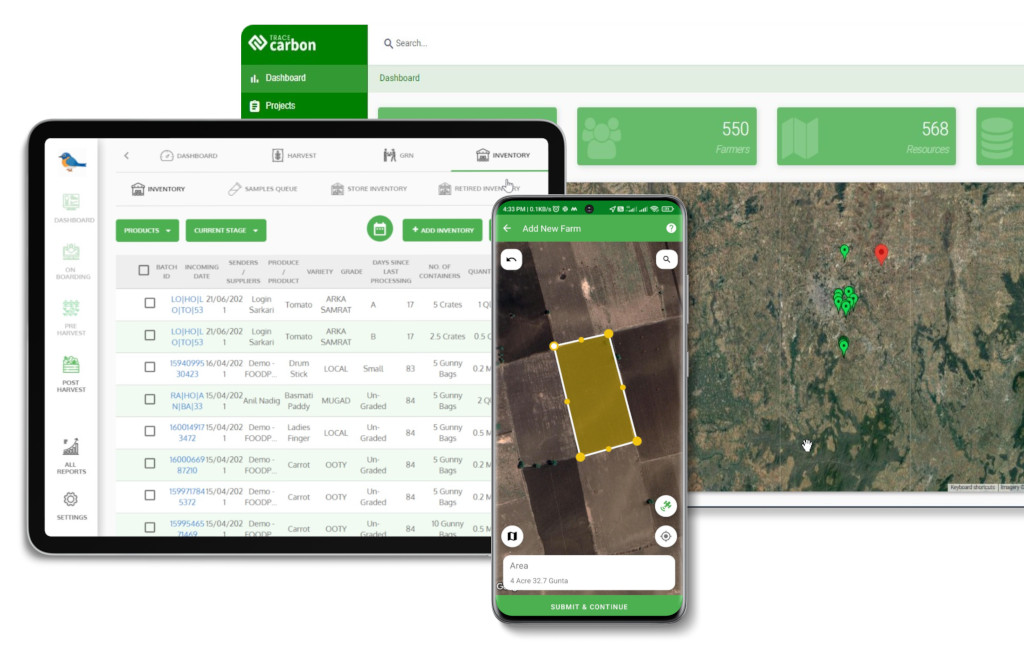
Through digital supplier onboarding, TraceX captures KYC information and required documents directly from farmers, cooperatives, and exporters reducing back-and-forth and data loss. Farms and plots are recorded using GPS-verified polygon capture, while AI-driven geolocation validation flags inaccuracies and deforestation-risk overlaps early. Automated, EUDR-aligned risk scoring helps teams prioritize remediation before coffee moves through Dutch ports. All data is structured to be TRACES-ready, eliminating last-minute rework, and integrates seamlessly with the ERP systems commonly used by Dutch importers and traders.
For coffee companies operating in the Netherlands, TraceX turns EUDR supplier data collection from a bottleneck into a scalable, audit-ready operating model that keeps coffee flowing.
Build an EUDR-ready coffee supply chain without chasing suppliers manually. Talk to TraceX about automating supplier data collection for coffee under EUDR.
Turning Supplier Data Collection into EUDR Readiness in the Netherlands’ Coffee Sector
Supplier Data Collection in EUDR for the Coffee Supply Chain in the Netherlands is no longer a back-office compliance task it is the determining factor for whether coffee can legally enter and circulate within the EU market. As a primary import, trading, and re-export hub, the Netherlands places traders, importers, and roasters at the centre of EUDR enforcement. Companies that succeed will treat supplier data as a structured, verifiable asset: mapping and prioritizing suppliers, standardizing collection, validating geolocation and legality, and addressing risk before shipments arrive. Those that don’t will face DDS rejections, customs delays, and commercial disruption. In short, mastering supplier data collection is how Dutch coffee companies protect market access, continuity, and credibility under EUDR.
Read our blog on EUDR Compliance for Coffee Supply Chains to see how importer, roaster, and trader responsibilities connect and where most compliance failures happen.
Explore our guide on EUDR for Operators and Traders to understand legal responsibility, DDS handover, and what checks you must perform before buying or selling coffee in the EU.
Dive into our practical breakdown of EUDR Due Diligence, including required data, risk assessment steps, and how to avoid delays at customs.
Frequently Asked Questions (FAQ’s)
What supplier data is mandatory for coffee under EUDR in the Netherlands?
Dutch companies must collect supplier identification (KYC), farm- and plot-level geolocation (preferably polygons), harvest year, volumes supplied, traceability to batch or lot, and proof of legal production. Without this data, a Due Diligence Statement (DDS) cannot be submitted, and coffee cannot be legally placed on or traded within the EU market.
Do Dutch roasters need farm-level geolocation data?
Yes if the roaster is the first operator placing coffee on the EU market. Dutch roasters that import green coffee directly must hold verified farm- or plot-level geolocation data. Roasters purchasing coffee already placed on the EU market must retain a valid DDS reference and maintain traceability records.
Can suppliers outside the EU provide EUDR data digitally?
Yes, and digital submission is strongly recommended. Non-EU suppliers farmers, cooperatives, and exporters can provide EUDR data through digital questionnaires, farm-mapping tools, or platforms that capture GPS polygons and supporting documents. Digital data is faster to validate and significantly reduces DDS rejection risk for Dutch importers and traders.
How long must supplier data be retained in the Netherlands?
Under EUDR, operators in the Netherlands must retain all due diligence and supplier data for at least five years and make it available to competent authorities upon request.
What happens if supplier data changes?
If supplier data changes such as new plots, updated geolocation, ownership changes, or volume adjustments the risk assessment must be updated. Material changes may require a new or revised DDS before coffee linked to the updated data can be placed on or traded within the EU market.
Start using TraceX
Transparency, Trust, & Success for your Climate Journey.
We use cookies on our website to give you the most relevant experience by remembering your preferences and repeat visits. By clicking “Accept All”, you consent to the use of ALL the cookies. However, you may visit "Cookie Settings" to provide a controlled consent.
This website uses cookies to improve your experience while you navigate through the website. Out of these, the cookies that are categorized as necessary are stored on your browser as they are essential for the working of basic functionalities of the website. We also use third-party cookies that help us analyze and understand how you use this website. These cookies will be stored in your browser only with your consent. You also have the option to opt-out of these cookies. But opting out of some of these cookies may affect your browsing experience.
Necessary cookies are absolutely essential for the website to function properly. These cookies ensure basic functionalities and security features of the website, anonymously.
Cookie
Duration
Description
cookielawinfo-checkbox-analytics
11 months
This cookie is set by GDPR Cookie Consent plugin. The cookie is used to store the user consent for the cookies in the category "Analytics".
cookielawinfo-checkbox-functional
11 months
The cookie is set by GDPR cookie consent to record the user consent for the cookies in the category "Functional".
cookielawinfo-checkbox-necessary
11 months
This cookie is set by GDPR Cookie Consent plugin. The cookies is used to store the user consent for the cookies in the category "Necessary".
cookielawinfo-checkbox-others
11 months
This cookie is set by GDPR Cookie Consent plugin. The cookie is used to store the user consent for the cookies in the category "Other.
cookielawinfo-checkbox-performance
11 months
This cookie is set by GDPR Cookie Consent plugin. The cookie is used to store the user consent for the cookies in the category "Performance".
viewed_cookie_policy
11 months
The cookie is set by the GDPR Cookie Consent plugin and is used to store whether or not user has consented to the use of cookies. It does not store any personal data.
Functional cookies help to perform certain functionalities like sharing the content of the website on social media platforms, collect feedbacks, and other third-party features.
Performance cookies are used to understand and analyze the key performance indexes of the website which helps in delivering a better user experience for the visitors.
Analytical cookies are used to understand how visitors interact with the website. These cookies help provide information on metrics the number of visitors, bounce rate, traffic source, etc.
Advertisement cookies are used to provide visitors with relevant ads and marketing campaigns. These cookies track visitors across websites and collect information to provide customized ads.