Quick summary: PPWR Fines and Penalties vary across 27 EU states. Learn what Article 68 requires, who faces enforcement and how to prepare before the Feb 2027 deadline.
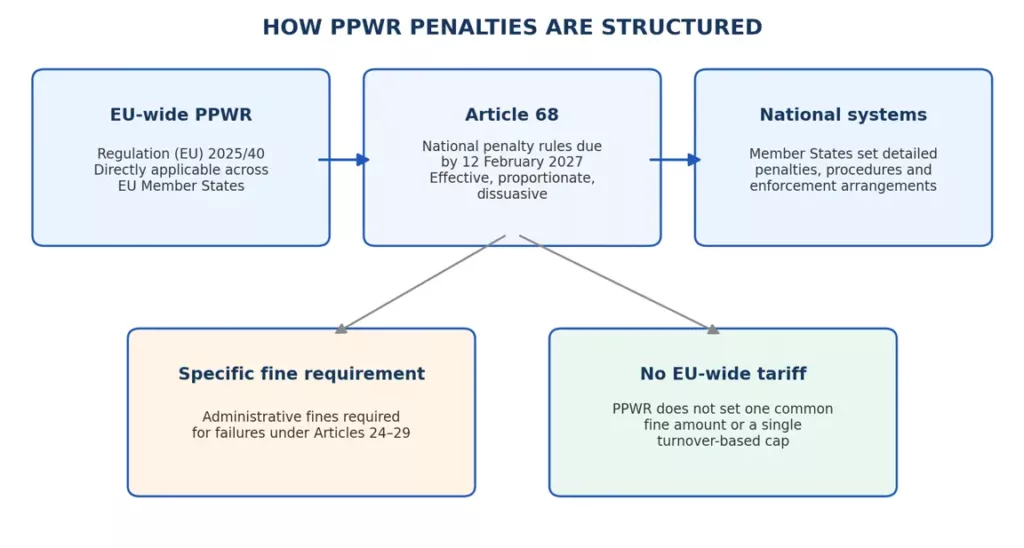
We need to understand how the EU Packaging and Packaging Waste Regulation (PPWR) Fines and Penalties will be enforced across the 27 EU Member States, and what businesses need to do to prepare. The Packaging and Packaging Waste Regulation (PPWR), Regulation (EU) 2025/40, creates a common EU framework for packaging requirements. However, the amount and mechanics of penalties are not set out as one harmonised EU tariff. Under Article 68, each Member State must establish national penalty rules by 12 February 2027. Those penalties must be effective, proportionate and dissuasive. Administrative fines are expressly required for failures to comply with Articles 24 to 29.
This means businesses selling packaging or packaged products in multiple EU countries should not assume that one national enforcement approach or penalty amount applies everywhere. They should identify the relevant national rules, competent authorities and obligations applicable to each market.
Key points at a glance
PPWR applies from 12 August 2026, subject to specific provisions and phased-in dates.
Article 68 requires Member States to establish penalty rules by 12 February 2027.
Penalties must be effective, proportionate and dissuasive.
Administrative fines must be included for failures under Articles 24–29.
PPWR does not prescribe one EU-wide fine amount or a universal turnover-based penalty cap.
Member States must notify the European Commission of their penalty rules by 12 February 2027.
Skip the scattered articles and regulatory PDFs.
Our handbook breaks down PPWR obligations, timelines, and requirements into one clear resource.
PPWR affects a broad packaging ecosystem: packaging manufacturers, suppliers, brand owners, importers, distributors, fulfilment providers and producers with extended producer responsibility (EPR) obligations. A business may need to manage packaging design and composition requirements, conformity assessment, technical documentation, labelling, producer registration, reporting and waste-management responsibilities.
The commercial exposure is not limited to a fine. Non-compliance can lead to corrective action, market disruption, delayed launches, product or packaging withdrawal where provided for under applicable law, reputational damage and additional costs to reconstruct supplier and technical evidence. The precise legal consequences depend on the breached requirement and the applicable national rules.
What Does Article 68 of the PPWR Say?
Article 68 is the PPWR provision dealing with penalties. It requires Member States to lay down rules on penalties for infringements of the Regulation and take the measures needed to implement them. The national rules must be in place by 12 February 2027.
Article 68 also specifies that penalties for failure to comply with Articles 24 to 29 must include administrative fines. If a Member State’s legal system does not provide for administrative fines, the provision allows a procedure in which the relevant authority initiates the fining process and competent national courts impose the fine, provided the legal remedies have equivalent effect.
Importantly, Article 68 does not state a single euro amount, a common percentage of turnover, or an EU-wide maximum fine. The detailed penalty framework is to be established at national level.
Which PPWR Requirements Are Explicitly Linked to Administrative Fines?
Article 68(2) specifically requires administrative fines for failures to comply with Articles 24 to 29. These provisions address packaging reduction, restrictions on certain packaging formats, reusable packaging, re-use systems, refill and re-use targets—not the general conformity-assessment provisions.
PPWR provision
Why it matters
Article 24
Obligation related to excessive packaging, including empty-space limits.
Article 25
Restrictions on the use of certain packaging formats listed in Annex V.
Article 26
Obligations in relation to reusable packaging.
Article 27
Obligation related to re-use systems.
Article 28
Obligations related to refill, including information and refill-station requirements.
Article 29
Re-use targets for specified packaging and economic operators.
The requirements are phased and apply to different actors and activities. The fact that Article 68(2) requires administrative fines does not mean that every requirement in Articles 24–29 is already applicable to every business. Check the operative date, scope, exemptions and responsible economic operator for each provision.
How PPWR Penalties Differ Across EU Member States
While the PPWR establishes a common regulatory framework across the EU, the financial consequences of packaging non-compliance can vary significantly between Member States.
Germany’s adopted VerpackDG provides for fines of up to €100,000 for certain registration failures and €200,000 for certain other offences, with confiscation also possible.
In France, existing environmental legislation provides for penalties of up to €30,000 for certain EPR registration and identification failures, while some other breaches can attract fines of up to €7,500 per unit or tonne.
Italy provides for fines ranging from €5,000 to €25,000 for certain environmental labelling violations, while
Spain’s broader waste legislation allows penalties of €2,001 to €3.5 million, depending on the severity of the infringement.
However, these figures should not be interpreted as a direct comparison of final PPWR penalties: Germany has adopted PPWR-specific implementing legislation, whereas the examples from France, Italy and Spain arise under existing national packaging and waste laws. Beyond financial penalties, non-compliant packaging may also face market restrictions, withdrawal or recall. Under Article 68, all Member States must establish and notify their PPWR penalty rules by 12 February 2027, making country-specific compliance monitoring essential for businesses operating across the EU.
Why Penalties May Differ Across the 27 Member States
The PPWR is a directly applicable EU regulation, but Article 68 requires national penalty rules. This creates a shared legal baseline alongside national differences in penalty amounts, procedures, competent authorities, investigation powers and enforcement practice.
Penalty design: national legislation determines the applicable sanctions within the Article 68 framework.
Calculation method: national rules may specify fixed amounts, ranges, criteria or other methods where permitted by the Regulation and national law.
Enforcement authority: Member States designate and organise competent authorities for relevant enforcement responsibilities.
Procedure and remedies: investigation, notice, appeal and court processes can differ between national systems.
Implementation and interpretation: administrative practice and enforcement priorities may evolve as authorities apply the PPWR.
A country-by-country comparison should therefore be based on enacted national measures and official authority guidance, not draft bills, press commentary or assumptions drawn from the previous Packaging and Packaging Waste Directive.
Does the PPWR Set a Maximum Fine or a 4% Turnover Penalty?
No. Article 68 does not establish a harmonised EU-wide maximum fine or a 4% turnover-based penalty formula. The PPWR requires penalties to be effective, proportionate and dissuasive, and expressly requires administrative fines for Articles 24–29. The amounts and detailed mechanisms are to be set through national penalty rules.
Businesses should avoid relying on penalty figures published for other EU regulations. For example, a turnover-based penalty model in another regulation does not automatically apply to PPWR. Always verify the legal basis and the national law relevant to the specific infringement.
Who Could Face PPWR Enforcement?
Responsibility depends on the economic operator’s legal role and the obligation concerned. A business may have more than one role across different packaging flows or transactions.
Manufacturers: assess applicable design, composition, conformity and documentation duties.
Importers: verify that relevant conformity and information requirements have been addressed before placing packaging on the EU market.
Distributors: understand applicable due-care, information and market-surveillance obligations.
Brand owners: determine whether they qualify as the manufacturer under the PPWR in the specific circumstances.
Producers under EPR: check registration, reporting, financing and producer-responsibility requirements in each relevant Member State.
Do not assume that every business in a packaging supply chain is responsible for every PPWR obligation. Role allocation should be assessed against the Regulation, Commission guidance and the actual contractual and operational arrangements.
Explore our detailed guide to understand PPWR EPR registration, producer responsibilities, authorised representatives, PRO participation and reporting requirements.
How Businesses Can Reduce the Risk of PPWR Non-Compliance
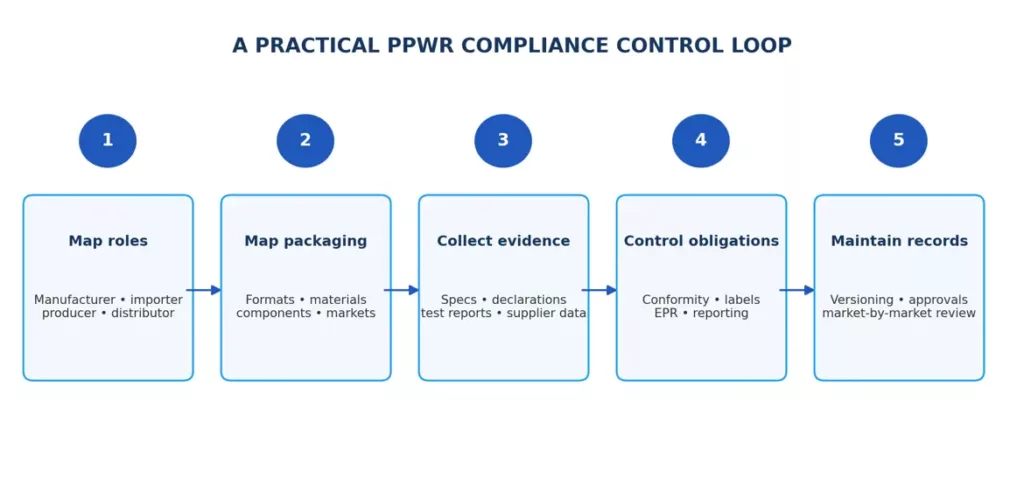
A practical compliance programme should make it possible to identify which packaging is placed on which market, who is responsible for each obligation, and where the supporting evidence is stored.
Create a packaging inventory: record packaging formats, components, materials, weights, intended uses and markets.
Map legal roles: identify manufacturer, importer, distributor, brand-owner and EPR producer responsibilities for each flow.
Collect supplier evidence: obtain specifications, material declarations, test reports, recycled-content evidence and other relevant technical information.
Manage conformity records: maintain technical documentation, assessment records and EU Declarations of Conformity where required.
Track national obligations: monitor producer registration, EPR, reporting and national implementation measures for each market.
Maintain change control: update records when packaging composition, suppliers, design, market destination or legal requirements change.
Prepare for audits and authority requests: keep evidence structured, traceable, current and accessible.
Explore our comprehensive guide to PPWR requirements and discover the key obligations, important deadlines and practical steps businesses should take to prepare.
How Digital Traceability and Compliance Systems Can Help
A digital compliance system can help businesses centralise packaging specifications, supplier declarations, supporting documents, product and packaging relationships, approvals and audit trails. It can also support visibility into which packaging versions are associated with particular suppliers, products and destination markets.
For businesses managing many suppliers and packaging formats, structured data reduces dependence on disconnected spreadsheets and email attachments. It can make it easier to identify missing evidence, retrieve documentation and review changes across the supply chain.
TraceX PPWR Solutions supports organisations with digital supplier data, traceability, sustainability and compliance workflows. These capabilities can support PPWR readiness by helping teams organise supplier information, packaging-related evidence and traceability records. The platform does not replace legal advice, official conformity assessment or the obligations of the responsible economic operator.
Managing packaging information across suppliers, products and EU markets?
TraceX helps businesses organise supplier information, traceability data and compliance evidence in connected digital workflows.
Conclusion: Prepare for PPWR Enforcement Before the Deadline
PPWR creates a common packaging framework, but Article 68 leaves the detailed penalty rules to national systems. With Member States required to establish and notify their penalty measures by 12 February 2027, businesses should build a clear view of their roles, packaging data, conformity evidence and country-specific obligations now.
The most resilient approach is to make compliance evidence part of everyday packaging and supplier management not a last-minute exercise after an authority request or a market-access problem.
Frequently Asked Questions
When must EU Member States establish PPWR penalty rules?
By 12 February 2027, under Article 68(1). They must also notify the European Commission of the rules and measures by that date.
Does PPWR impose the same fine in all 27 EU Member States?
No common fine amount is set in Article 68. Member States establish the detailed national penalty rules within the Regulation’s requirements.
Does PPWR require administrative fines?
Yes. Article 68(2) requires administrative fines for failures to comply with Articles 24 to 29. It also provides an alternative court-imposed process for legal systems that do not provide administrative fines.
Is there a 4% global-turnover fine under PPWR?
Article 68 does not prescribe a 4% turnover-based fine. Do not transfer penalty formulas from other EU regulations to PPWR.
When does PPWR apply?
The Regulation generally applies from 12 August 2026, although individual provisions have specific application dates and transitional arrangements.
Can a company face enforcement in more than one Member State?
A business active in several markets may need to comply with applicable obligations and national enforcement arrangements in more than one Member State. The competent authority and legal basis depend on the obligation and circumstances.
Are all PPWR obligations enforceable from 12 August 2026?
No. The Regulation has phased application dates and transitional provisions. Businesses should check the date applicable to each requirement rather than treating the entire Regulation as starting on one date.
Start using TraceX
Transparency, Trust, & Success for your Climate Journey.
We use cookies on our website to give you the most relevant experience by remembering your preferences and repeat visits. By clicking “Accept All”, you consent to the use of ALL the cookies. However, you may visit "Cookie Settings" to provide a controlled consent.
This website uses cookies to improve your experience while you navigate through the website. Out of these, the cookies that are categorized as necessary are stored on your browser as they are essential for the working of basic functionalities of the website. We also use third-party cookies that help us analyze and understand how you use this website. These cookies will be stored in your browser only with your consent. You also have the option to opt-out of these cookies. But opting out of some of these cookies may affect your browsing experience.
Necessary cookies are absolutely essential for the website to function properly. These cookies ensure basic functionalities and security features of the website, anonymously.
Cookie
Duration
Description
cookielawinfo-checkbox-analytics
11 months
This cookie is set by GDPR Cookie Consent plugin. The cookie is used to store the user consent for the cookies in the category "Analytics".
cookielawinfo-checkbox-functional
11 months
The cookie is set by GDPR cookie consent to record the user consent for the cookies in the category "Functional".
cookielawinfo-checkbox-necessary
11 months
This cookie is set by GDPR Cookie Consent plugin. The cookies is used to store the user consent for the cookies in the category "Necessary".
cookielawinfo-checkbox-others
11 months
This cookie is set by GDPR Cookie Consent plugin. The cookie is used to store the user consent for the cookies in the category "Other.
cookielawinfo-checkbox-performance
11 months
This cookie is set by GDPR Cookie Consent plugin. The cookie is used to store the user consent for the cookies in the category "Performance".
viewed_cookie_policy
11 months
The cookie is set by the GDPR Cookie Consent plugin and is used to store whether or not user has consented to the use of cookies. It does not store any personal data.
Functional cookies help to perform certain functionalities like sharing the content of the website on social media platforms, collect feedbacks, and other third-party features.
Performance cookies are used to understand and analyze the key performance indexes of the website which helps in delivering a better user experience for the visitors.
Analytical cookies are used to understand how visitors interact with the website. These cookies help provide information on metrics the number of visitors, bounce rate, traffic source, etc.
Advertisement cookies are used to provide visitors with relevant ads and marketing campaigns. These cookies track visitors across websites and collect information to provide customized ads.