Polygon Mapping for Carbon, Compliance, and Traceability
Published
, 16 minute read
Share this article
Quick summary: Explore how polygon mapping supports climate action by providing accurate tracking, measurement, and reporting for carbon projects, EUDR compliance, and environmental sustainability efforts.
Most climate, compliance, and traceability programs fail for one simple reason: they don’t know exactly where the land is. A single GPS point, a hand-drawn boundary, or a spreadsheet reference might look acceptable on paper, but when carbon claims are audited, or regulations like EUDR are enforced, those shortcuts collapse fast.Polygon mapping fixes this problem at the root.
By capturing the true boundaries of farms, plots, and land parcels, polygon mapping turns vague locations into verifiable spatial evidence. For carbon accounting, it means accurate area calculations and credible sequestration estimates. For compliance, it means defensible land-use verification. For traceability, it means linking products back to real, non-overlapping plots. As carbon markets, ESG reporting, and land-use regulations tighten, polygon mapping is no longer a technical nice-to-have it’s the foundation of trust.
Key Takeaways
Polygon mapping replaces vague GPS points and paper maps with precise plot boundaries, creating the spatial foundation needed for carbon accounting, regulatory compliance, and supply chain traceability.
By defining exactly where land begins and ends, polygons enable accurate carbon estimates, deforestation and land-use checks, overlap detection, and end-to-end traceability from farm to shipment.
They are especially critical in smallholder and agroforestry landscapes, where fragmented plots and land features increase risk.
Polygon mapping also powers DMRV systems by anchoring satellite data, field measurements, and carbon models to verified land parcels.
Solutions from TraceX make this scalable by combining GPS-verified capture, AI validation, and compliance-ready integration
What Is Polygon Mapping?
Polygon mapping is the process of digitally capturing the exact boundaries of a land parcel using a series of connected GPS coordinates to form a closed shape, or polygon. Unlike a single GPS point, which only marks an approximate location, polygon mapping defines the full area, shape, and extent of a plot, making it suitable for verification, monitoring, and reporting.
The key difference between GPS points and polygon boundaries is accuracy. A point shows where a farm is located, but a polygon shows how much land exists and where it begins and ends. For carbon accounting and regulatory compliance, this distinction is critical. Carbon calculations depend on precise land area, and compliance checks require clear proof that production or restoration activities occur within eligible, non-overlapping boundaries.
Because polygons represent land accurately and unambiguously, they are now the standard for carbon projects, ESG reporting, and regulations like EUDR. In simple terms, polygon mapping is used to define the exact boundaries of a land parcel for verification, monitoring, and reporting, providing the spatial integrity needed to support credible climate and traceability claims.
Read our blog on GIS in Agriculture to see how spatial data underpins carbon accounting, compliance, and modern traceability systems.
Explore our guide on Geographic Coordinates for EUDR to learn how accurate plot-level coordinates reduce DDS rejections and support deforestation-free verification
Polygon Mapping and Regulatory Compliance
As land-use regulations and climate disclosure rules become more stringent, polygon mapping has moved from a best practice to a regulatory expectation. For frameworks such as EUDR, SBTi FLAG, and ESG disclosure regimes, compliance increasingly depends on whether land can be spatially verified not just described.
Role of Polygon Mapping in Regulatory Requirements
Deforestation risk assessment
Polygon mapping allows authorities and companies to assess deforestation risk by overlaying precise plot boundaries with satellite imagery and deforestation datasets. Unlike GPS points, polygons make it possible to determine whether any part of a farm or plot overlaps with land deforested after regulatory cut-off dates. This spatial precision is essential for credible deforestation-free claims.
Land-use eligibility checks
Many regulations and standards require proof that land meets specific eligibility criteria such as historical land use, conservation status, or exclusion from protected areas. Polygon boundaries enable automated and auditable checks against land-use maps, forest cover data, and protected-area databases, reducing ambiguity and enforcement risk.
Legal due diligence
Under due diligence regimes, companies must demonstrate that sourcing and production are lawful. Polygon mapping links land parcels to legal documents, tenure declarations, and permits, allowing regulators and auditors to verify that production occurs on legitimately used land rather than relying on broad regional assumptions.
Why Regulators Require Spatially Verifiable Plots
Regulators require spatially verifiable plots because land-use impacts cannot be assessed reliably without boundaries. A single coordinate cannot show whether activities extend into forests, conservation zones, or neighbouring land. Polygons provide the transparency regulators need to enforce rules consistently, reduce false declarations, and detect non-compliance using remote sensing and independent data sources.
How Polygon Mapping Supports Key Frameworks
EUDR compliance
EUDR explicitly relies on plot-level geolocation to verify that commodities are deforestation-free. Polygon mapping enables accurate deforestation checks, prevents overlap between suppliers, and supports defensible Due Diligence Statements (DDS).
A Nigerian trading company used the polygon mapping feature of TraceX to ensure compliance with the EU Deforestation Regulation (EUDR). By leveraging GPS technology, the company accurately mapped farm boundaries to monitor risks associated with deforestation. The feature flagged areas near protected zones, enabling proactive and responsible land management. It also simplified the mapping process for field officers, ensuring precise boundary delineation and reducing errors, thereby aligning operations with EUDR’s sustainability and traceability standards.
For SBTi FLAG, polygon mapping helps companies understand where land-use emissions and removals occur within their value chains. It supports credible attribution of land-based emissions, removals, and mitigation actions to specific locations rather than generalized supply regions.
Land-use disclosure obligations
Across ESG and sustainability reporting, companies are increasingly required to disclose land footprints, sourcing risk, and land-use impacts. Polygon-based data allows these disclosures to be backed by verifiable spatial evidence, strengthening audit readiness and investor confidence.
In short, polygon mapping is the spatial backbone of modern land-use compliance enabling regulators, companies, and auditors to move from assumptions to evidence.
Polygon Mapping for Supply Chain Traceability
Effective supply chain traceability depends on one core question: exactly where did this product come from? Polygon mapping provides the spatial precision needed to answer that question with confidence, linking physical goods to verifiable land parcels rather than vague locations or supplier declarations.
Linking Farm Plots to Suppliers, Batches, and Shipments
Polygon mapping enables a direct connection between mapped farm plots, identified suppliers, and specific product flows. Each polygon can be linked to a farmer profile, production volumes, and harvest periods, and then associated with batches and shipments as products move through the supply chain. This creates a continuous trace from land to logistics, allowing companies to prove origin, manage risk, and respond quickly to audits or buyer inquiries.
Preventing Key Traceability Failures
Precise plot boundaries play a critical role in preventing common traceability failures:
Double counting Polygon validation ensures that the same land area is not claimed multiple times across different suppliers, batches, or sustainability programs.
Overlapping land claims Overlap detection flags situations where adjacent farms or projects inadvertently claim the same parcel, reducing legal, reputational, and verification risk.
Traceability breaks By anchoring traceability to spatially defined plots, companies avoid losing the link between farm-level data and downstream transactions during aggregation, processing, or trading.
Importance of High-Risk Commodities
Polygon mapping is especially important for commodities with elevated land-use and deforestation risk, including coffee, cocoa, palm oil, and rubber. These supply chains often involve thousands of smallholders, multiple intermediaries, and cross-border trade conditions where weak spatial data quickly leads to compliance and market access issues.
Relevance for Agroforestry and Smallholder Systems
In agroforestry and smallholder systems, plots are often small, irregular, and intercropped. Polygon mapping captures this complexity accurately, supporting fair attribution of production and environmental outcomes. It enables traceability systems that reflect real land use, not simplified assumptions, and supports long-term participation by ensuring farmers’ land and contributions are correctly represented.
By grounding traceability in precise land boundaries, polygon mapping turns supply chains from opaque and assumption-driven into transparent, auditable, and resilient systems.
See how boundary overlap detection strengthens carbon project validation Read the case study on Enhancing Carbon Project Validation with the Boundary Overlap Feature to learn how spatial validation reduced double counting risk, improved verifier confidence, and accelerated carbon credit approval.
Why Polygon Mapping Matters for Carbon Accounting
Accurate carbon accounting starts with a simple but non-negotiable input: how much land is involved. In land-based climate projects, every carbon estimate, whether for sequestration, removals, or avoided emissions, depends directly on the size, shape, and location of the land being measured. Polygon mapping provides the spatial precision needed to make those estimates credible.
Carbon Estimates Depend on Accurate Land Area
Carbon models calculate biomass growth, soil carbon change, and sequestration rates per unit area. If land area is overstated or understated, carbon outcomes are distorted from the start. Polygon mapping defines the true boundaries of a plot, ensuring that area calculations reflect reality rather than approximations based on a single coordinate or assumption.
Impact of Boundary Errors on Carbon Calculations
Inaccurate boundaries have cascading effects across carbon accounting:
Biomass calculations Tree counts, canopy cover, and growth models rely on plot size. Boundary errors can inflate or deflate aboveground biomass estimates, leading to incorrect carbon stock calculations.
Soil carbon estimates Soil organic carbon varies significantly within short distances due to slope, soil type, and management practices. Polygons allow carbon models to be applied to the correct land area, improving confidence in belowground carbon estimates.
Carbon baselines Establishing a credible baseline requires knowing exactly what land is included and its historical use. Vague or shifting boundaries undermine baseline integrity and make it difficult to demonstrate additionality.
Why Registries Reject Point-Based Data
Carbon registries and verifiers increasingly reject point-based mapping because a single GPS point cannot define land area or detect overlap. Points do not show whether carbon activities extend into neighbouring land, protected areas, or previously credited plots. Polygons, by contrast, allow registries to run automated spatial checks against satellite data and other projects, reducing uncertainty and fraud risk.
Risk of Over- or Under-Crediting Without Polygons
Without polygon mapping, projects face a high risk of over-crediting (claiming carbon from land that is not actually included) or under-crediting (failing to capture eligible land and sequestration). Both outcomes carry serious consequences over-crediting damages market integrity and invites enforcement action, while under-crediting reduces project revenue and investor confidence.
For buyers, registries, and regulators, polygon mapping is therefore not a technical detail it is the foundation that makes land-based carbon accounting accurate, defensible, and trustworthy.
Why GPS Points and Paper Maps Fail at Scale
GPS points and paper maps may work for basic location tracking, but they break down quickly when used for carbon accounting, compliance, or large-scale traceability. As projects grow in size and scrutiny increases, these methods introduce risks that are costly to fix later.
Common Issues with Point-Based Mapping
Point-based mapping captures only a single location reference, not the full extent of a land parcel. This leads to several critical problems:
Inaccurate area representation A single GPS point cannot define how large a plot is or where its boundaries lie, making area-based calculations unreliable.
Boundary ambiguity Without defined edges, it is impossible to know whether activities extend into neighboring land, forests, or restricted areas.
No overlap detection Points cannot be used to detect overlapping claims between farms, projects, or suppliers—one of the most common causes of verification failure and double counting.
Problems with Manual or Paper-Based Maps
Paper maps and hand-drawn boundaries introduce additional risks. They are often inconsistent, difficult to validate, and nearly impossible to integrate with satellite imagery or digital verification systems. Manual records are prone to loss, transcription errors, and version mismatches, especially in multi-year or multi-country projects.
The Cost of Fixing Errors After Verification Fails
When mapping errors surface during verification or audits, the cost escalates quickly. Projects may need to remap plots, re-collect farmer data, redo carbon baselines, or delay credit issuance and compliance filings. In some cases, claims are rejected outright. Fixing spatial errors after the fact is far more expensive and disruptive than capturing accurate polygon data from the start making early investment in proper mapping a critical risk-management decision.
Polygon Mapping in Smallholder and Agroforestry Landscapes
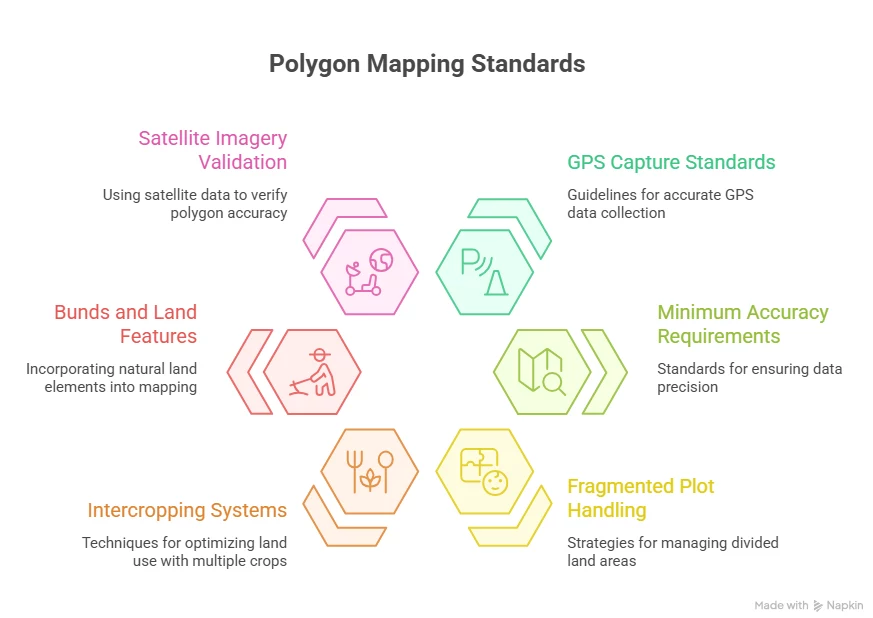
Smallholder and agroforestry landscapes are among the most complex environments to map and also the most sensitive to mapping errors. Plots are often small, irregularly shaped, intercropped, and closely adjacent to one another. In these contexts, even minor spatial inaccuracies can create outsized risks for carbon claims, compliance, and long-term project success.
Why Small Plots Increase Mapping Risk
Small plots amplify mapping risk because boundaries are tight and margins for error are minimal. A few meters of inaccuracy can significantly distort plot area, overlap with neighbouring land, or unintentionally include ineligible zones. When thousands of such plots are involved, these small errors compound, increasing the likelihood of overlap, double counting, and verification failure.
Importance of Mapping Key Land Features
Polygon mapping in agroforestry must go beyond basic plot outlines. Capturing functional land features is essential, including:
Bunds, which control runoff, reduce erosion, and improve soil moisture
Contours, which influence water flow and land stability on sloped terrain
Tree rows and conservation structures, which affect biomass distribution and carbon sequestration
Mapping these features provides a more accurate representation of how land is managed and how agroforestry systems function in practice.
How Polygon Mapping Supports Long-Term Outcomes
Accurate polygon mapping strengthens carbon permanence by supporting better assumptions around tree survival, soil stability, and long-term land management. It improves soil and water management by making erosion-control and water-harvesting structures visible and measurable. Over time, this spatial clarity contributes to long-term resilience, helping agroforestry systems withstand climate stress, maintain productivity, and deliver durable environmental and social benefits.
In smallholder and agroforestry landscapes, polygon mapping is not just about accuracy it is about capturing the reality of land use in a way that supports credible, lasting impact.
How Polygon Mapping Feeds DMRV Systems
Digital Measurement, Reporting, and Verification (DMRV) systems rely on one foundational input: clean, spatially accurate land data. Polygon mapping provides that foundation by defining exactly where monitoring, measurement, and verification should occur.
Role of Polygons in DMRV
Polygons act as the spatial anchor for DMRV. They tell the system which land parcels to monitor, measure, and include in reporting. Without polygons, DMRV platforms cannot reliably determine what area is in scope, making automated verification unreliable.
Linking Spatial Data to Core DMRV Inputs
Polygon mapping enables seamless integration between multiple data sources:
Satellite monitoring Polygons allow satellite imagery to be clipped precisely to plot boundaries, enabling accurate detection of land-use change, tree cover, and biomass growth over time.
Field data Ground observations such as tree counts, survival rates, and management practices can be linked directly to specific polygons, improving data consistency and auditability.
Carbon models Carbon sequestration and emissions models require exact land area and location. Polygons ensure models are applied to the correct plots, reducing uncertainty and improving confidence in results.
Why DMRV Systems Fail Without Clean Polygon Data
Without clean polygon data, DMRV systems face fundamental limitations. Point-based or inconsistent mapping leads to misaligned satellite analysis, incorrect area calculations, and gaps between field data and modelled outcomes. This increases the risk of over- or under-reporting carbon, triggering verifier concerns, registry rejection, or buyer distrust. In short, DMRV cannot scale or be trusted without precise polygon boundaries.
How TraceX Enables Polygon Mapping for Carbon, Compliance, and Traceability
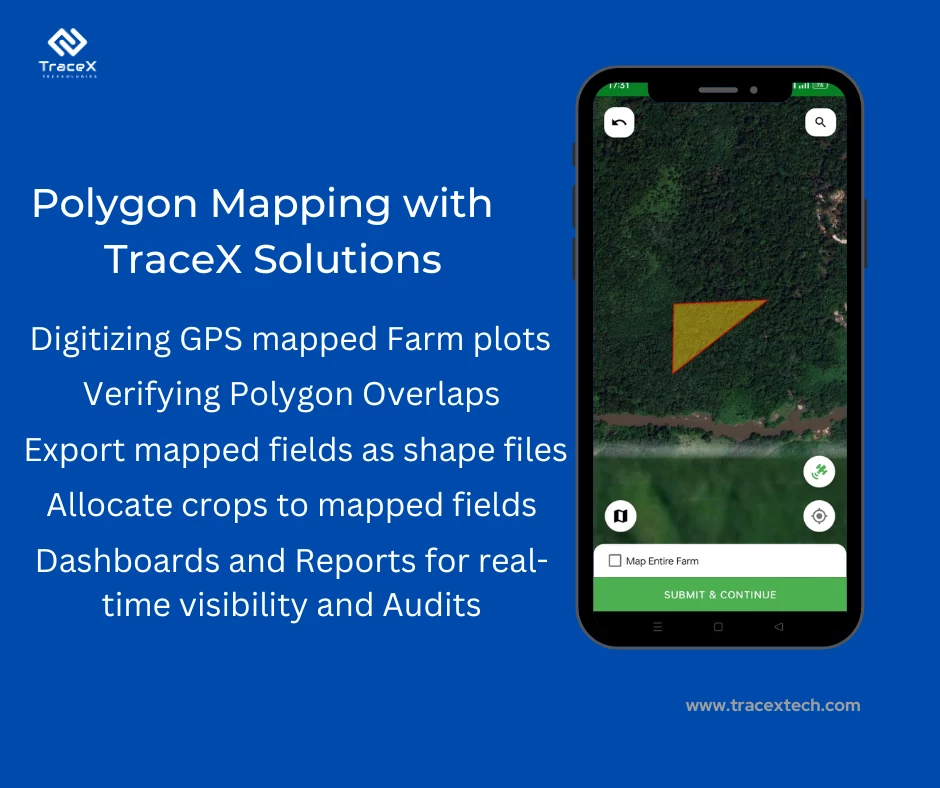
TraceX Polygon Mapping Feature is built to make polygon mapping operational at scale, even across complex, multi-country landscapes.
Core Capabilities
GPS-verified polygon capture Field teams and partners can capture accurate plot boundaries using GPS-enabled tools designed for real-world conditions.
AI-driven boundary validation Automated checks validate polygon completeness, shape, and alignment with known land features, reducing manual errors.
Overlap and eligibility checks TraceX feature detects overlapping claims, flags ineligible land, and supports deforestation and land-use risk assessments.
Integrated, Scalable Workflows
TraceX integrates polygon data directly with:
Satellite data, enabling continuous monitoring and change detection
DMRV workflows, supporting carbon accounting and verification
ERP and compliance systems, linking spatial data to suppliers, batches, and regulatory reporting
Designed for multi-country, multi-commodity programs, TraceX allows organizations to standardize polygon mapping, reduce verification risk, and move from fragmented land data to audit-ready carbon, compliance, and traceability outcomes.
Reach out to us today and discover how our polygon mapping solutions can help you track, measure, and report environmental impacts with accuracy
Turning Polygon Mapping into Trust, Compliance, and Scale
Polygon Mapping for Carbon, Compliance, and Traceability is no longer a technical enhancement it is the foundation of credible land-based programs. As carbon markets mature, regulations like EUDR tighten, and supply chain scrutiny increases, organizations must move beyond approximate locations to precise, verifiable land boundaries. Polygon mapping enables accurate carbon accounting, defensible compliance, and end-to-end traceability by anchoring every claim to clearly defined plots. Companies that invest early in polygon-based mapping reduce verification risk, avoid costly rework, and build land data systems that scale across regions, commodities, and regulatory regimes.
Explore our guide on DCF Sourcing and learn how companies operationalize deforestation-free commitments across complex agricultural supply chains.
Dive into Farm Mapping for Compliance to see how accurate geolocation and polygon mapping underpin EUDR, ESG reporting, and audit readiness.
Frequently Asked Questions (FAQ’s)
What is polygon mapping and why is it important?
Polygon mapping defines the exact boundaries of a land parcel using GPS coordinates, enabling accurate area measurement, spatial validation, and reliable verification for carbon, compliance, and traceability.
Why are GPS points not sufficient for carbon and compliance programs?
GPS points show location but not land area or boundaries. Without polygons, it is impossible to calculate carbon accurately, detect overlap, or prove land-use eligibility.
Is polygon mapping required for EUDR compliance?
While EUDR requires plot-level geolocation, polygon mapping is the most defensible way to demonstrate deforestation-free sourcing, assess risk, and support Due Diligence Statements.
How does polygon mapping support DMRV systems?
Polygons provide the spatial anchor for satellite monitoring, field data, and carbon models, enabling automated, scalable, and auditable digital MRV workflows.
Can polygon mapping work in smallholder and agroforestry systems?
Yes. With the right tools and validation, polygon mapping can accurately capture small, fragmented, and intercropped plots, including bunds and conservation features, at scale.
Start using TraceX
Transparency, Trust, & Success for your Climate Journey.
We use cookies on our website to give you the most relevant experience by remembering your preferences and repeat visits. By clicking “Accept All”, you consent to the use of ALL the cookies. However, you may visit "Cookie Settings" to provide a controlled consent.
This website uses cookies to improve your experience while you navigate through the website. Out of these, the cookies that are categorized as necessary are stored on your browser as they are essential for the working of basic functionalities of the website. We also use third-party cookies that help us analyze and understand how you use this website. These cookies will be stored in your browser only with your consent. You also have the option to opt-out of these cookies. But opting out of some of these cookies may affect your browsing experience.
Necessary cookies are absolutely essential for the website to function properly. These cookies ensure basic functionalities and security features of the website, anonymously.
Cookie
Duration
Description
cookielawinfo-checkbox-analytics
11 months
This cookie is set by GDPR Cookie Consent plugin. The cookie is used to store the user consent for the cookies in the category "Analytics".
cookielawinfo-checkbox-functional
11 months
The cookie is set by GDPR cookie consent to record the user consent for the cookies in the category "Functional".
cookielawinfo-checkbox-necessary
11 months
This cookie is set by GDPR Cookie Consent plugin. The cookies is used to store the user consent for the cookies in the category "Necessary".
cookielawinfo-checkbox-others
11 months
This cookie is set by GDPR Cookie Consent plugin. The cookie is used to store the user consent for the cookies in the category "Other.
cookielawinfo-checkbox-performance
11 months
This cookie is set by GDPR Cookie Consent plugin. The cookie is used to store the user consent for the cookies in the category "Performance".
viewed_cookie_policy
11 months
The cookie is set by the GDPR Cookie Consent plugin and is used to store whether or not user has consented to the use of cookies. It does not store any personal data.
Functional cookies help to perform certain functionalities like sharing the content of the website on social media platforms, collect feedbacks, and other third-party features.
Performance cookies are used to understand and analyze the key performance indexes of the website which helps in delivering a better user experience for the visitors.
Analytical cookies are used to understand how visitors interact with the website. These cookies help provide information on metrics the number of visitors, bounce rate, traffic source, etc.
Advertisement cookies are used to provide visitors with relevant ads and marketing campaigns. These cookies track visitors across websites and collect information to provide customized ads.
Download the 2026 Traceability Scorecard and Benchmark Your Supply Chain Across 10 Critical Capabilities.
Download our eBook
Don’t Wait for an Audit to Find Your EUDR Gaps
The 2026 Simplification Package changes how HS codes, DDS pass-through and geolocation rules apply to you. Get the free guide and 20-point readiness checklist before enforcement catches you unprepared.