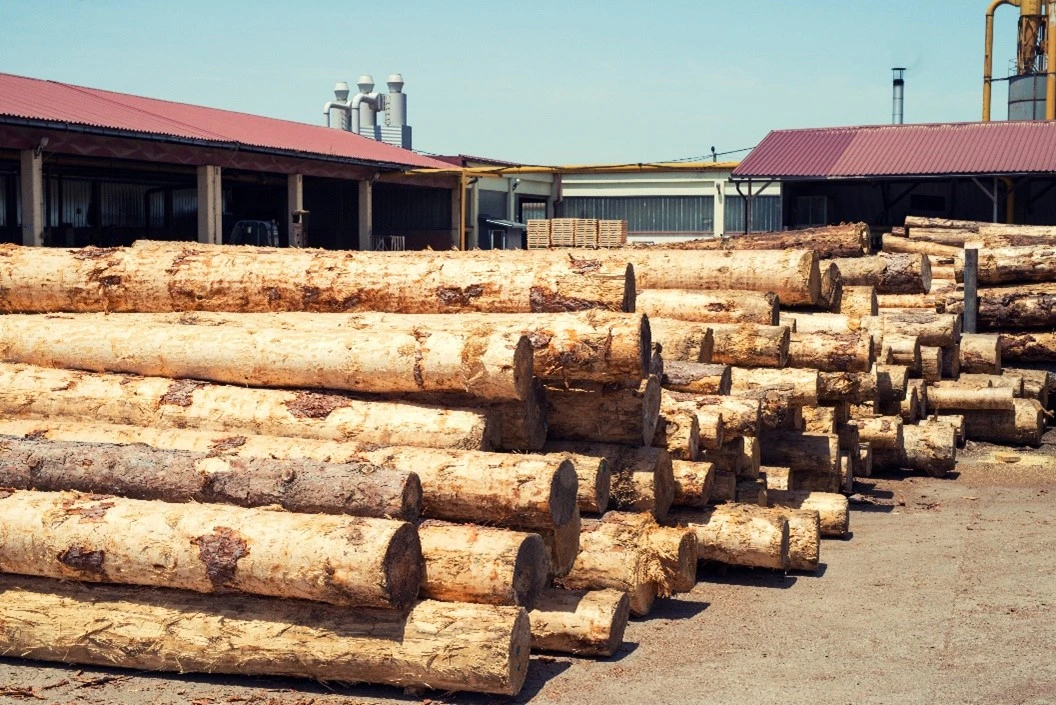
Quick summary: Learn how geo mapping helps Indonesia wood exporters meet EUDR compliance with GPS polygon mapping, GeoJSON validation, traceability, and deforestation risk checks.
Indonesia is one of the world’s largest exporters of wood and timber products to the European Union, making compliance with the EU Deforestation Regulation increasingly critical for timber exporters, furniture manufacturers, plywood producers, pulp and paper companies, and wood processing businesses. At the center of EUDR compliance lies precise geolocation: GPS polygon mapping of the forest plots where timber was harvested. Geo mapping for wood exporters in Indonesia is becoming a foundational capability for validating sourcing origin, demonstrating legality, and maintaining uninterrupted access to EU markets. This guide walks through the key requirements and operational considerations for achieving compliance at scale.
EUDR Deadlines Are Near
Start Your Free Trial Before Your Wood Exports Face Compliance Risks
What the EU Deforestation Regulation Requires for Indonesia Wood Exporters
Regulation (EU) 2023/1115, commonly referred to as EUDR, entered into force on June 29, 2023, with mandatory compliance obligations beginning in late 2024. The regulation targets seven high-risk commodities linked to deforestation and forest degradation, including wood and timber products.
For Indonesia’s export-driven forestry sector, EUDR introduces a major shift in how sourcing, legality, traceability, and forest monitoring must be managed across supply chains.
Core Legal Obligations
Operators and traders placing wood or wood-derived products on the EU market must demonstrate three core requirements before products can enter the EU:
No deforestation: Timber must not originate from land deforested after December 31, 2020.
Legal compliance: The wood must be harvested and produced in accordance with the laws of the country of production, including forestry regulations, land-use rights, labor laws, environmental obligations, and harvesting permits.
Due diligence: Companies must conduct and document due diligence through a Due Diligence Statement (DDS) submitted to the EU Information System.
The Geolocation Mandate
Article 9 of EUDR makes geolocation mandatory for timber supply chains. Operators must provide precise geographic coordinates of the forest plots where the wood was harvested, typically through GPS polygon mapping.
Coordinate type
GPS polygons (lat/long pairs forming a closed boundary)
Accuracy standard
Parcel-level, sufficient to verify against satellite forest-cover data
Cut-off date
December 31, 2020 (forest cover must be intact at this date)
Format requirement
GeoJSON or compatible geospatial format
Linked documentation
Due diligence statement referencing coordinates
Submission system
EU TRACES / dedicated EUDR IT platform
For Indonesia wood exporters, this means:
Mapping harvesting concessions and forest plots accurately
Collecting polygon-level geolocation data
Validating GeoJSON files before submission
Linking timber sourcing records to export batches
Maintaining auditable traceability documentation across supply chains
Key Data Requirements Include:
GPS polygon coordinates of harvesting plots
Supplier and concession information
Timber species and harvesting records
Harvest dates and sourcing documentation
Traceability linkage across processing and export workflows
Deforestation risk verification
As EU buyers strengthen sourcing requirements, geospatial traceability is becoming essential not only for regulatory compliance, but also for maintaining long-term market access and buyer confidence in Indonesia’s timber sector.
or Indonesia wood exporters, this means:
Mapping forest concessions and harvesting areas accurately
Collecting polygon-level geolocation data
Validating GeoJSON formats before DDS submission
Linking harvested timber to traceable sourcing and concession records
Maintaining auditable traceability documentation across supply chains
Indonesia Wood Exports
Indonesia remains one of the world’s major wood-product exporters, with the sector anchored by plywood, furniture, and other processed wood items. Recent data indicate that Indonesia’s wood exports were about US$3.98 billion in 2023 for wood and articles of wood, wood charcoal, while wood furniture exports were around US$1.8 billion in 2023–2024.
Data Snapshot
Indonesia’s export base is still led by plywood, followed by sawn wood, industrial roundwood, and veneer. The main destination markets are the United States, China, Japan, South Korea, and the European Union, with Japan and the U.S. especially important for higher-value shipments. For furniture, Indonesia shipped 97,087.5 tons of wood furniture in Q1 2025, worth US$407.32 million, showing that wood-based furniture remains a strong export category
Indicator
Time Period
Value / Quantity
Total Forestry Product Exports
Full Year 2023
17.19 Million Tons
Wood & Articles of Wood Exports
Full Year 2023
US$3.98 Billion
Wood Furniture Exports
2023 – 2024
~US$1.80 Billion
Wood Furniture Exports (Volume)
Q1 2025
97,087.5 Tons
Wood Furniture Export Value
Q1 2025
US$407.32 Million
Market Insights
The sector’s competitive advantage lies in its strong processing base, especially plywood and furniture manufacturing. However, Indonesia still trails Vietnam in wooden furniture exports, partly because licensing restrictions and complex procedures have slowed investment and production scaling. That means export growth is less about raw timber and more about improving value-added manufacturing, certification, and supply-chain efficiency.
The strongest signal is that Indonesia’s wood export market is large, diversified, and value-added, but not yet as globally dominant in furniture as its regional peers. Export demand remains concentrated in a few major markets, which helps scale but also exposes the sector to policy and housing-cycle swings. Rising shipments in 2025 suggest that wood-based furniture is still an important growth engine, especially for exporters able to meet quality and compliance requirements.
Indonesia matters because it has the raw material base, industrial depth, and market access to remain a major player in global wood trade. For exporters, the opportunity is to move further up the value chain into branded furniture, engineered wood, and certified sustainable products. For buyers, Indonesia offers scale and product diversity, but traceability and regulatory compliance are becoming more important, especially in markets that are tightening sustainability standards.
GeoJSON Errors Can Delay EU Shipments
Verify farm boundaries, fix formatting issues, and ensure your data is ready for DDS submission.
Why Geolocation (GPS Polygons) Is Mandatory for Indonesia Wood Exporters
The EU Deforestation Regulation GPS polygon requirement is not simply a documentation obligation it is the technical foundation of the EU’s deforestation verification framework. Without accurate forest plot boundaries, Indonesia’s timber supply chains cannot demonstrate compliant sourcing.
The Satellite Verification Pipeline
The EU and third-party verification systems rely heavily on satellite imagery including Copernicus, ESA Sentinel datasets, and Global Forest Watch to assess forest-cover changes at the parcel level. This process depends entirely on accurate polygon mapping.
The verification workflow typically follows these steps:
Exporter submits GPS polygon coordinates for the forest harvesting plot or concession area.
Coordinates are overlaid against historical satellite imagery dating back to December 31, 2020.
Algorithms assess whether the area was forested before the EUDR cut-off date.
Any post-2020 deforestation activity within the polygon can trigger a compliance flag.
Non-compliant timber shipments may be restricted from entering the EU market.
Why GPS Points Are Not Enough
Traditional timber traceability systems often relied on a single GPS point or approximate location reference. Under EUDR, this is no longer sufficient.
Polygon mapping is mandatory because:
Forest harvesting concessions are often irregular and fragmented
A single point cannot accurately define harvesting boundaries
Satellite systems require area-level calculations to assess canopy loss
Polygon data supports traceability aggregation across multiple forest plots, concessions, and suppliers
Regulatory Note
For smaller harvesting plots, operators must still provide a closed polygon with multiple coordinate pairs. Larger concessions and forest areas must accurately reflect actual harvesting boundaries rather than approximate square-shaped polygons.
Indonesia’s timber and forestry supply chain presents significant operational and traceability challenges for EUDR compliance.
Fragmented Supplier Ecosystem
Indonesia’s forestry sector involves:
Concession holders
Plantation operators
Community forestry groups
Aggregators
Sawmills
Processors
Furniture manufacturers
This creates major traceability complexity across sourcing networks.
Common challenges include:
Inconsistent concession and land documentation
Fragmented harvesting areas across islands and provinces
Limited digital mapping infrastructure
Supplier data inconsistency
Complex intermediary sourcing networks before export processing
Geographic & Infrastructure Constraints
Key timber-producing regions such as:
Kalimantan
Sumatra
Papua
Sulawesi
Java
Maluku
often include remote sourcing areas with:
Limited mobile connectivity
Difficult forest terrain
Inconsistent GIS data quality
Remote concession access challenges
Forest-edge sourcing complexities
Traceability Gaps Across Processing Networks
Indonesia’s timber processing ecosystem relies heavily on:
Small and medium sawmills
Wood processors
Plywood manufacturers
Furniture exporters
Multi-tier timber sourcing networks
As timber moves through processing and manufacturing layers, maintaining traceability continuity becomes significantly more difficult.
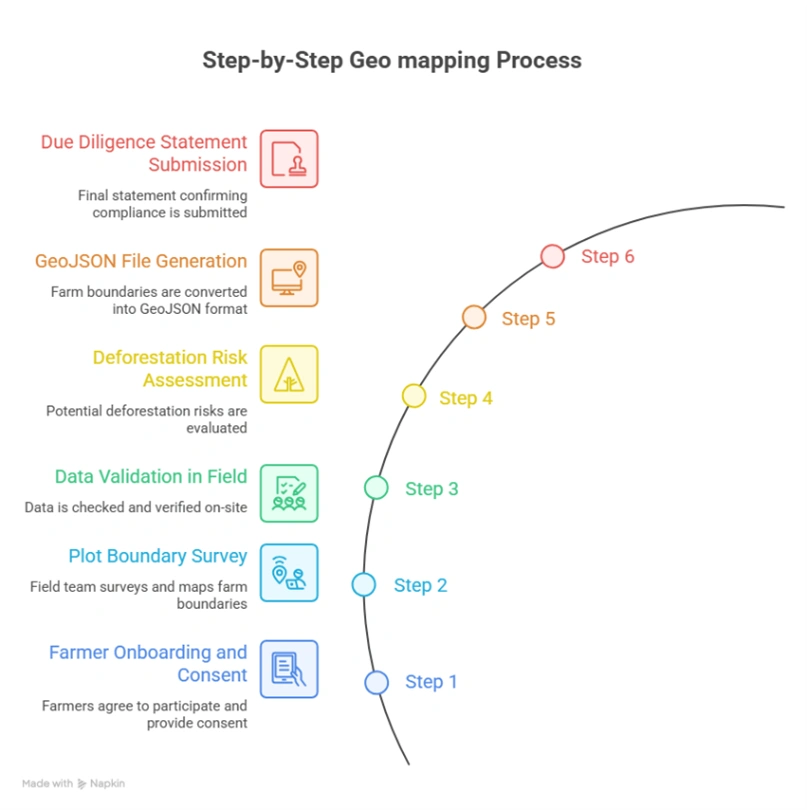
Step-by-Step Geo Mapping Process for Indonesia Wood Exporters
Step 1: Supplier & Concession Owner Onboarding
Before mapping begins, exporters should:
Register supplier and concession holder identity information
Verify harvesting and land-use rights
Obtain consent for geolocation collection
Validate legality and concession documentation
Explain EUDR obligations clearly to suppliers and operators
Step 2: Forest Plot & Concession Boundary Mapping
Field teams use GPS-enabled devices or GIS applications to capture harvesting polygons and concession boundaries.
Best practices include:
Confirm GPS accuracy before mapping
Walk actual harvesting boundaries
Capture coordinates at regular intervals
Close polygons correctly
Capture geotagged field photographs
Record species and harvesting details
Step 3: Field-Level Validation
Before leaving the site, field validation should confirm:
Polygon closure accuracy
No self-intersecting polygons
Area consistency against concession records
Visual alignment with satellite basemaps
Step 4: Deforestation Risk Assessment
Captured polygons should then be screened against:
Global Forest Watch
Copernicus datasets
Indonesian forest-cover maps
EU deforestation risk datasets (where applicable)
Plots showing post-2020 deforestation risk may require remediation or exclusion from EU-bound sourcing.
Step 5: GeoJSON File Generation
Validated polygon data must then be exported into:
RFC 7946-compliant GeoJSON format
Structured geospatial records suitable for DDS workflows
Audit-ready traceability documentation
Proper GeoJSON validation is critical before submission to avoid DDS rejection, customs delays, or shipment disruptions.
Geometry type
Polygon (Feature)
Coordinate system
WGS 84 (EPSG:4326) mandatory
Coordinate order
Longitude first, then Latitude (per GeoJSON spec)
Winding order
Exterior ring: counter-clockwise
Properties
farmer_id, plot_id, area_ha, crop_type, country, region
Encoding
UTF-8
Validation tool
geojsonlint.com, QGIS geometry validator, or Turf.js
Step 6: Due Diligence Statement Submission
The final stage connects GeoJSON polygon data and timber traceability records to an official Due Diligence Statement (DDS) submitted through the EU Information System or TRACES-linked workflows.
For Indonesia wood exporters, this process typically involves:
Compiling all validated GeoJSON polygons associated with timber harvesting plots and concession areas for a given export batch.
Attaching supporting compliance documentation, including concession permits, harvesting approvals, legality verification records, SVLK-related documentation, and forest-cover assessment results.
Completing the DDS workflow while referencing applicable HS codes for wood and timber products (for example plywood, veneer, sawn timber, furniture, pulp, paper, or wood panels).
Submitting the DDS through the EU Information System and retaining the generated reference number for customs and shipment documentation.
Maintaining traceability and compliance records for a minimum of 5 years in accordance with Article 10 of the EU Deforestation Regulation.
Geo mapping for wood exporters in Indonesia becomes significantly easier with TraceX EUDR solutions, enabling accurate concession mapping, GeoJSON validation, supplier traceability, deforestation risk assessment, and end-to-end DDS compliance management across complex timber supply chains.
Common Errors in GeoJSON / Polygon Mapping
Data quality failures at the polygon level are the single most common reason EUDR submissions are flagged for review or rejected. Field teams and data managers should be trained to identify and fix the following errors:
Error Type
Description
Impact
Fix
Self-Intersection
Polygon boundary crosses itself, creating a ‘bowtie’ shape. Occurs when field agent reverses direction while walking.
Latitude and longitude values transposed (lat first, instead of GeoJSON spec’s lon first).
Plot placed in wrong hemisphere or ocean; immediate deforestation false-alarm.
Validate first coordinate: Vietnam lon ≈ 102–109°E; lat ≈ 8–23°N.
Spike Artefacts
One or more vertices are outliers caused by GNSS signal bounce under canopy.
Polygon area inflated; boundary bleeds into adjacent plots.
Remove outlier points; apply Douglas-Peucker simplification at 1m tolerance.
Duplicate Polygons
Same farm submitted twice with different farmer_id due to aggregator duplication.
Inflated area records; compliance review flags double-counting.
Spatial deduplication using PostGIS ST_Equals or Turf.js booleanEqual.
Overly Simplified Polygon
Only 3 or 4 vertices used for complex, irregularly shaped plots.
True boundary not captured; adjacent deforested land may be excluded or included.
Minimum 6–8 vertices for plots with non-linear edges; re-survey if needed.
Conclusion
For Indonesia’s wood exporters, EUDR compliance is no longer simply a documentation obligation it represents a major transformation in how timber supply chains demonstrate legality, traceability, and deforestation-free sourcing. At the center of that transformation is GPS polygon mapping, which creates the verifiable connection between forest concessions, harvesting plots, and the wood products entering the European market.
The challenges are substantial: fragmented supplier ecosystems, concession-level complexity, remote sourcing regions, inconsistent land documentation, and geospatial data accuracy all create operational hurdles for exporters. But the direction forward is increasingly clear. Companies that invest early in scalable geo mapping infrastructure combining field-level data collection, GeoJSON validation, deforestation screening, supplier traceability, and DDS automation will not only achieve EUDR readiness, but strengthen long-term competitiveness in global timber trade.
The pressure is growing. Geolocation is now foundational to timber compliance. The companies building these capabilities today will shape the future of sustainable wood exports from Indonesia.
Explore the tools you need for EUDR compliance. Discover how wood exporters are using digital solutions for geolocation, traceability, and DDS submission.
What is geo mapping for wood exporters in Indonesia?
Geo mapping for wood exporters in Indonesia involves capturing GPS polygon coordinates of forest harvesting plots and concession areas to verify timber origin and support EUDR deforestation-free sourcing requirements.
Why is geo mapping important for EUDR compliance in timber supply chains?
Geo mapping is mandatory under the EU Deforestation Regulation because it enables authorities and buyers to verify that timber products are not sourced from land deforested after December 31, 2020.
What data is required for geo mapping timber sourcing areas in Indonesia?
Exporters typically need:
GPS polygon coordinates of harvesting plots and concessions
Supplier and concession holder information
Timber species and harvesting details
Land-use and legality documentation
Harvest and sourcing records
How do wood exporters capture geolocation data for EUDR?
Geolocation data is commonly captured using:
Mobile GIS applications
GPS-enabled field devices
GeoJSON/KML uploads
Field mapping teams
Satellite-linked mapping platforms
What are the common challenges in geo mapping timber supply chains?
Key challenges include:
Fragmented sourcing ecosystems
Concession boundary complexity
GeoJSON formatting errors
Difficulty validating deforestation risk
Limited upstream visibility across multi-tier supply chains
Digital traceability solutions help overcome these issues through automated geospatial validation, supplier onboarding, and centralized compliance workflows.
Download the Complete EUDR Checklist for Wood Exporters
Get a practical checklist covering geolocation, traceability, risk assessment, and DDS submission to stay fully compliant.
We use cookies on our website to give you the most relevant experience by remembering your preferences and repeat visits. By clicking “Accept All”, you consent to the use of ALL the cookies. However, you may visit "Cookie Settings" to provide a controlled consent.
This website uses cookies to improve your experience while you navigate through the website. Out of these, the cookies that are categorized as necessary are stored on your browser as they are essential for the working of basic functionalities of the website. We also use third-party cookies that help us analyze and understand how you use this website. These cookies will be stored in your browser only with your consent. You also have the option to opt-out of these cookies. But opting out of some of these cookies may affect your browsing experience.
Necessary cookies are absolutely essential for the website to function properly. These cookies ensure basic functionalities and security features of the website, anonymously.
Cookie
Duration
Description
cookielawinfo-checkbox-analytics
11 months
This cookie is set by GDPR Cookie Consent plugin. The cookie is used to store the user consent for the cookies in the category "Analytics".
cookielawinfo-checkbox-functional
11 months
The cookie is set by GDPR cookie consent to record the user consent for the cookies in the category "Functional".
cookielawinfo-checkbox-necessary
11 months
This cookie is set by GDPR Cookie Consent plugin. The cookies is used to store the user consent for the cookies in the category "Necessary".
cookielawinfo-checkbox-others
11 months
This cookie is set by GDPR Cookie Consent plugin. The cookie is used to store the user consent for the cookies in the category "Other.
cookielawinfo-checkbox-performance
11 months
This cookie is set by GDPR Cookie Consent plugin. The cookie is used to store the user consent for the cookies in the category "Performance".
viewed_cookie_policy
11 months
The cookie is set by the GDPR Cookie Consent plugin and is used to store whether or not user has consented to the use of cookies. It does not store any personal data.
Functional cookies help to perform certain functionalities like sharing the content of the website on social media platforms, collect feedbacks, and other third-party features.
Performance cookies are used to understand and analyze the key performance indexes of the website which helps in delivering a better user experience for the visitors.
Analytical cookies are used to understand how visitors interact with the website. These cookies help provide information on metrics the number of visitors, bounce rate, traffic source, etc.
Advertisement cookies are used to provide visitors with relevant ads and marketing campaigns. These cookies track visitors across websites and collect information to provide customized ads.
Download the 2026 Traceability Scorecard and Benchmark Your Supply Chain Across 10 Critical Capabilities.
Download our eBook
Don’t Wait for an Audit to Find Your EUDR Gaps
The 2026 Simplification Package changes how HS codes, DDS pass-through and geolocation rules apply to you. Get the free guide and 20-point readiness checklist before enforcement catches you unprepared.