Farm Management for Exports: How to Build Export-Ready Farm Data
Published
, 8 minute read
Share this article
Quick summary: Farm management for exports turns farm and plot data into audit-ready proof, so you meet buyer, certification and EUDR requirements and avoid shipment holds.
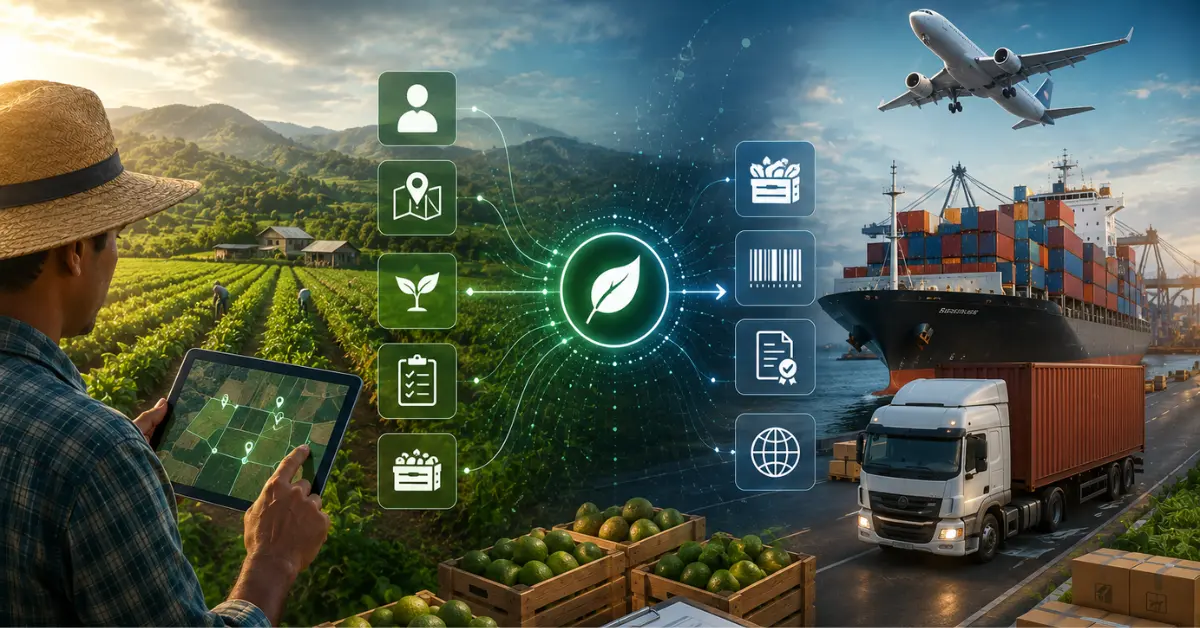
Farm management for exports is the digital capture of farm and plot data, covering farmer identity, mapped plots, inputs, harvest volumes and post-harvest movements, so that produce can clear customs and satisfy buyers abroad. It replaces scattered notebooks with one connected, audit-ready record. That record is what buyer contracts, certifications and regulations such as EUDR now sit on top of, and it is what keeps a container moving instead of held.
For export houses, cooperatives and producer companies, the pressure point is no longer growing good produce. It is proving, with records that hold up to an audit, where that produce came from and how it was grown. Farm management for exports is what turns that proof from a season-end scramble into a process the team runs every day.
KEY TAKEAWAYS
Farm management for exports keeps farmer, plot, crop, input and harvest data in one connected record, not scattered files.
Buyers and regulators now ask for farm-level proof, not warehouse-level declarations, so the record decides market access.
Certifications such as GLOBALG.A.P. and rules such as EUDR plot-level proof rely on this data underneath them.
Lot-level records contain problems to a single consignment, shorten audits and support the sustainability claims premium buyers pay for.
Spreadsheets hold until the season scales; a connected platform turns a mid-shipment records request into a lookup.
It links farmers, mapped plots, crop cycles, inputs, harvests and post-harvest custody in one record.
It captures data at the source on mobile, so field staff enter it once and everyone downstream can use it.
It serves procurement, quality, sustainability and export teams from the same set of facts.
Buyers and regulators now ask for farm-level evidence, not warehouse-level declarations. Farm management for exports answers that by keeping every farmer, plot and crop cycle in one connected record instead of scattered notebooks and phone photos. A grape exporter shipping to the EU and the Gulf, for example, can pull the spray records, harvest dates and plot coordinates for a single container in minutes rather than days, because the data was captured as the season ran, not reconstructed afterwards.
Why farm management for exports decides market access
Three forces have raised the bar on acceptable proof.
Certifications: schemes such as GLOBALG.A.P. and organic require documented practices and traceable records, not verbal assurance.
Buyer due diligence: importers and retailers audit their suppliers and want to see the underlying farm data on request.
Regulation: EUDR wants plot coordinates for relevant commodities, and destination markets enforce pesticide residue limits and phytosanitary rules.
Turn Farm Data Into Compliance-Ready Records → Read the Blog
A coffee cooperative selling into the EU has to show plot coordinates that prove the beans are deforestation-free against the December 2020 cut-off under EUDR. A spice exporter has to keep pesticide records that stay within each destination country’s residue limits. In both cases, farm management for exports supplies the underlying data that certificates and declarations rest on. Companies that cannot produce structured, verifiable farm data risk losing access to premium and regulated markets, which is the practical reason farm management for exports has moved from a nice-to-have to a condition of trade.
Timing raises the stakes further. EUDR applies from 30 December 2026 for large and medium operators, and destination markets keep tightening residue limits year on year, so farm management for exports has to keep pace with rules that move rather than sit still.
From Farm to Export: Discover How Cocoa Traceability Enabled EUDR Readiness
Certificates alone will not clear a container. Here is the evidence auditors and buyers look for.
Farmer identity: a unique ID per farmer, tied to their plots and agreements.
Plot mapping: GPS polygons for each plot, needed for EUDR-relevant commodities and many buyer programmes.
Input and spray records: what was applied, when, and at what rate, so residue limits can be evidenced.
Harvest and lot links: volumes tied to the lot that ships, so a container traces back to specific plots.
Post-harvest custody: each handover from field to pack-house to export terminal kept intact.
Auditors and buyers want to see that the farm system exists and works, not just that a certificate is held. Farm management for exports records each of these at the source and links them to the lot on the container. A mango exporter that can trace a rejected pallet back to one plot and one spray event contains the problem to a single lot instead of losing a whole consignment. Good farm management for exports also protects margins: clean lot-level records shorten audits, cut rejected consignments and back up the sustainability claims that premium buyers pay for.
Most export teams find their real gap the moment a buyer asks for records mid-shipment. The fix is to capture farm data once, at the source, and link it to the shipping lot from the start, so a request becomes a lookup rather than a week of phone calls.
The TraceX Farm Management platform is built to register farmers, map plots with GPS polygons, capture inputs and harvests on mobile, and link every lot to its farms for export audits and buyer requests.
Farm management for exports: spreadsheets vs a connected platform
Spreadsheets work until the season scales, staff change and a buyer asks mid-shipment.
Farm management for exports on a connected platform keeps farmer, plot and harvest data in one place with an audit trail, so an information request becomes a quick lookup. When produce moves across several handlers before it ships, the TraceX Farm Management platform keeps the chain of custody intact, so nothing has to be reconstructed after the fact.
See how the TraceX platform registers farmers, maps plots, captures field data on mobile and links every lot for export audits.
The producers winning premium contracts treat farm management for exports as a data system they run all season, not a folder they assemble the week a container is booked. That habit is what keeps their shipments moving while others wait on a hold.
Buyer’s checklist: choosing a farm data system for exports
Use this when comparing tools. A system that cannot do these will not hold up at an export audit.
☐Registers each farmer with a unique ID linked to their plots and agreements.
☐Maps plots as GPS polygons, ready for EUDR-relevant commodities and buyer programmes.
☐Captures inputs, spray records and harvests on mobile, at the source.
☐Links every harvest lot to the container that ships, both ways.
☐Keeps post-harvest custody intact from field to export terminal.
☐Produces audit-ready exports for buyers, certifiers and authorities on request.
☐Scales across seasons and staff changes without losing history.
Frequently Asked Questions
What is farm management for exports?
It is the digital capture and management of farm and plot data, farmer IDs, mapped plots, inputs, harvests and post-harvest custody, kept in one record so produce can meet buyer, certification and regulatory requirements abroad.
We already hold GLOBALG.A.P. Do we still need this?
Yes. A certificate proves you passed an audit on a given date. Farm management for exports keeps the day-to-day records that the certificate depends on, and that buyers and authorities ask to see between audits.
How does it help with EUDR?
For EUDR-relevant commodities such as coffee and cocoa, the system stores the plot polygons and harvest links needed to show produce is deforestation-free against the 31 December 2020 cut-off, which feeds the due diligence process.
Is this only for large exporters?
No. Smallholder cooperatives and producer companies use it too. Mobile-first capture lets field staff register farmers and plots without paperwork, which is often where cooperatives struggle most.
What data do buyers actually ask for?
Commonly: farmer and plot identity, plot coordinates, input and spray records against residue limits, harvest volumes tied to the shipped lot, and proof of custody through pack-house and export.
How does it prevent shipment holds and rejections?
Because every lot traces back to specific plots and events, a problem stays contained to one consignment. You can answer a buyer or customs query quickly instead of losing time, or a whole shipment, to missing records.
When do we need to move off spreadsheets?
When volumes grow, staff change, or a buyer asks for records mid-shipment and you cannot produce them fast. At that point, farm management for exports on a connected platform pays for itself in avoided holds and shorter audits.
Start using TraceX
Transparency, Trust, & Success for your Climate Journey.
We use cookies on our website to give you the most relevant experience by remembering your preferences and repeat visits. By clicking “Accept All”, you consent to the use of ALL the cookies. However, you may visit "Cookie Settings" to provide a controlled consent.
This website uses cookies to improve your experience while you navigate through the website. Out of these, the cookies that are categorized as necessary are stored on your browser as they are essential for the working of basic functionalities of the website. We also use third-party cookies that help us analyze and understand how you use this website. These cookies will be stored in your browser only with your consent. You also have the option to opt-out of these cookies. But opting out of some of these cookies may affect your browsing experience.
Necessary cookies are absolutely essential for the website to function properly. These cookies ensure basic functionalities and security features of the website, anonymously.
Cookie
Duration
Description
cookielawinfo-checkbox-analytics
11 months
This cookie is set by GDPR Cookie Consent plugin. The cookie is used to store the user consent for the cookies in the category "Analytics".
cookielawinfo-checkbox-functional
11 months
The cookie is set by GDPR cookie consent to record the user consent for the cookies in the category "Functional".
cookielawinfo-checkbox-necessary
11 months
This cookie is set by GDPR Cookie Consent plugin. The cookies is used to store the user consent for the cookies in the category "Necessary".
cookielawinfo-checkbox-others
11 months
This cookie is set by GDPR Cookie Consent plugin. The cookie is used to store the user consent for the cookies in the category "Other.
cookielawinfo-checkbox-performance
11 months
This cookie is set by GDPR Cookie Consent plugin. The cookie is used to store the user consent for the cookies in the category "Performance".
viewed_cookie_policy
11 months
The cookie is set by the GDPR Cookie Consent plugin and is used to store whether or not user has consented to the use of cookies. It does not store any personal data.
Functional cookies help to perform certain functionalities like sharing the content of the website on social media platforms, collect feedbacks, and other third-party features.
Performance cookies are used to understand and analyze the key performance indexes of the website which helps in delivering a better user experience for the visitors.
Analytical cookies are used to understand how visitors interact with the website. These cookies help provide information on metrics the number of visitors, bounce rate, traffic source, etc.
Advertisement cookies are used to provide visitors with relevant ads and marketing campaigns. These cookies track visitors across websites and collect information to provide customized ads.
Download the 2026 Traceability Scorecard and Benchmark Your Supply Chain Across 10 Critical Capabilities.
Download our eBook
Don’t Wait for an Audit to Find Your EUDR Gaps
The 2026 Simplification Package changes how HS codes, DDS pass-through and geolocation rules apply to you. Get the free guide and 20-point readiness checklist before enforcement catches you unprepared.