EUDR Wood Challenges: Why Timber Supply Chains Face the Toughest Compliance Test
Published
, 15 minute read
Share this article
Quick summary: Discover the top challenges of EUDR for timber and wood industry players and how AI-powered digital traceability solutions turn compliance into a competitive advantage.
EUDR wood challenges are the traceability, geolocation, and due diligence hurdles that timber-based supply chains face under the EU Deforestation Regulation. Unlike sectors that buy finished components, wood supply chains begin in forests, pass through multiple intermediaries, and frequently mix materials from different species and origin countries. To comply, operators must trace every product back to the plot of land where the timber was harvested, collect geolocation coordinates, assess and mitigate deforestation and legality risk, and file a Due Diligence Statement (DDS) before placing products on the EU market obligations that FSC certification supports but does not replace. Large and medium operators must comply from 30 December 2026; micro and small enterprises from 30 June 2027.
EUDR wood challenges begin where most compliance programmes have never had to look: inside the forest itself. In plain terms, the EU Deforestation Regulation (EUDR) requires any company placing wood, timber, pulp, paper, or wood-derived products on the EU market to prove with plot-level geolocation data and a formal Due Diligence Statement that those products are deforestation-free and legally harvested.
For most regulated commodities, that is demanding. For the wood sector, it is uniquely difficult. Coffee importers deal with beans; cocoa traders deal with pods. The wood industry deals with a raw material that is felled in fragmented forest plots, aggregated by logging contractors, traded across borders, sawn, chipped, pulped, laminated, and recombined often several times before it becomes a chair, a carton, or a construction panel. Every one of those steps blurs the connection between the finished product and the land it came from. This guide walks through the nine biggest compliance hurdles facing timber-based businesses, and what early movers are doing about each one before the December 2026 application date for large and medium operators.
Key Takeaways
Wood supply chains start in forests, not factories traceability must reach the original harvest plot, often through four or five intermediaries.
Plot-level geolocation is the single hardest data requirement, especially with smallholders, historical sourcing records, and imported timber.
FSC certification helps with governance and chain of custody, but it does not replace geolocation, risk assessment, or the Due Diligence Statement.
Material mixing multiple species, origins, and recycled/virgin fibre combinations multiplies the verification burden for engineered and composite products.
Legacy ERPs and spreadsheets typically trace back to the sawmill, not the forest plot; purpose-built digital traceability closes that gap.
Non-compliance risks include DDS rejection, blocked shipments, penalties of at least 4% of EU turnover , and lost EU buyers.
EUDR Wood Challenges Start in the Forest, Not the Factory
The wood sector’s compliance burden is structurally different because its supply chains originate at the point of harvest rather than at a component supplier. This section covers:
Why raw-material origin makes wood harder to trace than assembled goods
The typical chain of actors between forest and finished product
Where visibility usually breaks down
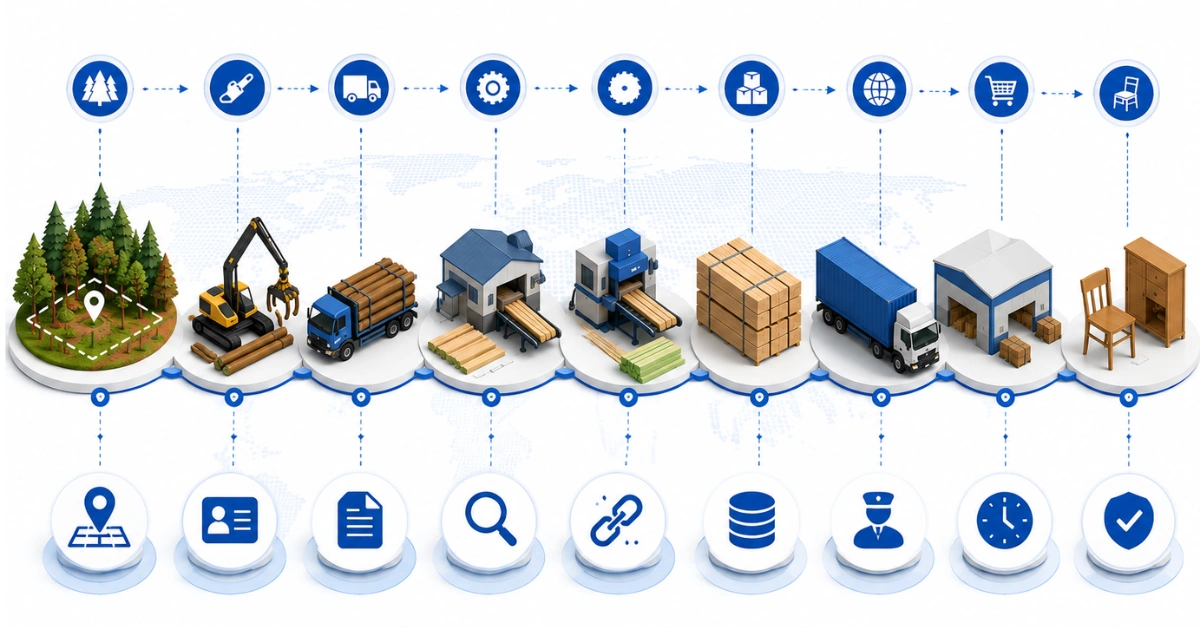
Most industries subject to EUDR source semi-finished inputs from a known supplier tier. The wood sector sources a living raw material from land. Between the forest and the factory sits a long chain of actors: forest owners, logging contractors, traders and aggregators, sawmills, secondary processors, manufacturers, and exporters. Each hand-off is a point where origin information can be simplified, summarised, or simply lost.
Consider a wooden furniture manufacturer in Central Europe. The oak in a single dining table may have been purchased from a trader, who bought from a sawmill, which sourced logs from two logging contractors, who harvested across a dozen privately owned forest plots. That is four or five intermediaries deep and EUDR obligations reach all the way to the first link. The manufacturer, as the operator placing the product on the EU market, must be able to name the plots, produce the coordinates, and evidence legal harvest for every one of them.
EUDR requires businesses to prove that in-scope commodities are sourced from deforestation-free supply chains. Learn how to strengthen traceability, engage suppliers, and build a due diligence program that supports long-term compliance.
EUDR Wood Challenges in Traceability: Mixing, Multiple Species, Multiple Origins
Traceability degrades as timber moves downstream, because processing deliberately combines materials. Key issues:
Material mixing at sawmills, pulp mills, and panel plants
Multi-species and multi-origin inputs in a single product
Reprocessing steps that break the documentary chain
Recycled and virgin fibre combinations in composite products
A plywood panel illustrates the problem neatly. Its veneers may come from several forests in different countries, peeled at different mills, glued at a third facility, and finished at a fourth. Engineered wood products MDF, OSB, cross-laminated timber, particleboard are, by design, blends. So are many paper and packaging grades, where virgin pulp is combined with recovered fibre.
Under EUDR, each relevant input must be verifiable back to its origin plots. That means a single SKU can carry dozens of geolocation records, and a single production batch may aggregate inputs with very different risk profiles. Businesses that have historically managed traceability at the level of “supplier and invoice” now have to manage it at the level of “plot and harvest event” a shift in data granularity that most transaction systems were never designed to hold.
The practical consequence: traceability can no longer be reconstructed after the fact from paperwork. It has to be captured at the point of origin and preserved through every mixing and processing step or the operator inherits a gap it cannot close.
Under EUDR, businesses must be able to trace timber products back through their supply chain with confidence. Learn how end-to-end timber traceability strengthens due diligence, reduces compliance risks, and supports market access.
EUDR Wood Challenges with Geolocation: Plot-Level Data Is the Hardest Requirement
Geolocation is where most wood-sector compliance programmes stall. This section explains why:
EUDR requires coordinates for every plot of land where timber was harvested
Plots over 4 hectares require polygon boundaries, not just a point
Historical sourcing records rarely contain geospatial data
Imported timber from complex regions compounds the problem
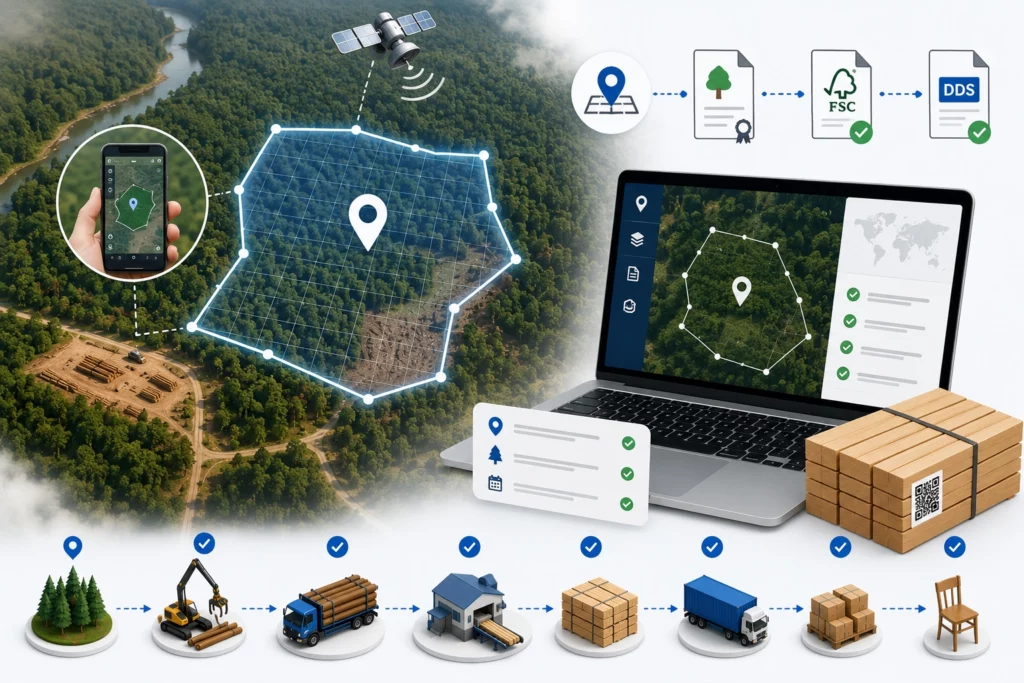
The regulation requires geolocation for the plots of land where the wood was harvested, with polygon mapping expected for larger plots. For a paper producer sourcing pulp from multiple suppliers across two or three continents, this can translate into thousands of coordinate sets many of them held (if they exist at all) by parties three tiers upstream.
Common failure points include small forest plots that have never been digitally mapped, legacy purchase contracts that reference regions rather than plots, supplier records that stop at the concession or forest-management-unit level, and imported timber from jurisdictions where cadastral data is unreliable. Collecting this data retroactively is slow and expensive; collecting it at the point of harvest, through structured supplier workflows, is the only approach that scales.
EUDR Wood Challenges in Supplier Engagement and Fragmented Forest Ownership
Almost all of the data EUDR demands sits outside the operator’s own four walls. This section covers:
The documents operators must collect from upstream suppliers
Why smallholders and family-owned forests struggle to respond
How to structure supplier engagement so it actually delivers data
Timber compliance documents suppliers must provide
A packaging manufacturer depends almost entirely on its upstream pulp suppliers for traceability evidence. The core document set includes harvest permits and legal harvesting authorisations, species and scientific-name information, chain-of-custody records for every transformation step, geolocation files (points and polygons), and legality evidence covering land-use rights, environmental rules, and labour requirements in the country of harvest.
From timber sourcing and geolocation data to due diligence and traceability, EUDR introduces new requirements for businesses placing wood and wood products on the EU market. Learn how to prepare your supply chain for compliance.
Wood supply chain smallholders: the capability gap
Many wood supply chains rest on smallholders, family-owned forests, and independent logging operators. A single European importer may source indirectly from hundreds of small forest owners. These suppliers often have limited digital capability, no geospatial records, and inconsistent documentation practices. Emailing them a spreadsheet template does not work; what works is a simple, mobile-friendly data collection workflow, in the supplier’s language, with validation at the point of entry so errors are caught before they propagate downstream.
EUDR Wood Challenges vs FSC Certification: Why FSC Alone Is Not Compliance
Certification is an asset but it is frequently mistaken for compliance. The distinction matters:
What FSC genuinely provides: governance, audits, chain of custody, responsible sourcing
What EUDR additionally requires: geolocation, risk assessment, risk mitigation, and the DDS
How to use certification correctly within a due diligence system
FSC certification gives operators real advantages: an audited governance framework, chain-of-custody discipline, and credible responsible-sourcing evidence. None of that is wasted under EUDR certified supply chains are typically better documented and lower risk.
But EUDR is an operator obligation, not a certification scheme. It additionally requires plot-level geolocation for every relevant plot, a documented risk assessment covering deforestation and legality, active risk mitigation where risk is not negligible, and a Due Diligence Statement filed in the EU Information System before products are placed on the market. An FSC certificate does not supply coordinates, does not perform your risk assessment, and cannot file your DDS.
Bottom line: FSC certification supports risk mitigation and strengthens your evidence base, but it does not replace the operator’s own due diligence, geolocation, or DDS obligations. Treat certificates as one input into the due diligence system never as the system itself.
FSC certification is an important step toward responsible forest management—but EUDR introduces additional due diligence, traceability, geolocation, and risk assessment requirements. Learn where FSC supports compliance and where additional action is needed.
EUDR Wood Challenges in Risk Assessment: Country Risk and Legality Layers
Even with full traceability, operators must still assess and classify risk. This section covers:
The risk dimensions EUDR expects operators to evaluate
Why two certified suppliers can carry very different risk profiles
How the EU country benchmarking system affects due diligence depth
For every sourcing line, companies must assess deforestation risk in the area of harvest, governance and corruption indicators in the origin country, the legality framework applying to the harvest, and supply chain complexity itself the more intermediaries and mixing steps, the higher the inherent risk. The EU’s country benchmarking classification (low, standard, high risk) then determines how deep the due diligence and verification must go.
This is why two suppliers holding identical FSC certificates can still present very different EUDR risk profiles: one may harvest in a low-risk benchmarked country with strong forest governance, while the other operates in a region with contested land tenure and weak enforcement. Risk assessment has to be evidence-based, documented, repeatable, and refreshed as conditions change not a one-off questionnaire at onboarding.
Under EUDR, your due diligence obligations are influenced by the European Commission’s country risk classification. Learn how low-, standard-, and high-risk countries affect your compliance strategy and supplier engagement.
EUDR Wood Challenges with Legacy Systems: Spreadsheets Cannot Reach the Forest
Most existing systems were built to trace transactions, not land. Typical gaps:
Spreadsheets and email as the primary supplier data channel
ERP records that stop at the first-tier supplier or sawmill
No native support for polygons, species data, or DDS workflows
Many companies can trace a product to a sawmill but not back to the original forest plot. ERPs hold purchase orders, invoices, and supplier master data; they do not hold harvest events, polygon files, or legality evidence. The result is a compliance process stitched together from spreadsheets, shared drives, and email threads, which collapses under the volume and validation burden EUDR creates.
The comparison below shows what changes when wood-sector due diligence moves from manual processes to a purpose-built traceability platform like TraceX EUDR Solutions
Compliance task
Manual / legacy approach
Automated with TraceX
Plot geolocation collection
Email requests, unvalidated coordinate spreadsheets, months of follow-up
Mobile-friendly supplier workflows with built-in polygon capture and validation
Data validation
Manual spot checks; errors found at DDS filing
Automated checks against deforestation maps and format rules at point of entry
Chain-of-custody records
Paper and PDF trails reconstructed per shipment
Digital chain of custody linked to batches, species, and origin plots
Risk assessment
Static questionnaires, updated annually at best
Continuous risk scoring by plot, supplier, and country benchmark
DDS preparation
Copy-paste into the EU Information System per consignment
DDS-ready data packages generated from verified records
Audit readiness
Days of document hunting per request
One-click evidence trail for every product batch
EUDR Wood Challenges by Industry: Furniture, Paper, Packaging, Construction, Textiles
The core obligations are identical, but the hardest problem differs by vertical:
Furniture manufacturers — multiple timber species and long intermediary chains behind a single product line; bills of materials must be mapped to origin plots per component.
Paper producers — pulp traceability across blended furnish; fibre-origin logic (virgin, 100% recycled, mixed, packaging-as-product) determines what falls in scope and what evidence each stream needs.
Packaging companies — complex fibre sourcing plus the distinction between packaging placed on the market as a product versus packaging merely containing another product.
Construction materials companies — engineered wood and composite materials that aggregate inputs from many origins into a single certified structural product.
Textile and apparel brands — forest-derived fibres such as viscose and lyocell, where the forest origin sits behind a chemical processing step most brands have never mapped.
Whatever the vertical, the pattern repeats: the further a business sits from the forest, the more it depends on structured upstream data collection and the earlier it needs to start.
EUDR Wood Challenges and the Commercial Cost of Getting It Wrong
Non-compliance is not an abstract legal risk; it is a commercial one. Potential consequences:
DDS rejection and consignments blocked at the EU border
Delayed shipments and broken delivery commitments
Lost EU customers who reallocate volume to compliant suppliers
Regulatory penalties, product confiscation, and exclusion from public procurement
Reputational damage with retailers, investors, and NGOs
The most immediate risk is not the fine it is the purchase order. A furniture manufacturer that cannot supply complete geolocation data does not merely face regulatory exposure; it becomes an unreliable supplier in the eyes of every EU buyer running its own due diligence. Compliance readiness is rapidly becoming a commercial qualification criterion, checked before contracts are signed.
EUDR Wood Challenges: How to Prepare Early with TraceX
Early preparation converts a compliance scramble into a manageable programme. The essential moves:
Map supply chains to the origin forest, not just to tier one
Identify origin plots and begin geolocation collection now
Engage suppliers early with simple, validated data workflows
Evaluate what existing FSC systems already cover and what they don’t
Build digital traceability that survives material mixing
Establish repeatable risk assessment and DDS procedures
This is precisely the workload TraceX Solutions was built for. The platform digitises supplier onboarding and document collection, captures and validates plot-level geolocation (points and polygons), maintains chain-of-custody records through processing and mixing steps, runs continuous risk assessment against deforestation and country-benchmark data, and generates DDS-ready data packages for the EU Information System replacing the spreadsheet-and-email machinery that breaks at scale.
See how TraceX collects plot-level geolocation, automates supplier documentation, and generates DDS-ready data for wood, paper, and packaging supply chains.
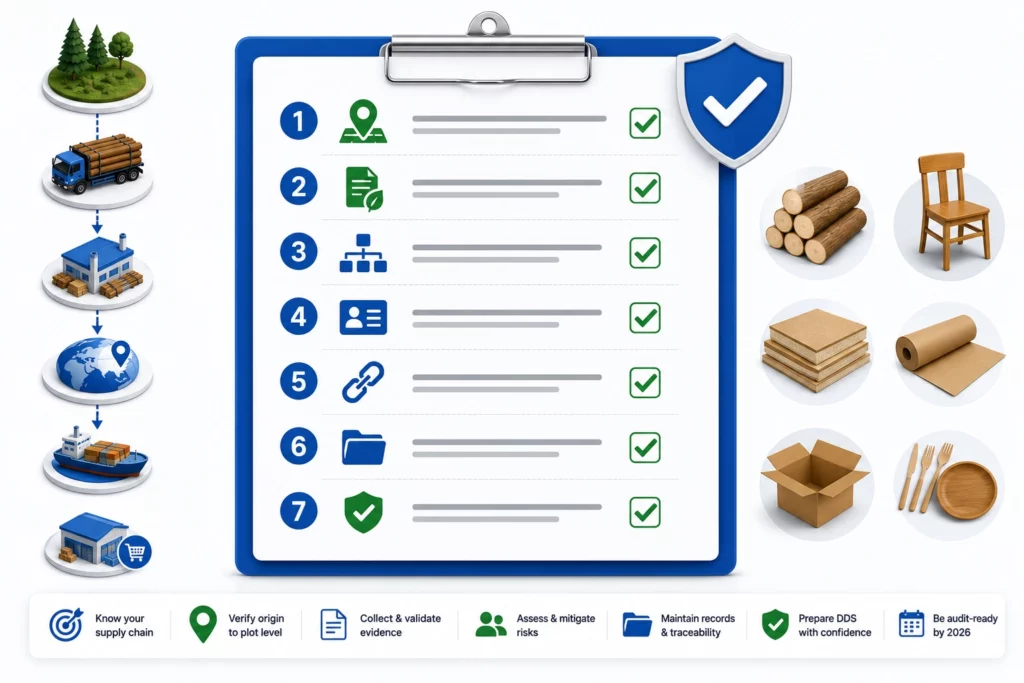
Have we mapped every product line back to origin forest plots?
Do we hold valid geolocation (polygons where required) for all current sourcing?
Can suppliers submit harvest permits, species data, and legality evidence digitally?
Is our risk assessment documented, repeatable, and refreshed on a schedule?
Can we generate a complete DDS data package per consignment without manual rework?
Do we know which SKUs contain mixed, recycled, or composite inputs and their evidence status?
Have we tested our audit trail: can we evidence any batch within one working day?
Frequently Asked Questions (FAQ’s)
What are the biggest EUDR wood challenges for timber companies?
The hardest hurdles are plot-level geolocation collection, traceability through material mixing and multiple intermediaries, supplier engagement with smallholders, and building a documented risk assessment and DDS process. Legacy systems that trace only to the sawmill compound all four.
Does FSC certification make my wood products EUDR compliant?
No. FSC certification supports risk mitigation and provides valuable chain-of-custody evidence, but it does not replace the operator’s obligations: plot-level geolocation, documented risk assessment and mitigation, and filing a Due Diligence Statement in the EU Information System.
When do wood companies need to comply with EUDR?
Large and medium operators and traders must comply from 30 December 2026; micro and small enterprises from 30 June 2027.
What geolocation data does EUDR require for wood products?
Operators must provide the geolocation of every plot of land where the timber was harvested. Larger plots require polygon boundaries rather than a single coordinate point. The data must be accurate enough to check against deforestation monitoring maps.
How do engineered wood and mixed-fibre products handle EUDR traceability?
Every relevant input stream must be traceable to its origin plots, even when blended. In practice this means capturing origin data per batch at each processing step, and applying fibre-origin logic (virgin, 100% recycled, mixed) to determine scope and evidence requirements for each stream.
What happens if a wood shipment fails EUDR due diligence?
Consequences can include DDS rejection, blocked or delayed consignments at the border, fines of at least 4% of EU-wide annual turnover, product confiscation, and commercially most damaging loss of EU buyers who require demonstrated compliance from their suppliers.
Start using TraceX
Transparency, Trust, & Success for your Climate Journey.
We use cookies on our website to give you the most relevant experience by remembering your preferences and repeat visits. By clicking “Accept All”, you consent to the use of ALL the cookies. However, you may visit "Cookie Settings" to provide a controlled consent.
This website uses cookies to improve your experience while you navigate through the website. Out of these, the cookies that are categorized as necessary are stored on your browser as they are essential for the working of basic functionalities of the website. We also use third-party cookies that help us analyze and understand how you use this website. These cookies will be stored in your browser only with your consent. You also have the option to opt-out of these cookies. But opting out of some of these cookies may affect your browsing experience.
Necessary cookies are absolutely essential for the website to function properly. These cookies ensure basic functionalities and security features of the website, anonymously.
Cookie
Duration
Description
cookielawinfo-checkbox-analytics
11 months
This cookie is set by GDPR Cookie Consent plugin. The cookie is used to store the user consent for the cookies in the category "Analytics".
cookielawinfo-checkbox-functional
11 months
The cookie is set by GDPR cookie consent to record the user consent for the cookies in the category "Functional".
cookielawinfo-checkbox-necessary
11 months
This cookie is set by GDPR Cookie Consent plugin. The cookies is used to store the user consent for the cookies in the category "Necessary".
cookielawinfo-checkbox-others
11 months
This cookie is set by GDPR Cookie Consent plugin. The cookie is used to store the user consent for the cookies in the category "Other.
cookielawinfo-checkbox-performance
11 months
This cookie is set by GDPR Cookie Consent plugin. The cookie is used to store the user consent for the cookies in the category "Performance".
viewed_cookie_policy
11 months
The cookie is set by the GDPR Cookie Consent plugin and is used to store whether or not user has consented to the use of cookies. It does not store any personal data.
Functional cookies help to perform certain functionalities like sharing the content of the website on social media platforms, collect feedbacks, and other third-party features.
Performance cookies are used to understand and analyze the key performance indexes of the website which helps in delivering a better user experience for the visitors.
Analytical cookies are used to understand how visitors interact with the website. These cookies help provide information on metrics the number of visitors, bounce rate, traffic source, etc.
Advertisement cookies are used to provide visitors with relevant ads and marketing campaigns. These cookies track visitors across websites and collect information to provide customized ads.
Download the 2026 Traceability Scorecard and Benchmark Your Supply Chain Across 10 Critical Capabilities.
Download our eBook
Don’t Wait for an Audit to Find Your EUDR Gaps
The 2026 Simplification Package changes how HS codes, DDS pass-through and geolocation rules apply to you. Get the free guide and 20-point readiness checklist before enforcement catches you unprepared.