EUDR Timber Malaysia: How Exporters Can Get Audit-Ready
Published
, 7 minute read
Share this article
Quick summary: EUDR Timber Malaysia rules apply from 30 Dec 2026. See geolocation, legality and MyTLAS gaps, plus a buyer checklist to keep EU timber orders moving.
EUDR timber Malaysia compliance means every consignment of Malaysian wood sold into the EU must trace back to geolocated harvest plots, be free of deforestation and forest degradation after 31 December 2020, and be legally produced under Malaysian law. The EU importer files the Due Diligence Statement, but Malaysian exporters must supply the evidence. Obligations apply from 30 December 2026.
Key takeaways
30 December 2026 applies to large and medium operators and to micro and small operators already under the EU Timber Regulation, so most timber buyers get no mid-2027 grace period.
Malaysia is classified standard risk: full due diligence, no simplified route.
MyTLAS and MTCS (PEFC) certification supports risk mitigation but does not replace plot geolocation or the Due Diligence Statement.
Conversion of natural forest to plantation forest after the cut-off counts as forest degradation and disqualifies the timber.
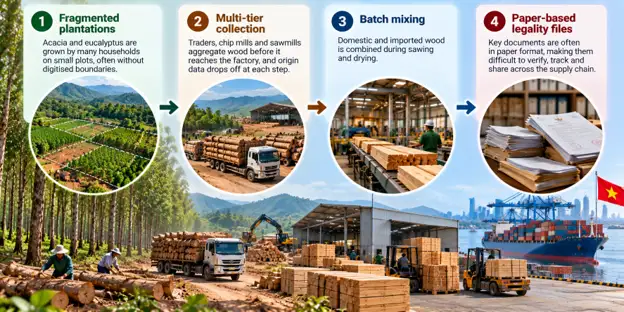
One unmapped input in a mixed batch makes the whole product non-compliant.
What Is EUDR Timber Malaysia Compliance?
The plain-language definition, and who carries which obligation.
What the regulation covers for Malaysian wood
Who files the Due Diligence Statement
What exporters must hand over
EUDR timber Malaysia compliance is the evidence Malaysian sawnwood, plywood, veneer, MDF, furniture and pulp exporters must provide so EU buyers can file a valid Due Diligence Statement (DDS) under Regulation (EU) 2023/1115. Timber is one of seven EUDR commodities, alongside cattle, cocoa, coffee, oil palm, rubber and soya.
The legal duty to file sits with the operator placing the product on the EU market, usually the importer. In practice, that duty flows straight back to Malaysia. No geolocation and no legality file means no order.
EUDR Timber Malaysia Deadlines and Risk Status in 2026
The dates, Malaysia’s country classification and the latest scope changes.
Application dates after two postponements
Standard-risk classification and inspection rates
Annex I product changes from July 2026
Discover the key EUDR requirements for timber exporters, from sourcing transparency and geolocation to due diligence and documentation.
EUDR timber deadlines: why timber gets no 2027 grace
Regulation (EU) 2025/2650 set the current dates. Large and medium operators and traders must comply from 30 December 2026. Other micro and small operators have until 30 June 2027, but those already covered by the EU Timber Regulation (EUTR) stay on the December 2026 date. For EUDR timber Malaysia supply chains, that puts almost every EU buyer of Malaysian wood on the same clock, and buyers want supplier data months before their first filing.
EUDR Malaysia risk status: standard, not low
The Commission’s May 2025 benchmarking classified Malaysia as standard risk. That rules out the simplified due diligence available for low-risk origins, and EU competent authorities must check at least 3% of operators sourcing from standard-risk countries each year.
EUDR timber scope: re-check your HS codes
A delegated act adopted on 13 July 2026 amended Annex I, removing items such as aircraft and motor vehicle seats under HS 9401 because their wood content is minimal. Logs, sawnwood, panels, wooden furniture and pulp remain in scope. Re-run your HS code mapping rather than relying on last year’s list.
EUDR Timber Malaysia Requirements for Exporters
The evidence layers every consignment needs before it ships.
Plot-level geolocation for concessions and plantations
Deforestation and forest degradation screening
Legality evidence per state jurisdiction
Segregated chain of custody
EUDR timber geolocation for Malaysian concessions
Every plot where the timber was harvested must be geolocated to six decimal places, with polygons for plots above four hectares. For EUDR timber Malaysia files, that means forest management unit, concession or plantation boundaries, not a district name or a mill address.
EUDR deforestation and forest degradation checks
Timber faces a test most commodities do not: forest degradation. Wood from land converted from primary or naturally regenerating forest to plantation forest after 31 December 2020 fails the EUDR, even if the harvest was licensed. For EUDR timber Malaysia shipments that blend natural forest and plantation wood, this is the biggest technical risk.
EUDR legality evidence across Malaysia’s three jurisdictions
Forestry is a state matter, so Peninsular Malaysia, Sabah and Sarawak each run their own legality assurance arrangements. A complete EUDR timber Malaysia legality file covers harvest rights, land tenure, environmental and labour law, tax, and trade and customs records for each source.
EUDR chain of custody: no mixing
The EUDR has no mass-balance option. If a sawmill or plywood plant cannot link its output to geolocated inputs, the entire batch is non-compliant.
Discover how Malaysian wood exporters can navigate EUDR requirements, verify timber origins, and prepare the documentation needed for EU market access.
Read the blog to understand the requirements and prepare your export supply chain for EUDR compliance.
EUDR Timber Malaysia and MyTLAS: What Certification Covers
How national schemes help, and where they stop.
MyTLAS-EUDR and the MyTLAS Plus upgrade
MTCS and PEFC chain of custody
The limits of certification under the EUDR
Malaysia has a head start. MTIB began MyTLAS-EUDR trial runs in September 2025 and reported issuing about 150 MyTLAS-EUDR certificates for EU shipments, which it says were accepted. It is now upgrading the scheme as MyTLAS Plus, adding geolocation, scientific species names and ESG elements. The MTCS, endorsed by PEFC, adds sustainable forest management and chain-of-custody assurance.
Certification supports EUDR timber Malaysia risk mitigation. It never replaces the Due Diligence Statement, plot-level geolocation or verifiable evidence. EU operators can use these schemes as risk-assessment inputs, but the underlying coordinates and documents must still sit in the file.
How TraceX supports Malaysian timber exporters
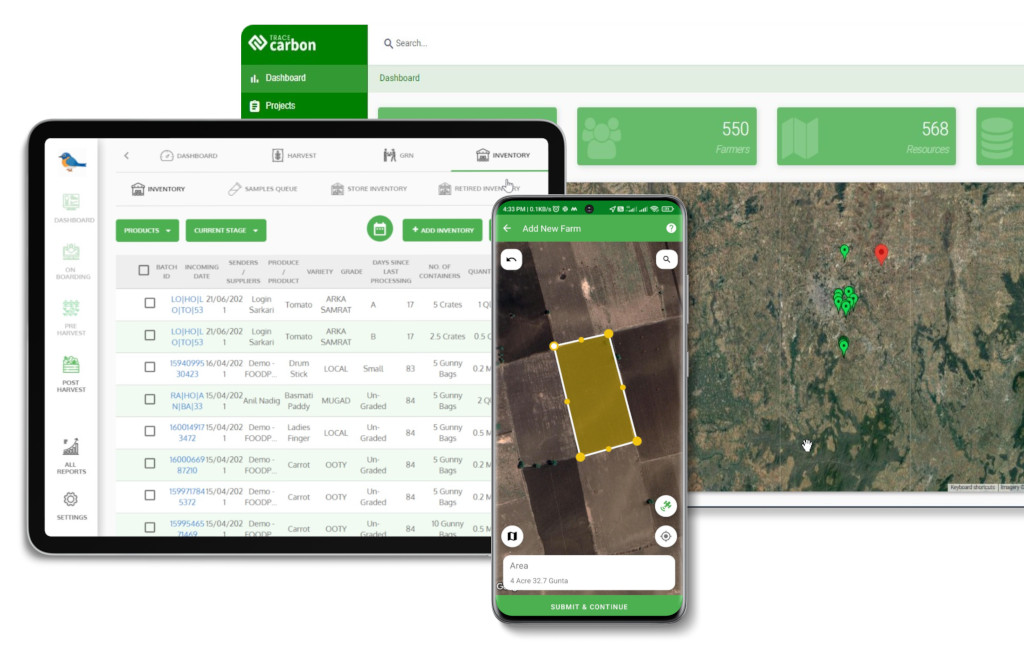
TraceX EUDR Solutions captures concession and plantation polygons in GeoJSON, screens each plot against satellite forest-cover baselines for the 31 December 2020 cut-off, maps MyTLAS, MTCS and permit documents to every consignment and generates DDS-ready data packages for each EU buyer. The result: one auditable EUDR timber Malaysia record per shipment instead of scattered spreadsheets.
Move from spreadsheets and fragmented supplier data to a traceable, audit-ready EUDR workflow with TraceX.
EUDR Timber Malaysia Compliance: Manual Process vs Platform
Where spreadsheet workflows break under EUDR load.
Six workflow stages compared
Audit-response speed
For exporters supplying several EU buyers from multiple states, this comparison shows where manual EUDR timber Malaysia workflows fail first.
Workflow stage
Manual process
TraceX
Plot geolocation
GPS points in spreadsheets, inconsistent formats
Polygon capture and GeoJSON validation
Deforestation and degradation screening
Ad hoc map checks per concession
Automated satellite screening against the 2020 cut-off
Legality evidence
PDFs in email threads
Documents linked to each plot and batch
Batch traceability
Mill records disconnected from source plots
Input-to-output batch linking
Buyer data requests
Weeks of rework per buyer
DDS-ready packages per buyer
Audit response
File rebuilt under pressure
Shipment file retrievable on demand
EUDR Timber Malaysia Buyer Evaluation Checklist
Questions to ask before choosing a compliance platform.
Data, screening, legality and integration criteria
Use this list when evaluating software for EUDR timber Malaysia compliance:
Does it capture and validate polygons to six decimal places for concessions and plantations?
Does it screen for forest degradation, not only deforestation?
Can it hold legality evidence for Peninsular Malaysia, Sabah and Sarawak separately?
Does it link mill output batches to geolocated inputs?
Can it export data in the format your EU buyers submit to the EUDR Information System?
Does it integrate with your ERP and MyTLAS documentation?
Frequently Asked Questions
Do Malaysian timber exporters file the Due Diligence Statement?
Usually not. The operator placing the product on the EU market files it. Exporters supply the geolocation, legality and risk evidence that makes the filing possible.
Does MTCS or PEFC certification make timber EUDR compliant?
No. Certification supports risk assessment and mitigation, but the DDS still needs plot geolocation and verifiable evidence for each consignment.
When does the EUDR apply to Malaysian timber?
EUDR timber Malaysia obligations start on 30 December 2026 for large and medium operators and for micro and small operators already under the EUTR. Other micro and small operators follow on 30 June 2027.
Is Malaysia high risk under the EUDR?
No. Malaysia is classified standard risk, so full due diligence applies and EU authorities check at least 3% of operators sourcing from it.
Is wooden furniture covered?
Yes. Wooden furniture stays in Annex I, although aircraft and motor vehicle seats were removed in July 2026.
Start using TraceX
Transparency, Trust, & Success for your Climate Journey.
We use cookies on our website to give you the most relevant experience by remembering your preferences and repeat visits. By clicking “Accept All”, you consent to the use of ALL the cookies. However, you may visit "Cookie Settings" to provide a controlled consent.
This website uses cookies to improve your experience while you navigate through the website. Out of these, the cookies that are categorized as necessary are stored on your browser as they are essential for the working of basic functionalities of the website. We also use third-party cookies that help us analyze and understand how you use this website. These cookies will be stored in your browser only with your consent. You also have the option to opt-out of these cookies. But opting out of some of these cookies may affect your browsing experience.
Necessary cookies are absolutely essential for the website to function properly. These cookies ensure basic functionalities and security features of the website, anonymously.
Cookie
Duration
Description
cookielawinfo-checkbox-analytics
11 months
This cookie is set by GDPR Cookie Consent plugin. The cookie is used to store the user consent for the cookies in the category "Analytics".
cookielawinfo-checkbox-functional
11 months
The cookie is set by GDPR cookie consent to record the user consent for the cookies in the category "Functional".
cookielawinfo-checkbox-necessary
11 months
This cookie is set by GDPR Cookie Consent plugin. The cookies is used to store the user consent for the cookies in the category "Necessary".
cookielawinfo-checkbox-others
11 months
This cookie is set by GDPR Cookie Consent plugin. The cookie is used to store the user consent for the cookies in the category "Other.
cookielawinfo-checkbox-performance
11 months
This cookie is set by GDPR Cookie Consent plugin. The cookie is used to store the user consent for the cookies in the category "Performance".
viewed_cookie_policy
11 months
The cookie is set by the GDPR Cookie Consent plugin and is used to store whether or not user has consented to the use of cookies. It does not store any personal data.
Functional cookies help to perform certain functionalities like sharing the content of the website on social media platforms, collect feedbacks, and other third-party features.
Performance cookies are used to understand and analyze the key performance indexes of the website which helps in delivering a better user experience for the visitors.
Analytical cookies are used to understand how visitors interact with the website. These cookies help provide information on metrics the number of visitors, bounce rate, traffic source, etc.
Advertisement cookies are used to provide visitors with relevant ads and marketing campaigns. These cookies track visitors across websites and collect information to provide customized ads.
Download the 2026 Traceability Scorecard and Benchmark Your Supply Chain Across 10 Critical Capabilities.
Download our eBook
Don’t Wait for an Audit to Find Your EUDR Gaps
The 2026 Simplification Package changes how HS codes, DDS pass-through and geolocation rules apply to you. Get the free guide and 20-point readiness checklist before enforcement catches you unprepared.