EUDR Supplier Challenges: 5 Data Gaps That Block Your DDS
Published
, 7 minute read
Share this article
Quick summary: EUDR supplier challenges explained: the 5 supplier data gaps that block your DDS, what they cost, and how to close them before 30 Dec 2026.
EUDR supplier challenges are the gaps between what the EU Deforestation Regulation requires and what suppliers can provide: plot-level geolocation, legality evidence, batch traceability and named accountability. From 30 December 2026 (30 June 2027 for micro and small operators), a product without that evidence cannot be covered by a valid due diligence statement (DDS) or placed on the EU market.
In plain terms, EUDR supplier data is the evidence trail showing where a commodity was grown, that it was grown legally, and that no forest was cleared for it after 31 December 2020.
Key Takeaways
Geolocation is the first blocker: polygons for plots above four hectares, points for smaller plots.
Certificates support risk assessment but never replace plot-level data and legality evidence.
The operator that first places goods on the EU market, or exports them, files the DDS; downstream parties keep the reference number.
Most EUDR supplier challenges are collection problems, so the fix is mobile, multilingual, offline-capable tooling.
Download our eBook to assess your EUDR readiness, uncover data gaps, and take proactive steps towards stronger compliance.
EUDR Supplier Challenges Start With What the Regulation Requires
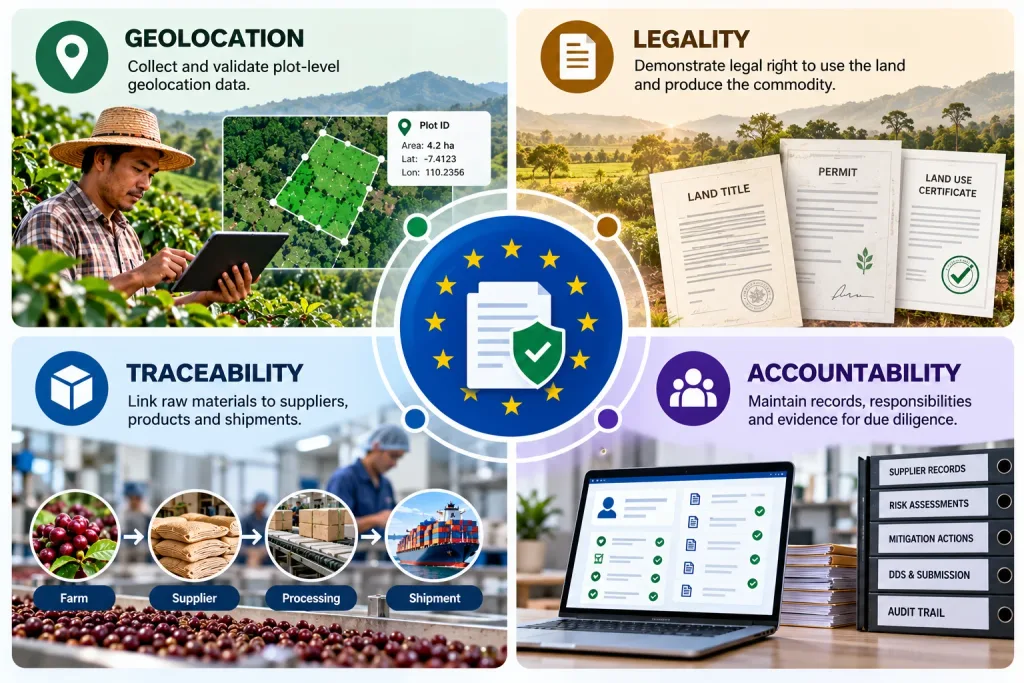
Four categories of supplier data decide whether your due diligence holds up.
EUDR supplier challenges begin with a mismatch. Most supplier pipelines were built for invoices and certificates, while the regulation asks for evidence at plot level. Under Regulation (EU) 2025/2650, the operator that first places a product on the EU market, or exports it, submits the DDS. Downstream operators and traders no longer file their own; they keep the reference number of the DDS above them. Either way, the data starts at the farm.
Geolocation. Coordinates in GeoJSON for every plot: a polygon for plots above four hectares, a point for smaller ones. Village or district names do not qualify. See our guide to EUDR geolocation requirements.
Legality evidence. Land use rights, permits and, where relevant, community consent, kept on file for risk assessment and authority checks. Read the EUDR legality requirements.
Traceability records. Which farmer grew it, which aggregator collected it, and which batch it joined.
Supplier accountability. Contact details for verification and a signed declaration for every supplier in the chain.
Even FSC or RSPO certified suppliers must provide plot-specific data.Certifications under EUDRsupport risk assessment, but they do not solve EUDR supplier challenges on their own.
EUDR Supplier Challenges in Practice: The 5 Data Gaps That Block a DDS
The same five gaps appear across agri-exporters, importers and food brands.
Imprecise geolocation data
Incomplete legality evidence
Hidden aggregators and subcontractors
Reluctance to share sensitive records
Manual and offline collection
EUDR Supplier Challenge 1: Imprecise Geolocation Data
Suppliers send PDFs, screenshots or village names instead of GeoJSON. Polygons overlap, self-intersect or land in water. Until a plot can be checked against post-2020 forest cover, the requirement is not met. It is the most frequent of the EUDR supplier challenges, so review the common GeoJSON file errors.
Many suppliers do not know which documents qualify, or hesitate to share land and consent records. The operator then holds coordinates without proof of legal production and cannot conclude that risk is negligible.
EUDR Supplier Challenge 3: Hidden Aggregators and Subcontractors
Data often stops at the first supplier. When an aggregator mixes crops or a subcontractor was never onboarded, the chain from plot to batch breaks and the operator carries the gap. These EUDR supplier challenges stay hidden until filing; see chain of custody under EUDR.
EUDR Supplier Challenge 4: Reluctance to Share Sensitive Records
Consent and tenure documents feel risky to hand over. Suppliers who do not understand why the records are needed, or how they are protected, delay or refuse. Clear supplier engagement for EUDR due diligence removes most of that resistance.
EUDR Supplier Challenge 5: Manual and Offline Collection
Paper forms and WhatsApp photos produce inconsistent data, missed harvest dates and late GPS uploads. One slow upload can push a filing past the shipping window. See EUDR data from smallholder producers.
Read our blog on EUDR Supplier Risk Assessmentto discover practical ways to evaluate supplier risks, prioritise corrective actions and build a more transparent, traceable supply chain.
EUDR Supplier Challenges Carry a Real Commercial Cost
Unresolved EUDR supplier challenges fail at the point of filing, then again at the buyer’s desk.
Blocked filing. Without valid geolocation, the operator cannot complete a DDS, so the product cannot be placed on the EU market or exported.
Enforcement. Competent authorities can check, and Article 25 requires Member States to set maximum fines of at least 4% of annual EU turnover, alongside confiscation of the goods. See EUDR penalties and fines.
Lost buyers. EU operators defending their own due diligence may shift volume to suppliers whose data they can trust.
Solving EUDR Supplier Challenges: Manual Tracking vs a Compliance Platform
Spreadsheets and email can store supplier data, but they cannot resolve EUDR supplier challenges at scale.
Supplier task
Manual tracking
Compliance platform
Plot geolocation
PDFs, screenshots, typed coordinates
Mobile capture, exported as GeoJSON
Legality documents
Scattered across inboxes and drives
Uploaded at source, stored per plot
Aggregator visibility
Known only at first-supplier level
Plot, aggregator and batch linked in one chain
Validation
Checked by hand before filing
Missing fields and file errors flagged
Supplier onboarding
Email chains in one language
Invite, bulk upload or mobile link, in local languages
Missed Our Webinar on EUDR Beyond DDS? Catch the Recording!
Watch the webinar recording to understand what lies beyond DDS filing and how to strengthen your EUDR compliance workflow.
TraceX EUDR Solutions is built around these EUDR supplier challenges. Teams invite suppliers, collect data in the field and fix problems before filing.
A tire manufacturer used this approach to digitize rubber sourcing and map supplier plots: read the case study.
Product point of view
Collects supplier data at source through mobile, multilingual onboarding with no app install required.
Captures plot points and polygons offline and validates GeoJSON before filing.
Extracts land tenure and certification details from supplier documents using agentic AI.
Handles consent and land records under ISO 27001-certified security controls.
EUDR Supplier Data Checklist: What to Look for in a Platform
Use these six checks to test any tool against your EUDR supplier challenges, or to compare supplier data management for EUDR options.
Captures plot points and polygons offline on a basic phone
Validates GeoJSON for overlaps, self-intersections and water
Stores legality documents per plot, with expiry alerts
Links plot, aggregator and batch in one chain
Onboards suppliers by invite, bulk upload or mobile link, in local languages
Exports audit-ready records for five-year retention
Frequently Asked Questions (FAQ’s)
EUDR Supplier Challenges: Which Data Gaps Matter Most?
The data gaps that matter most are missing plot-level geolocation, incomplete legality evidence, hidden aggregators, reluctance to share sensitive records and manual collection. Geolocation comes first: a DDS cannot be completed without it.
EUDR Supplier Data: Who Files the DDS?
DDS is filed by the operator that first places the product on the EU market, or exports it from the EU. Downstream operators and traders retain the reference number instead.
EUDR Supplier Data: What If a Supplier Will Not Share Geolocation?
If a supplier does not share geolocation, you cannot complete a valid DDS for that product, so it cannot be placed on the EU market. Onboard the supplier into a collection tool or source elsewhere.
EUDR Supplier Certification: Is It Enough?
No, EUDR supplier certification Is not enough. Certification supports risk assessment, but you still need plot-level geolocation, legality evidence and traceability records.
Start using TraceX
Transparency, Trust, & Success for your Climate Journey.
We use cookies on our website to give you the most relevant experience by remembering your preferences and repeat visits. By clicking “Accept All”, you consent to the use of ALL the cookies. However, you may visit "Cookie Settings" to provide a controlled consent.
This website uses cookies to improve your experience while you navigate through the website. Out of these, the cookies that are categorized as necessary are stored on your browser as they are essential for the working of basic functionalities of the website. We also use third-party cookies that help us analyze and understand how you use this website. These cookies will be stored in your browser only with your consent. You also have the option to opt-out of these cookies. But opting out of some of these cookies may affect your browsing experience.
Necessary cookies are absolutely essential for the website to function properly. These cookies ensure basic functionalities and security features of the website, anonymously.
Cookie
Duration
Description
cookielawinfo-checkbox-analytics
11 months
This cookie is set by GDPR Cookie Consent plugin. The cookie is used to store the user consent for the cookies in the category "Analytics".
cookielawinfo-checkbox-functional
11 months
The cookie is set by GDPR cookie consent to record the user consent for the cookies in the category "Functional".
cookielawinfo-checkbox-necessary
11 months
This cookie is set by GDPR Cookie Consent plugin. The cookies is used to store the user consent for the cookies in the category "Necessary".
cookielawinfo-checkbox-others
11 months
This cookie is set by GDPR Cookie Consent plugin. The cookie is used to store the user consent for the cookies in the category "Other.
cookielawinfo-checkbox-performance
11 months
This cookie is set by GDPR Cookie Consent plugin. The cookie is used to store the user consent for the cookies in the category "Performance".
viewed_cookie_policy
11 months
The cookie is set by the GDPR Cookie Consent plugin and is used to store whether or not user has consented to the use of cookies. It does not store any personal data.
Functional cookies help to perform certain functionalities like sharing the content of the website on social media platforms, collect feedbacks, and other third-party features.
Performance cookies are used to understand and analyze the key performance indexes of the website which helps in delivering a better user experience for the visitors.
Analytical cookies are used to understand how visitors interact with the website. These cookies help provide information on metrics the number of visitors, bounce rate, traffic source, etc.
Advertisement cookies are used to provide visitors with relevant ads and marketing campaigns. These cookies track visitors across websites and collect information to provide customized ads.
Download the 2026 Traceability Scorecard and Benchmark Your Supply Chain Across 10 Critical Capabilities.
Download our eBook
Don’t Wait for an Audit to Find Your EUDR Gaps
The 2026 Simplification Package changes how HS codes, DDS pass-through and geolocation rules apply to you. Get the free guide and 20-point readiness checklist before enforcement catches you unprepared.