EUDR Rubber Compliance in Vietnam: What Exporters Must Prove
Published
, 7 minute read
Share this article
Quick summary: EUDR rubber compliance in Vietnam applies from 30 Dec 2026. See what low-risk status means, how to map smallholder plots and trace imported rubber.
EUDR rubber compliance in Vietnam means proving that natural rubber and rubber products shipped to the EU come from land not deforested after 31 December 2020, were produced legally under Vietnamese law, and trace back to plot-level geolocation. Vietnam is classified low risk, so EU importers can use simplified due diligence, but geolocation data and a Due Diligence Statement (DDS) are still required from 30 December 2026.
Key takeaways
Large and medium EU operators apply the EUDR from 30 December 2026; most micro and small operators from 30 June 2027.
Vietnam’s low-risk benchmark removes the mandatory risk assessment step, not the geolocation requirement.
Smallholders supply about 63% of Vietnam’s rubber raw material, the weakest traceability link.
Rubber imported from Cambodia and Laos for processing can trigger full due diligence if its origin is unclear.
Certifications such as VFCS/PEFC help, but never replace plot-level evidence and the DDS.
December 2026 is approaching. Is your supply chain actually ready?
Move from spreadsheets and fragmented supplier data to a traceable, audit-ready EUDR workflow with TraceX.
EUDR Rubber Compliance in Vietnam: What It Means for Exporters
Every rubber shipment entering the EU must meet three conditions.
Deforestation-free: no deforestation on the source plot after 31 December 2020.
Legal: produced under relevant Vietnamese law, including land use rights, environmental, labour, tax and anti-corruption rules.
Declared: covered by a DDS filed in the EU Information System.
In plain terms, EUDR rubber compliance in Vietnam is the evidence trail that lets an EU buyer legally place your rubber on the market. It covers natural rubber and derived products listed in Annex I, such as compounded rubber, tyres, gloves and other vulcanised rubber articles. Synthetic rubber is outside scope.
Who files the DDS? The EU importer or manufacturer that first places the product on the EU market. Vietnamese processors and exporters supply the geolocation and legality data that statement relies on, which makes data quality a commercial issue for every supplier.
Understand the key EUDR requirements for Vietnamese rubber exporters, from plot-level geolocation and deforestation checks to due diligence and traceability. Read the Guide →
EUDR Rubber Compliance in Vietnam Deadlines and Risk Status
Two facts shape your timeline: the application date and Vietnam’s benchmark.
Application dates are now fixed and confirmed.
Low-risk status changes the depth of due diligence, not the data required.
EUDR Rubber Deadlines for 2026 and 2027
After two postponements, Regulation (EU) 2025/2650 set 30 December 2026 for large and medium operators and 30 June 2027 for most micro and small operators. The Commission’s 4 May 2026 simplification review confirmed there will be no further delay. In practice, EU buyers will want verified supplier data in their systems weeks before the first post-December shipment, so the real deadline for EUDR rubber compliance in Vietnam is earlier.
Vietnam’s Low-Risk Classification for Rubber
In the Commission’s May 2025 benchmarking, Vietnam was classified low risk. EU operators sourcing from low-risk countries still collect information, including geolocation, and still file a DDS, but they do not have to run the full risk assessment and mitigation steps unless they find signs of non-compliance or circumvention. Authorities check at least 1% of operators sourcing from low-risk countries, against 3% for standard and 9% for high risk.
Low risk lowers the paperwork, not the proof. EUDR rubber compliance in Vietnam still depends on coordinates for every plot that supplies latex.
The first review of the benchmarks is scheduled for 2026, so treat the low-risk label as current, not permanent.
Is Your Country EUDR Low, Standard or High Risk?
Understand how EUDR country risk classification affects due diligence, risk assessment and compliance requirements for your supply chain. Check the Latest Classification →
EUDR Rubber Compliance in Vietnam: Three Supply Chain Gaps
Most failures in EUDR rubber compliance in Vietnam trace back to three structural gaps.
Smallholder plots without digital maps.
Imported rubber mixed into domestic processing.
Land tenure and legality records that do not reach the exporter.
Rubber Smallholder Plots and Collection Agents
Smallholders hold about 54% of Vietnam’s rubber planted area and supply about 63% of raw material. Collection agents buy from farmers and from other agents, so origin is lost within one or two transactions. Under the EUDR, plots above four hectares need a polygon; smaller plots can use a single GPS point. Closing this gap is the biggest single step toward EUDR rubber compliance in Vietnam.
Rubber Imported from Cambodia and Laos
Vietnamese processors also handle natural rubber imported mainly from Cambodia and, to a lesser extent, Laos. Once that supply is mixed with domestic latex, an exporter cannot show which plot produced which bale. Mixing with product of unknown origin is exactly the risk that pushes an EU buyer out of simplified due diligence. For EUDR rubber compliance in Vietnam, segregate or map imported supply before it reaches the factory.
Rubber Land Tenure and Legality Evidence
Legality means land use right certificates, conversion history for older plantations, and labour and tax records. Vietnam Rubber Group reported that about 80% of its domestic area held VFCS/PEFC forest management certification in 2025. Certification supports risk mitigation, but it never replaces plot-level geolocation, legality documents or the DDS.
EUDR Rubber Compliance in Vietnam in Five Steps
A repeatable workflow keeps every shipment DDS-ready.
Map every supplying plot: register smallholders through collection agents and capture a GPS point or polygon for each plot.
Verify deforestation-free status: check each plot against satellite data for the 31 December 2020 cut-off.
Collect legality documents: link land use rights and supplier records to each plot.
Control imported rubber: segregate it, or run full risk assessment where origin sits outside Vietnam or is unknown.
Package data per shipment: send your EU buyer DDS-ready geolocation and evidence, and keep records for five years.
Exporters who run EUDR rubber compliance in Vietnam this way answer buyer questionnaires in hours, not weeks, and avoid shipments held at EU borders.
How TraceX supports EUDR rubber compliance in Vietnam
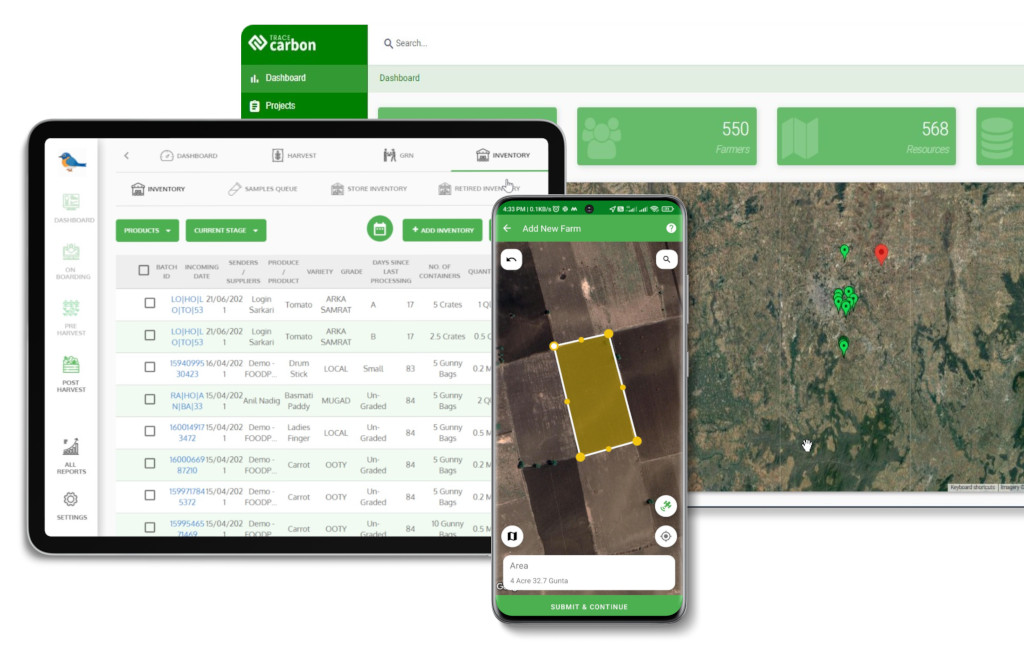
TraceX EUDR Solutions is built for smallholder-heavy supply chains like Vietnamese rubber:
Offline mobile plot mapping for field teams and collection agents, with Vietnamese-language interfaces
Satellite deforestation checks validated against JRC and Hansen datasets
Agentic AI that extracts land tenure and certification data from supplier documents
Batch-level traceability that flags imported or mixed-origin rubber
DDS-ready exports and TRACES-ready API submission for EU buyers
See how Vietnamese rubber suppliers map plots and deliver DDS-ready data to EU buyers.
EUDR Rubber Compliance in Vietnam: Manual vs Platform
Task
Manual approach
With TraceX
Plot mapping
Paper forms, handheld GPS, re-keyed data
Offline app capture synced to one database
Deforestation check
Ad hoc map reviews
Automated satellite screening per plot
Imported rubber
Mixed in stock, origin lost
Batch segregation and origin flags
Legality documents
Email folders per supplier
AI-parsed documents linked to plots
DDS data for EU buyer
Days to compile per shipment
DDS-ready export per shipment
Five-year record keeping
Scattered files
Audit-ready archive
EUDR Rubber Compliance in Vietnam Buyer Checklist
Use these questions to evaluate any platform for EUDR rubber compliance in Vietnam.
Does it capture GPS points and polygons offline, in Vietnamese?
Does it screen plots against the 31 December 2020 baseline?
Can it trace batches from plot to bale, including imported rubber?
Does it export geolocation in a format the EU Information System accepts?
Does it store legality documents per plot for five years?
Does it integrate with your ERP and buyer portals?
A platform that passes all six gives EU buyers confidence that EUDR rubber compliance in Vietnam is handled before goods leave port.
Frequently Asked Questions
Is Vietnamese rubber low risk under the EUDR?
Yes. Vietnam was classified low risk in the May 2025 benchmarking. Geolocation and a DDS are still required, and the classification can change in the 2026 review.
Do Vietnamese exporters submit the DDS?
No. The EU operator first placing the product on the market files it. Exporters provide the data behind it.
Is synthetic rubber covered?
No. The EUDR covers natural rubber and derived products listed in Annex I.
Is VFCS or PEFC certification enough?
No. Certification helps, but EUDR rubber compliance in Vietnam still needs plot geolocation and legality evidence.
What happens if a shipment fails?
Member States can confiscate goods, impose fines of up to at least 4% of EU annual turnover, and exclude operators from public contracts.
Start using TraceX
Transparency, Trust, & Success for your Climate Journey.
We use cookies on our website to give you the most relevant experience by remembering your preferences and repeat visits. By clicking “Accept All”, you consent to the use of ALL the cookies. However, you may visit "Cookie Settings" to provide a controlled consent.
This website uses cookies to improve your experience while you navigate through the website. Out of these, the cookies that are categorized as necessary are stored on your browser as they are essential for the working of basic functionalities of the website. We also use third-party cookies that help us analyze and understand how you use this website. These cookies will be stored in your browser only with your consent. You also have the option to opt-out of these cookies. But opting out of some of these cookies may affect your browsing experience.
Necessary cookies are absolutely essential for the website to function properly. These cookies ensure basic functionalities and security features of the website, anonymously.
Cookie
Duration
Description
cookielawinfo-checkbox-analytics
11 months
This cookie is set by GDPR Cookie Consent plugin. The cookie is used to store the user consent for the cookies in the category "Analytics".
cookielawinfo-checkbox-functional
11 months
The cookie is set by GDPR cookie consent to record the user consent for the cookies in the category "Functional".
cookielawinfo-checkbox-necessary
11 months
This cookie is set by GDPR Cookie Consent plugin. The cookies is used to store the user consent for the cookies in the category "Necessary".
cookielawinfo-checkbox-others
11 months
This cookie is set by GDPR Cookie Consent plugin. The cookie is used to store the user consent for the cookies in the category "Other.
cookielawinfo-checkbox-performance
11 months
This cookie is set by GDPR Cookie Consent plugin. The cookie is used to store the user consent for the cookies in the category "Performance".
viewed_cookie_policy
11 months
The cookie is set by the GDPR Cookie Consent plugin and is used to store whether or not user has consented to the use of cookies. It does not store any personal data.
Functional cookies help to perform certain functionalities like sharing the content of the website on social media platforms, collect feedbacks, and other third-party features.
Performance cookies are used to understand and analyze the key performance indexes of the website which helps in delivering a better user experience for the visitors.
Analytical cookies are used to understand how visitors interact with the website. These cookies help provide information on metrics the number of visitors, bounce rate, traffic source, etc.
Advertisement cookies are used to provide visitors with relevant ads and marketing campaigns. These cookies track visitors across websites and collect information to provide customized ads.
Download the 2026 Traceability Scorecard and Benchmark Your Supply Chain Across 10 Critical Capabilities.
Download our eBook
Don’t Wait for an Audit to Find Your EUDR Gaps
The 2026 Simplification Package changes how HS codes, DDS pass-through and geolocation rules apply to you. Get the free guide and 20-point readiness checklist before enforcement catches you unprepared.