EUDR Rubber Compliance in Thailand: What Exporters Must Prove
Published
, 7 minute read
Share this article
Quick summary: EUDR Rubber Compliance in Thailand explained: low-risk status, plot-level geolocation, smallholder gaps and a 5-step workflow to protect EU market access.
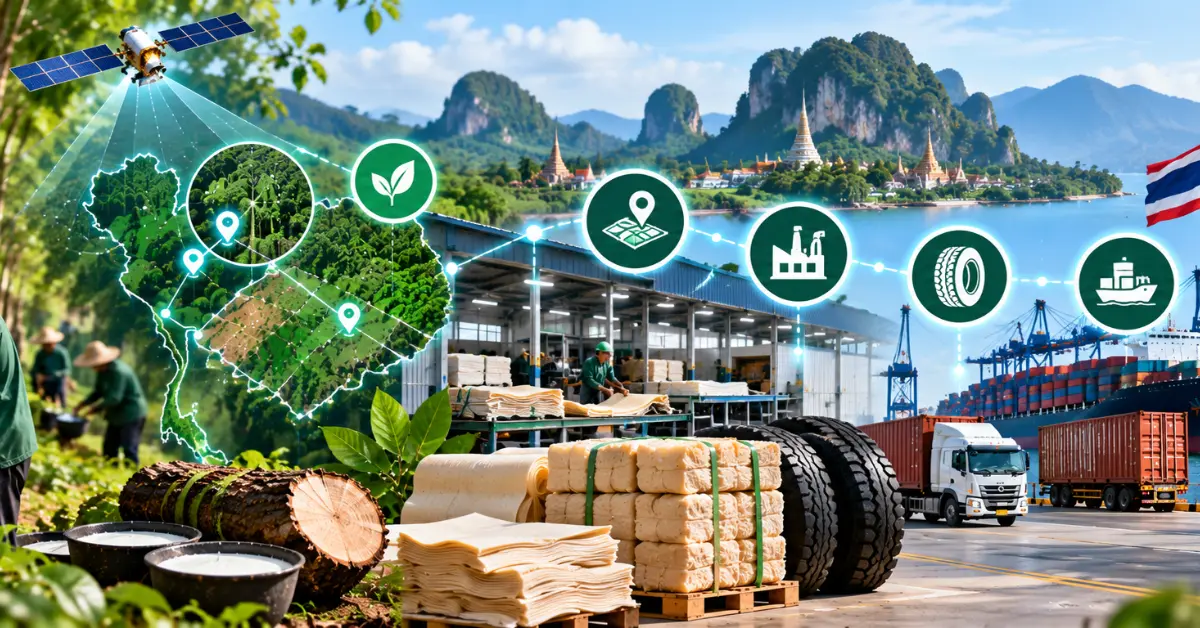
EUDR Rubber Compliance in Thailand means proving that every rubber shipment bound for the EU came from plots not deforested after 31 December 2020, was produced legally, and can be traced to plot-level geolocation. The EU operator that first places the rubber on the market files the Due Diligence Statement (DDS), but it relies on Thai exporters for the evidence. Large and medium operators must comply from 30 December 2026.
Key takeaways
Thailand is classified low risk, which simplifies due diligence but does not remove geolocation or the DDS.
Smallholders manage most Thai rubber area, so plot data is the main bottleneck.
Plots above four hectares need polygons. Smaller plots can use a single point.
Certifications support the evidence but never replace it.
December 2026 is approaching. Is your supply chain actually ready?
Move from spreadsheets and fragmented supplier data to a traceable, audit-ready EUDR workflow with TraceX.
EUDR Rubber Compliance in Thailand: What the Regulation Requires
Three conditions decide whether Thai rubber can enter the EU market.
Deforestation-free: no forest conversion on the plot after 31 December 2020.
Legal: produced in line with land use, labour and environmental law.
Covered by a DDS: with geolocation for every plot of origin.
Natural rubber and several derived products are in scope. Thai exporters are rarely the party that files. Under the December 2025 revision, the first operator placing goods on the EU market submits the DDS, so your EU buyer will ask you for geolocation, legality documents and batch records. EUDR Rubber Compliance in Thailand therefore decides whether buyers keep sourcing from you after 30 December 2026 (30 June 2027 for micro and small non-timber operators).
The date is under three months away, and the Commission confirmed in May 2026 that there will be no further postponement. Buyers will need supplier data before then, so exporters without plot-level proof risk losing orders to origins that have it. For EUDR rubber compliance in Thailand, readiness is a sales issue as much as a legal one.
Discover how Thai rubber exporters can manage farmer and plantation data, plot-level geolocation, deforestation risk assessment, supplier traceability, due diligence, and DDS requirements to build transparent, EU-ready rubber supply chains. Read the Full Blog →
EUDR Rubber Compliance in Thailand: Why Low-Risk Status Is Not a Free Pass
Thailand’s rating lightens the paperwork, not the fieldwork.
Listed as low risk in Implementing Regulation (EU) 2025/1093.
Simplified due diligence applies unless there is a substantiated concern.
Authorities check about 1% of low-risk operators, against 3% standard and 9% high.
Low risk lets operators skip the standard risk assessment and mitigation steps. It does not remove the duty to collect plot geolocation, confirm legality and file a DDS for each consignment.
Low risk shortens the risk-assessment step. It does not shorten the data-collection step.
The Commission can revise the country list, so exporters pursuing EUDR Rubber Compliance in Thailand should build plot data now. Treat the rating as a reason to be efficient, not relaxed: a low-risk origin with incomplete plot data still cannot support a DDS. Exporters who treat EUDR rubber compliance in Thailand as a data project, not a paperwork project, will move fastest.
Discover how country-level factors influence EUDR risk assessment, what businesses need to evaluate beyond country risk, and how to combine country information with supplier, geolocation, deforestation, legality, and supply-chain evidence. Read the Full Blog
Thai Rubber Traceability: Where EUDR Compliance Breaks Down
Three structural gaps slow Thai exporters.
Thai rubber is hard to trace because of structure, not intent. A very large number of small plots feed a multi-tier chain, and every handover is a chance to lose the origin record.
Rubber Smallholder Geolocation Gaps
Thailand is the world’s largest natural rubber producer, and smallholders manage around 88% of rubber plantation area. The Rubber Authority of Thailand has mapped roughly 79% of production area, yet about 20% of smallholders lack formal land documents.
Rubber Plot Geolocation: Points Versus Polygons
Plots larger than four hectares need a polygon. Smaller plots can use one coordinate point. Record when and by whom each plot was captured so the data can be verified.
Rubber Batch Mixing at Collection Points
Rubber passes through collectors, cooperatives, processors and compounders. Mixing at any stage breaks the link to the plot. Keep compliant and non-compliant rubber separate and map each batch to its source plots.
Discover how the EUDR impacts rubber producers, exporters, and supply chains, from plot-level geolocation and deforestation checks to supplier due diligence, risk assessment, traceability, and DDS requirements for EU-bound rubber exports. Read the Full Blog →
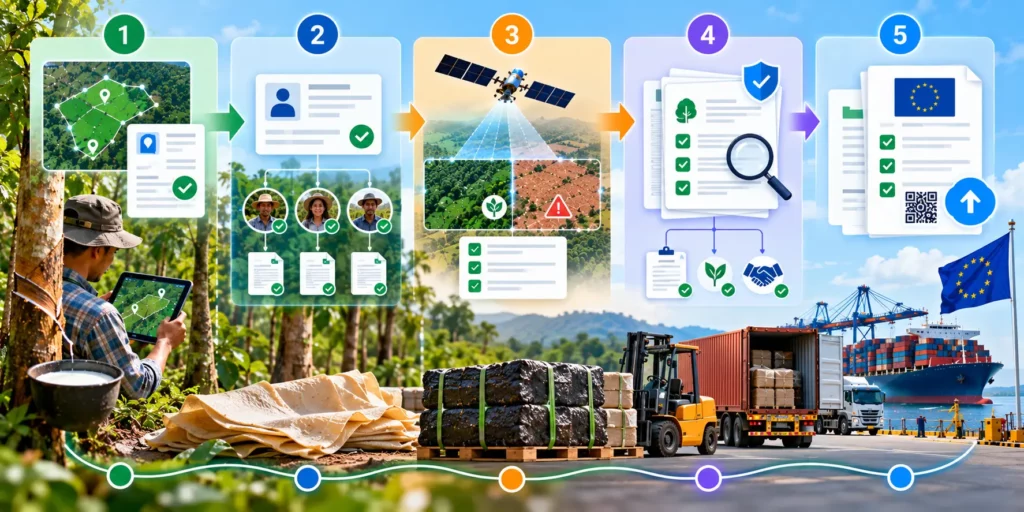
EUDR Rubber Compliance in Thailand: A Five-Step Exporter Workflow
Follow this sequence to be audit-ready before 30 December 2026.
Map your supply base: list every collector, cooperative and farm feeding each plant.
Capture evidence: plot coordinates, land documents and Rubber Authority of Thailand registration.
Screen plots against forest-loss data after 31 December 2020.
Link batches to plots at every handover so origin survives mixing.
Share the package with your EU buyer and keep records for five years.
Start with step one even before you choose software. A clean supplier map shows where your data gaps sit and which collectors supply the most volume. Close gaps at your highest-volume collection points first, because that protects the most shipments. A structured approach to EUDR rubber compliance in Thailand works better than chasing every farm at once.
Certifications such as FSC or PEFC can support this package, but they never replace plot-level geolocation or the DDS.
Thai Rubber Due Diligence: Manual Spreadsheets vs a Traceability Platform
Task
Manual approach
Platform approach
Geolocation capture
Paper forms and spreadsheets each season
Offline mobile capture of points and polygons in local languages
Forest-loss screening
Manual map checks, plot by plot
Automated check against post-2020 satellite data
Batch-to-plot linking
Lot numbers in separate files
Linked records across collectors and processors
DDS evidence
Assembled by hand per buyer
Exportable DDS-ready data package
Audit trail
Scattered files and emails
One time-stamped record per plot
The gap is not in any single task. It is in repeating all five across thousands of plots each season while keeping one consistent record. Spreadsheets break at that scale, and an exporter facing a buyer audit must show where each batch came from within hours, not weeks. A traceability platform for EUDR rubber compliance in Thailand should turn that into a lookup.
For EUDR Rubber Compliance in Thailand, the hard part is onboarding thousands of smallholders, not filing the statement. TraceX EUDR Solutions is built for offline, multilingual smallholder capture and DDS-ready outputs.
Use this list when shortlisting tools for EUDR rubber compliance in Thailand. Ask each vendor to demonstrate the workflow on pooled smallholder rubber, not on a single estate, because estate demos hide the exact problem Thai exporters face.
Captures points and polygons offline, in Thai.
Links pooled rubber to plots across multiple tiers.
Screens plots against post-2020 forest-loss data.
Stores land and legality documents per plot.
Exports evidence your EU buyer can use in its DDS.
Keeps an audit trail for five-year record retention.
Frequently Asked Questions
Is Thai rubber high risk under the EUDR?
No. Thailand is on the low-risk list in Implementing Regulation (EU) 2025/1093, though EUDR rubber compliance in Thailand still requires plot-level data.
Does a Thai exporter file the DDS?
Usually not. The EU operator first placing the rubber on the market files it, using data from the exporter.
Do smallholders need polygons?
Only for plots above four hectares. Smaller plots can use a single point.
Can certifications replace geolocation data?
No. FSC or PEFC certification can support risk mitigation, but it never replaces plot-level geolocation, verifiable evidence or the DDS.
What is the first step toward compliance?
Build a supply-base map. It anchors EUDR rubber compliance in Thailand because it shows where plot data is missing.
When does the EUDR apply to Thai rubber?
From 30 December 2026 for large and medium operators, and 30 June 2027 for micro and small non-timber operators.
Start using TraceX
Transparency, Trust, & Success for your Climate Journey.
We use cookies on our website to give you the most relevant experience by remembering your preferences and repeat visits. By clicking “Accept All”, you consent to the use of ALL the cookies. However, you may visit "Cookie Settings" to provide a controlled consent.
This website uses cookies to improve your experience while you navigate through the website. Out of these, the cookies that are categorized as necessary are stored on your browser as they are essential for the working of basic functionalities of the website. We also use third-party cookies that help us analyze and understand how you use this website. These cookies will be stored in your browser only with your consent. You also have the option to opt-out of these cookies. But opting out of some of these cookies may affect your browsing experience.
Necessary cookies are absolutely essential for the website to function properly. These cookies ensure basic functionalities and security features of the website, anonymously.
Cookie
Duration
Description
cookielawinfo-checkbox-analytics
11 months
This cookie is set by GDPR Cookie Consent plugin. The cookie is used to store the user consent for the cookies in the category "Analytics".
cookielawinfo-checkbox-functional
11 months
The cookie is set by GDPR cookie consent to record the user consent for the cookies in the category "Functional".
cookielawinfo-checkbox-necessary
11 months
This cookie is set by GDPR Cookie Consent plugin. The cookies is used to store the user consent for the cookies in the category "Necessary".
cookielawinfo-checkbox-others
11 months
This cookie is set by GDPR Cookie Consent plugin. The cookie is used to store the user consent for the cookies in the category "Other.
cookielawinfo-checkbox-performance
11 months
This cookie is set by GDPR Cookie Consent plugin. The cookie is used to store the user consent for the cookies in the category "Performance".
viewed_cookie_policy
11 months
The cookie is set by the GDPR Cookie Consent plugin and is used to store whether or not user has consented to the use of cookies. It does not store any personal data.
Functional cookies help to perform certain functionalities like sharing the content of the website on social media platforms, collect feedbacks, and other third-party features.
Performance cookies are used to understand and analyze the key performance indexes of the website which helps in delivering a better user experience for the visitors.
Analytical cookies are used to understand how visitors interact with the website. These cookies help provide information on metrics the number of visitors, bounce rate, traffic source, etc.
Advertisement cookies are used to provide visitors with relevant ads and marketing campaigns. These cookies track visitors across websites and collect information to provide customized ads.
Download the 2026 Traceability Scorecard and Benchmark Your Supply Chain Across 10 Critical Capabilities.
Download our eBook
Don’t Wait for an Audit to Find Your EUDR Gaps
The 2026 Simplification Package changes how HS codes, DDS pass-through and geolocation rules apply to you. Get the free guide and 20-point readiness checklist before enforcement catches you unprepared.