EUDR Compliance in Brazil: What Exporters and EU Importers Must Prove
Published
, 6 minute read
Share this article
Quick summary: EUDR compliance in Brazil starts 30 December 2026. See what soy, coffee, cattle, cocoa and wood exporters must prove, from CAR polygons to DDS-ready data.
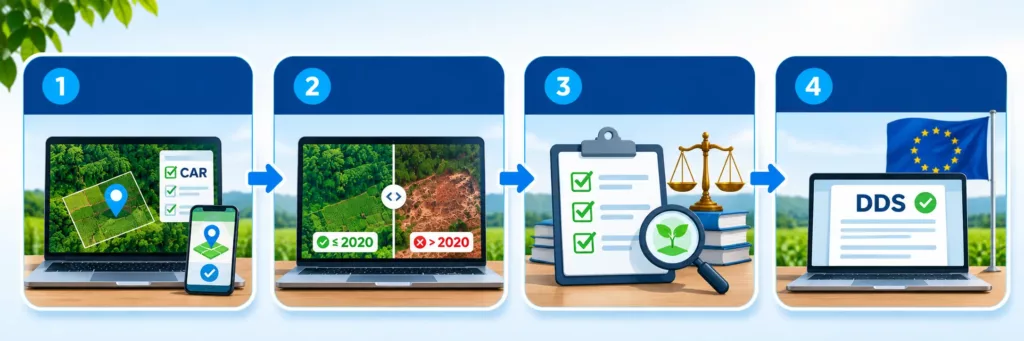
EUDR compliance in Brazil means proving that soy, coffee, cattle, cocoa, wood, rubber and palm oil sold into the EU come from land not deforested after 31 December 2020 and were produced legally under Brazilian law. Obligations apply from 30 December 2026. The EU importer files the due diligence statement (DDS); the Brazilian exporter supplies the plot-level evidence.
EUDR compliance in Brazil is no longer a planning exercise. In May 2026 the European Commission confirmed there will be no third delay, so EU buyers are already deciding which Brazilian suppliers can hand over due diligence data that survives an audit.
EUDR-covered sales are only about 5% of Brazil’s total exports, but they sit in the sectors EU trade depends on: soy, coffee, wood and cattle. In those sectors, EUDR compliance in Brazil decides who keeps the contract.
Key takeaways
Deadlines: 30 December 2026 for large and medium companies; 30 June 2027 for micro and small operators outside timber.
Brazil is standard risk: full due diligence applies, and EU authorities check at least 3% of these operators yearly.
Cut-off is 31 December 2020: clearing that was legal under the Forest Code still fails.
CAR is a starting point, not proof: Rural Environmental Registry boundaries are self-declared.
Scope changed in 2026: leather is out; soluble coffee joins from 30 December 2027.
Download our eBook
Assess your EUDR readiness, uncover data gaps, and take proactive steps towards stronger compliance.
Three EU decisions in 2026 reset the rules for EUDR compliance in Brazil.
Dates locked: Regulation (EU) 2025/2650 set 30 December 2026, and the Commission’s May 2026 review ruled out further postponement.
Scope updated: Delegated Regulation (EU) 2026/2102 removed cattle hides, skins and leather and added soluble coffee and frozen cattle tongues from 30 December 2027.
Filing simplified: the DDS now sits mainly with the operator who first places the product on the EU market.
Brazil remains standard risk under Implementing Regulation (EU) 2025/1093, though a 2026 benchmark review could change that. The federal Agro Brasil + Sustentável (AB+S) platform offers producers free official data, including an INPE deforestation map. It helps, but it does not replace the operator’s own due diligence.
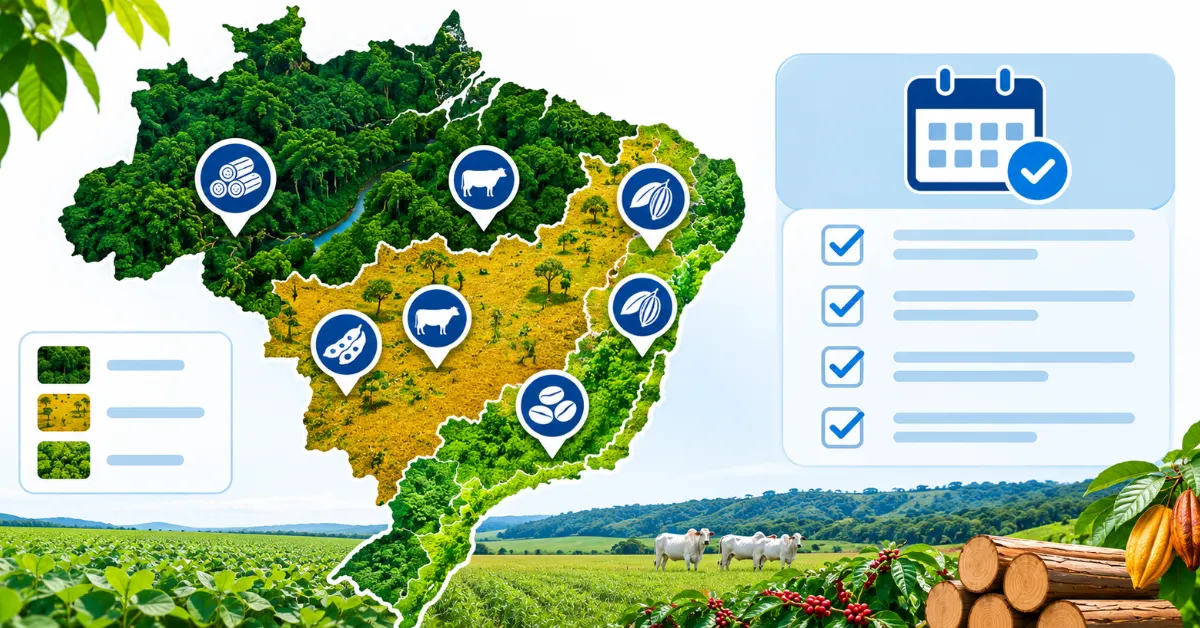
EUDR Compliance in Brazil by Commodity
Each commodity carries a different proof burden for EUDR compliance in Brazil.
Commodity
Main regions
What EU buyers will ask for
Soy
Mato Grosso, Cerrado states
Polygons for every lot; segregation at silos and crushers
Coffee
Minas Gerais, Espírito Santo
Smallholder plot data via cooperatives
Cattle (beef)
Mato Grosso, Pará
Every establishment where animals were kept, including indirect suppliers
Cocoa
Bahia, Pará
Canopy history for cabruca agroforestry plots
Wood, rubber, palm oil
South, Southeast, Pará
Harvest permits, plot polygons, legality evidence
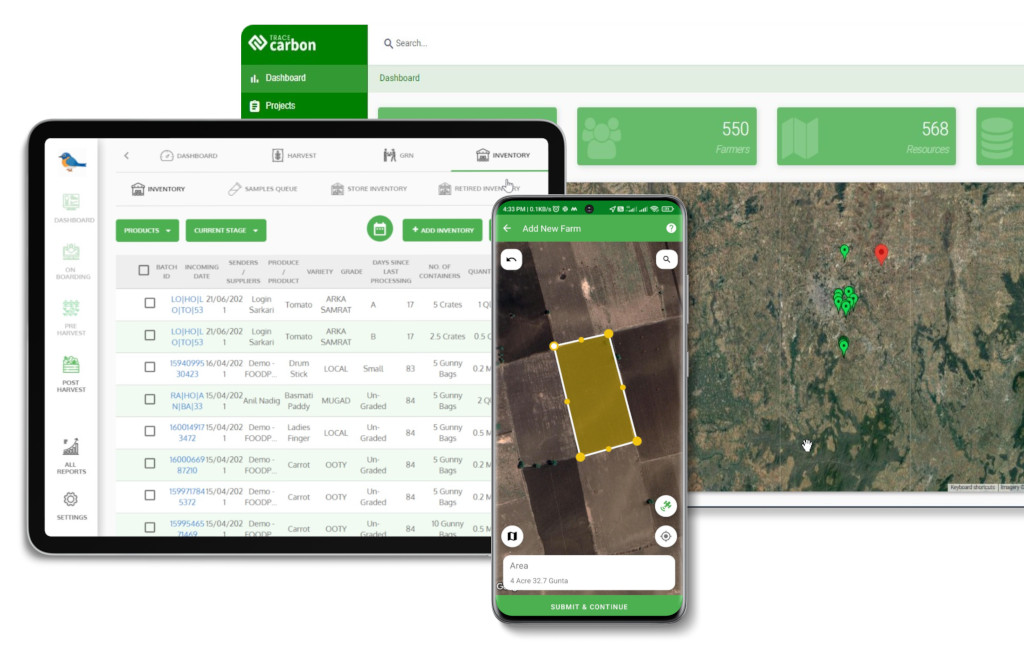
Discover how to streamline supplier onboarding, validate plot-level geolocation, assess deforestation risks, and manage due diligence requirements with the right technology.
For EUDR compliance in Brazil, the legal duty sits in the EU, but the evidence starts on Brazilian farms.
EU operator (usually the importer): runs due diligence and submits the DDS in the EU Information System.
Brazilian exporter: supplies geolocation, supplier records and legality evidence for every shipment.
Penalties: operators face fines of at least 4% of annual EU turnover for serious breaches.
In practice, EUDR compliance in Brazil is a data handover. The exporter who arrives with validated plots becomes the easiest supplier to keep.
EUDR Brazil geolocation: why the CAR is not enough
CAR boundaries are self-declared, so every polygon needs checking for overlaps and post-2020 clearing.
The Cadastro Ambiental Rural already maps most rural properties, a head start few origins have. Plots over 4 hectares need full polygons, and cattle need every holding in the animal’s life, which means linking CAR data with GTA animal-transit records.
EUDR Brazil legality: Forest Code vs deforestation-free
Meeting the Forest Code is necessary but not sufficient.
Legality covers land-use rights, environmental rules, labour and human rights, Indigenous peoples’ rights, and tax and customs law. Certifications such as RTRS or Rainforest Alliance support risk mitigation, but never replace plot geolocation, verifiable evidence or the DDS.
Legal clearing under Brazil’s Forest Code after 2020 still makes a product non-compliant under the EUDR.
Learn what the EUDR requires for plot-level geolocation, polygon mapping, coordinate validation and farm-level traceability.
We use cookies on our website to give you the most relevant experience by remembering your preferences and repeat visits. By clicking “Accept All”, you consent to the use of ALL the cookies. However, you may visit "Cookie Settings" to provide a controlled consent.
This website uses cookies to improve your experience while you navigate through the website. Out of these, the cookies that are categorized as necessary are stored on your browser as they are essential for the working of basic functionalities of the website. We also use third-party cookies that help us analyze and understand how you use this website. These cookies will be stored in your browser only with your consent. You also have the option to opt-out of these cookies. But opting out of some of these cookies may affect your browsing experience.
Necessary cookies are absolutely essential for the website to function properly. These cookies ensure basic functionalities and security features of the website, anonymously.
Cookie
Duration
Description
cookielawinfo-checkbox-analytics
11 months
This cookie is set by GDPR Cookie Consent plugin. The cookie is used to store the user consent for the cookies in the category "Analytics".
cookielawinfo-checkbox-functional
11 months
The cookie is set by GDPR cookie consent to record the user consent for the cookies in the category "Functional".
cookielawinfo-checkbox-necessary
11 months
This cookie is set by GDPR Cookie Consent plugin. The cookies is used to store the user consent for the cookies in the category "Necessary".
cookielawinfo-checkbox-others
11 months
This cookie is set by GDPR Cookie Consent plugin. The cookie is used to store the user consent for the cookies in the category "Other.
cookielawinfo-checkbox-performance
11 months
This cookie is set by GDPR Cookie Consent plugin. The cookie is used to store the user consent for the cookies in the category "Performance".
viewed_cookie_policy
11 months
The cookie is set by the GDPR Cookie Consent plugin and is used to store whether or not user has consented to the use of cookies. It does not store any personal data.
Functional cookies help to perform certain functionalities like sharing the content of the website on social media platforms, collect feedbacks, and other third-party features.
Performance cookies are used to understand and analyze the key performance indexes of the website which helps in delivering a better user experience for the visitors.
Analytical cookies are used to understand how visitors interact with the website. These cookies help provide information on metrics the number of visitors, bounce rate, traffic source, etc.
Advertisement cookies are used to provide visitors with relevant ads and marketing campaigns. These cookies track visitors across websites and collect information to provide customized ads.