EUDR Compliance for Coffee Exporters: Farm Geolocation, Traceability and DDS
Published
, 9 minute read
Share this article
Quick summary: Learn how coffee exporters can support EUDR compliance with farm geolocation, plot validation, deforestation evidence, traceability and DDS data for EU buyers.
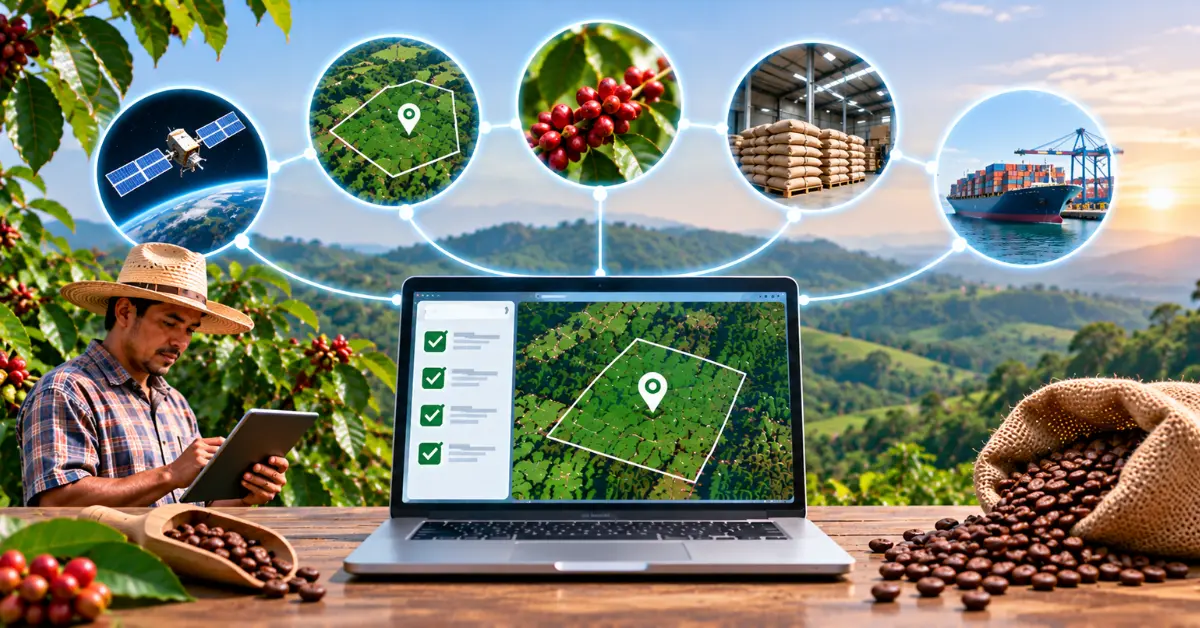
EUDR Compliance for Coffee Exporters requires accurate supplier information, validated farm geolocation and reliable supply-chain traceability. Exporters must be prepared to share deforestation-related evidence and connect farm-level data with procurement, processing and export shipments to support their EU buyers’ due diligence requirements.
Coffee exporters supplying the European Union face growing requests from buyers for farm-level geolocation, supplier records, deforestation evidence and traceability information. Under the EU Deforestation Regulation (EUDR), coffee and relevant coffee products listed in Annex I must meet specific conditions before they can be placed on the EU market or exported from the EU.
For exporters in coffee-producing countries, the practical challenge is preparing reliable information across farmers, cooperatives, washing stations, mills and export consignments. Although a non-EU exporter is not automatically the EUDR operator simply because it sells coffee to an EU customer, its data and cooperation may be essential for the EU operator to complete due diligence. This guide explains what coffee exporters should prepare and how to connect farm data with shipments.
Key Takeaways
Supplier Data: Maintain accurate farmer, supplier and sourcing information.
Farm Geolocation: Collect and validate GPS coordinates and polygon boundaries for relevant coffee plots.
Deforestation Checks: Ensure coffee is not sourced from land subject to deforestation after 31 December 2020.
Supply Chain Traceability: Connect farm records with procurement, processing, inventory and export shipments.
DDS Support: Provide accurate supplier, plot and shipment information to help EU buyers complete their Due Diligence Statements.
Data Validation: Identify duplicate plots, incorrect coordinates and gaps in farm-level records before sharing data.
Download our eBook to assess your EUDR readiness
Uncover data gaps, and take proactive steps towards stronger compliance.
EUDR, Regulation (EU) 2023/1115, requires relevant coffee products to be deforestation-free, legally produced in the country of production and covered by the required due diligence process. The deforestation cut-off date is 31 December 2020. The relevant land must not have been subject to deforestation after that date.
The legality requirement concerns relevant legislation in the country of production. Depending on the context, this can include land-use rights, environmental protection, labour and human rights, third-party rights, tax, anti-corruption, trade and customs. Exporters should work with suppliers to identify the evidence their EU customers need, rather than relying on a broad statement that the coffee is sustainable.
Check product scope: Confirm that the coffee product and customs classification are included in the current EUDR Annex I. Requirements and application dates can differ for products added to the scope later.
Discover the key regulatory requirements, practical compliance steps and how dedicated software can simplify coffee supply-chain due diligence.
Who is legally responsible for EUDR due diligence?
The upstream operator placing a relevant product on the EU market for the first time, or exporting it from the EU, is generally responsible for carrying out due diligence. In a typical export from a non-EU coffee-producing country to an EU importer, the EU importer may be the operator responsible for the DDS and due diligence obligations.
The exporter still has a critical commercial role: providing complete and accurate farm, supplier, production and shipment information; responding to buyer requests; and maintaining records that support the origin and traceability of the coffee. Contractual data-sharing arrangements can clarify responsibilities between partners, but they do not by themselves change who has legal obligations under EUDR.
Build a structured record of farmers, cooperatives, aggregators, washing stations and mills involved in sourcing. Each supplier or farmer record should be linked to the relevant production plots and deliveries. The information should be consistent across seasons and updated when supplier relationships or farm details change.
2. Farm geolocation and polygon validation
Geolocation identifies the land where coffee was produced. Under the general rule, plots larger than four hectares used to produce relevant commodities other than cattle require polygon geolocation; smaller plots may use a point location. The EU operator needs the geolocation for all relevant plots contributing to the product.
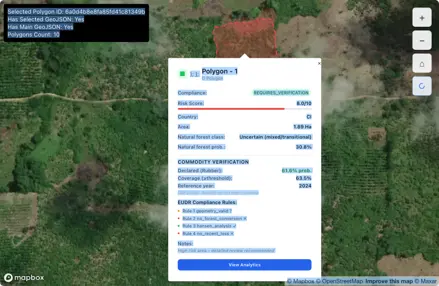
Exporters should validate coordinates and boundaries before sharing them. Common errors include reversed latitude and longitude, inaccurate plot boundaries, duplicate records, invalid GeoJSON files and plot data that is not linked to the correct farmer or supplier. A validation process should check coordinate ranges, geometry, area and supplier-to-plot relationships.
3. Evidence of deforestation-free production
Exporters should be able to provide plot-level information that allows their EU customers to assess whether coffee was produced on land subject to deforestation after 31 December 2020. Satellite imagery and forest-cover datasets can support screening by comparing plot boundaries with relevant forest baselines and highlighting possible land-cover change.
A satellite alert should be reviewed rather than treated as an automatic compliance decision. Similarly, the absence of an alert does not prove that all EUDR conditions have been met. Keep the underlying plot data, assessment results and relevant supporting evidence available for the operator’s due diligence process.
4. Production, procurement and shipment traceability
Farm geolocation must be connected to the coffee that is actually purchased and exported. Exporters should maintain records linking farm deliveries to purchase transactions, aggregation points, processing lots, warehouse inventory and export consignments.
This is particularly important where coffee from multiple farms is combined, processed or split into different lots. Quantity reconciliation and clear batch relationships help explain which farms contributed to a shipment and reduce the risk of disconnected or inconsistent origin information. Relevant information must be transferred to the EU buyer in a usable format.
5. Support the Due Diligence Statement
The responsible EU operator submits the Due Diligence Statement (DDS) through the EU EUDR Information System where required. The DDS includes prescribed product and operator information and geolocation details. Exporters should agree with their EU buyers on how farm data, product quantities, supplier details and shipment references will be provided, checked and updated.
Do not assume that the exporter must independently file the EU importer’s DDS. Instead, establish who is the operator, who submits the statement and how the DDS reference or other relevant information will be shared and associated with the shipment.
Ready to explore it yourself?
Experience how digital compliance management can simplify your preparation.
How EUDR compliance software helps coffee exporters
Spreadsheets and email can be difficult to manage when exporters work with large supplier networks, thousands of farm plots and multiple shipments. EUDR-focused software can help organise the information and make it easier to share with EU customers.
Supplier and farmer onboarding with structured profiles and sourcing records.
Farm geolocation capture, GeoJSON upload, polygon validation and duplicate checks.
Satellite-backed plot screening and a record of findings for buyer review.
Traceability from farm deliveries through procurement, processing, inventory and export batches.
Quantity and shipment-level records that connect source plots with exported coffee.
Organised evidence and data exports to support the EU operator’s due diligence and DDS workflow.
TraceX’s EUDR platform supports supplier and farm data management, geospatial validation, satellite-backed deforestation-risk assessment, traceability and EUDR due diligence workflows. For coffee exporters, the focus is on preparing reliable plot-level information and connecting it to procurement and shipment records so EU customers can use it in their compliance process.
EUDR application dates for coffee businesses
As of November 2026, the European Commission states that EUDR applies from 30 December 2026 to large and medium operators, and from 30 June 2027 to most micro and small operators. Micro and small operators already covered by the EU Timber Regulation have the 30 December 2026 application date. These dates relate to the relevant operator’s status; exporters should confirm the position with their EU customers rather than assume that the same date applies to every company in the chain.
Certain products newly added to the scope, including soluble coffee, are scheduled to become subject to EUDR from 30 December 2027. Check the current Annex I, product classification and official guidance for the exact product and date.
Map farmers, cooperatives, aggregators, mills and other suppliers.
Collect geolocation for all relevant coffee production plots.
Validate coordinates, polygon boundaries, duplicate records and plot ownership links.
Maintain evidence relevant to deforestation-free production and legality.
Connect farm deliveries with procurement, processing, inventory and export batches.
Reconcile quantities and retain records showing which plots contributed to each shipment.
Agree with EU buyers on data formats, update processes and DDS information handover.
Prepare your coffee exports for EUDR
EUDR readiness starts before the shipment is booked. Coffee exporters that map suppliers, validate farm geolocation and connect plot information to procurement and export records can respond to EU buyer requirements with greater consistency. Establishing these processes early can also help identify data gaps before they delay commercial transactions.
Talk to TraceX
Explore how Cleara can help organise supplier onboarding, farm geolocation, satellite-backed plot assessment and traceability from farm to export shipment.
Does EUDR apply directly to coffee exporters outside the EU?
A non-EU exporter is not automatically the EUDR operator merely because it exports coffee to an EU buyer. The upstream operator placing the product on the EU market generally carries out due diligence. The exporter may need to provide the information and cooperation required by that operator.
Do coffee exporters need to provide farm GPS coordinates?
Yes, EU buyers need the required geolocation for all relevant plots where the coffee was produced. Exporters should be prepared to collect and share accurate points or polygons, depending on plot size and the applicable rules.
Does a DDS have to be submitted by the coffee exporter?
No, DDS is not submitted by the coffee exporter. The responsible operator submits the DDS through the EU Information System where required. In a typical non-EU export to an EU importer, the importer may be responsible for the statement. Confirm the operator role for each supply-chain arrangement.
Can a coffee exporter use Excel to manage EUDR data?
Spreadsheets may help with small or simple datasets, but they can become difficult to control across multiple suppliers, plot geometries, purchases and shipments. A dedicated platform can support validation, traceability, evidence management and data sharing.
Start using TraceX
Transparency, Trust, & Success for your Climate Journey.
We use cookies on our website to give you the most relevant experience by remembering your preferences and repeat visits. By clicking “Accept All”, you consent to the use of ALL the cookies. However, you may visit "Cookie Settings" to provide a controlled consent.
This website uses cookies to improve your experience while you navigate through the website. Out of these, the cookies that are categorized as necessary are stored on your browser as they are essential for the working of basic functionalities of the website. We also use third-party cookies that help us analyze and understand how you use this website. These cookies will be stored in your browser only with your consent. You also have the option to opt-out of these cookies. But opting out of some of these cookies may affect your browsing experience.
Necessary cookies are absolutely essential for the website to function properly. These cookies ensure basic functionalities and security features of the website, anonymously.
Cookie
Duration
Description
cookielawinfo-checkbox-analytics
11 months
This cookie is set by GDPR Cookie Consent plugin. The cookie is used to store the user consent for the cookies in the category "Analytics".
cookielawinfo-checkbox-functional
11 months
The cookie is set by GDPR cookie consent to record the user consent for the cookies in the category "Functional".
cookielawinfo-checkbox-necessary
11 months
This cookie is set by GDPR Cookie Consent plugin. The cookies is used to store the user consent for the cookies in the category "Necessary".
cookielawinfo-checkbox-others
11 months
This cookie is set by GDPR Cookie Consent plugin. The cookie is used to store the user consent for the cookies in the category "Other.
cookielawinfo-checkbox-performance
11 months
This cookie is set by GDPR Cookie Consent plugin. The cookie is used to store the user consent for the cookies in the category "Performance".
viewed_cookie_policy
11 months
The cookie is set by the GDPR Cookie Consent plugin and is used to store whether or not user has consented to the use of cookies. It does not store any personal data.
Functional cookies help to perform certain functionalities like sharing the content of the website on social media platforms, collect feedbacks, and other third-party features.
Performance cookies are used to understand and analyze the key performance indexes of the website which helps in delivering a better user experience for the visitors.
Analytical cookies are used to understand how visitors interact with the website. These cookies help provide information on metrics the number of visitors, bounce rate, traffic source, etc.
Advertisement cookies are used to provide visitors with relevant ads and marketing campaigns. These cookies track visitors across websites and collect information to provide customized ads.