EUDR Competent Authorities: What They Check and How to Pass an Audit
Published
, 9 minute read
Share this article
Quick summary: Learn how Competent Authorities under the EUDR enforce deforestation-free trade, verify compliance, and safeguard sustainable supply chains across Europe.
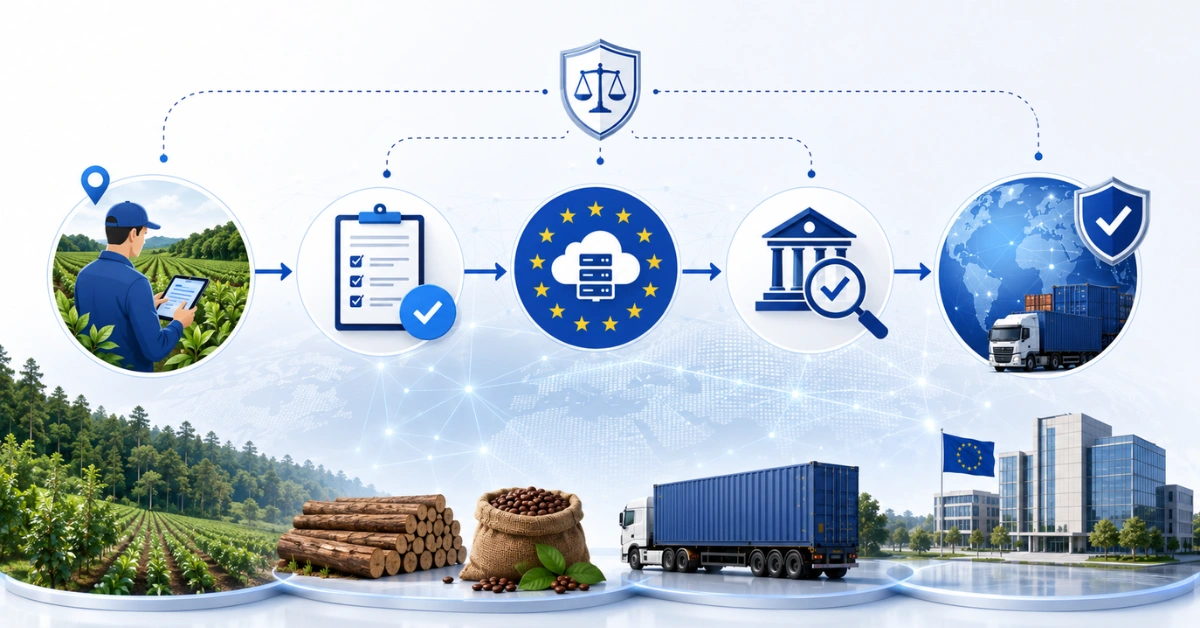
EUDR competent authorities are the national enforcement bodies each EU Member State designates under Regulation (EU) 2023/1115 to verify that operators and traders placing soy, coffee, cocoa, palm oil, rubber, cattle, and wood on the EU market can prove those products are deforestation-free and legally produced. In plain terms: they are the regulators who audit your Due Diligence Statements (DDS), inspect your geolocation and legality evidence, and impose penalties when proof is missing. If you import or export covered commodities, the competent authority in your Member State is the office that decides whether your shipment moves or stops.
KEY TAKEAWAYS
Competent authorities are state-appointed regulators not the European Commission that enforce the EUDR inside each Member State.
They run risk-based checks: verifying DDS data, validating geolocation polygons, reviewing legality documents, and coordinating with customs.
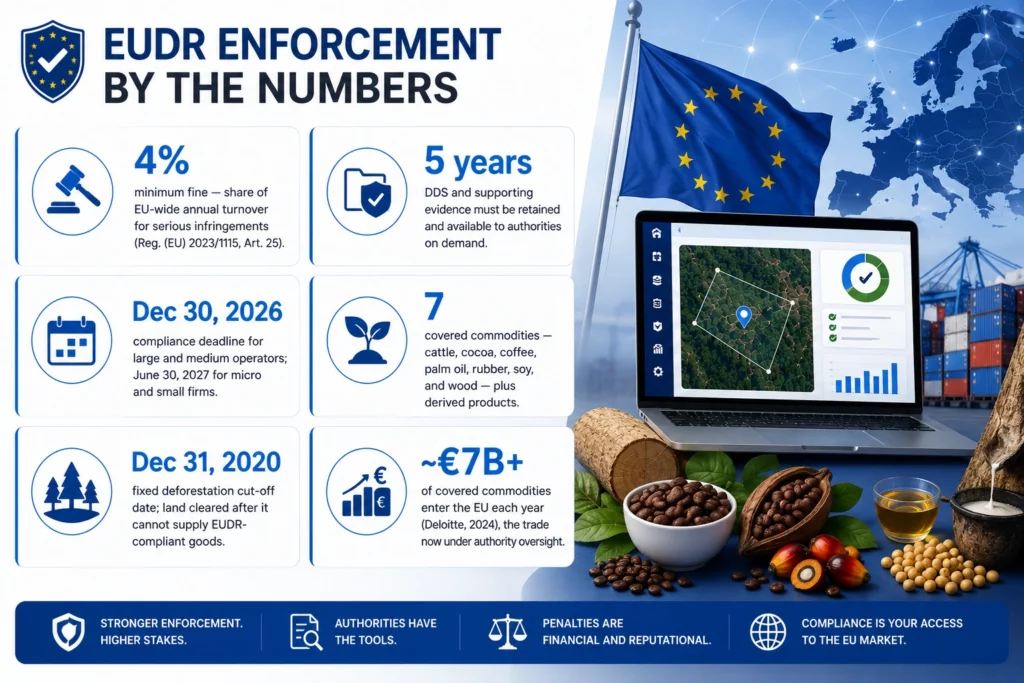
Penalties are real: fines of at least 4% of EU-wide turnover, product and revenue confiscation, market bans, and public naming.
Records must be audit-ready for 5 years and produced on demand the single biggest operational failure point.
The fastest way to pass is a system that keeps DDS, geolocation, and legality evidence validated and one click from inspection.
What EUDR Competent Authorities Do (and Why They Decide Your Market Access)
Competent authorities are the bridge between the regulation on paper and accountability in the real world. The EUDR sets the rules; the competent authority in each Member State makes them real. Their mandate is to confirm that every operator and trader placing covered commodities on the EU market can substantiate a deforestation-free, legally produced claim with verifiable evidence not just a sustainability statement.
Their core responsibilities include:
Running risk-based checks on operators and traders, weighted by commodity, supply-chain complexity, and the country-of-production risk tier.
Verifying Due Diligence Statements (DDS) and validating geolocation coordinates down to the farm or plot polygon.
Reviewing legality documentation and risk-mitigation records held in the EU Information System.
Coordinating with customs, environmental, and trade agencies, and investigating “substantiated concerns” raised by NGOs or the public.
Logging every check in the information system and imposing penalties for non-compliance.
How EUDR Competent Authorities Enforce Compliance Through Audits
THE PAIN
“We’ve filed our DDS but if a competent authority audits us, can we actually produce the evidence fast enough?” Most compliance teams hold DDS data, geolocation, and legality proof in fragmented systems ERP here, spreadsheets there, TRACES separately. When an authority requests records, the scramble begins.
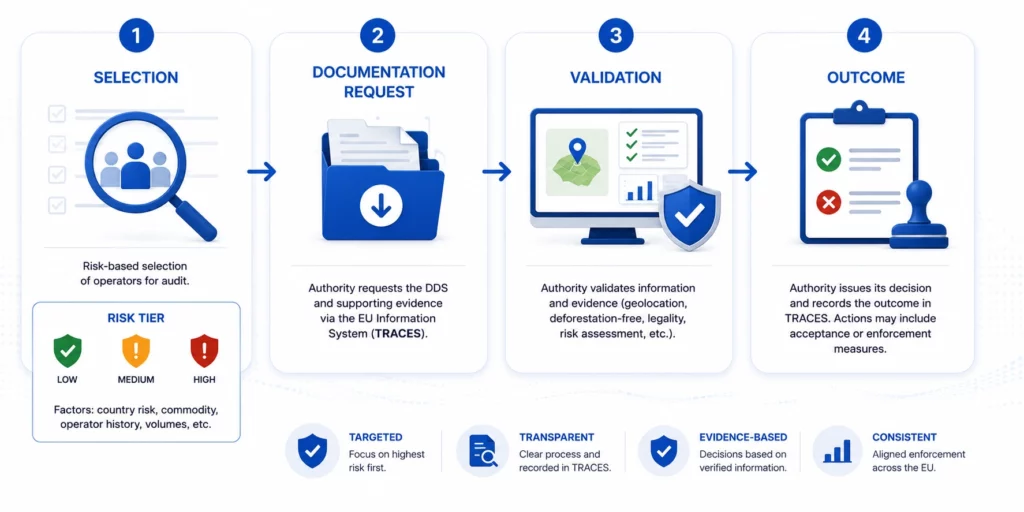
Enforcement is not a one-time checkpoint. Authorities conduct annual, risk-weighted inspections and can open a review at any point during the five-year retention window. An audit typically moves through four stages:
Selection — the authority flags operators using national risk criteria (commodity, supply-chain complexity, country risk tier).
Documentation request — you must surface the relevant DDS, geolocation polygons, supplier KYC, and legality evidence on demand.
Validation — authorities check geolocation accuracy, cross-reference legality records, and test whether the DDS matches the shipment.
Outcome — compliant, corrective action, or penalty. Substantiated concerns from third parties can trigger this cycle independently.
HOW TRACEX CLOSES THE GAP
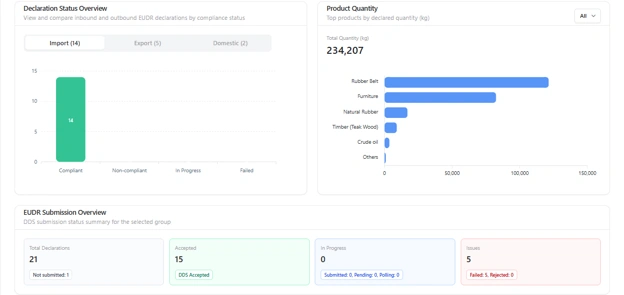
TraceX consolidates DDS submissions, validated geolocation, supplier records, and risk assessments into a single, blockchain-timestamped pipeline with 5-year retention. An authority audit becomes a dashboard view not a multi-day documentation hunt across drives and inboxes.
What EUDR Competent Authorities Check in a DDS Audit
When a competent authority inspects a Due Diligence Statement, they are testing whether the data behind your declaration holds up. These are the evidence points operators are most often asked to produce and where rejections originate:
What authorities verify
What you must be able to produce
Geolocation accuracy
Valid GeoJSON polygons or points for every plot the most common rejection trigger when geometry fails validation.
DDS-to-shipment match
Consistent EORI numbers, HS commodity codes, and quantities across the DDS and the supporting documents.
Legality evidence
Land-use rights, environmental, labor, and tax documentation for the country of production.
Deforestation-free proof
Evidence the land was not cleared after the December 31, 2020 cut-off, ideally satellite-backed.
Risk assessment & mitigation
Documented risk screening and the actions taken to reduce more-than-negligible risk.
5-year record retention
Instant, on-demand access to every record above for any shipment in the last five years.
Connect the pain to the capability: every row above maps to a place where fragmented data causes audit gaps. TraceX validates geolocation and DDS structure before submission, enforces a “no data, no draft” rule, and keeps all six evidence types in one audit-ready record set.
Filing an EUDR Due Diligence Statement (DDS) is only half the challenge—filing it correctly is what matters.
Penalties EUDR Competent Authorities Can Impose for Non-Compliance
The stakes are why buyer-side teams treat competent authorities as a real operational risk, not a paperwork exercise. Member States set the exact penalties, but the EUDR establishes a floor, and the range of sanctions is broad:
Fines: a minimum of 4% of the company’s EU-wide turnover for the previous financial year, scalable to remove any economic benefit gained.
Confiscation: of the non-compliant products and of the revenue earned from them.
Market exclusion: temporary bans on placing or exporting covered products, and exclusion from public procurement and funding.
Public naming: non-compliant companies are published on the European Commission’s website a reputational signal to buyers, investors, and journalists.
Shipment stops: a rejected or missing DDS reference blocks goods at customs, with immediate cash-flow and continuity impact.
For most operators, losing EU market access is a bigger threat than the fine itself which is exactly why audit readiness is a board-level priority, not a compliance afterthought.
EUDR Competent Authorities by Member State: Who You Answer To
Each EU Member State designates its own competent authority (or authorities), and the office you deal with depends on where your products enter the market. The European Commission maintains the official, regularly updated list with names, addresses, and contact details. A representative sample of the bodies operators most often encounter:
Member State
Type of competent authority (illustrative)
Germany
Federal agency for agriculture and food, coordinating with customs.
France
Ministry for agriculture / ecological transition enforcement body.
Netherlands
Food and consumer product safety authority.
Spain
Ministry for ecological transition, with regional coordination.
Italy
Ministry of environment / forestry enforcement carabinieri.
Always confirm the current designated authority against the European Commission’s official Member State list before filing designations and contacts are updated as enforcement scales.
Preparing for EUDR starts with understanding the EU Information System.
How to Prove Compliance to EUDR Competent Authorities
Passing an authority audit comes down to one capability: producing complete, validated, consistent evidence on demand. Operators who build that infrastructure now are not just meeting the deadline they are protecting EU market access for the next decade. Five questions reveal whether you are audit-ready:
Can you pull every DDS, geolocation polygon, and legality record for any shipment in under 24 hours?
Is your geolocation validated at source, so polygons pass authority geometry checks the first time?
Does your DDS data match your POs and shipments exactly EORI, HS codes, quantities?
Is your evidence retained and accessible across a full 5-year retrospective window?
Are your deforestation risk assessments running automatically against current satellite data?
TURN COMPLIANCE INTO A DASHBOARD VIEW
TraceX EUDR Solutions gives operators and authorities a single EUDR stack: supplier onboarding, geolocation validation, automated DDS generation, direct TRACES integration, and blockchain-timestamped 5-year records. “Where did this come from?” becomes a one-click answer instead of a documentation scramble.
Make your next competent authority audit a dashboard view, not a scramble.
TraceX digitizes the full EUDR workflow DDS automation, geolocation validation, TRACES integration, and 5-year audit-ready records so you can prove deforestation-free, legally produced sourcing the moment an authority asks.
EUDR Competent Authority Audits: Manual vs. Platform-Based Readiness
When a competent authority comes knocking, the difference between a clean audit and a shipment stop is usually your operating model. Here is how manual, spreadsheet-led compliance compares to a connected platform:
Audit requirement
Manual / spreadsheet approach
TraceX connected platform
Producing records on demand
Hours to days hunting across drives, email, and PDFs
One-click dashboard view per shipment
Geolocation validation
Manual checks; high geometry-rejection risk
Validated at source before DDS draft
DDS-to-shipment consistency
Re-keyed data; mismatch errors common
Auto-pulled from POs and shipments
5-year retention
Fragmented; audit gaps over time
Blockchain-timestamped, tamper-proof
Ongoing deforestation risk
Point-in-time, often stale
Automated against current satellite data
Authority queries
Slow, multi-team scramble
Centralized evidence trail, fast response
Frequently Asked Questions (FAQ’s)
Who are the competent authorities under the EUDR?
They are the public bodies each EU Member State designates under Regulation (EU) 2023/1115 to enforce the EUDR verifying DDS, validating geolocation and legality evidence, and imposing penalties for non-compliance.
Are competent authorities the same as the European Commission?
No. The Commission sets the regulatory framework and operates the EU Information System; competent authorities are national bodies that carry out enforcement, inspections, and penalties within their own Member State.
How do EUDR competent authorities select who to audit?
They use risk-based national criteria weighing the commodity, supply-chain complexity, and the country-of-production risk tier (low, standard, or high), and can also act on substantiated concerns from NGOs or the public.
What penalties can EUDR competent authorities impose?
Fines of at least 4% of EU-wide annual turnover, confiscation of products and revenue, temporary market and procurement bans, and public naming. A missing or rejected DDS can also stop shipments at customs.
How do I prove compliance to a competent authority?
Maintain instant access to all DDS submissions, validated geolocation, supplier records, and risk assessments for five years. Platforms like TraceX centralize this into an audit-ready record set, making inspections a dashboard view.
How long must records be available to competent authorities?
All DDS filings and supporting documentation must be retained for five years and produced on demand during any inspection within that window.
Start using TraceX
Transparency, Trust, & Success for your Climate Journey.
We use cookies on our website to give you the most relevant experience by remembering your preferences and repeat visits. By clicking “Accept All”, you consent to the use of ALL the cookies. However, you may visit "Cookie Settings" to provide a controlled consent.
This website uses cookies to improve your experience while you navigate through the website. Out of these, the cookies that are categorized as necessary are stored on your browser as they are essential for the working of basic functionalities of the website. We also use third-party cookies that help us analyze and understand how you use this website. These cookies will be stored in your browser only with your consent. You also have the option to opt-out of these cookies. But opting out of some of these cookies may affect your browsing experience.
Necessary cookies are absolutely essential for the website to function properly. These cookies ensure basic functionalities and security features of the website, anonymously.
Cookie
Duration
Description
cookielawinfo-checkbox-analytics
11 months
This cookie is set by GDPR Cookie Consent plugin. The cookie is used to store the user consent for the cookies in the category "Analytics".
cookielawinfo-checkbox-functional
11 months
The cookie is set by GDPR cookie consent to record the user consent for the cookies in the category "Functional".
cookielawinfo-checkbox-necessary
11 months
This cookie is set by GDPR Cookie Consent plugin. The cookies is used to store the user consent for the cookies in the category "Necessary".
cookielawinfo-checkbox-others
11 months
This cookie is set by GDPR Cookie Consent plugin. The cookie is used to store the user consent for the cookies in the category "Other.
cookielawinfo-checkbox-performance
11 months
This cookie is set by GDPR Cookie Consent plugin. The cookie is used to store the user consent for the cookies in the category "Performance".
viewed_cookie_policy
11 months
The cookie is set by the GDPR Cookie Consent plugin and is used to store whether or not user has consented to the use of cookies. It does not store any personal data.
Functional cookies help to perform certain functionalities like sharing the content of the website on social media platforms, collect feedbacks, and other third-party features.
Performance cookies are used to understand and analyze the key performance indexes of the website which helps in delivering a better user experience for the visitors.
Analytical cookies are used to understand how visitors interact with the website. These cookies help provide information on metrics the number of visitors, bounce rate, traffic source, etc.
Advertisement cookies are used to provide visitors with relevant ads and marketing campaigns. These cookies track visitors across websites and collect information to provide customized ads.
Download the 2026 Traceability Scorecard and Benchmark Your Supply Chain Across 10 Critical Capabilities.
Download our eBook
Don’t Wait for an Audit to Find Your EUDR Gaps
The 2026 Simplification Package changes how HS codes, DDS pass-through and geolocation rules apply to you. Get the free guide and 20-point readiness checklist before enforcement catches you unprepared.