EUDR Coffee Roasters: Your 2026 Downstream Obligations, Decoded
Published
, 11 minute read
Share this article
Quick summary: EUDR coffee roasters: know your 2026 operator vs downstream obligations, DDS reference rules, deadlines and how to build audit-ready compliance.
EUDR coffee roasters must prove their coffee is deforestation-free and legally produced before it reaches EU buyers. Under Regulation (EU) 2025/2650, roasters that import green coffee directly act as operators and file a Due Diligence Statement (DDS) in the EU’s TRACES system, backed by plot-level GPS geolocation. Roasters that buy customs-cleared coffee from an EU importer are downstream operators they no longer file their own DDS, but the first downstream operator must collect and retain the upstream DDS reference number. The rules apply from 30 December 2026 for large and medium roasters and 30 June 2027 for micro and small roasters.
Key takeaways
EUDR coffee roasters fall into two roles importing operators and downstream operators and the obligations differ sharply.
Direct importers file a DDS with plot-level GPS geolocation; downstream roasters instead collect and retain the upstream DDS reference number.
Deadlines: 30 December 2026 (large/medium) and 30 June 2027 (micro/small). The deforestation cut-off of 31 December 2020 has not moved.
Penalties can reach at least 4% of EU-wide annual turnover, plus market withdrawal and blocked shipments.
Certifications (Rainforest Alliance, Fairtrade) support risk mitigation but do not replace geolocation, legality proof or the DDS.
December 2026 is approaching. Is your supply chain actually ready?
Move from spreadsheets and fragmented supplier data to a traceable, audit-ready EUDR workflow with TraceX.
EUDR coffee roasters are the businesses that place roasted or green coffee (HS code 0901) onto the EU market and must show it was not grown on land deforested after 31 December 2020. The EU Deforestation Regulation Regulation (EU) 2023/1115, amended by Regulation (EU) 2025/2650 turns what used to be a voluntary sustainability claim into a hard condition of market access. Coffee is one of seven regulated commodities, alongside cocoa, soy, palm oil, cattle, rubber and wood.
In plain terms: if you cannot trace a lot of coffee back to the plot it grew on and prove that plot was deforestation-free and legally farmed, that coffee cannot legally be sold in the EU. For EUDR coffee roasters, the practical question is no longer whether to comply, but which obligations attach to your specific role in the chain because a roaster importing green beans from Brazil carries very different duties from one buying pre-cleared beans from a Hamburg importer.
Enforcement is risk-tiered by country. Coffee from origins the Commission classifies as high-risk faces enhanced checks, while standard-risk origins get lighter scrutiny. That country benchmarking does not remove any obligation it changes how heavily a given lot is examined so roasters sourcing from mixed-risk origins should expect their high-risk lots to draw the most attention.
How Does Country Risk Affect EUDR Compliance?
Learn how EUDR country risk classification works, what it means for your due diligence, and how businesses should account for country-level and supply-chain-specific risks.
EUDR coffee roasters obligations by supply-chain role
Your obligations depend entirely on where you sit in the chain. For EUDR coffee roasters, three roles cover almost every scenario:
1. Direct importers (operators)
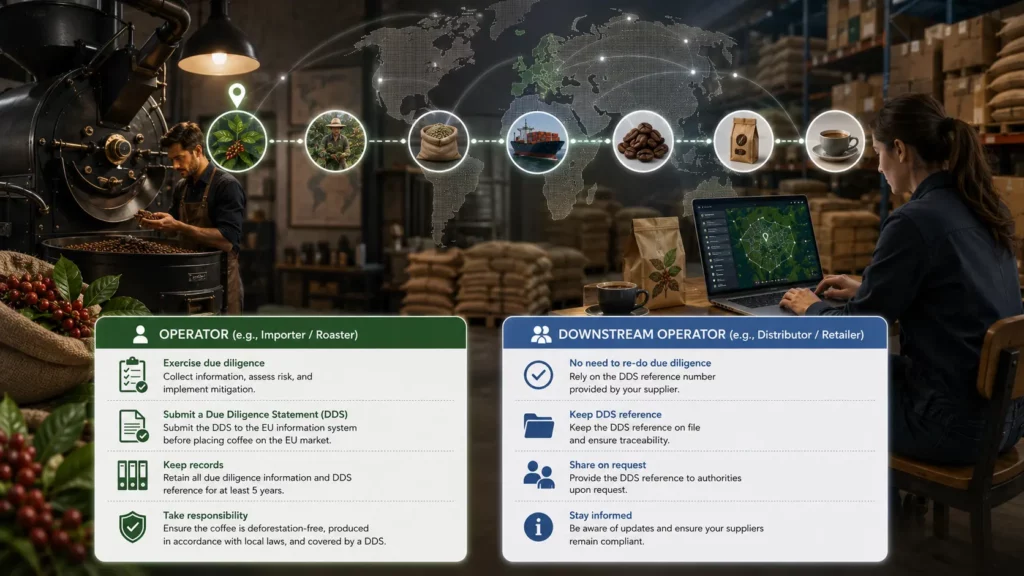
Roasters that bring green coffee directly into the EU are operators. They must collect precise farm-level GPS geolocation data polygons for larger plots, coordinates for small ones and submit a Due Diligence Statement (DDS) through the EU’s TRACES system before the coffee is placed on the market. This is the heaviest obligation: full due diligence, risk assessment and, where risk is not negligible, risk mitigation. In practice that means running a documented risk assessment for every supplier and origin, and where risk is more than negligible, taking mitigation steps additional data, audits or independent checks before the DDS can be submitted. The operator carries the full legal liability for that statement.
2. Downstream buyers (SME and large roasters)
Roasters that purchase already-cleared green or roasted coffee from an EU importer are downstream operators. They do not file a fresh DDS. The first downstream operator in the chain must reference and retain the upstream DDS reference number as proof that due diligence was completed for that lot. Larger roasters carry fuller record-keeping duties; SMEs face lighter, simplified obligations but both must be able to produce the reference number on request.
Downstream operators can still have important responsibilities around supplier information, due diligence references, traceability and record-keeping when placing relevant products on the EU market.
Whichever role applies, the coffee must have been produced in line with the origin country’s labour, environmental and land-use laws. “Deforestation-free” and “legally produced” are two separate tests a lot can be one without the other, and EUDR requires both.
If you are unsure which role you occupy, resolve it before you do anything else it determines every later decision about data, systems and cost. Many EUDR coffee roasters play both roles at once: importing some green coffee directly while buying the rest pre-cleared from EU importers. In that case you carry operator duties for the beans you import and downstream duties for the beans you buy, and your systems need to handle both cleanly.
The latest downstream obligations for coffee roasters (2025/2650)
This is where the December 2025 amendment matters most. Regulation (EU) 2025/2650 created a distinct downstream operator category, and it gives EUDR coffee roasters buying from EU importers a genuinely lighter path than the original text did.
No repeat DDS. Downstream operators no longer submit their own Due Diligence Statement for coffee that an upstream operator has already declared.
Reference number, collected once. Only the first downstream operator collects and retains the upstream DDS reference number. Under the amended rule, that reference does not have to be passed further down the chain.
TRACES registration. Downstream operators still need to be registered in the EU information system so authorities can trace the lot.
Records for five years. Reference numbers and supporting documents must be kept audit-ready for five years, and you must act on any substantiated concern of non-compliance.
Most EUDR coffee roasters sourcing through EU importers will fall into this downstream category but the classification is not automatic. Under the revised Article 2(15) the default status is still operator, with all the heavier duties that brings. If you want the lighter downstream route, you generally need to confirm your classification before the application date rather than assume it.
There is one practical wrinkle worth planning for. Between 30 December 2026 and 30 June 2027, large and medium downstream roasters are already live while some of their micro and small upstream suppliers are not, meaning the reference numbers those roasters are expected to collect may not yet exist for every lot. Map which of your suppliers sit on which side of that gap now, so it does not surprise you mid-season.
EUDR coffee roasters: deadlines, scope and penalties
EUDR coffee roasters must be ready by role and size, not by a single universal date:
30 December 2026 — large and medium operators and traders (this is the deadline most established roasters should plan around).
30 June 2027 — micro and small enterprises and natural persons.
31 December 2020 — the deforestation cut-off. It is a property of the land and has never moved through any postponement.
The stakes are commercial, not just reputational. Penalties under EUDR can reach at least 4% of a company’s total annual EU-wide turnover, and customs authorities can block non-compliant shipments while member states can order products withdrawn from the market. For a roaster, a blocked container of green coffee at peak season is the risk that concentrates the mind. Enforcement readiness, then, is less about a single deadline and more about being able to answer a competent authority quickly: roasters who can retrieve the evidence for any lot on request are the ones who avoid the shipment holds that do the real commercial damage.
Our guide breaks down EUDR coffee compliance, including the key requirements for coffee importers, roasters and other supply-chain actors—and what you need to prepare before placing coffee products on the EU market.
How coffee roasters build audit-ready EUDR compliance
For EUDR coffee roasters, the compliance challenge is really a data problem, not a policy one. The obligations are knowable; the hard part is retrieving the right geolocation, legality evidence and DDS reference for the right lot, on demand, across a fragmented supplier base of importers, cooperatives and smallholders.
The hardest data to retrieve is almost always the farm-level layer, because coffee typically passes through cooperatives, washing stations and multiple traders before it reaches a roaster. Consolidating that fragmented origin data geolocation, legality documents and the chain of custody linking them is exactly where roasters lose the most time under a manual approach.
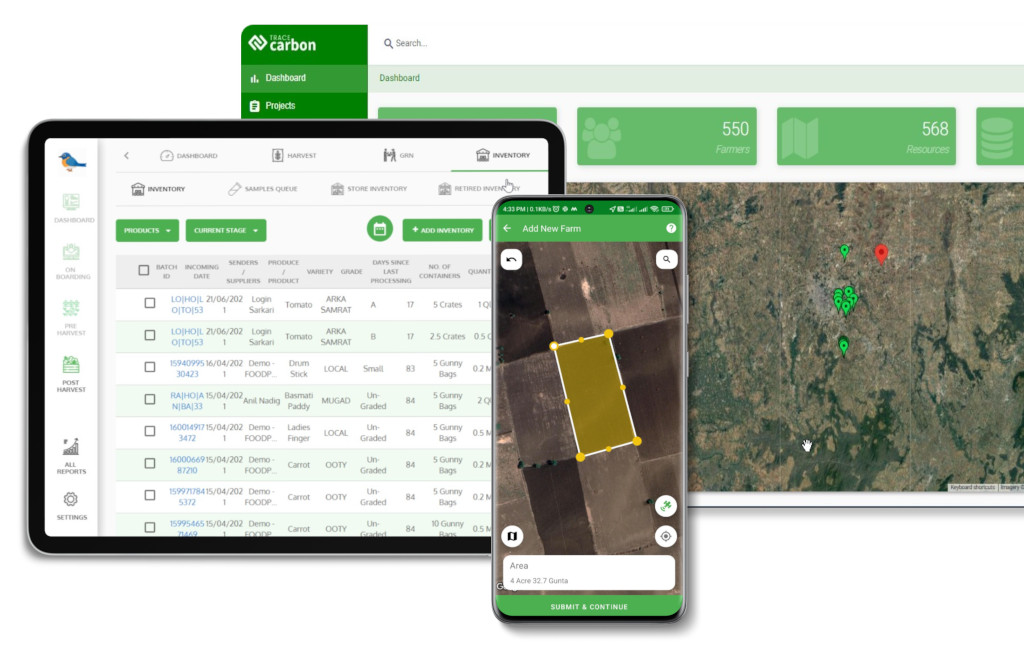
This is where a single traceability layer changes the economics of compliance. TraceX EUDR Solutions maps your supplier network, captures plot-level geolocation, links each lot to its DDS reference number, and flags gaps before they become blocked shipments. Instead of chasing spreadsheets across brokers, the platform gives EUDR coffee roasters a single audit-ready record per lot the same record that answers a buyer’s due-diligence questionnaire and an authority’s audit request.
The proof point roasters care about: when the reference number, the geolocation and the legality documents all live in one place, producing evidence takes minutes, not the frantic week of email archaeology that manual compliance turns into.
Ready to make your coffee lots audit-ready?
See how TraceX maps your supplier network, captures plot-level geolocation and links every lot to its DDS reference so you’re ready well before the 30 December 2026 deadline.
EUDR coffee roasters that treat compliance as a retrieval problem “can I produce the evidence for this lot in minutes?” will outcompete those still treating it as an annual paperwork scramble. The regulation rewards the roasters whose data is already organised. One clean data layer, mapped once, answers every future request: EUDR today, CSDDD and buyer questionnaires tomorrow.
EUDR coffee roasters: manual compliance vs. a traceability platform
Task
Manual / spreadsheet
Traceability platform
Plot-level geolocation
Emailed files, inconsistent formats, no validation
Captured, validated and stored against each lot
DDS reference numbers
Tracked in ad-hoc sheets; easy to lose
Linked automatically to the lot and supplier
Legality documents
Scattered across brokers and inboxes
Centralised, versioned, audit-ready
Gap detection
Found during an audit too late
Flagged before the shipment moves
Responding to an audit
Days of email archaeology
Evidence produced in minutes
Reusable for CSDDD / buyers
Rebuilt from scratch each time
Same data layer answers every request
Buyer’s checklist: choosing an EUDR solution as a coffee roaster
When EUDR coffee roasters evaluate a compliance platform, these are the questions that separate a real solution from a document store:
Does it capture plot-level GPS geolocation (polygons and coordinates) and validate it, not just store files?
Does it link each lot to its DDS reference number and the upstream operator automatically?
Can it tell operator from downstream-operator obligations and apply the right workflow to each supplier?
Does it flag missing references or geolocation before a shipment moves, not after?
Does it keep a five-year, audit-ready record you can export on demand?
Will the same data serve CSDDD and buyer due-diligence questionnaires, so you build the layer once?
Frequently Asked Questions
Do coffee roasters need to file their own DDS under EUDR?
Only if you are an operator that is, you import green coffee into the EU yourself. If you buy customs-cleared coffee from an EU importer you are a downstream operator and do not file a fresh DDS; the first downstream operator instead collects and retains the upstream DDS reference number.
What is the EUDR deadline for coffee roasters?
30 December 2026 for large and medium roasters and traders, and 30 June 2027 for micro and small roasters, under Regulation (EU) 2025/2650. The deforestation cut-off date of 31 December 2020 is unchanged.
Is roasted coffee in scope, or only green coffee?
Both. EUDR covers coffee under HS code 0901, which includes green beans, roasted beans and coffee-derived products. Roasting does not take coffee out of scope.
What geolocation data do coffee roasters need?
For every plot of production land, geographic coordinates (polygons for larger areas) with the required precision, so authorities can verify the coffee was not grown on land deforested after 31 December 2020. Operators collect this; downstream roasters rely on the upstream operator’s DDS.
Does Rainforest Alliance or Fairtrade certification make a roaster EUDR-compliant?
No. Certifications support risk mitigation and can strengthen a due-diligence file, but they do not replace plot-level geolocation, legality proof or the DDS itself. EUDR requires the underlying evidence, not just a certificate.
What are the penalties for non-compliant coffee roasters?
Fines of at least 4% of total annual EU-wide turnover, blocked shipments at customs, and orders to withdraw products from the market. Non-compliant coffee simply cannot be legally placed on the EU market.
What does the 2025/2650 downstream operator change mean in practice?
It gives most roasters buying through EU importers a lighter route: no repeat DDS, a single reference number collected by the first downstream operator, TRACES registration and five-year records. But the default classification is still ‘operator’, so confirm your status rather than assume the lighter path applies.
Start using TraceX
Transparency, Trust, & Success for your Climate Journey.
We use cookies on our website to give you the most relevant experience by remembering your preferences and repeat visits. By clicking “Accept All”, you consent to the use of ALL the cookies. However, you may visit "Cookie Settings" to provide a controlled consent.
This website uses cookies to improve your experience while you navigate through the website. Out of these, the cookies that are categorized as necessary are stored on your browser as they are essential for the working of basic functionalities of the website. We also use third-party cookies that help us analyze and understand how you use this website. These cookies will be stored in your browser only with your consent. You also have the option to opt-out of these cookies. But opting out of some of these cookies may affect your browsing experience.
Necessary cookies are absolutely essential for the website to function properly. These cookies ensure basic functionalities and security features of the website, anonymously.
Cookie
Duration
Description
cookielawinfo-checkbox-analytics
11 months
This cookie is set by GDPR Cookie Consent plugin. The cookie is used to store the user consent for the cookies in the category "Analytics".
cookielawinfo-checkbox-functional
11 months
The cookie is set by GDPR cookie consent to record the user consent for the cookies in the category "Functional".
cookielawinfo-checkbox-necessary
11 months
This cookie is set by GDPR Cookie Consent plugin. The cookies is used to store the user consent for the cookies in the category "Necessary".
cookielawinfo-checkbox-others
11 months
This cookie is set by GDPR Cookie Consent plugin. The cookie is used to store the user consent for the cookies in the category "Other.
cookielawinfo-checkbox-performance
11 months
This cookie is set by GDPR Cookie Consent plugin. The cookie is used to store the user consent for the cookies in the category "Performance".
viewed_cookie_policy
11 months
The cookie is set by the GDPR Cookie Consent plugin and is used to store whether or not user has consented to the use of cookies. It does not store any personal data.
Functional cookies help to perform certain functionalities like sharing the content of the website on social media platforms, collect feedbacks, and other third-party features.
Performance cookies are used to understand and analyze the key performance indexes of the website which helps in delivering a better user experience for the visitors.
Analytical cookies are used to understand how visitors interact with the website. These cookies help provide information on metrics the number of visitors, bounce rate, traffic source, etc.
Advertisement cookies are used to provide visitors with relevant ads and marketing campaigns. These cookies track visitors across websites and collect information to provide customized ads.
Download the 2026 Traceability Scorecard and Benchmark Your Supply Chain Across 10 Critical Capabilities.
Download our eBook
Don’t Wait for an Audit to Find Your EUDR Gaps
The 2026 Simplification Package changes how HS codes, DDS pass-through and geolocation rules apply to you. Get the free guide and 20-point readiness checklist before enforcement catches you unprepared.