Quick summary: Explore real-world EUDR coffee supply chain examples and learn how your business can navigate compliance, traceability, and due diligence to stay competitive in the EU market.
EUDR coffee examples are real-world supply chain scenarios showing how coffee exporters in Colombia, Ethiopia, Brazil, and Vietnam achieve deforestation-free compliance under EU Regulation 2023/1115. Each example demonstrates the specific steps farm-level GPS mapping, satellite deforestation checks, chain-of-custody digitization, and Due Diligence Statement (DDS) submission required before coffee can enter the EU market after December 30, 2026. Non-compliance risks fines of up to 4% of annual EU turnover, shipment seizure, and permanent market exclusion.
EUDR coffee examples reveal a hard truth: most coffee supply chains are not ready for EU enforcement. Under EU Regulation 2023/1115, every batch of coffee entering the EU must be proven deforestation-free, traceable to GPS-level farm data, and accompanied by a submitted Due Diligence Statement (DDS) or face seizure, fines, and market bans.
This guide walks through four real-world EUDR coffee supply chain examples from Colombia, Ethiopia, Brazil, and Vietnam. For each, we show the exact compliance gaps, the required fixes, and the digital tools that make compliance scalable.
Key Takeaways
The 4 most common EUDR coffee compliance failure scenarios (and how to fix each)
The 6-step EUDR compliance framework every exporter must follow
Exact data requirements for a valid Due Diligence Statement (DDS)
How to compare manual vs. digital compliance approaches by cost and risk
What questions to ask when evaluating a EUDR compliance platform
EUDR Coffee Examples: Why Coffee Is the EU’s Highest-Risk Commodity
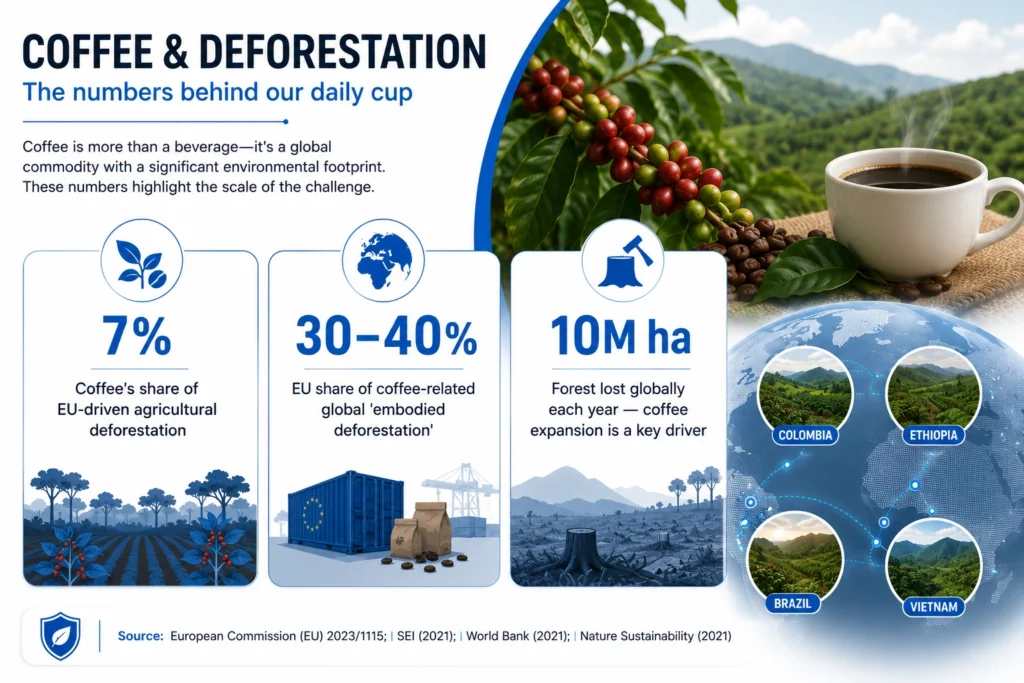
EUDR coffee examples start with understanding why coffee earned specific scrutiny. Coffee expansion is directly linked to deforestation in key growing regions the EU’s demand for coffee accounts for approximately 7% of EU-driven agricultural deforestation globally.
Under EU Regulation 2023/1115, coffee placed on the EU market must meet four conditions:
Grown on land that was not deforested after December 31, 2020
Traceable to GPS-level farm coordinates or plot polygons
Produced in compliance with local laws (land tenure, labor rights, environmental rules)
Accompanied by a submitted DDS before customs clearance
Operator Type
Enforcement Deadline
Status
Large operators and traders
December 30, 2026
⚠️ ACTIVE — Plan now
Small and micro enterprises
June 30, 2027
⚠️ Approaching
Proposed 1-year extension (Nov 2025)
Not legally binding
❌ Do NOT rely on this
Is Your Coffee Supply Chain EUDR-Ready?
Don’t wait until customs flags your shipment. The December 30, 2026 deadline applies to large operators and the compliance process takes 6–12 months to implement properly.
The following EUDR coffee examples are drawn from real supply chain challenges facing exporters across origin countries. Each scenario shows the compliance gap, its business impact, and the exact fix required.
EUDR Coffee Example 1: Colombian Exporter — The Blocked Shipment
A premium Colombian coffee exporter secures a major contract with a European retailer. Just before shipment, a compliance check reveals a critical gap: no geolocation proof that the coffee wasn’t grown on deforested land. Result: shipment halted at Hamburg Port, contract at risk, EU market access denied.
The Compliance Gaps:
Hundreds of smallholder farms in the supply chain no centralized farm mapping existed
No digital chain of custody from harvest to export port
Missing DDS data at customs no quick way to retrieve supplier geo-records
Shipment scheduled before deforestation risk assessment was completed
The Financial Impact:
Colombia exported approximately $2.8B in coffee to the EU in 2024. A single blocked shipment during peak contract season can cost exporters $50,000–$500,000 in detention fees, rescheduling, and contract penalties.
The EUDR-Compliant Fix:
Pre-map all farm plots to GPS polygon boundaries before the shipping season opens
Digitize chain of custody at every handoff: farm → cooperative → processor → export warehouse
Use cloud-based traceability platforms to retrieve full supplier geo-records in minutes, not days
Submit DDS proactively to the EU Information System before coffee boards the vessel
EUDR Coffee Example 2: Ethiopian Cooperative — The Smallholder Data Gap
Ethiopia is Africa’s largest Arabica producer with over 5 million smallholder farmers across Sidama, Yirgacheffe, Guji, and Harar. Farms are often sub-0.5 hectare plots in dense agroforestry systems without formal land titles or internet connectivity. Ethiopia’s 2025/26 season is forecast to produce a record 11.56 million 60-kg bags (~694,000 metric tons). Without farm-level traceability, a significant portion of this volume risks EU market exclusion.
The Compliance Gaps:
5 million+ smallholders — gathering GPS data at scale is operationally complex
Batches from thousands of farms mixed through brokers — chain of custody breaks at aggregation points
Remote areas with limited internet — mobile-first and offline data collection is essential
No formal land titles — legal land-use verification requires cooperative-level documentation
The EUDR-Compliant Fix:
Mobile-first farmer onboarding with GPS mapping at cooperative registration (offline-capable apps)
Blockchain-backed lot tracking that maintains batch identity through each processing step
AI + satellite monitoring to flag deforestation alerts at the plot level before export
Cooperative-level data hubs that aggregate and standardize smallholder records for DDS submission
EUDR Coffee Example 3: Brazilian Large-Scale Producer — Turning Compliance into Competitive Advantage
Brazil is one of the world’s largest coffee exporters and is considered ‘well prepared’ for EUDR by industry analysts. The Brazilian Coffee Exporters Council (Cecafé) is leading development of georeferencing technology with up to 50cm accuracy. For Brazilian operators who invest now, EUDR compliance becomes a competitive moat not just a regulatory checkbox.
EU buyers are pre-qualifying suppliers based on compliance readiness. EUDR coffee examples from Brazil show that compliant lots are being contracted at premiums over non-verified supply. This is the first major EUDR coffee example where compliance directly drives pricing power.
What Compliance-Ready Brazilian Operators Are Doing:
Full plot polygon mapping for all sourced farms with 50cm+ accuracy georeferencing
Digital DDS pre-filing systems that submit automatically before shipment loading begins
Buyer-facing compliance dashboards showing real-time deforestation-free status by lot
Integration of EUDR data into Rainforest Alliance, UTZ, and 4C certification workflows
EUDR Coffee Examples: Compliance vs. Non-Compliance — What’s at Stake
Factor
Compliant Exporter
Non-Compliant Exporter
EU Market Access
✅ Full access post-Dec 2026
❌ Shipment seizure / ban
Pricing Power
8–12% premium for verified lots
Discounted or rejected
Buyer Relationships
Pre-qualified, long-term contracts
Excluded from tender lists
Compliance Cost
~0.03–0.07% of annual revenue
Up to 4% fine of EU turnover
Consumer Price Impact
+0.018% per cup
N/A goods don’t reach market
Audit Risk
Low records retained 5 years
High no documentation trail
EUDR Coffee Example 4: Vietnamese Exporter — The Government-Industry Partnership Model
Vietnam is a major robusta producer facing EUDR compliance pressure at scale. The Vietnamese government has partnered with private sector players to build a national farm mapping system that identifies at-risk areas and creates a compliance framework specifically for smallholders. Exporters who align with this national infrastructure gain streamlined compliance at reduced per-unit cost.
Key Lesson for Any Origin Country:
Plug into national or regional farm mapping initiatives where available — don’t build traceability infrastructure alone
Contribute to cooperative geo-data pools that all members can cite in their DDS submissions
Use the government risk classification (low / standard / high risk country) to calibrate your due diligence depth
Shared national infrastructure can reduce per-farm compliance cost by 40–60% vs. standalone approaches
EUDR Coffee Examples: The 6-Step Compliance Framework
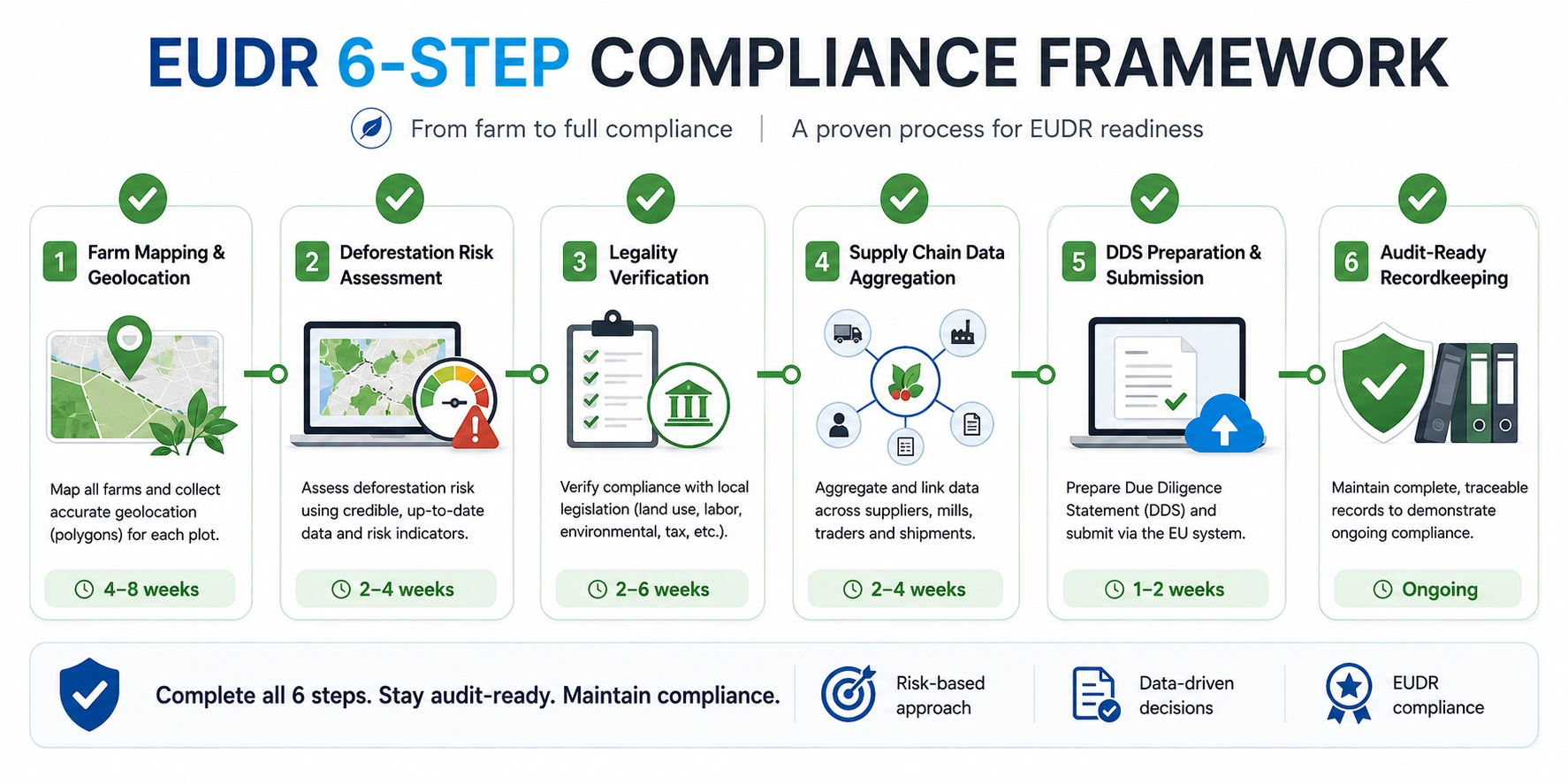
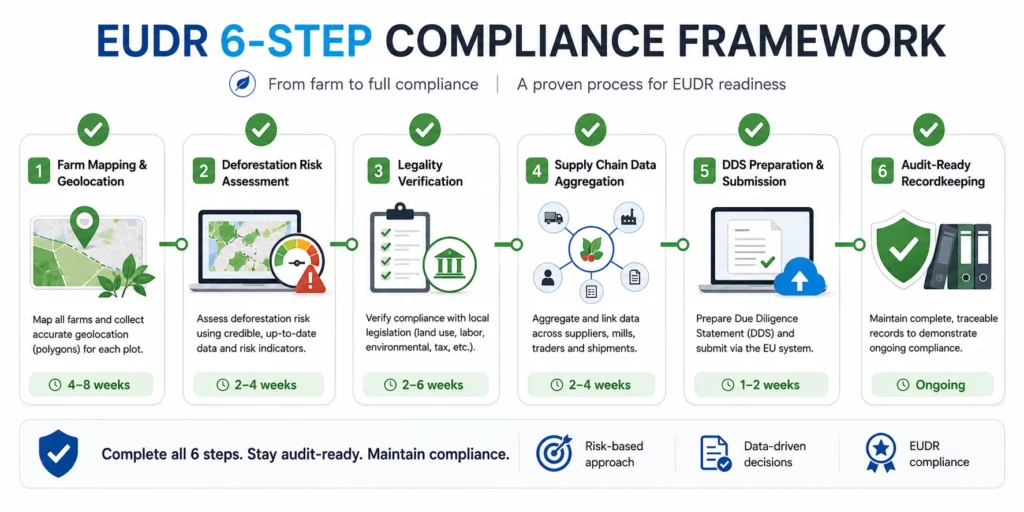
Across all four EUDR coffee examples above, compliance follows the same six-step structure. This is the end-to-end framework every coffee exporter must implement before December 30, 2026.
Step 1: Farm Mapping and Geolocation Collection
Every farm supplying EU-bound coffee must be GPS-mapped to a point coordinate or polygon boundary. Polygons are preferred and may be required for high-risk origins, as they confirm no deforestation occurred within the specific plot boundary.
Approximately 12% of submitted farm polygons contain errors (overlapping boundaries, wrong coordinates) that cause instant DDS rejection
Use validated mapping tools with built-in quality checks before submission
For smallholder-dense origins (Ethiopia, Vietnam), use mobile-first offline mapping apps
Using satellite imagery and reference datasets (including the EU’s Copernicus Land Monitoring Service), assess whether any mapped plot shows deforestation activity after December 31, 2020. This is not a one-time check ongoing satellite monitoring is required as farms continue operating.
Beyond deforestation-free status, EUDR requires coffee to be produced in compliance with all local laws land tenure, labor rights, and environmental regulations. For origins with fragmented land records, this typically requires working through cooperative structures that hold collective documentation.
Step 4: Supply Chain Data Aggregation
The chain of custody from farm to EU border must be digitally documented with zero breaks. Track every handoff: farm → washing station → dry mill → export warehouse → shipping lot.
Aggregation is common in coffee but dangerous under EUDR: once farm identity is mixed without documented lot separation, compliance cannot be proven
Use lot-level digital tracking that preserves origin identity through processing steps
Step 5: Due Diligence Statement (DDS) Preparation and Submission
The DDS is the legal declaration submitted to the EU Information System before goods enter the EU market. It must include:
Operator details and product description
Quantity and country of production
Geolocation data of all source plots
Certification that due diligence confirms deforestation-free and legally compliant sourcing
Step 6: Audit-Ready Recordkeeping
EUDR-compliant companies must retain all supporting documentation geo-data, risk assessments, supplier declarations, DDS confirmations for a minimum of five years. EU authorities can request these records at any point during enforcement.
EUDR Coffee Examples: The Real Cost of Non-Compliance
The following table shows the exact consequences EU authorities can impose and the data behind why the EUDR coffee examples above treat compliance as a business-critical investment, not a cost center.
Consequence
Detail
Business Impact
Fines
Up to 4% of total EU annual turnover
Tens to hundreds of millions for large operators
Shipment confiscation
EU authorities can seize and destroy non-compliant goods at port
Full cargo loss + contract default
Market ban
Repeat violators face temporary or permanent EU market exclusion
Permanent loss of EU revenue stream
Reputational damage
56% of EU consumers factor sustainability in purchases; violations are public record
Brand erosion, NGO campaigns
Contract loss
EU buyers require pre-verified EUDR-compliant sourcing before signing
Excluded from EU tender lists
Compliance cost (in contrast)
~0.03–0.07% of annual revenue for full compliance
Consumer price impact: +0.018% per cup
The Compliance Math Is Clear
EUDR compliance costs less than 0.1% of revenue. Non-compliance fines start at 4% of EU turnover. TraceX has helped coffee exporters across origin countries achieve compliant status before their first EU shipment deadline.
EUDR Coffee Examples: Manual vs. Digital Compliance — Which Approach Wins?
Across the EUDR coffee examples from Colombia, Ethiopia, Brazil, and Vietnam, one pattern is consistent: companies relying on manual processes (spreadsheets, PDF supplier declarations, email-based geo-data collection) fail the DDS submission stage. Here is why.
Compliance Activity
Manual Approach
Digital Platform (e.g., TraceX)
Risk of Manual
Farm GPS mapping
Field agents with handheld GPS + spreadsheet entry
Mobile app with offline capture + auto-validation
12% polygon error rate → DDS rejection
Deforestation check
Annual satellite image review by consultant
Continuous automated satellite monitoring with alerts
Changes between reviews go undetected
Chain of custody
Paper manifests + email confirmations
Digital lot tracking with blockchain audit trail
Single missing handoff breaks DDS eligibility
DDS submission
Manual data entry into EU IS portal
Automated pre-population + one-click submission
Data entry errors = submission rejection
Recordkeeping
Local file server / shared drive
Cloud-based audit-ready document library
Files lost, inaccessible, or incomplete
Scale
Works for <50 farms
Scalable to 500,000+ smallholders
Cannot scale to complex supply chains
TraceX EUDR Solutions helps coffee businesses achieve EUDR compliance by digitizing traceability from farm to export. The platform enables geolocation and polygon mapping, supplier data collection, deforestation risk assessments, chain of custody management, and Due Diligence Statement (DDS) preparation. By bringing together geospatial intelligence, supplier collaboration, and audit-ready documentation, TraceX simplifies compliance while helping coffee producers, exporters, traders, and importers confidently access the EU market.
Ready to Make Your Coffee Supply Chain EUDR-Compliant?
TraceX has helped coffee exporters across countries achieve compliant status before their EU shipment deadlines. Our platform covers farm-level GPS mapping, satellite monitoring, chain-of-custody tracking, and automated DDS submission built for the scale of real coffee supply chains.
Frequently Asked Questions (FAQ’s)
What are EUDR coffee examples and why do they matter for exporters?
EUDR coffee examples are documented supply chain scenarios showing how coffee businesses in key origin countries (Colombia, Ethiopia, Brazil, Vietnam) have navigated or failed EUDR compliance requirements. They matter because they reveal the specific failure points missing GPS data, broken chain of custody, late DDS submission that result in shipment seizures and EU market bans. Studying these examples lets exporters identify their own gaps before enforcement.
Which coffee origin countries face the highest EUDR compliance risk?
Based on EUDR coffee examples, Ethiopia and Colombia face the highest structural risk due to smallholder-dominated supply chains, fragmented land records, and limited digital infrastructure. Brazil is considered lower-risk due to advanced national georeferencing programs. Vietnam falls in the middle government-led initiatives are reducing risk but implementation varies by cooperative.
What data do I need to submit a valid EUDR Due Diligence Statement for coffee?
A valid EUDR DDS for coffee requires: (1) operator and importer details, (2) product description and HS code, (3) quantity of goods, (4) country of origin, (5) GPS coordinates or polygon boundaries for all source farms, (6) confirmation that deforestation risk assessment and legality checks have been completed, and (7) supporting documentation retained for five years.
What is the EUDR enforcement deadline for coffee exporters?
Large operators and traders must comply by December 30, 2026. Small and micro enterprises have until June 30, 2027. Note: a proposed one-year extension discussed in November 2025 has not been legally ratified do not plan operations around unconfirmed delays.
How long does it take to implement EUDR compliance for a coffee supply chain?
Based on EUDR coffee examples from multiple origin countries, full compliance implementation typically takes 6–12 months for established supply chains and 12–18 months for complex smallholder-heavy origins. Key time drivers: farm mapping scale, existing digital infrastructure, supplier onboarding, and DDS platform integration. Companies starting now for December 2026 have minimal buffer.
Can a digital platform really handle EUDR coffee compliance at scale?
Yes. EUDR coffee examples from Brazil and Vietnam show that digital compliance platforms combining GPS mobile apps, satellite monitoring, blockchain chain-of-custody tracking, and automated DDS submission can manage 500,000+ smallholder farms in a single system. Manual approaches consistently break down above 50 farms. For any exporter with a multi-tier supply chain, a digital platform is not optional it is the only viable compliance path.
Start using TraceX
Transparency, Trust, & Success for your Climate Journey.
We use cookies on our website to give you the most relevant experience by remembering your preferences and repeat visits. By clicking “Accept All”, you consent to the use of ALL the cookies. However, you may visit "Cookie Settings" to provide a controlled consent.
This website uses cookies to improve your experience while you navigate through the website. Out of these, the cookies that are categorized as necessary are stored on your browser as they are essential for the working of basic functionalities of the website. We also use third-party cookies that help us analyze and understand how you use this website. These cookies will be stored in your browser only with your consent. You also have the option to opt-out of these cookies. But opting out of some of these cookies may affect your browsing experience.
Necessary cookies are absolutely essential for the website to function properly. These cookies ensure basic functionalities and security features of the website, anonymously.
Cookie
Duration
Description
cookielawinfo-checkbox-analytics
11 months
This cookie is set by GDPR Cookie Consent plugin. The cookie is used to store the user consent for the cookies in the category "Analytics".
cookielawinfo-checkbox-functional
11 months
The cookie is set by GDPR cookie consent to record the user consent for the cookies in the category "Functional".
cookielawinfo-checkbox-necessary
11 months
This cookie is set by GDPR Cookie Consent plugin. The cookies is used to store the user consent for the cookies in the category "Necessary".
cookielawinfo-checkbox-others
11 months
This cookie is set by GDPR Cookie Consent plugin. The cookie is used to store the user consent for the cookies in the category "Other.
cookielawinfo-checkbox-performance
11 months
This cookie is set by GDPR Cookie Consent plugin. The cookie is used to store the user consent for the cookies in the category "Performance".
viewed_cookie_policy
11 months
The cookie is set by the GDPR Cookie Consent plugin and is used to store whether or not user has consented to the use of cookies. It does not store any personal data.
Functional cookies help to perform certain functionalities like sharing the content of the website on social media platforms, collect feedbacks, and other third-party features.
Performance cookies are used to understand and analyze the key performance indexes of the website which helps in delivering a better user experience for the visitors.
Analytical cookies are used to understand how visitors interact with the website. These cookies help provide information on metrics the number of visitors, bounce rate, traffic source, etc.
Advertisement cookies are used to provide visitors with relevant ads and marketing campaigns. These cookies track visitors across websites and collect information to provide customized ads.
Download the 2026 Traceability Scorecard and Benchmark Your Supply Chain Across 10 Critical Capabilities.
Download our eBook
Don’t Wait for an Audit to Find Your EUDR Gaps
The 2026 Simplification Package changes how HS codes, DDS pass-through and geolocation rules apply to you. Get the free guide and 20-point readiness checklist before enforcement catches you unprepared.