How EU Sustainability Regulations – PPWR, EPR, and EUDR Work Together
Published
, 12 minute read
Share this article
Quick summary: If you ship physical goods into the European Union, three acronyms are about to dictate whether your product reaches a shelf or sits at customs: PPWR, EPR, and EUDR. Each was written by a different policy team, with a different scope, on a different timeline. But they land on the same desk yours and they ask overlapping questions […]
If you ship physical goods into the European Union, three acronyms are about to dictate whether your product reaches a shelf or sits at customs:PPWR, EPR, and EUDR. Each was written by a different policy team, with a different scope, on a different timeline. But they land on the same desk yours and they ask overlapping questions about the same products. Together, these emerging EU sustainability regulations are reshaping how companies manage packaging, sourcing, traceability, and compliance across global supply chains. Organizations can no longer treat these requirements in isolation; they must build integrated data and compliance capabilities that support multiple regulations simultaneously.
Treated separately, they become three parallel compliance programs, each with its own data model, audit trail, and reporting cycle. Treated together, they become a single problem with a single answer: one connected view of every product, package, and supplier you place on the EU market.
This article unpacks how the three regulations relate, what jobs your team is actually trying to get done, the operational challenges getting in the way, and what a unified strategy looks like.
Key Takeaways:
PPWR, EPR, and EUDR are not three separate programs — they ask different questions about the same product master data. 2026 is the inflection year: PPWR applies 12 August, EUDR applies 30 December — both backed by market-access enforcement, not just fines. Eco-modulated EPR fees can vary 3–4x between recyclable and non-recyclable packaging — making PPWR-driven design changes a direct EPR cost lever. Traceability is the shared backbone: build it once, feed all three regulations from it. The teams winning in 2026 treat compliance as one operating capability with three reporting views — not three competing projects.
Aug 12, 2026 — PPWR application date for the EU’s 27 member states
Dec 30, 2026 — EUDR application date for large & medium operators
€200K Maximum EPR fine per EU market for non-registration
The Three EU Sustainability Regulations at a Glance
PPWR — Packaging and Packaging Waste Regulation
Regulation (EU) 2025/40 entered into force on 11 February 2025 and applies directly across all 27 member states from 12 August 2026. It replaces the 30-year-old Packaging Directive with one harmonized rulebook no national transposition required.
What it asks of you: design packaging that is recyclable at scale by 2030, contains minimum recycled content (plastic), is no heavier than necessary, carries the right labels, and avoids restricted substances like PFAS. From 12 August 2026, packaging that fails these tests can be denied EU market access.
Learn what PPWR means for your business, who falls within scope, and the key steps organizations should take to prepare for upcoming requirements.
EPR is the financial and operational mechanism that funds the system PPWR is designing. Producers typically the company that first places packaged products on a national market must register, declare packaging volumes, and pay fees to a national Producer Responsibility Organization (PRO). PPWR makes eco-modulation of EPR fees mandatory: packaging that scores well on recyclability pays less, sometimes 3–4x less than non-recyclable formats.
What it asks of you: register in each EU country where you place product (Germany’s LUCID, France’s CITEO, Italy’s CONAI, and so on), file accurate volume declarations, and pay eco-modulated fees per material and per market.
EUDR — EU Deforestation Regulation
Regulation (EU) 2023/1115 prohibits seven commodities cocoa, coffee, palm oil, soy, rubber, cattle, and wood plus their derived products (chocolate, paper, packaging materials) from entering the EU unless they are deforestation-free and legally produced. Following the December 2025 amendment under Regulation (EU) 2025/2650, the application date is 30 December 2026 for large and medium operators, and 30 June 2027 for non-timber SMEs.
What it asks of you: submit a Due Diligence Statement (DDS) for every relevant product, with plot-level geolocation coordinates linking the commodity to a specific parcel of land, plus evidence that the land was not deforested after 31 December 2020 and that production complied with the law of the country of origin.
Discover the key EUDR requirements, understand who is in scope, and learn the practical steps businesses can take to build a deforestation-free and audit-ready supply chain.
Submit Due Diligence Statement (DDS) with geolocation evidence
Penalty Range
Market bans, recalls, multi-million-euro fines
Up to €200,000 + marketplace bans (varies by country)
Up to 4% of EU annual turnover, product seizure
What You’re Actually Trying to Solve
Compliance is rarely the end goal. Compliance is what lets you do the actual job get product to market, protect margin, and grow without surprise enforcement. Here are the five jobs we see real teams hiring this kind of guide to do:
1. Map every obligation back to the SKU ‘When a regulator audits a specific product, I want a single record that shows its packaging spec, eco-modulated EPR fees per market, and EUDR due-diligence statement so I can answer in hours, not weeks.’
2. Stop re-collecting the same supplier data three times ‘My packaging team, EPR filer, and procurement lead all ping the same suppliers for overlapping questionnaires. I want to ask once, store once, and reuse the answer across all three regulations.’
3. Forecast compliance cost before redesign ‘Before I sign off a packaging change, I want to see how it shifts eco-modulated EPR fees across 12 markets, whether it still meets PPWR recyclability targets in 2030, and whether it triggers new EUDR sourcing exposure.’
4. Move from reactive filings to a control framework ‘I want a single calendar of deadlines, a single risk register, and audit-ready evidence instead of three calendars, three risk logs, and three folders of PDFs.’
5. Convince the board to fund the program once, not three times ‘I need a unified business case that frames PPWR + EPR + EUDR as one capability traceable products, eco-designed packaging, defensible sourcing not three line items competing for budget.’
How PPWR, EPR, and EUDR Work Together
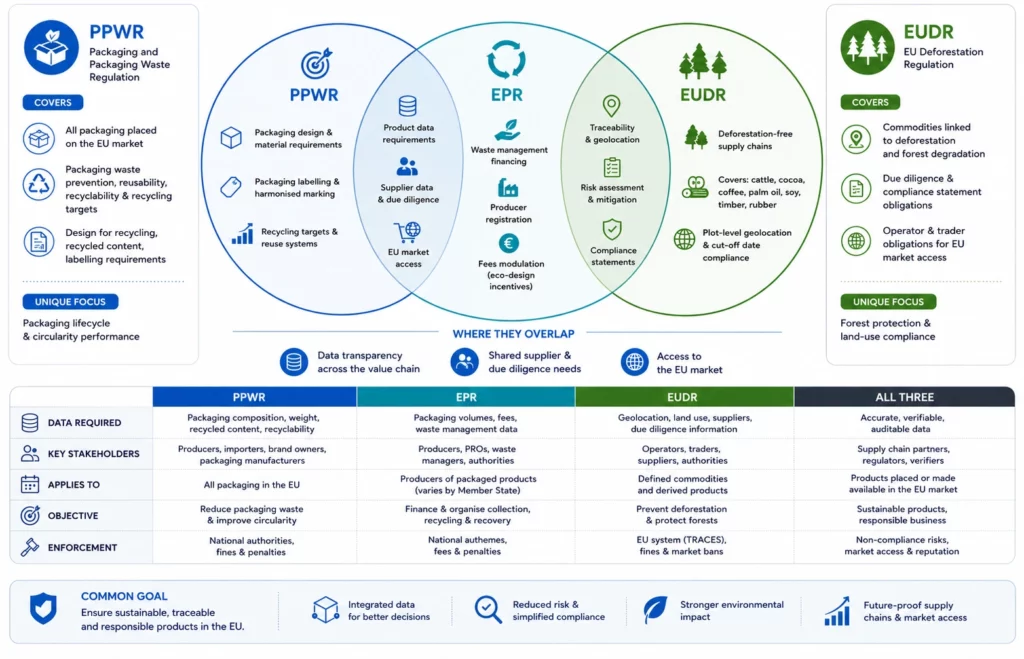
These regulations are usually presented as separate boxes packaging, waste, sourcing. The more useful frame is to look at what they share. Three things, specifically.
1. They all key off the same product master data
PPWR needs your packaging bill of materials. EPR needs the same bill of materials, broken down by weight and material, by market. EUDR needs the upstream commodity provenance for any input derived from the seven listed commodities including paper, cardboard, and wood-based packaging materials that are simultaneously in PPWR scope. A paper carton can be a PPWR object, an EPR fee trigger, and an EUDR risk vector at the same time.
2. They all assume traceability you probably don’t yet have
PPWR requires technical documentation per packaging format. EPR requires producer-of-record traceability per market. EUDR requires geolocation traceability per plot of land. If you can produce only one of those, you’ll fail audits in the other two. Conversely: build the traceability backbone once, and the same data feeds all three.
3. They all use market access as the enforcement lever
This is the biggest behavioural shift. None of these regimes rely primarily on fines. PPWR can ban non-compliant packaging from sale. EPR-unregistered producers face marketplace removal. EUDR-non-compliant shipments can be seized at the border. Non-compliance is no longer a finance problem it is a revenue problem.
Discover why leading organizations are treating traceability not as a standalone capability, but as the backbone of modern supply chain compliance.
Across regulatory affairs and supply chain teams preparing for 2026, the same six bottlenecks come up. None of them is the regulation itself. All of them are operating-model problems.
Challenge
Why It Hurts
Fragmented data ownership
Packaging data sits with design teams, EPR data with finance, EUDR data with procurement. None of them talk to each other and every regulator wants a different cut of the same product information.
Country-by-country EPR sprawl
27 EPR registries, 27 fee schedules, 27 reporting formats. Aluminum fees alone range from €48 in Belgium to €1,090 in Sweden. Multiply that across materials and markets and the spreadsheet becomes the risk.
Geolocation traceability gap
EUDR demands plot-level geolocation coordinates back to the source farm or forest. Most procurement systems were built to track suppliers, not parcels of land.
Overlapping but inconsistent definitions
What counts as ‘packaging’ under PPWR differs from what counts as a ‘placement on market’ under EPR, which differs from a ‘relevant product’ under EUDR. The same SKU triggers all three with different rules.
Moving compliance dates
EUDR has been postponed twice. PPWR provisions stagger between 2026 and 2040. Eco-modulation rules vary by country. Static compliance plans go stale within a quarter.
Penalty cliff
PPWR market bans, EPR fines up to €200,000 per market, EUDR fines up to 4% of EU turnover non-compliance now means lost shelf space, not just a slap on the wrist.
The pattern is consistent: the regulation isn’t the bottleneck. The way the company is organized around the regulation is. Teams that have moved fastest in 2026 are the ones that stopped treating PPWR, EPR, and EUDR as three projects and started treating them as three views of one master product-and-supplier record.
Not sure how prepared your organization is?
Schedule a TraceX Sustainability Readiness Consultation to evaluate your current approach across PPWR, EPR, and EUDR. Our experts will help identify data gaps, assess process maturity, and show how a centralized product-and-supplier record can simplify compliance across multiple regulations.
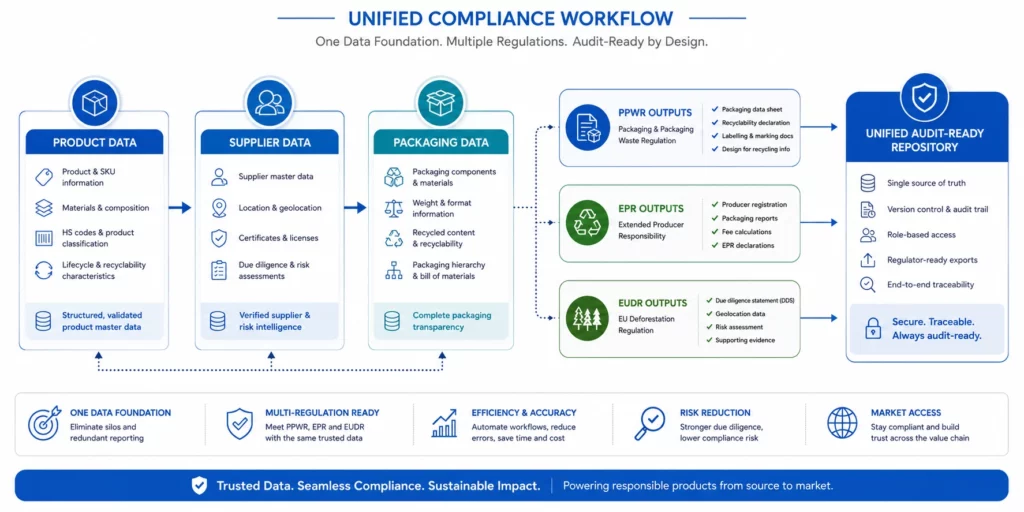
A unified approach doesn’t mean one regulator or one filing. It means one underlying data architecture that can answer all three. In practice, that looks like five capabilities:
Single product & packaging master record — every SKU mapped to its bill of materials, packaging spec, commodity origins, and supplier identities, in one place.
Supplier intake that’s regulation-agnostic — ask suppliers for the union of PPWR + EPR + EUDR evidence once, refresh on a schedule, and reuse across filings.
Geolocation traceability for high-risk commodities — plot-level coordinates linked to each commodity batch, satisfying EUDR and reinforcing recycled-content claims under PPWR.
Country-aware fee modelling — eco-modulated EPR fees calculated per market against the same packaging spec PPWR audits will check.
Audit-ready evidence vault — technical files, DDS submissions, EPR declarations, and supplier attestations stored against the SKU, retrievable in hours for any regulator.
TraceX Solutions provides the digital foundation for this unified compliance model by creating a single source of truth for products, packaging, suppliers, and sourcing data. Through integrated traceability, supplier data management, packaging compliance workflows, geolocation tracking, and audit-ready documentation, organizations can leverage the same underlying data architecture to support PPWR, EPR, EUDR, and future sustainability regulations.
Done well, this collapses three programs into one capability. Done poorly, you’ll be running three audits with three teams and three spreadsheets and the first regulator that asks a cross-cutting question will expose all of it.
One Product, One Data Foundation, Multiple Regulations
PPWR, EPR, and EUDR may have been developed independently, but they increasingly rely on the same underlying information: product data, packaging composition, supplier records, traceability evidence, and compliance documentation. Organizations that approach these regulations as separate compliance projects risk creating duplicate processes, fragmented data, and unnecessary operational complexity. The companies moving fastest are building a unified compliance foundation that enables them to collect data once and use it across multiple regulatory requirements. As sustainability regulations continue to evolve, success will depend less on managing individual regulations and more on establishing the visibility, traceability, and governance needed to support them all. The future belongs to organizations that treat compliance as an integrated business capability rather than a series of disconnected regulatory obligations.
Frequently Asked Questions (FAQ’s)
What is the difference between PPWR, EPR, and EUDR?
PPWR focuses on packaging sustainability, design, recyclability, and packaging waste reduction. EPR establishes producer responsibility for packaging waste management and reporting. EUDR requires companies to demonstrate that specific commodities and products are deforestation-free, legally produced, and supported by due diligence processes.
Do PPWR, EPR, and EUDR apply to the same products?
In many cases, yes. A product sold in the EU may need compliant packaging under PPWR, packaging reporting under EPR, and traceability and due diligence evidence under EUDR if it contains regulated commodities such as coffee, cocoa, timber, rubber, palm oil, cattle, or soy.
Why should companies manage PPWR, EPR, and EUDR together?
These regulations often require overlapping data, including product information, supplier records, material composition, packaging details, and compliance documentation. Managing them through a shared data framework reduces duplication, improves efficiency, and strengthens audit readiness.
How does traceability support compliance across these regulations?
Traceability helps organizations connect products to suppliers, packaging materials, sourcing locations, and supporting documentation. This improves visibility across the supply chain and provides the evidence needed for regulatory reporting, due diligence, and compliance verification.
What capabilities should companies prioritize for multi-regulation compliance?
Organizations should focus on supplier data management, product and packaging master data, traceability, document management, regulatory workflow automation, audit trails, risk monitoring, and centralized compliance reporting. These capabilities create a scalable foundation for current and future EU sustainability regulations.
Start using TraceX
Transparency, Trust, & Success for your Climate Journey.
We use cookies on our website to give you the most relevant experience by remembering your preferences and repeat visits. By clicking “Accept All”, you consent to the use of ALL the cookies. However, you may visit "Cookie Settings" to provide a controlled consent.
This website uses cookies to improve your experience while you navigate through the website. Out of these, the cookies that are categorized as necessary are stored on your browser as they are essential for the working of basic functionalities of the website. We also use third-party cookies that help us analyze and understand how you use this website. These cookies will be stored in your browser only with your consent. You also have the option to opt-out of these cookies. But opting out of some of these cookies may affect your browsing experience.
Necessary cookies are absolutely essential for the website to function properly. These cookies ensure basic functionalities and security features of the website, anonymously.
Cookie
Duration
Description
cookielawinfo-checkbox-analytics
11 months
This cookie is set by GDPR Cookie Consent plugin. The cookie is used to store the user consent for the cookies in the category "Analytics".
cookielawinfo-checkbox-functional
11 months
The cookie is set by GDPR cookie consent to record the user consent for the cookies in the category "Functional".
cookielawinfo-checkbox-necessary
11 months
This cookie is set by GDPR Cookie Consent plugin. The cookies is used to store the user consent for the cookies in the category "Necessary".
cookielawinfo-checkbox-others
11 months
This cookie is set by GDPR Cookie Consent plugin. The cookie is used to store the user consent for the cookies in the category "Other.
cookielawinfo-checkbox-performance
11 months
This cookie is set by GDPR Cookie Consent plugin. The cookie is used to store the user consent for the cookies in the category "Performance".
viewed_cookie_policy
11 months
The cookie is set by the GDPR Cookie Consent plugin and is used to store whether or not user has consented to the use of cookies. It does not store any personal data.
Functional cookies help to perform certain functionalities like sharing the content of the website on social media platforms, collect feedbacks, and other third-party features.
Performance cookies are used to understand and analyze the key performance indexes of the website which helps in delivering a better user experience for the visitors.
Analytical cookies are used to understand how visitors interact with the website. These cookies help provide information on metrics the number of visitors, bounce rate, traffic source, etc.
Advertisement cookies are used to provide visitors with relevant ads and marketing campaigns. These cookies track visitors across websites and collect information to provide customized ads.
Download the 2026 Traceability Scorecard and Benchmark Your Supply Chain Across 10 Critical Capabilities.
Download our eBook
Don’t Wait for an Audit to Find Your EUDR Gaps
The 2026 Simplification Package changes how HS codes, DDS pass-through and geolocation rules apply to you. Get the free guide and 20-point readiness checklist before enforcement catches you unprepared.