Challenges in Seed Supply Chain: Why Good Seed Still Fails Farmers
Published
, 9 minute read
Share this article
Quick summary: The challenges in seed supply chain aren’t five separate problems — they share one root: lost lot identity. See why fake seed fails in the field, and how to fix it.
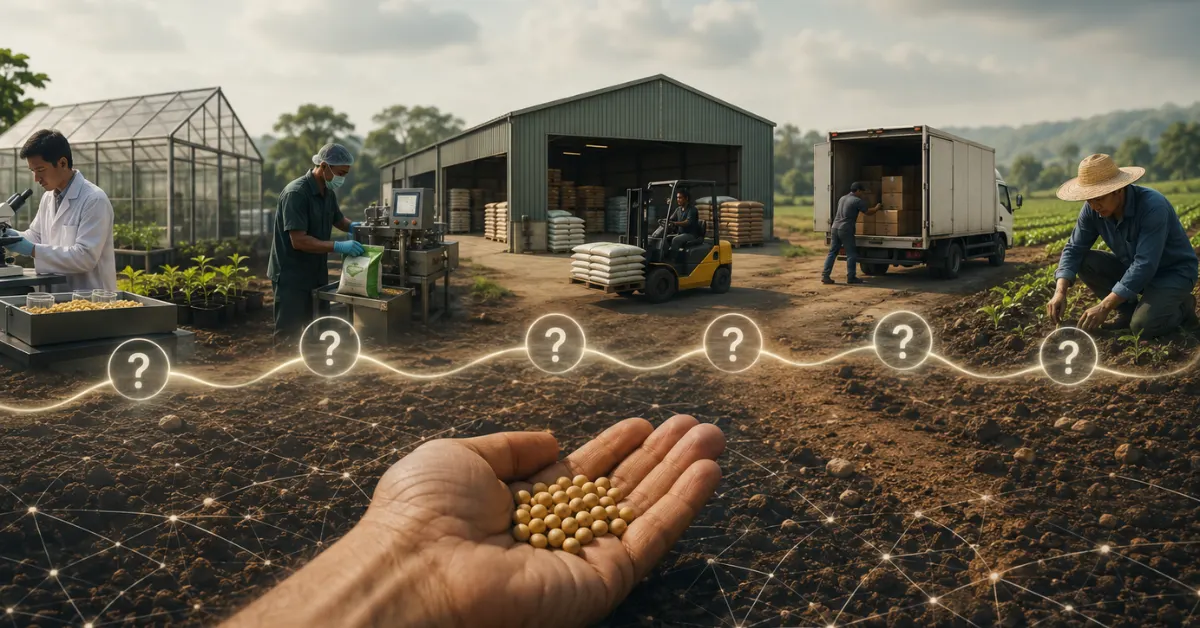
The five most cited challenges in seed supply chain management are counterfeit or spurious seeds, poor cold-chain and short shelf life, fragmented procurement, weak traceability with paper records, and limited real-time visibility. But they are not five separate problems. Each traces back to a single root cause: the loss of verifiable lot identity as seed moves from breeder to farmer. A counterfeit or degraded lot rarely fails at the point of sale it fails weeks later in the field, when the crop doesn’t come up and the lot can no longer be traced. Giving every lot a persistent digital identity, verifiable before planting, is what resolves all five at once.
Key Takeaways
Five symptoms, one root. The scattered challenges in seed supply chain management share a single cause lost lot identity between stakeholders.
Seed fails on a delay. A fake or low-germination lot isn’t caught at the counter; it surfaces weeks into the season, after land, labour and money are already spent.
A QR code alone isn’t traceability. Authentication only works if it’s backed by a lot record that follows the seed from production to the farmer’s hand.
Identity before planting beats forensics after failure. The win is making problems visible before a farmer sows, not tracing them after a crop fails.
Could a farmer verify your seed before they plant it?
See how TraceX gives every seed lot a digital identity from plot to bag to farmer scan.
Challenges in Seed Supply Chain: The Five You’ll Always Hear
The challenges in seed supply chain management are usually listed as five. A seed supply chain is the end-to-end system breeders, production farmers, processors, distributors and retailers that moves seed from development to a farmer’s field, and each link adds a way for things to go wrong:
Counterfeit and spurious seeds. Inferior or untested seed repackaged in branded bags, usually through unregulated intermediary traders.
Short shelf life and weak cold chain. Certified seed must be revalidated regularly and stored carefully; germination drops fast when it isn’t.
Fragmented procurement. Organizers aggregate thousands of acres and mix lots into single truckloads on paper, creating disputes and delays.
Weak traceability and paper records. Disorganised, multi-player setups with no digital chain of custody from breeder to farmer.
Limited real-time visibility. Fragmented data means no one can see quality, stock or provenance as it moves.
Every seed traceability vendor recites this list. The problem is that treating them as five separate challenges leads to five disconnected fixes and none of them holds.
The Real Root Behind Every Challenge in Seed Supply Chain
Follow any of those five back and they meet at the same place: a seed lot loses its verifiable identity. Counterfeits get in because a bag can’t prove what it is. Procurement disputes happen because a lot can’t prove where it came from. Germination failures slip through because no record ties the lot to its test date and storage. The challenges in seed supply chain management are one problem lost lot identity wearing five different costumes.
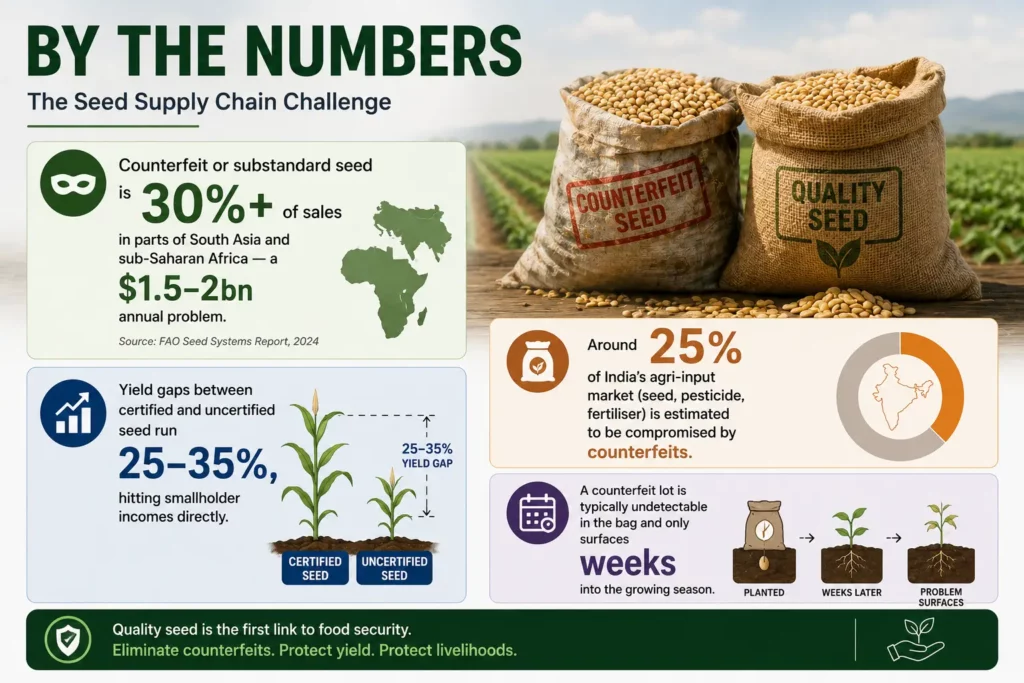
There’s a second, crueller factor: time. Most products reveal a defect at the moment of use. Seed doesn’t. A counterfeit or degraded lot looks identical to a good one in the bag, so the failure only shows up weeks into the season, when the crop fails to emerge. By then the farmer has already spent on land preparation, labour and irrigation, the season is gone, and the lot is untraceable. Seed fails slowly, then all at once.
That combination lost identity plus delayed feedback is why you can’t solve the challenges in seed supply chain stage by stage, and why a QR code slapped on a bag isn’t enough. The only durable fix is a persistent lot identity that a farmer can verify before planting, not a forensic trail assembled after a crop has already failed.
Challenges in Seed Supply Chain in the Real World
These reported cases show how lost identity and delayed feedback play out and what would have caught them
Cotton seed that couldn’t germinate — Yavatmal, Maharashtra
A seed dealer was charged with selling counterfeit BT cotton seed to more than two dozen farmers. Laboratory analysis later confirmed the seed was incapable of germinating but only after farmers had sown it and lost the early season. The defect was invisible at purchase and catastrophic in the field. What would have caught it: a scannable lot identity linking each bag to a verified germination test before the sale.
346 tonnes seized — Telangana
In one season, authorities in Telangana seized hundreds of tonnes of counterfeit cotton and chilli seed, and thousands of acres of maize in one district were hit by defective seed. The scale shows this isn’t a fringe issue it’s a systemic gap that opens every peak sowing season. What would have caught it: registered distributors and blockchain-stamped bags that make unregistered, counterfeit stock obvious.
A brand counterfeited against itself — Andhra Pradesh
A leading seed company selling through 800-plus distributors and 12,000 retailers found seed bearing its own brand being counterfeited and sold. It surfaced only after farmer trust and market share had already eroded. What would have caught it: unique distributor IDs and farmer-facing QR authentication so buyers verify authenticity at the point of sale.
Learn how forward traceability helps seed companies track every seed lot from production to distribution, ensuring authenticity, faster recalls, regulatory compliance, and greater confidence across the supply chain.
The lot that got lost in the truck — contract procurement
Organizers managing thousands of acres mixed lots from many farmers into single truckloads, tracked on paper. One mismatched or missing lot ID made a shipment impossible to trace to source triggering payment disputes and delayed settlements to farmers. What would have caught it: digital lot IDs and weighments that keep each farmer’s contribution traceable through aggregation.
Discover how TraceX helped a state government eliminate spurious seeds through blockchain-powered traceability, improving transparency, farmer trust, and seed authenticity across the agricultural supply chain.
Solving the Challenges in Seed Supply Chain: Identity Before Planting
If the root cause is lost lot identity, the fix is to give every lot a digital identity that survives every handoff and reaches the farmer’s hand. A platform built for the challenges in seed supply chain management should do six things.
Register plots with a permanent identity. Geo-tag every production plot with GPS polygon mapping so seed origin is fixed from the start.
Track lots on an immutable record. Blockchain-backed batch tracking carries each lot from the conditioning plant through distribution to delivery, tamper-evident at every step.
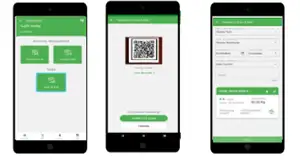
Put authentication in the farmer’s hand. Dynamic QR codes let a farmer scan a bag to verify variety, certification status and germination before they buy and plant.
Capture the first mile offline. Offline-first field apps let agents onboard farmers and retailers and record data in low-connectivity areas, syncing when signal returns.
Digitise procurement and payments. Digital lot IDs and weighments keep each farmer’s contribution traceable through aggregation and drive accurate, farmer-wise payments.
Discover how digital procurement, supplier traceability, and real-time visibility can help ensure seed quality, reduce procurement risks, and build a more resilient agricultural supply chain.
Tie germination and certification to the lot. Store test dates, revalidation and storage conditions against each lot, so degraded seed is flagged before it ships.
Challenges in Seed Supply Chain: Symptom, Root Cause, Fix
Every listed challenge maps to the same underlying gap and the same class of fix.
Challenge (symptom)
The real root cause
What closes it
Counterfeit / spurious seed
No verifiable lot identity at the point of sale
Blockchain-stamped QR per bag; farmer scans to authenticate before buying
Short shelf life / cold chain
Germination and storage status not tied to the lot
Lot-level records of germination test, revalidation and storage conditions
Fragmented procurement
Lot identity lost when organizers mix truckloads on paper
Digital lot IDs, digital weighments and farmer-wise payment reconciliation
Weak traceability / paper
No digital identity passing between stakeholders
End-to-end digital chain of custody from breeder to farmer
Limited real-time visibility
Data dies at each handoff
One live dashboard fed by offline-first field capture
TraceX Farm Management Solutions helps seed companies, government agencies, cooperatives, and agri-businesses build transparent, secure, and traceable seed supply chains. Its blockchain-powered platform enables end-to-end visibility from seed production and certification to distribution and farmer adoption, helping eliminate counterfeit seeds, improve inventory tracking, ensure regulatory compliance, and strengthen trust across the ecosystem. By digitizing every transaction and movement, TraceX empowers stakeholders with real-time insights, enhances seed authenticity, and promotes sustainable agricultural outcomes.
Turn the challenges in seed supply chain into your competitive edge.
TraceX gives every seed lot a digital identity geo-tagged plots, blockchain-backed lot records, and farmer-facing QR authentication so quality is provable before a single seed is planted.
Challenges in Seed Supply Chain: Readiness Checklist
Before you trust your seed chain to hold, confirm every box.
✓Every production plot is geo-tagged with a permanent digital identity.
✓Each lot has an immutable, tamper-evident record from conditioning to delivery.
✓Farmers can scan a bag to verify variety, certification and germination before buying.
✓Field agents can onboard and capture data offline in low-connectivity areas.
✓Procurement uses digital lot IDs and weighments, not paper.
✓Germination, revalidation and storage status are tied to each lot.
✓One live dashboard shows quality, stock and provenance end to end.
Frequently Asked Questions
What are the main challenges in the seed supply chain?
Counterfeit or spurious seed, short shelf life and weak cold chain, fragmented procurement, poor traceability with paper records, and limited real-time visibility. All five stem from one root cause: the loss of verifiable lot identity as seed moves from breeder to farmer.
Why are counterfeit seeds so hard to detect?
A counterfeit lot looks identical to a genuine one in the bag. The defect only shows up weeks into the season when the crop fails to emerge by which point the money, land preparation and season are already lost and the lot is untraceable.
How does traceability solve seed supply chain challenges?
By giving every lot a persistent digital identity geo-tagged origin, an immutable lot record, and farmer-facing QR authentication so problems are visible before planting rather than after a crop fails.
Isn’t a QR code on the bag enough?
Only if it’s backed by a real lot record. A QR that isn’t linked to verified origin, germination and certification data can itself be copied. Authentication has to sit on top of end-to-end traceability.
How big is the counterfeit seed problem?
The FAO’s 2024 seed systems work estimates counterfeit or substandard seed at 30%+ of sales in parts of South Asia and sub-Saharan Africa a $1.5–2 billion annual problem that falls hardest on smallholders
Start using TraceX
Transparency, Trust, & Success for your Climate Journey.
We use cookies on our website to give you the most relevant experience by remembering your preferences and repeat visits. By clicking “Accept All”, you consent to the use of ALL the cookies. However, you may visit "Cookie Settings" to provide a controlled consent.
This website uses cookies to improve your experience while you navigate through the website. Out of these, the cookies that are categorized as necessary are stored on your browser as they are essential for the working of basic functionalities of the website. We also use third-party cookies that help us analyze and understand how you use this website. These cookies will be stored in your browser only with your consent. You also have the option to opt-out of these cookies. But opting out of some of these cookies may affect your browsing experience.
Necessary cookies are absolutely essential for the website to function properly. These cookies ensure basic functionalities and security features of the website, anonymously.
Cookie
Duration
Description
cookielawinfo-checkbox-analytics
11 months
This cookie is set by GDPR Cookie Consent plugin. The cookie is used to store the user consent for the cookies in the category "Analytics".
cookielawinfo-checkbox-functional
11 months
The cookie is set by GDPR cookie consent to record the user consent for the cookies in the category "Functional".
cookielawinfo-checkbox-necessary
11 months
This cookie is set by GDPR Cookie Consent plugin. The cookies is used to store the user consent for the cookies in the category "Necessary".
cookielawinfo-checkbox-others
11 months
This cookie is set by GDPR Cookie Consent plugin. The cookie is used to store the user consent for the cookies in the category "Other.
cookielawinfo-checkbox-performance
11 months
This cookie is set by GDPR Cookie Consent plugin. The cookie is used to store the user consent for the cookies in the category "Performance".
viewed_cookie_policy
11 months
The cookie is set by the GDPR Cookie Consent plugin and is used to store whether or not user has consented to the use of cookies. It does not store any personal data.
Functional cookies help to perform certain functionalities like sharing the content of the website on social media platforms, collect feedbacks, and other third-party features.
Performance cookies are used to understand and analyze the key performance indexes of the website which helps in delivering a better user experience for the visitors.
Analytical cookies are used to understand how visitors interact with the website. These cookies help provide information on metrics the number of visitors, bounce rate, traffic source, etc.
Advertisement cookies are used to provide visitors with relevant ads and marketing campaigns. These cookies track visitors across websites and collect information to provide customized ads.
Download the 2026 Traceability Scorecard and Benchmark Your Supply Chain Across 10 Critical Capabilities.
Download our eBook
Don’t Wait for an Audit to Find Your EUDR Gaps
The 2026 Simplification Package changes how HS codes, DDS pass-through and geolocation rules apply to you. Get the free guide and 20-point readiness checklist before enforcement catches you unprepared.